
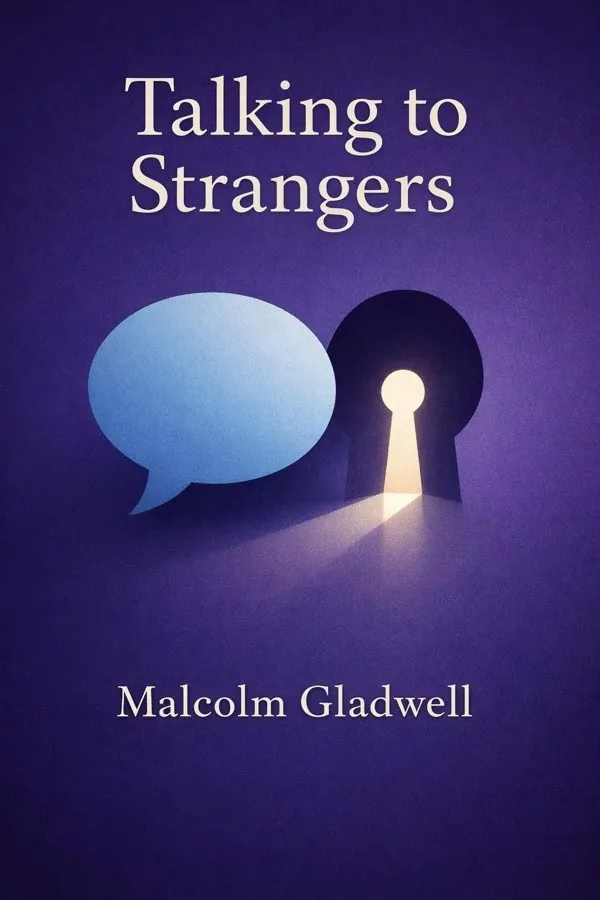
Talking to Strangers: Summary & Key Insights
 10 min9 chaptersAudio available
Key Takeaways from Talking to Strangers
Gladwell builds on psychologist Tim Levine’s “default to truth” theory, which argues that human beings are wired to assume honesty in most interactions.
Few stories illustrate human credulity better than Bernie Madoff’s Ponzi scheme.
A second major mistake in our dealings with strangers is the belief that people’s inner feelings are visible on their faces and in their behavior.
The Amanda Knox case demonstrates how badly things can go when authorities and the public overinterpret behavior.
Gladwell argues that behavior is tightly linked to circumstance, a principle he explores through the concept of coupling.
What Is Talking to Strangers About?
Talking to Strangers by Malcolm Gladwell is a non-fiction book published in 2019 spanning 9 pages. Talking to Strangers examines one of the most ordinary yet consequential acts in human life: judging people we do not know. Malcolm Gladwell argues that these encounters are far less reliable than we assume. Whether in policing, intelligence, courtrooms, diplomacy, dating, or business, we routinely misread motives, emotions, honesty, and danger. We think facial expressions reveal inner truth, that confidence signals credibility, and that deception should look suspicious. Gladwell shows how often those assumptions fail. Drawing on psychology, criminology, history, and headline-making case studies, he explores why misunderstandings between strangers can escalate into scandal, injustice, and tragedy. Central to the book is the idea that human beings are wired to trust by default and to interpret behavior without adequately considering context. Those tendencies make social life possible, but they also leave us vulnerable to manipulation and error. Gladwell is especially well positioned to tell this story. As a longtime New Yorker writer and bestselling author of books such as The Tipping Point, Blink, and Outliers, he has built a career explaining how hidden patterns shape everyday decisions. Here, he turns that skill toward one of the most urgent questions of modern life: why we so often get strangers wrong.
This FizzRead summary covers all 9 key chapters of Talking to Strangers in approximately 10 minutes, distilling the most important ideas, arguments, and takeaways from Malcolm Gladwell's work. Also available as an audio summary and Key Quotes Podcast.
Talking to Strangers
Talking to Strangers examines one of the most ordinary yet consequential acts in human life: judging people we do not know. Malcolm Gladwell argues that these encounters are far less reliable than we assume. Whether in policing, intelligence, courtrooms, diplomacy, dating, or business, we routinely misread motives, emotions, honesty, and danger. We think facial expressions reveal inner truth, that confidence signals credibility, and that deception should look suspicious. Gladwell shows how often those assumptions fail.
Drawing on psychology, criminology, history, and headline-making case studies, he explores why misunderstandings between strangers can escalate into scandal, injustice, and tragedy. Central to the book is the idea that human beings are wired to trust by default and to interpret behavior without adequately considering context. Those tendencies make social life possible, but they also leave us vulnerable to manipulation and error.
Gladwell is especially well positioned to tell this story. As a longtime New Yorker writer and bestselling author of books such as The Tipping Point, Blink, and Outliers, he has built a career explaining how hidden patterns shape everyday decisions. Here, he turns that skill toward one of the most urgent questions of modern life: why we so often get strangers wrong.
Who Should Read Talking to Strangers?
This book is perfect for anyone interested in non-fiction and looking to gain actionable insights in a short read. Whether you're a student, professional, or lifelong learner, the key ideas from Talking to Strangers by Malcolm Gladwell will help you think differently.
- ✓Readers who enjoy non-fiction and want practical takeaways
- ✓Professionals looking to apply new ideas to their work and life
- ✓Anyone who wants the core insights of Talking to Strangers in just 10 minutes
Want the full summary?
Get instant access to this book summary and 100K+ more with Fizz Moment.
Get Free SummaryAvailable on App Store • Free to download
Key Chapters
One of the book’s most unsettling insights is that our biggest social strength may also be our greatest weakness: we tend to believe people unless the evidence against them becomes overwhelming. Gladwell builds on psychologist Tim Levine’s “default to truth” theory, which argues that human beings are wired to assume honesty in most interactions. This tendency makes everyday life possible. Imagine trying to maintain friendships, work in teams, buy things, or raise children if you approached every statement with suspicion. Trust is efficient, stabilizing, and often necessary.
But the same instinct that makes society function also makes deception surprisingly easy. Skilled liars exploit the fact that most people do not begin from doubt. We give others the benefit of the doubt even when warning signs appear, often explaining away inconsistencies because we prefer a coherent, trustworthy world. This is why frauds, abusers, and manipulators can thrive for years while surrounded by intelligent people.
The practical implication is not that we should become paranoid. Gladwell’s point is subtler: we must recognize that trust is not neutral. It is a bias, and like any bias, it can distort judgment. In hiring, investing, parenting, dating, or leadership, it helps to ask what evidence would actually change your mind. Are you evaluating facts, or simply extending confidence because that feels socially natural?
Actionable takeaway: Keep your trust, but build verification into high-stakes decisions. In situations involving money, safety, legal risk, or power, do not rely on instinctive belief alone—use independent checks, documentation, and outside perspectives.
Few stories illustrate human credulity better than Bernie Madoff’s Ponzi scheme. Madoff did not fool only careless people. He deceived sophisticated investors, regulators, charities, and financial professionals for years. That is precisely Gladwell’s point: when someone appears stable, respectable, and socially credible, our default is not to interrogate them deeply but to assume legitimacy.
Madoff benefited from multiple layers of trust. He looked successful, moved in elite circles, projected calm confidence, and had social proof on his side. Each of those signals reassured observers who might otherwise have asked harder questions. Even people who sensed something odd often failed to act decisively because suspicion feels disruptive, rude, and socially costly. It is easier to assume there is an explanation than to confront the possibility of deliberate deception.
This case matters because Madoff’s success was not just about his lies. It was also about the systems around him. Regulators missed obvious red flags. Investors relied on reputation instead of transparent evidence. Institutions trusted one another’s judgment, creating a chain reaction of misplaced confidence. Gladwell uses this example to show that deception rarely succeeds in isolation; it succeeds because social environments reward belief and punish skepticism.
In ordinary life, the Madoff lesson applies whenever authority substitutes for proof. A charismatic founder, a persuasive salesperson, a polished job candidate, or a confident online expert can trigger the same misplaced trust. The more impressive the appearance, the more important the underlying verification becomes.
Actionable takeaway: When stakes are high, separate reputation from evidence. Ask for audited numbers, independent references, and direct proof rather than relying on social status, charm, or the fact that “everyone trusts them.”
A second major mistake in our dealings with strangers is the belief that people’s inner feelings are visible on their faces and in their behavior. Gladwell calls this the transparency assumption. We think nervous people are guilty, calm people are innocent, smiling people are happy, and tearful people are sincere. In reality, human expression is far less straightforward.
Some people show distress with remarkable clarity, but many do not. Trauma can produce flatness rather than emotion. Innocent people can appear evasive when frightened. Deceptive people can seem relaxed and likable. Cultural norms also shape how openly individuals display feeling. What looks suspicious in one context may simply reflect personality, stress, neurodiversity, upbringing, or unfamiliarity with the setting.
This matters most when judgment is swift and consequences are severe. In interviews, courtrooms, classrooms, airports, and hospitals, people are often assessed based on demeanor. A manager may read hesitation as incompetence. A teacher may interpret eye contact differently across students. A jury may mistake confidence for honesty. Gladwell warns that these conclusions often rest on a false premise: that observable behavior transparently reveals inner truth.
The alternative is to become more context-sensitive. Instead of asking, “What does this person’s face tell me?” ask, “What pressures, histories, or norms might shape this behavior?” A person’s expression is data, but it is incomplete data. Treating it as decisive creates needless error.
Actionable takeaway: Before drawing conclusions from someone’s demeanor, pause and generate at least two alternative explanations. This simple habit reduces the risk of equating appearance with truth.
The Amanda Knox case demonstrates how badly things can go when authorities and the public overinterpret behavior. After Knox’s roommate Meredith Kercher was murdered in Italy, Knox’s manner struck many observers as strange, detached, or inappropriate. She did not grieve in the “right” way. Her expressions and movements were treated as clues to guilt. Gladwell uses the case to show how powerfully we rely on transparency assumptions even when evidence is uncertain.
The problem is that there is no universal template for how innocent people behave under stress. Shock can produce laughter, numbness, confusion, contradiction, or emotional inconsistency. Young people in unfamiliar legal systems may appear awkward rather than composed. Add language barriers, cultural differences, media pressure, and fear, and behavior becomes even harder to interpret accurately.
Knox became, in Gladwell’s analysis, a symbol onto which observers projected expectations about how an innocent woman should look. Once those expectations were violated, her oddness was taken as moral evidence. This is an important warning for any setting where appearance affects judgment. We do it in offices, schools, police interviews, and social media debates. People who seem “off” are often treated as if they are untrustworthy.
The Knox example teaches that behavior without context is dangerously ambiguous. If we are not careful, we can turn style into substance and awkwardness into guilt. It also reminds us that public narratives are sticky: once a strange impression forms, facts struggle to catch up.
Actionable takeaway: In emotionally charged situations, refuse to treat “that person seemed weird” as meaningful evidence. Distinguish impressions from proof, and be especially cautious when fear or media attention amplify snap judgments.
Gladwell argues that behavior is tightly linked to circumstance, a principle he explores through the concept of coupling. Some actions are not simply products of character or intention; they are strongly connected to specific environments, opportunities, and constraints. When we ignore context, we misunderstand both why people act and how problems can be prevented.
A classic example involves suicide methods. Gladwell discusses how self-harm rates can be strongly influenced by access to particular means. This suggests that behavior is not always a pure expression of desire or personality. Change the environment, and outcomes can change dramatically. The same logic applies beyond public health. Workplace misconduct may be encouraged by incentives. Academic cheating may rise under extreme pressure. Road rage may be shaped by congestion, heat, or anonymity. Context does not erase responsibility, but it helps explain patterns that personal judgment alone misses.
This idea matters because we often prefer moral explanations. It feels simpler to label someone reckless, dishonest, or unstable than to examine the systems around them. Yet if behavior is coupled to setting, then better design can reduce harm. Safer products, better procedures, clearer norms, and fewer high-risk triggers can produce real improvements.
In personal life, context awareness also makes us more compassionate and more strategic. Instead of asking only, “What is wrong with this person?” we can ask, “What conditions are shaping this outcome?” That shift often reveals practical solutions.
Actionable takeaway: When facing repeated problems—your own or others’—study the environment before blaming character. Identify the triggers, incentives, and access points that may be coupling behavior to circumstance, then redesign the setting where possible.
Another of Gladwell’s striking claims is that certain contexts do not just influence behavior; they fundamentally impair our ability to interpret it. Alcohol is one of the clearest examples. In the book, he explores how intoxication changes communication, consent, vulnerability, and judgment. Under the influence, people may become more impulsive, less coherent, and less able to send or receive clear social signals. Observers, meanwhile, may wrongly assume they understand what the other person wants or means.
This has major implications for situations involving risk, intimacy, and responsibility. In sober settings, we already misread strangers. Add alcohol, and ambiguity multiplies. A person may appear willing when they are actually confused. Another may overestimate mutual understanding because their own confidence has risen even as their judgment has declined. Traditional ideas about reading body language or “knowing what someone meant” become especially unreliable in these circumstances.
Gladwell’s broader point is that communication cannot be judged apart from the conditions under which it occurs. If context degrades perception, then social norms and institutions must respond accordingly. Universities, workplaces, event organizers, and friend groups should treat intoxicated environments as structurally high-risk, not merely as places where isolated bad decisions happen.
On an everyday level, this insight encourages humility. Many people assume they are good at sensing intention in nightlife or party situations. Gladwell suggests the opposite: those are precisely the settings where confidence in your interpretive powers should drop.
Actionable takeaway: In any situation involving alcohol, raise your standard for clarity. Avoid making important social, sexual, or conflict-related judgments based on assumptions; seek explicit communication or postpone decisions until everyone is sober.
Some of the book’s most urgent pages focus on law enforcement, where misreading strangers can have life-or-death consequences. Gladwell examines the 2015 traffic stop involving Sandra Bland to show how quickly ordinary encounters can escalate when officers and civilians interpret each other through fear, authority, and incomplete information. A routine stop became a chain reaction of misjudgment.
Police work often requires making rapid decisions about people officers do not know. Yet officers are not immune to the same errors everyone else makes. They may treat noncompliance as threat, nervousness as guilt, or confusion as disrespect. Civilians, meanwhile, may misread commands, react defensively, or fail to appreciate how their behavior is being interpreted. The encounter then becomes less about objective danger and more about mutually escalating perceptions.
Gladwell does not reduce these events to simple personal failure. He also critiques investigative tactics based on the belief that skilled observers can reliably detect deception from demeanor. If that belief is shaky, then systems built on reading behavior under stress are inherently unstable. Add institutional pressure, racial dynamics, legal authority, and public mistrust, and the likelihood of tragic error rises.
This lesson extends beyond policing to any profession involving high-pressure assessments of strangers: security, medicine, education, immigration, and management. Whenever power is uneven and time is short, overconfidence in reading people becomes dangerous.
Actionable takeaway: If your role involves judging strangers under pressure, rely less on intuition and more on protocols, de-escalation, corroborating evidence, and training that acknowledges the limits of reading behavior.
Gladwell broadens his argument by showing that the problem of misreading strangers is not just personal or local; it has shaped world events. Diplomatic failures, espionage mistakes, and historical misunderstandings often grow from the same assumptions we make in ordinary life. Leaders think they can read sincerity, detect deception, or infer character from meetings and expressions. Often they cannot.
One of the book’s recurring examples concerns the ways intelligence officials and political leaders misjudged figures such as Hitler or Fidel Castro. In some cases, people met dangerous individuals and came away reassured because the person seemed reasonable, calm, or personable. In others, officials underestimated threats because they projected familiar motives onto unfamiliar actors. The result was not just interpersonal confusion but strategic catastrophe.
This is a sobering reminder that access does not equal understanding. Sitting across from someone, shaking their hand, or speaking with confidence about their character does not mean you truly grasp their intentions. High-status people are often especially vulnerable here because they overrate their own judgment. They assume experience gives them near-magical insight into strangers, when in fact it may only increase their confidence.
For readers, the practical value of this chapter lies in recognizing how easily we map our own norms onto others. In business partnerships, cross-cultural teams, negotiations, and international settings, misunderstanding is common not because others are opaque, but because we expect them to be transparent on our terms.
Actionable takeaway: In cross-cultural or high-stakes interactions, replace personality-based judgments with structured information gathering. Learn the other side’s incentives, norms, and history before drawing conclusions from charm, politeness, or personal chemistry.
Perhaps the deepest lesson of Talking to Strangers is that human understanding is more limited than we like to admit. We often believe that with enough intelligence, empathy, or attention, we can figure people out. Gladwell pushes back against that confidence. Strangers remain partly unknowable, not because we are careless, but because the tools we trust—demeanor, first impressions, confidence, intuition—are weaker than we think.
This conclusion can sound pessimistic, but Gladwell treats it as a call for humility. If we accept that other people are harder to read than they appear, we become less judgmental and more careful. We stop assuming that our interpretation is obviously right. We become slower to condemn, slower to idealize, and more willing to gather context before acting.
This insight is especially useful in an age of digital overexposure. Social media encourages instant certainty about strangers based on clips, posts, headlines, and fragments of behavior. We feel entitled to total judgment on partial evidence. Gladwell’s message cuts against that culture. A stranger’s visible behavior rarely tells the full story, and certainty built on thin context is often dangerous.
In relationships, leadership, and civic life, humility is not weakness. It is a form of intellectual discipline. Recognizing the limits of insight can help us create better institutions, fairer procedures, and kinder interactions. It also helps protect us from manipulation by reminding us that confidence in our own people-reading skills is often misplaced.
Actionable takeaway: Treat your first interpretation of a stranger as a hypothesis, not a verdict. Build the habit of asking, “What don’t I know yet?” before making consequential decisions or moral judgments.
All Chapters in Talking to Strangers
About the Author
Malcolm Gladwell is a Canadian journalist, author, and public intellectual best known for exploring the hidden patterns behind human behavior and social systems. Born in England and raised in Canada, he began his journalism career at The American Spectator and The Washington Post before joining The New Yorker in 1996, where he became a staff writer. Gladwell rose to international prominence with The Tipping Point, followed by bestselling books such as Blink, Outliers, David and Goliath, and Talking to Strangers. His work blends research, storytelling, and cultural observation, often turning academic ideas into accessible narratives for general readers. Known for his curiosity and contrarian thinking, Gladwell has become one of the most influential nonfiction writers of his generation.
Get This Summary in Your Preferred Format
Read or listen to the Talking to Strangers summary by Malcolm Gladwell anytime, anywhere. FizzRead offers multiple formats so you can learn on your terms — all free.
Available formats: App · Audio · PDF · EPUB — All included free with FizzRead
Download Talking to Strangers PDF and EPUB Summary
Key Quotes from Talking to Strangers
“One of the book’s most unsettling insights is that our biggest social strength may also be our greatest weakness: we tend to believe people unless the evidence against them becomes overwhelming.”
“Few stories illustrate human credulity better than Bernie Madoff’s Ponzi scheme.”
“A second major mistake in our dealings with strangers is the belief that people’s inner feelings are visible on their faces and in their behavior.”
“The Amanda Knox case demonstrates how badly things can go when authorities and the public overinterpret behavior.”
“Gladwell argues that behavior is tightly linked to circumstance, a principle he explores through the concept of coupling.”
Frequently Asked Questions about Talking to Strangers
Talking to Strangers by Malcolm Gladwell is a non-fiction book that explores key ideas across 9 chapters. Talking to Strangers examines one of the most ordinary yet consequential acts in human life: judging people we do not know. Malcolm Gladwell argues that these encounters are far less reliable than we assume. Whether in policing, intelligence, courtrooms, diplomacy, dating, or business, we routinely misread motives, emotions, honesty, and danger. We think facial expressions reveal inner truth, that confidence signals credibility, and that deception should look suspicious. Gladwell shows how often those assumptions fail. Drawing on psychology, criminology, history, and headline-making case studies, he explores why misunderstandings between strangers can escalate into scandal, injustice, and tragedy. Central to the book is the idea that human beings are wired to trust by default and to interpret behavior without adequately considering context. Those tendencies make social life possible, but they also leave us vulnerable to manipulation and error. Gladwell is especially well positioned to tell this story. As a longtime New Yorker writer and bestselling author of books such as The Tipping Point, Blink, and Outliers, he has built a career explaining how hidden patterns shape everyday decisions. Here, he turns that skill toward one of the most urgent questions of modern life: why we so often get strangers wrong.
Compare Talking to Strangers

More by Malcolm Gladwell
You Might Also Like

Browse by Category
Ready to read Talking to Strangers?
Get the full summary and 100K+ more books with Fizz Moment.