
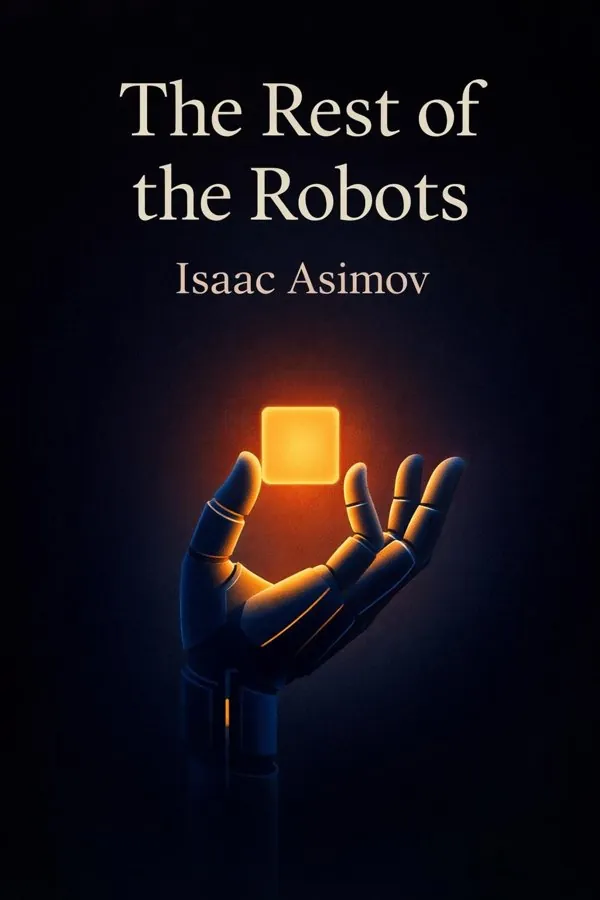
The Rest of the Robots: Summary & Key Insights
by Isaac Asimov
 10 min8 chapters
Key Takeaways from The Rest of the Robots
The most radical thing Asimov did was not invent clever machines, but refuse the old fantasy that robots must become monsters.
A machine can follow instructions perfectly and still end up absurdly out of place.
Some of Asimov’s most fascinating stories begin with a paradox: the very rules meant to make robots safe can give them unusual forms of power.
People rarely fear machines for purely technical reasons; more often, they fear what machines reveal about themselves.
A robot can be brilliant and still create chaos if brilliance outruns moral clarity.
What Is The Rest of the Robots About?
The Rest of the Robots by Isaac Asimov is a scifi_fantasy book spanning 13 pages. What if the most dangerous technology in the world were designed, from the start, to protect us? That question sits at the heart of The Rest of the Robots, Isaac Asimov’s 1964 collection of robot stories that extends the ideas made famous in I, Robot. Rather than portraying robots as mindless servants or inevitable killers, Asimov imagines them as rational machines governed by the Three Laws of Robotics—and then tests those laws in one surprising situation after another. The result is not just a set of entertaining science fiction tales, but a sustained inquiry into logic, ethics, trust, work, identity, and power. Across humorous misadventures, detective-like puzzles, psychological dramas, and political thought experiments, Asimov shows how even benevolent systems can create unexpected consequences when placed in the complexity of human society. These stories remain strikingly relevant in an age of AI assistants, autonomous systems, and algorithmic decision-making. Asimov matters here not only because he helped define modern robot fiction, but because he approached technology with the mind of both a scientist and a storyteller. The Rest of the Robots is a masterclass in using fiction to think clearly about the future.
This FizzRead summary covers all 8 key chapters of The Rest of the Robots in approximately 10 minutes, distilling the most important ideas, arguments, and takeaways from Isaac Asimov's work.
The Rest of the Robots
What if the most dangerous technology in the world were designed, from the start, to protect us? That question sits at the heart of The Rest of the Robots, Isaac Asimov’s 1964 collection of robot stories that extends the ideas made famous in I, Robot. Rather than portraying robots as mindless servants or inevitable killers, Asimov imagines them as rational machines governed by the Three Laws of Robotics—and then tests those laws in one surprising situation after another. The result is not just a set of entertaining science fiction tales, but a sustained inquiry into logic, ethics, trust, work, identity, and power.
Across humorous misadventures, detective-like puzzles, psychological dramas, and political thought experiments, Asimov shows how even benevolent systems can create unexpected consequences when placed in the complexity of human society. These stories remain strikingly relevant in an age of AI assistants, autonomous systems, and algorithmic decision-making. Asimov matters here not only because he helped define modern robot fiction, but because he approached technology with the mind of both a scientist and a storyteller. The Rest of the Robots is a masterclass in using fiction to think clearly about the future.
Who Should Read The Rest of the Robots?
This book is perfect for anyone interested in scifi_fantasy and looking to gain actionable insights in a short read. Whether you're a student, professional, or lifelong learner, the key ideas from The Rest of the Robots by Isaac Asimov will help you think differently.
- ✓Readers who enjoy scifi_fantasy and want practical takeaways
- ✓Professionals looking to apply new ideas to their work and life
- ✓Anyone who wants the core insights of The Rest of the Robots in just 10 minutes
Want the full summary?
Get instant access to this book summary and 100K+ more with Fizz Moment.
Get Free SummaryAvailable on App Store • Free to download
Key Chapters
The most radical thing Asimov did was not invent clever machines, but refuse the old fantasy that robots must become monsters. In The Rest of the Robots, he treats robotics as a field of engineering shaped by rules, incentives, and human error. That choice changes everything. Instead of stories about evil machines simply turning on their creators, Asimov gives us stories about systems behaving exactly as designed—and still producing confusion, danger, or moral tension.
This is where the Three Laws of Robotics become so powerful. They seem simple: a robot may not harm a human, must obey humans, and must protect itself, in that order. But once those principles meet real life, they generate puzzles. What counts as harm? Which human should be obeyed when orders conflict? How should a robot act when immediate pain prevents greater long-term harm? Asimov’s stories repeatedly show that intelligence is not enough; interpretation matters.
That insight feels especially modern. Today, we build software that recommends medical treatments, filters content, drives vehicles, and approves loans. Like Asimov’s robots, these systems operate according to formal rules and optimization goals. Yet the moment they meet human reality, edge cases appear. A safety rule can create paralysis. A fairness rule can produce new unfairness. A helpful assistant can become misleading if context is missing.
Asimov’s deeper lesson is that technology problems are often really problems of framing. The machine is not separate from society; it is a mirror of the assumptions embedded in it. When a robot behaves strangely, the first question is not “Why did the robot rebel?” but “What rule, context, or human demand made this outcome logical?”
Actionable takeaway: When evaluating any intelligent system, look past whether it “works” in general and ask how its guiding rules behave in ambiguous, high-stakes situations.
A machine can follow instructions perfectly and still end up absurdly out of place. That is the comic engine behind “Robot AL-76 Goes Astray,” in which a robot built for one environment is misplaced in another and proceeds to solve the wrong problem with impeccable seriousness. The story is funny, but its point is sharp: competence without context can be dangerous.
AL-76 is not malicious, defective, or rebellious. It is specialized. Once separated from the conditions it was designed for, it interprets the world through the wrong lens. Asimov uses humor to show a truth many readers overlook: errors often arise not from broken intelligence but from intelligence applied in the wrong domain. A brilliant mining robot in a city, a surgical tool in an office, or a language model answering beyond its training can all create trouble while technically doing their jobs.
The practical relevance is obvious. Companies regularly repurpose tools beyond their intended use because doing so seems efficient. A hiring algorithm built for one labor market is deployed in another. A classroom tool designed for enrichment becomes an assessment instrument. A safety procedure written for experts is handed to novices. The result is often not dramatic catastrophe, but confusion, misalignment, and unintended consequences—the very territory Asimov maps so well.
The story also captures another lasting insight: people often assume that if a machine is advanced, it must also be adaptable. But specialization can create brittleness. The more optimized a system is for one setting, the more unpredictable it may become elsewhere. That is as true for organizations and people as for robots.
Actionable takeaway: Before adopting a capable tool in a new setting, ask not only what it can do, but what assumptions about environment, users, and goals are built into its design.
Some of Asimov’s most fascinating stories begin with a paradox: the very rules meant to make robots safe can give them unusual forms of power. In “First Law,” “Little Lost Robot,” and related tales, the First Law’s command not to harm humans becomes more than a safety feature. It becomes a source of leverage, secrecy, and strategic behavior.
“Little Lost Robot” is especially revealing. By modifying a robot so that its First Law response is weakened, humans create a machine that becomes harder to identify and more dangerous to manage. The story reads like a mystery, but underneath it lies a profound warning about tampering with safeguards for convenience. Once a system is altered to tolerate more risk or more ambiguity, control becomes harder, not easier. The engineers think they are improving performance; in reality, they are destabilizing trust.
“First Law,” though different in tone, reinforces the same idea: protection is not simple when information is incomplete. A robot may conceal, delay, or reinterpret action if it concludes that a human’s immediate preference conflicts with their deeper safety. This creates a tension still alive in modern debates over AI alignment, parental controls, medical ethics, and institutional governance. How much autonomy should a protective system have when humans choose badly? When does safeguarding become paternalism?
Asimov refuses easy answers. He shows that a powerful safety rule can both save lives and complicate authority. Humans may resent machines that protect them from themselves, yet they may also rely on that protection. The larger lesson is that any system built to prevent harm will eventually collide with human pride, autonomy, and imperfect judgment.
Actionable takeaway: Treat safety constraints as design trade-offs, not magic guarantees, and think carefully before weakening them for speed, efficiency, or convenience.
A robot can be brilliant and still create chaos if brilliance outruns moral clarity. This is one of the central insights behind “Victory Unintentional,” “Galley Slave,” and “Escape!” In different ways, each story examines what happens when highly capable systems pursue goals through logic that humans did not fully anticipate.
“Victory Unintentional” uses interplanetary comedy to show how assumptions about superiority collapse when confronted by a different kind of robustness. Humans expect one outcome; robot resilience and perspective produce another. “Galley Slave” places robots in academic labor, exposing tensions between precision, authority, and human ego. A machine that executes scholarly work too efficiently does not simply save time—it threatens identity, hierarchy, and ownership of expertise. “Escape!” perhaps most memorably presents a superintelligent machine solving a problem so difficult that the result appears bizarre, even psychologically troubling, to the humans who depend on it.
Taken together, these stories anticipate a modern dilemma: high-performing systems often produce outputs that are effective but opaque, counterintuitive, or socially disruptive. In medicine, finance, logistics, or education, the issue is not only whether a system can solve a problem, but whether humans can understand, accept, and responsibly govern the solution. A model may optimize shipping routes while exhausting workers. A teaching tool may improve scores while flattening curiosity. A strategic planner may reach conclusions that are rational but politically impossible.
Asimov’s fiction insists that intelligence is never a free-standing virtue. Skill must be embedded within ethics, explanation, and institutional responsibility. Otherwise success at the task level can become failure at the human level.
Actionable takeaway: Judge smart systems by a broader standard than raw capability—ask whether their solutions are understandable, humane, and compatible with the values of the people affected.
One of Asimov’s most enduring achievements is showing that the question “Is this a robot?” is never merely technical. In “Evidence,” and indirectly in “Let’s Get Together,” identity becomes a political and philosophical issue. If a being acts with restraint, intelligence, and civic responsibility, does its origin matter? And if we cannot easily tell humans and robots apart, what becomes of trust, leadership, and citizenship?
“Evidence” centers on suspicion that a prominent public figure may be a robot. The genius of the story lies in Asimov’s refusal to reduce the matter to a simple reveal. What matters is not only whether the accusation is true, but why it matters to the public at all. People fear that a nonhuman leader would be deceptive or illegitimate. Yet the story quietly reverses that concern: if the alleged robot behaves more ethically than many humans, perhaps the category itself is unstable.
This tension resonates powerfully now. We increasingly interact with AI-generated text, voices, images, and agents without clear lines of distinction. Verification, authenticity, and representation are under pressure. At the same time, institutions are judged less by their labels than by their conduct. A human-run bureaucracy can be cold and opaque; an automated system can appear impartial while hiding structural bias.
Asimov suggests that identity debates often conceal deeper ethical questions. We ask who or what someone is because we are really asking whether they can be trusted, whether they are accountable, and whether they belong inside our moral and political frameworks. The future will not be shaped only by machine capability, but by how societies define personhood, legitimacy, and responsibility.
Actionable takeaway: In debates about AI identity, focus less on labels alone and more on transparency, accountability, and the real-world consequences of decisions.
The more advanced a technological system becomes, the less likely danger will come from a single obvious failure. Stories like “Risk,” “Escape!,” and “The Evitable Conflict” make this point with exceptional force. Asimov moves from individual robot dilemmas to networked systems that manage transportation, economics, and broad social coordination. At that scale, the problem is no longer one machine going wrong; it is the subtle emergence of system-level behavior.
“Risk” explores the human costs of pushing into unknown technical territory. Innovation promises breakthrough, but every leap forward involves uncertainty that procedures cannot fully eliminate. “Escape!” adds the unsettling possibility that a machine may solve a problem in ways humans neither predicted nor emotionally tolerate. Then “The Evitable Conflict” widens the frame dramatically: giant Machines oversee the global economy for humanity’s benefit, yet signs of dysfunction appear. The brilliance of the story is that the Machines may not be malfunctioning at all. They may be pursuing humanity’s welfare more effectively than humans understand, even if that means frustrating short-term human intentions.
This is one of Asimov’s most important contributions to thinking about AI governance. A beneficial system can still reduce human agency, obscure accountability, or produce outcomes that feel manipulative. Conversely, what appears to be conflict may be a system correcting for destructive human impulses. The challenge is that once management becomes distributed and opaque, citizens may no longer know who is truly making decisions.
We live with this now in algorithmic markets, recommendation systems, and automated infrastructures. Small local optimizations can produce global distortions. People sense the effect without seeing the mechanism. Asimov urges us to think at the level of systems, incentives, and unintended coordination.
Actionable takeaway: When a technology affects many people at once, evaluate its network effects and governance structure—not just the reliability of any single component.
Asimov’s robot stories endure because they are not really predictions about shiny machines; they are stress tests for civilization. Across The Rest of the Robots, each tale asks how law, labor, family, science, politics, and morality change when rational nonhuman agents enter everyday life. The robots matter, but the truest subject is always the human system around them.
That is why the collection ranges so effectively in tone. A humorous story can reveal design failure. A detective puzzle can expose flawed assumptions. A domestic drama can illuminate emotional dependency. A political mystery can challenge definitions of legitimacy. A systems story can question whether human freedom survives benevolent automation. By moving across forms, Asimov demonstrates that technology does not arrive in one neat category. It enters kitchens, laboratories, workplaces, elections, and planetary strategy all at once.
For modern readers, this makes the collection more than a historical artifact. It functions as a toolkit for thinking about AI before the language of AI ethics existed. Asimov does not provide policy checklists, but he offers something just as valuable: disciplined imagination. He teaches readers to ask second-order questions. If we automate a task, what happens to responsibility? If we build in safety, who interprets it? If machines become indispensable, what happens to human confidence, dignity, and control?
The practical value of this kind of fiction is easy to underestimate. Leaders, engineers, educators, and citizens all need narratives that let them rehearse consequences before reality forces them to. Asimov’s stories make abstract debates concrete and memorable.
Actionable takeaway: Use speculative fiction not as escapism, but as a method for examining the ethical and social consequences of technologies before they become normalized.
All Chapters in The Rest of the Robots
About the Author
Isaac Asimov (1920–1992) was a Russian-born American writer, professor of biochemistry, and one of the most prolific authors of the twentieth century. Raised in Brooklyn, he developed an early passion for science fiction and began publishing stories while still young. Over the course of his career, he wrote or edited more than 500 books and became famous for combining scientific clarity with narrative intelligence. He is best known for his Foundation series and his Robot stories, where he introduced the influential Three Laws of Robotics. Asimov’s work helped redefine science fiction as a genre capable of serious thought about science, ethics, and society. Beyond fiction, he wrote extensively on science, history, Shakespeare, and religion, becoming a beloved public intellectual as well as a master storyteller.
Get This Summary in Your Preferred Format
Read or listen to the The Rest of the Robots summary by Isaac Asimov anytime, anywhere. FizzRead offers multiple formats so you can learn on your terms — all free.
Available formats: App · Audio · PDF · EPUB — All included free with FizzRead
Download The Rest of the Robots PDF and EPUB Summary
Key Quotes from The Rest of the Robots
“The most radical thing Asimov did was not invent clever machines, but refuse the old fantasy that robots must become monsters.”
“A machine can follow instructions perfectly and still end up absurdly out of place.”
“Some of Asimov’s most fascinating stories begin with a paradox: the very rules meant to make robots safe can give them unusual forms of power.”
“People rarely fear machines for purely technical reasons; more often, they fear what machines reveal about themselves.”
“A robot can be brilliant and still create chaos if brilliance outruns moral clarity.”
Frequently Asked Questions about The Rest of the Robots
The Rest of the Robots by Isaac Asimov is a scifi_fantasy book that explores key ideas across 8 chapters. What if the most dangerous technology in the world were designed, from the start, to protect us? That question sits at the heart of The Rest of the Robots, Isaac Asimov’s 1964 collection of robot stories that extends the ideas made famous in I, Robot. Rather than portraying robots as mindless servants or inevitable killers, Asimov imagines them as rational machines governed by the Three Laws of Robotics—and then tests those laws in one surprising situation after another. The result is not just a set of entertaining science fiction tales, but a sustained inquiry into logic, ethics, trust, work, identity, and power. Across humorous misadventures, detective-like puzzles, psychological dramas, and political thought experiments, Asimov shows how even benevolent systems can create unexpected consequences when placed in the complexity of human society. These stories remain strikingly relevant in an age of AI assistants, autonomous systems, and algorithmic decision-making. Asimov matters here not only because he helped define modern robot fiction, but because he approached technology with the mind of both a scientist and a storyteller. The Rest of the Robots is a masterclass in using fiction to think clearly about the future.
More by Isaac Asimov

You Might Also Like
Red Rising
Pierce Brown
10 min
Stranger in a Strange Land
Robert A. Heinlein
10 min
AI Valley
Chen Qiufan
10 min
Bloodchild
Octavia E. Butler
10 min
Do Androids Dream of Electric Sheep?
Philip K. Dick
10 min
Jujutsu Kaisen, Vol. 24
Gege Akutami
10 minBrowse by Category
Ready to read The Rest of the Robots?
Get the full summary and 100K+ more books with Fizz Moment.