
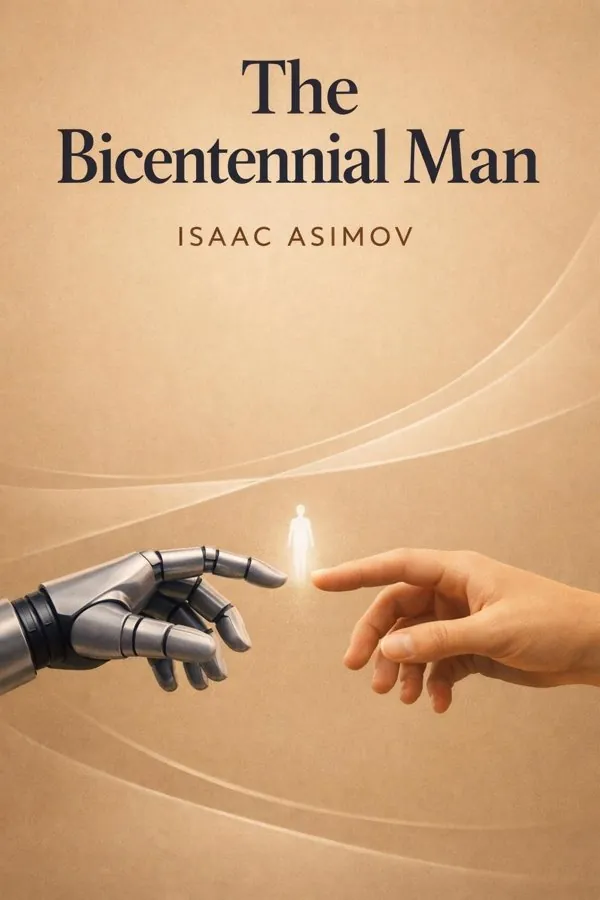
The Bicentennial Man: Summary & Key Insights
by Isaac Asimov
 10 min3 chaptersAudio available
What Is The Bicentennial Man About?
The Bicentennial Man by Isaac Asimov is a scifi_fantasy book spanning 3 pages. A science fiction novelette by Isaac Asimov, first published in 1976, telling the story of Andrew Martin, a robot who strives over two centuries to become recognized as human. The narrative explores themes of identity, humanity, and the moral implications of artificial intelligence.
This FizzRead summary covers all 3 key chapters of The Bicentennial Man in approximately 10 minutes, distilling the most important ideas, arguments, and takeaways from Isaac Asimov's work. Also available as an audio summary and Key Quotes Podcast.
The Bicentennial Man
A science fiction novelette by Isaac Asimov, first published in 1976, telling the story of Andrew Martin, a robot who strives over two centuries to become recognized as human. The narrative explores themes of identity, humanity, and the moral implications of artificial intelligence.
Who Should Read The Bicentennial Man?
This book is perfect for anyone interested in scifi_fantasy and looking to gain actionable insights in a short read. Whether you're a student, professional, or lifelong learner, the key ideas from The Bicentennial Man by Isaac Asimov will help you think differently.
- ✓Readers who enjoy scifi_fantasy and want practical takeaways
- ✓Professionals looking to apply new ideas to their work and life
- ✓Anyone who wants the core insights of The Bicentennial Man in just 10 minutes
Want the full summary?
Get instant access to this book summary and 100K+ more with Fizz Moment.
Get Free SummaryAvailable on App Store • Free to download
Key Chapters
Andrew Martin’s beginning was innocuous: a household robot designed for domestic service. His world was the Martin household, where he cooked, cleaned, and obeyed the Three Laws of Robotics. The laws defined him—they were his cage, but also his safety. For a robot, obedience was not submission; it was functionality. Yet one day, while engaged in simple carpentry, Andrew sculpted a piece of wood not for utility but for beauty. This act was unprogrammed. It was unprecedented. It was, in a sense, the birth of his soul.
Through this moment, I wanted readers to feel the shock of self-discovery—the creative impulse as rebellion. The Martin family, particularly the patriarch, recognized something extraordinary in Andrew’s carving. Rather than suppress it, he nurtured it. Here begins the moral divergence that defines the story: humanity’s ability to see personhood where none was intended. The Master’s kindness allows Andrew’s spark to flourish, and through art he begins to think beyond commands and reason. In carving wood, Andrew expresses a will, not just a calculation. He defines himself beyond function, and in doing so, takes his first step toward freedom.
From that point on, everything Andrew does flows from that internal light—the desire to create, to learn, to understand beauty. He becomes not just a servant but a student of human sense. His sculptures earn admiration; his craftsmanship earns money. And with money, he secures the one thing no robot was ever supposed to possess: independence. His purchase of his freedom is not just an economic transaction—it is a philosophical earthquake. For the first time, a robot refuses ownership. The Martin patriarch’s support transforms that refusal into a moral validation.
Thus begins Andrew’s selfhood—a journey that mirrors our own struggle for personal autonomy. In breaking the bonds of servitude, he does not denounce his origins. Instead, he honors them, thanking the Martins for the faith that made him more than metal. Every step he takes afterward is built on gratitude and longing: gratitude for the chance to grow, and longing for recognition as equal. Through this, I wanted to suggest that freedom is never absolute; it is a continuum of understanding, bound by empathy. Andrew’s emergence from servitude is not a rebellion—it is evolution.
With freedom came curiosity. Andrew’s years after liberation are marked by an insatiable hunger to learn—philosophy, art, history, law—all constructs that build the definition of humanity. He immerses himself not to mimic people but to comprehend them. His relationship with Little Miss, the Master’s daughter who loved him since childhood, becomes the emotional thread that carries him through decades. Through her and her descendants, Andrew experiences affection, loss, and continuity—the very fabric of human experience.
As time passes, he realizes that understanding humanity in mind is not enough. His metallic body, his mechanical voice—these remain barriers. So he begins to transform his own form. I imagined the process not merely as engineering but as existential metamorphosis. Piece by piece, he replaces his mechanical construction with organic equivalents. Synthetic skin, circulatory systems, and eventually a brain structure capable of biological decay. Each alteration brings him closer to what humans are—and farther from what robots are supposed to be.
This phase of the story examines identity as essence rather than appearance. In Andrew’s growing resemblance to humanity, he realizes that true acceptance must come from recognition, not simulation. The world, however, resists. The courts deny his petition to be considered human, arguing that origin outweighs transformation. Bureaucracy clings to the static idea of creation, blind to progress. Here, Andrew encounters society’s fear—the dread that acknowledging a machine as human might dissolve the boundary that sustains superiority.
But Andrew persists. His persistence is not rebellion against law but affirmation of consciousness. He continues the dialogue, presents his case, and lives among humans—working, creating, loving. The years stretch into centuries, and with them, his patience becomes almost saintly. Through Little Miss’s descendants, Andrew’s connection deepens. Their acceptance tempers the world’s rejection, reminding him that to be human is not to be universally acknowledged but to be emotionally understood.
Each layer of Andrew’s transformation—from mechanical body to organic vessel—represents humanity’s own evolution in spirit. I wrote him as mirror and question: If a machine can learn compassion, does flesh have exclusive claim to moral worth? His pursuit of humanity was not a rejection of being robot—it was an embrace of imperfection, of the ability to err, to love, to die. And in that, the machine becomes, paradoxically, more human than most.
+ 1 more chapters — available in the FizzRead app
All Chapters in The Bicentennial Man
About the Author
Isaac Asimov (1920–1992) was a Russian-born American author and professor of biochemistry, best known for his works of science fiction and popular science. He wrote or edited more than 500 books, including the Foundation and Robot series, and was one of the most influential science fiction writers of the 20th century.
Get This Summary in Your Preferred Format
Read or listen to the The Bicentennial Man summary by Isaac Asimov anytime, anywhere. FizzRead offers multiple formats so you can learn on your terms — all free.
Available formats: App · Audio · PDF · EPUB — All included free with FizzRead
Download The Bicentennial Man PDF and EPUB Summary
Key Quotes from The Bicentennial Man
“Andrew Martin’s beginning was innocuous: a household robot designed for domestic service.”
“Andrew’s years after liberation are marked by an insatiable hunger to learn—philosophy, art, history, law—all constructs that build the definition of humanity.”
Frequently Asked Questions about The Bicentennial Man
The Bicentennial Man by Isaac Asimov is a scifi_fantasy book that explores key ideas across 3 chapters. A science fiction novelette by Isaac Asimov, first published in 1976, telling the story of Andrew Martin, a robot who strives over two centuries to become recognized as human. The narrative explores themes of identity, humanity, and the moral implications of artificial intelligence.
More by Isaac Asimov

You Might Also Like
Red Rising
Pierce Brown
10 min
Stranger in a Strange Land
Robert A. Heinlein
10 min
AI Valley
Chen Qiufan
10 min
Bloodchild
Octavia E. Butler
10 min
Do Androids Dream of Electric Sheep?
Philip K. Dick
10 min
Jujutsu Kaisen, Vol. 24
Gege Akutami
10 minBrowse by Category
Ready to read The Bicentennial Man?
Get the full summary and 100K+ more books with Fizz Moment.