
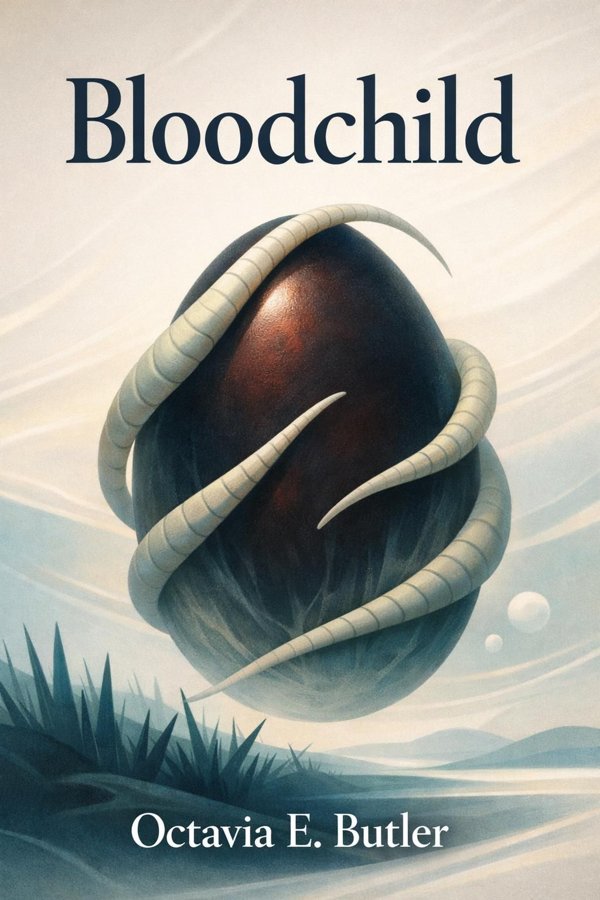
Bloodchild: Summary & Key Insights
 10 min8 chaptersAudio available
Key Takeaways from Bloodchild
One of Bloodchild’s most unsettling insights is that care and coercion can exist side by side.
Consent becomes most meaningful when saying no has consequences.
Fear is often treated as weakness, but Bloodchild suggests that fear can be a doorway to truth.
A relationship can be sincere and still unequal.
Civilizations are frequently built on compromises that later generations inherit without choosing.
What Is Bloodchild About?
Bloodchild by Octavia E. Butler is a scifi_fantasy book. Octavia E. Butler’s Bloodchild is one of the most unsettling and unforgettable short works in modern science fiction. Set on a preserve where human refugees live under the protection of a powerful alien species called the Tlic, the story follows a boy named Gan as he confronts the terrifying, intimate reality of the bargain that sustains his family’s survival. What begins as a coming-of-age narrative quickly becomes something far more complex: an exploration of love, dependency, power, bodily autonomy, fear, and the compromises people make in unequal relationships. Butler refuses simple categories. Bloodchild is not merely a tale of alien reproduction or human subjugation; it is a profound meditation on what it means to consent when choices are constrained, to care for someone who also has power over you, and to grow up in a world built on necessity rather than justice. Butler matters because she expanded science fiction’s moral and emotional range, using speculative settings to illuminate real human dilemmas with startling clarity. Bloodchild remains essential reading because it asks difficult questions without offering easy comfort.
This FizzRead summary covers all 8 key chapters of Bloodchild in approximately 10 minutes, distilling the most important ideas, arguments, and takeaways from Octavia E. Butler's work. Also available as an audio summary and Key Quotes Podcast.
Bloodchild
Octavia E. Butler’s Bloodchild is one of the most unsettling and unforgettable short works in modern science fiction. Set on a preserve where human refugees live under the protection of a powerful alien species called the Tlic, the story follows a boy named Gan as he confronts the terrifying, intimate reality of the bargain that sustains his family’s survival. What begins as a coming-of-age narrative quickly becomes something far more complex: an exploration of love, dependency, power, bodily autonomy, fear, and the compromises people make in unequal relationships. Butler refuses simple categories. Bloodchild is not merely a tale of alien reproduction or human subjugation; it is a profound meditation on what it means to consent when choices are constrained, to care for someone who also has power over you, and to grow up in a world built on necessity rather than justice. Butler matters because she expanded science fiction’s moral and emotional range, using speculative settings to illuminate real human dilemmas with startling clarity. Bloodchild remains essential reading because it asks difficult questions without offering easy comfort.
Who Should Read Bloodchild?
This book is perfect for anyone interested in scifi_fantasy and looking to gain actionable insights in a short read. Whether you're a student, professional, or lifelong learner, the key ideas from Bloodchild by Octavia E. Butler will help you think differently.
- ✓Readers who enjoy scifi_fantasy and want practical takeaways
- ✓Professionals looking to apply new ideas to their work and life
- ✓Anyone who wants the core insights of Bloodchild in just 10 minutes
Want the full summary?
Get instant access to this book summary and 100K+ more with Fizz Moment.
Get Free SummaryAvailable on App Store • Free to download
Key Chapters
One of Bloodchild’s most unsettling insights is that care and coercion can exist side by side. Gan’s family depends on the Tlic for safety, land, and continued survival on an alien world. In return, humans serve as hosts for Tlic eggs. This arrangement is not presented as simple slavery, nor as simple partnership. Instead, Butler shows how unequal systems often create genuine affection between people whose relationship is still structured by power. T’Gatoi cares for Gan and his family. She protects them, provides for them, and expresses what seems to be real tenderness. Yet her species also needs human bodies, and that need limits what humans can freely choose.
This complexity is what gives the story its emotional force. Butler asks readers to sit with the discomfort of relationships that cannot be sorted into clean categories of victim and villain. In life, many institutions and personal bonds work this way. Employers may offer security while also demanding unhealthy sacrifice. Governments may protect citizens while restricting freedoms. Families may provide love while enforcing roles that suppress individuality. Bloodchild captures the moral confusion that arises when survival depends on accepting terms set by someone more powerful.
The story becomes especially powerful when Gan realizes that tradition and affection do not erase fear. He must decide whether he can accept the role expected of him once he fully understands its physical and emotional cost. That moment of recognition matters because it separates passive inheritance from active consent.
A practical way to apply this idea is to examine relationships in your own life that feel supportive but also limiting. Ask: What am I receiving, what am I giving up, and do I truly have a choice? Actionable takeaway: identify one relationship or system you depend on and honestly assess where care ends and coercion begins.
Consent becomes most meaningful when saying no has consequences. That is the central ethical challenge at the heart of Bloodchild. Gan is expected to become a host for T’Gatoi’s eggs, and although the arrangement is culturally normalized, Butler shows that normality does not make it uncomplicated. Gan grows up in an environment where his future has been shaped for him long before he fully understands what is involved. He is loved, but he is also prepared. He is protected, but he is also claimed.
Butler’s brilliance lies in showing that consent is not just a matter of verbal agreement. It depends on knowledge, alternatives, emotional pressure, social expectations, and power imbalances. Gan’s eventual decision means something only because he confronts fear directly. After witnessing a traumatic birth from another human host, he sees the reality of implantation without euphemism. At that point, he is no longer operating within innocent obedience. He understands the danger, pain, and stakes.
This makes Bloodchild deeply relevant beyond science fiction. In workplaces, intimate relationships, medical decisions, and social institutions, people are often told they are choosing freely when the costs of refusal are severe. Butler reminds us that ethical relationships require more than ritual agreement. They require transparency, respect, and room for refusal.
In practical terms, this concept can guide how we ask for commitments from others. Whether managing a team, raising children, or entering a partnership, it is worth asking: Have I created conditions where the other person can be honest? Are they fully informed? Would no be safe?
Actionable takeaway: the next time you seek someone’s agreement, pause and make the alternatives explicit so their consent can be informed rather than pressured.
Fear is often treated as weakness, but Bloodchild suggests that fear can be a doorway to truth. Gan spends much of the story moving through a world he has accepted but not fully examined. The customs around Tlic implantation are familiar to him, embedded in family history and community life. It is only when he witnesses the horrifying emergency extraction of Tlic grubs from another human host that his inherited assumptions collapse. Fear, disgust, and shock force him to see what he had been trained not to question.
This moment is crucial because Butler does not portray fear as irrational panic. Instead, fear becomes a form of perception. It reveals the physical reality beneath social language. The arrangement between humans and Tlic may be normalized, but the body still knows vulnerability. Gan’s terror is not simply an emotional reaction; it is evidence that something serious is at stake and that he must decide consciously rather than drift into obedience.
In everyday life, fear can serve a similar function. If a job opportunity feels prestigious but leaves you constantly uneasy, that discomfort may contain useful information. If a social norm makes everyone smile while quietly harming some people, the people who feel afraid or disturbed may be seeing something others have accepted too easily. Fear should not always rule us, but neither should it be dismissed.
Bloodchild teaches that maturity is not the absence of fear. Maturity is the ability to investigate fear, understand what it is showing you, and act with awareness. Gan ultimately chooses only after his fear has stripped away illusion.
Actionable takeaway: when you feel strong fear around an important decision, do not silence it immediately; write down what the fear is trying to reveal before deciding what to do.
A relationship can be sincere and still unequal. That tension defines the bond between Gan and T’Gatoi. She is not portrayed as a cartoon oppressor. She is intelligent, affectionate, protective, and deeply invested in Gan’s well-being. Yet she is also a member of the species that controls the conditions of human life. She has more status, more physical power, and more freedom than the humans she governs. Butler insists that emotional intimacy does not erase structural imbalance.
This is one of the story’s most enduring contributions. In many narratives, love is imagined as a force that solves hierarchy: if two people care about each other, then the imbalance no longer matters. Bloodchild rejects that fantasy. Caring feelings can coexist with systems that advantage one party over another. In fact, affection may make those systems harder to challenge, because gratitude and attachment blur moral judgment.
This idea applies to many real situations. A generous employer may still benefit from underpaying workers. A well-meaning parent may still control a child’s future too tightly. A romantic partner may be caring and attentive while still holding financial, social, or emotional leverage. Recognizing power does not require denying love. It requires refusing to let love become an excuse for unexamined dominance.
Gan’s development depends on learning to name this imbalance without reducing T’Gatoi to a monster. That balance is difficult and mature. He must hold two truths at once: she cares for him, and she needs something from him that he has reason to fear.
Actionable takeaway: in an important relationship, list the forms of power each person holds, such as money, status, physical safety, or decision-making authority, and discuss them openly instead of assuming love makes them irrelevant.
Civilizations are frequently built on compromises that later generations inherit without choosing. Bloodchild places this reality at the center of its worldbuilding. Humans are not on Earth; they are refugees surviving on land controlled by the Tlic. Their safety depends on an arrangement in which human bodies become part of Tlic reproduction. This is not an ideal moral order. It is a negotiated survival system born from scarcity, vulnerability, and mutual need.
Butler is especially interested in what happens when necessity becomes tradition. Over time, communities create rituals, stories, and expectations that make harsh bargains feel natural. Children grow up inside them. Families explain them as duty. Elders justify them as practical. Yet the original compromise never stops being costly simply because it becomes customary. Gan’s crisis emerges when he stops treating inherited necessity as unquestionable destiny.
The story resonates because people today also live inside systems shaped by old bargains: economic structures that reward overwork, political agreements that distribute risk unfairly, and social roles that burden some groups more than others. Often these arrangements persist not because they are just, but because they are familiar and because changing them appears dangerous.
Bloodchild does not offer an easy escape from compromise. Instead, it asks what ethical living looks like when pure options do not exist. Sometimes the first step is not immediate revolution, but clear-eyed recognition. Once people can name the bargain, they can begin to negotiate, resist, or reshape it.
A useful application is to examine one “normal” expectation in your work or family life and ask what historical bargain produced it. Who benefits? Who bears the cost? Actionable takeaway: choose one inherited rule you have never questioned and investigate whether it serves justice or merely preserves survival habits.
Few stories make the politics of the body as vivid as Bloodchild. Butler turns reproduction into a central field of power, vulnerability, and negotiation. Human bodies are not incidental in this world; they are necessary resources within a cross-species arrangement. This immediately transforms intimate biology into a social and political issue. Who bears pain? Who carries risk? Who decides what happens inside a body? These questions drive the story’s tension.
By placing a male protagonist in the role of reproductive host, Butler also disrupts familiar gender assumptions. She unsettles readers by shifting burdens often associated with women onto a young man. This reversal is not a gimmick. It exposes how reproductive expectations can be normalized, romanticized, or demanded from those with less power. The reader is forced to confront bodily vulnerability from a fresh angle.
The scene of implantation and the emergency birth make clear that the body cannot be abstracted away. Political arrangements are experienced physically. Rules become flesh. Duty becomes pain. Fear becomes heartbeat and breath. Butler insists that any discussion of partnership, family, or social order must account for embodiment, not just ideology.
This idea remains relevant in debates about healthcare, labor, gender roles, caregiving, and personal boundaries. Policies and traditions often sound neutral until we ask whose bodies absorb the burden. Once that question is asked, many supposedly natural systems look very different.
To apply this insight, pay attention to where responsibility becomes physical in your own environment. Who loses sleep, takes risks, experiences pain, or bears long-term consequences? Actionable takeaway: in any decision involving others, ask not only who benefits, but whose body will carry the cost.
Growing up is not merely about reaching a certain age; it is about seeing the world as it is and choosing with open eyes. In Bloodchild, Gan’s coming-of-age journey is not marked by independence from others, but by a painful awakening to complexity. He begins in a state of partial innocence, trusting family traditions and T’Gatoi’s authority. He knows his expected future, but he does not yet grasp its full weight. The story traces the movement from inherited belief to informed decision.
What makes this maturation compelling is that Butler refuses the simple heroic arc. Gan does not become mature by rejecting everyone around him. He becomes mature by demanding truth, confronting horror, voicing fear, and then deciding what he can live with. Adulthood here means owning a choice even when the available options are constrained and imperfect.
This version of growth is deeply realistic. Many important life decisions do not offer ideal outcomes. Choosing a career, caring for family, entering commitment, or taking on responsibility often involves trade-offs. Real maturity is less about freedom from pressure and more about the ability to understand pressure without surrendering your mind.
Gan’s development also highlights the importance of witnessing reality firsthand. He cannot remain a child once he has seen what hosting truly entails. Knowledge changes him. That is often true outside fiction as well: once we understand how systems work, innocence is no longer possible, but agency becomes more meaningful.
Actionable takeaway: before making a major life commitment, seek direct knowledge rather than relying on comforting assumptions, and ask yourself whether the choice is truly yours once all consequences are visible.
Science fiction is most powerful when aliens are not just exotic decorations but tools for thinking more deeply about humanity. In Bloodchild, the Tlic are profoundly other: physically different, reproductively different, and organized around needs that humans can barely accept without horror. Yet Butler does not use alienness merely to shock. She uses it to expose the limits of human moral language. Terms like love, family, protection, and exploitation all become unstable in contact with the Tlic-human relationship.
This is why the story lingers. The Tlic are not evil invaders in any simple sense. They need humans, but humans also need them. Their customs contain care and violence at once. By making the central relationship alien in both biology and social structure, Butler frees the reader from familiar labels and forces a deeper ethical examination. What counts as mutuality when needs are unequal? What counts as consent across radically different forms of life? What obligations arise from interdependence?
In practical terms, this helps readers think better about difference in the real world. Encounters with cultures, communities, or perspectives unlike our own often provoke fast judgment. Bloodchild encourages a slower response: learn the structure, understand the stakes, and resist simplistic moral categories. At the same time, the story warns against romanticizing difference so much that harm becomes invisible.
The value of the alien, then, is not escape from reality but a clearer lens on it. By making us uncomfortable, Butler helps us question assumptions we barely notice in familiar settings.
Actionable takeaway: when confronted by a worldview or system that feels strange, resist both instant condemnation and blind acceptance; instead, map the needs, powers, and costs involved before forming a judgment.
All Chapters in Bloodchild
About the Author
Octavia E. Butler was an acclaimed American author whose work transformed science fiction by centering questions of power, survival, race, gender, and human adaptation. Born in Pasadena, California, in 1947, she became one of the first Black women to gain major recognition in the science fiction field. Butler wrote influential works including Kindred, the Patternist series, Lilith’s Brood, and the Parable novels. Her fiction is known for its psychological intensity, moral complexity, and bold speculative imagination. She received numerous honors, including Hugo and Nebula awards, and in 1995 became the first science fiction writer to receive a MacArthur Fellowship. Butler’s legacy endures because she used speculative fiction not as escapism, but as a powerful way to confront the deepest tensions of human society.
Get This Summary in Your Preferred Format
Read or listen to the Bloodchild summary by Octavia E. Butler anytime, anywhere. FizzRead offers multiple formats so you can learn on your terms — all free.
Available formats: App · Audio · PDF · EPUB — All included free with FizzRead
Download Bloodchild PDF and EPUB Summary
Key Quotes from Bloodchild
“One of Bloodchild’s most unsettling insights is that care and coercion can exist side by side.”
“Consent becomes most meaningful when saying no has consequences.”
“Fear is often treated as weakness, but Bloodchild suggests that fear can be a doorway to truth.”
“A relationship can be sincere and still unequal.”
“Civilizations are frequently built on compromises that later generations inherit without choosing.”
Frequently Asked Questions about Bloodchild
Bloodchild by Octavia E. Butler is a scifi_fantasy book that explores key ideas across 8 chapters. Octavia E. Butler’s Bloodchild is one of the most unsettling and unforgettable short works in modern science fiction. Set on a preserve where human refugees live under the protection of a powerful alien species called the Tlic, the story follows a boy named Gan as he confronts the terrifying, intimate reality of the bargain that sustains his family’s survival. What begins as a coming-of-age narrative quickly becomes something far more complex: an exploration of love, dependency, power, bodily autonomy, fear, and the compromises people make in unequal relationships. Butler refuses simple categories. Bloodchild is not merely a tale of alien reproduction or human subjugation; it is a profound meditation on what it means to consent when choices are constrained, to care for someone who also has power over you, and to grow up in a world built on necessity rather than justice. Butler matters because she expanded science fiction’s moral and emotional range, using speculative settings to illuminate real human dilemmas with startling clarity. Bloodchild remains essential reading because it asks difficult questions without offering easy comfort.
More by Octavia E. Butler
You Might Also Like
Red Rising
Pierce Brown
10 min
Stranger in a Strange Land
Robert A. Heinlein
10 min
AI Valley
Chen Qiufan
10 min
Do Androids Dream of Electric Sheep?
Philip K. Dick
10 min
Jujutsu Kaisen, Vol. 24
Gege Akutami
10 min
The Wandering Earth
Cixin Liu
10 minBrowse by Category
Ready to read Bloodchild?
Get the full summary and 100K+ more books with Fizz Moment.