
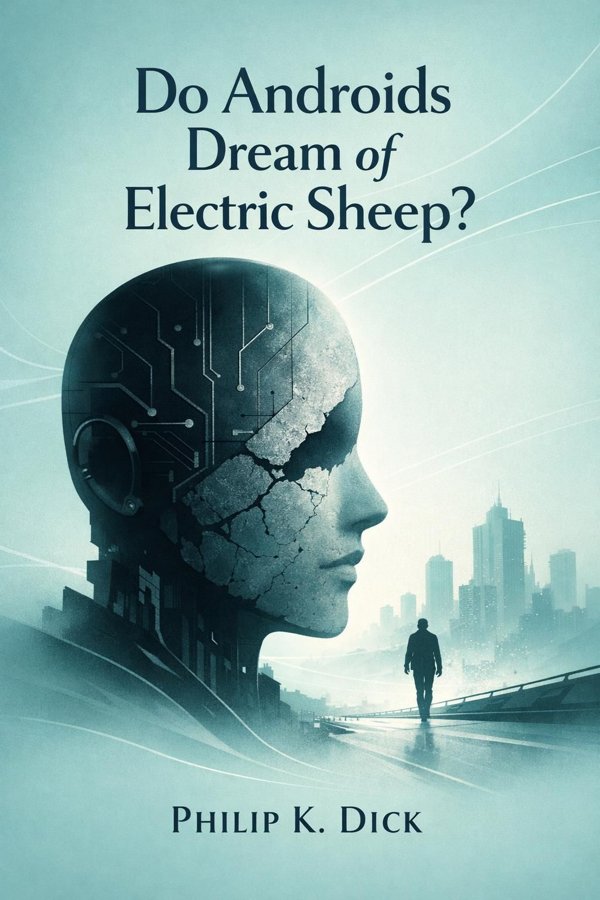
Do Androids Dream of Electric Sheep?: Summary & Key Insights
 10 min9 chaptersAudio available
Key Takeaways from Do Androids Dream of Electric Sheep?
A society can survive advanced technology more easily than it can survive the loss of empathy.
When imitation becomes good enough, people start forgetting why the real thing mattered.
Controlling how you feel is not the same as understanding why you feel empty.
People do not just seek pleasure; they seek participation in meaning, especially through suffering.
The easiest people to condemn are usually the ones you have not looked at closely.
What Is Do Androids Dream of Electric Sheep? About?
Do Androids Dream of Electric Sheep? by Philip K. Dick is a scifi_fantasy book. What if the line between human and machine were not drawn by intelligence, but by empathy? Philip K. Dick’s Do Androids Dream of Electric Sheep? is a haunting science fiction novel set in a radioactive, post-apocalyptic San Francisco after World War Terminus has devastated Earth. Most animals have died, many humans have emigrated to off-world colonies, and those who remain live among synthetic substitutes, mood-regulating technology, and increasingly lifelike androids. At the center is Rick Deckard, a bounty hunter tasked with "retiring" escaped androids who are nearly impossible to distinguish from real people. As he pursues them, the novel becomes less a chase story than a philosophical inquiry into identity, consciousness, morality, and what it truly means to be human. Dick matters because few writers have explored reality, perception, and artificial life with such unsettling originality. His work influenced generations of science fiction, philosophy, and film, including Blade Runner, yet this novel stands on its own as a deeper, stranger meditation on authenticity, compassion, and spiritual emptiness in a technologically saturated world.
This FizzRead summary covers all 9 key chapters of Do Androids Dream of Electric Sheep? in approximately 10 minutes, distilling the most important ideas, arguments, and takeaways from Philip K. Dick's work. Also available as an audio summary and Key Quotes Podcast.
Do Androids Dream of Electric Sheep?
What if the line between human and machine were not drawn by intelligence, but by empathy? Philip K. Dick’s Do Androids Dream of Electric Sheep? is a haunting science fiction novel set in a radioactive, post-apocalyptic San Francisco after World War Terminus has devastated Earth. Most animals have died, many humans have emigrated to off-world colonies, and those who remain live among synthetic substitutes, mood-regulating technology, and increasingly lifelike androids. At the center is Rick Deckard, a bounty hunter tasked with "retiring" escaped androids who are nearly impossible to distinguish from real people. As he pursues them, the novel becomes less a chase story than a philosophical inquiry into identity, consciousness, morality, and what it truly means to be human. Dick matters because few writers have explored reality, perception, and artificial life with such unsettling originality. His work influenced generations of science fiction, philosophy, and film, including Blade Runner, yet this novel stands on its own as a deeper, stranger meditation on authenticity, compassion, and spiritual emptiness in a technologically saturated world.
Who Should Read Do Androids Dream of Electric Sheep??
This book is perfect for anyone interested in scifi_fantasy and looking to gain actionable insights in a short read. Whether you're a student, professional, or lifelong learner, the key ideas from Do Androids Dream of Electric Sheep? by Philip K. Dick will help you think differently.
- ✓Readers who enjoy scifi_fantasy and want practical takeaways
- ✓Professionals looking to apply new ideas to their work and life
- ✓Anyone who wants the core insights of Do Androids Dream of Electric Sheep? in just 10 minutes
Want the full summary?
Get instant access to this book summary and 100K+ more with Fizz Moment.
Get Free SummaryAvailable on App Store • Free to download
Key Chapters
A society can survive advanced technology more easily than it can survive the loss of empathy. One of the novel’s central ideas is that being human is not primarily about logic, memory, language, or even biological origin. Instead, Philip K. Dick proposes that empathy—the ability to feel with and for another being—is the fragile moral core of human life. In the world of the novel, empathy is so important that it becomes the basis for distinguishing humans from androids through the Voigt-Kampff test, which measures emotional response to suffering, especially animal suffering.
This idea matters because the androids are not simple machines. They are intelligent, articulate, and often more composed than the humans hunting them. Yet they are portrayed as lacking spontaneous compassion. Dick uses this contrast to challenge the assumption that intelligence equals moral worth. A being may reason brilliantly and still remain emotionally barren. At the same time, the book complicates the issue by showing humans acting coldly, selfishly, and mechanically. Rick Deckard’s job requires him to kill sentient creatures, and his emotional certainty erodes over time. The result is an uncomfortable question: if humans behave without empathy, are they becoming android-like?
In everyday life, this idea applies beyond science fiction. Modern institutions often reward efficiency, speed, and analysis while neglecting kindness, patience, and care. In workplaces, schools, and digital communication, people can begin treating others as functions rather than feeling individuals. Dick’s warning is that dehumanization starts not with robots, but with human habits.
Actionable takeaway: judge humanity in yourself and others not only by competence or intelligence, but by the consistent practice of empathy in ordinary decisions.
When imitation becomes good enough, people start forgetting why the real thing mattered. In Do Androids Dream of Electric Sheep?, real animals are rare and precious because ecological devastation has made them symbols of status, morality, and connection to life itself. Many people who cannot afford real animals buy electric replicas, carefully maintaining the appearance of genuine care. This strange detail is more than world-building. It reveals a culture built on simulation, where social value often depends on convincing performance rather than authentic reality.
Dick’s genius lies in refusing to make the issue simple. Electric animals still provide comfort. Synthetic experiences still shape emotion. A fake creature can satisfy loneliness, just as mediated identities in modern life can provide belonging. Yet the novel insists that a difference remains between appearance and authenticity, even when the distinction is inconvenient or painful. Rick Deckard’s longing for a real animal reflects a broader hunger for contact with something not manufactured, programmed, or socially staged.
This theme feels strikingly contemporary. People curate online personas, consume algorithmically tailored experiences, and often substitute representations for direct engagement. A photo can replace a memory; a public signal of care can replace actual sacrifice. Dick is not merely condemning artifice. He is asking what happens when imitation becomes emotionally sufficient and moral seriousness dissolves.
Practical applications are easy to see. A company may advertise values without living them. A friendship may be maintained through habitual messages without vulnerability. A person may perform compassion publicly but avoid private responsibility. The more persuasive the simulation, the more discipline authenticity requires.
Actionable takeaway: regularly ask where in your life you are accepting convincing substitutes—relationships, values, experiences, or self-images—in place of what is real.
Controlling how you feel is not the same as understanding why you feel empty. One of the novel’s most memorable inventions is the Penfield mood organ, a device that allows users to dial specific emotional states. Instead of struggling through despair, apathy, or tension, people can select feelings like calm, motivation, or even appropriate sadness. This is both darkly funny and deeply disturbing, because it reveals a world where emotional management has become mechanized.
The mood organ represents a modern temptation: if inner life becomes difficult, perhaps it can be optimized. Dick’s point is not that emotional regulation is bad in itself. Structure, therapy, medication, ritual, and intentional habits can all help people function. The problem arises when control replaces meaning. The characters can manipulate their moods, yet they remain isolated, spiritually exhausted, and morally confused. The technology reduces friction without resolving alienation.
This insight resonates strongly today. Many people use productivity systems, dopamine-driven media, wellness routines, and pharmaceutical or digital tools to shape mood and attention. These can be helpful, but they do not answer existential questions. Why am I living this way? What do I owe others? What kind of person am I becoming? Dick shows that a society may become emotionally engineered while remaining psychologically and ethically hollow.
A practical example is the difference between restoring energy and avoiding reflection. Listening to music, exercising, or using a mindfulness app can improve a difficult day. But if such tools are used only to suppress discomfort, they can prevent deeper growth. The same applies in organizations that manage morale while ignoring toxic culture.
Actionable takeaway: use tools that regulate mood, but pair them with honest reflection so emotional comfort does not become a substitute for purpose.
The easiest people to condemn are usually the ones you have not looked at closely. Rick Deckard begins the novel with a relatively clear professional purpose: identify escaped androids and retire them. His work is socially sanctioned, economically rewarded, and presented as necessary for public safety. But the deeper he enters the task, the less stable his moral confidence becomes. The androids do not fit neatly into the category of soulless machines. They show fear, cunning, desire for survival, and at times a disorienting kind of vulnerability.
Dick uses Rick’s unease to show how roles can shield people from moral complexity. When society labels a group as less than fully worthy, violence becomes procedural. Bureaucracy, tests, and official language create distance. Yet lived encounters can disrupt ideology. Rick begins to perceive that the line between hunter and hunted is not as clean as his profession requires.
This idea applies to many domains beyond the novel. In politics, workplaces, and legal systems, people often rely on categories that flatten individuals into problems. A manager can see workers as performance units. A government can see migrants as numbers. Social media can turn opponents into abstractions. Once someone is reduced to a type, harsh treatment becomes easier to justify.
The lesson is not that all distinctions disappear or that dangerous behavior should be ignored. Rather, Dick argues that moral seriousness begins when certainty is interrupted by attention. If your system depends on never really seeing the other side, it may be ethically compromised.
A practical way to apply this is in conflict. Before making a final judgment, learn the person’s context, incentives, fears, and constraints. Nuance does not eliminate accountability, but it can humanize it.
Actionable takeaway: whenever your role gives you permission to judge or punish, slow down and examine whether your certainty depends on oversimplifying the person before you.
People often use possessions to display virtue when they are actually trying to cover insecurity. In the novel, owning a real animal is not just a private pleasure; it is a marker of social dignity. Because animals are scarce after ecological collapse, caring for one signals moral seriousness, prosperity, and participation in a shared cultural value. This produces a subtle but powerful social economy in which appearance, compassion, and status become entangled.
Dick is especially sharp in showing how noble values can become competitive signals. Caring about animals sounds admirable, and in many ways it is. But when social recognition becomes central, the moral act risks becoming performative. Rick Deckard’s desire for a real animal is sincere, yet it is also tangled with shame, envy, and the pressure to seem authentic in a world of imitation. The result is a powerful portrait of status anxiety dressed in ethical language.
This idea is highly relevant today. People communicate identity through brands, causes, lifestyle choices, and public commitments. Some of these are meaningful expressions of values. But they can also become substitutes for deeper ethical work. A person may buy the right products yet neglect compassion. A company may promote sustainability while exploiting workers. A reader may admire serious books as symbols rather than engage their demands.
The broader insight is that social prestige can attach itself to moral language, making it harder to tell whether an action is rooted in care or self-display. That does not mean visible commitments are worthless. It means motivation matters, and self-deception is easy.
A useful practice is to ask whether you would still do the same thing if nobody knew about it. That question can expose where principle ends and performance begins.
Actionable takeaway: examine whether your most visible values are being lived privately, especially in ways that bring no status reward.
The self feels solid until a convincing imitation appears beside it. One of the most unsettling achievements of Do Androids Dream of Electric Sheep? is the way it destabilizes identity. The androids are not metal caricatures of machine life; they are persuasive beings who mimic human behavior so well that the criteria for personhood begin to wobble. This does not only threaten institutions like law enforcement. It threatens the ordinary human need to believe that we are special in a clear and defensible way.
Dick shows that identity is often maintained by narratives, rituals, and boundaries rather than by simple facts. Humans in the novel rely on tests, myths, and social assumptions to secure their distinctiveness. But once those supports weaken, uncertainty floods in. If a machine can converse, deceive, desire, and fear, then what exactly anchors human uniqueness? Biology alone seems insufficient; intelligence no longer works; emotional performance can be faked. The novel leaves readers facing an unsettling possibility: perhaps human identity is less a fixed essence than an ethical achievement.
This matters practically in an era of AI, virtual identities, and increasingly blurred distinctions between natural and artificial experience. Many people now interact daily with systems that simulate understanding, empathy, and creativity. The question is not just whether machines can become more human-like. It is whether humans will define themselves more shallowly in response.
A healthy application of this idea is to avoid grounding identity solely in traits that can be replicated, measured, or displayed. Instead, focus on lived commitments: responsibility, compassion, courage, and integrity. These are not guaranteed by species membership; they are enacted.
Actionable takeaway: build your sense of self around values you practice, not around labels or assumptions about what makes you automatically different from others.
Loneliness does not just hurt; it distorts judgment. The world of the novel is marked by eerie emptiness. Population decline, environmental ruin, and migration to off-world colonies have left Earth sparse and psychologically depleted. This isolation shapes every aspect of the story. Characters live in physical proximity yet remain emotionally detached, relying on devices, routines, or synthetic experiences to fill the void. The result is not simply sadness, but a weakening of moral texture.
Dick suggests that ethics depend partly on sustained contact with others. When life becomes atomized, empathy can thin out. Other beings become harder to perceive as fully real. This helps explain why the culture of the novel tolerates so much emotional substitution. If genuine relationship is scarce, simulations start doing more of the work. But this solution deepens the problem by making emotional life more mediated and less reciprocal.
This insight is practical and urgent. Isolation today may not come from post-apocalyptic depopulation, but it can arise from remote living, hyper-individualism, overwork, and digital overstimulation. A person can be constantly connected yet relationally starved. Under those conditions, patience shrinks, cruelty becomes easier, and meaning fragments.
The novel implies that moral clarity is sustained not only by private conscience but by relational life. Conversations, obligations, care work, shared rituals, and community all reinforce the reality of other people. Without them, the self can become closed and instrumental.
A practical application is to treat connection as ethical maintenance rather than lifestyle decoration. Time with others is not merely recreational; it can preserve perspective, compassion, and accountability.
Actionable takeaway: create regular forms of human connection that require presence and reciprocity, because ethical sensitivity fades when isolation becomes normal.
Feeling disturbed by suffering is easier than taking responsibility for it. Throughout the novel, empathy is praised as the defining human trait, but Dick does not let readers reduce empathy to sentimentality. The story repeatedly asks whether emotional response actually changes behavior. Characters express concern, participate in collective rituals, or endorse humane values, yet they often remain complicit in systems of violence, deception, and moral convenience. In this way, the novel distinguishes between the appearance of compassion and the cost of practicing it.
Rick Deckard’s journey is central here. His growing discomfort with killing androids suggests an expansion of feeling, but that feeling does not automatically lead to moral transformation. He is entangled in duty, survival, and social expectation. Dick’s point is sobering: awareness alone is not redemption. One can recognize suffering and still continue harmful action.
This applies directly to modern life. People are exposed constantly to images of pain, injustice, and need. Emotional reaction has become easy and immediate. But outrage, sadness, or symbolic support can create the illusion of moral participation without demanding sacrifice. Genuine compassion usually requires inconvenience: time, money, changed habits, difficult conversations, or institutional resistance.
In practical terms, this might mean supporting a struggling friend through repeated effort rather than one sympathetic message. It might mean adjusting consumption habits to align with ethical concerns. In leadership, it could mean changing policies rather than celebrating values.
Dick’s deeper insight is that empathy becomes real when it crosses from internal sensation into external obligation. Feeling is important, but action gives it truth.
Actionable takeaway: whenever you feel compassion strongly, identify one concrete cost you are willing to bear so that the feeling becomes practice.
All Chapters in Do Androids Dream of Electric Sheep?
About the Author
Philip K. Dick was an American writer born in 1928 and is widely regarded as one of the most important voices in science fiction. Over the course of his career, he wrote dozens of novels and more than a hundred short stories, often focusing on reality, identity, artificial intelligence, political control, and the unstable nature of human perception. His fiction is known for combining pulp energy with philosophical depth, influencing literature, film, and discussions of technology far beyond the genre itself. Though he achieved limited mainstream success during much of his lifetime, his reputation grew enormously after his death in 1982. Today, Dick is celebrated as the author behind works that inspired major films such as Blade Runner, Minority Report, Total Recall, and A Scanner Darkly.
Get This Summary in Your Preferred Format
Read or listen to the Do Androids Dream of Electric Sheep? summary by Philip K. Dick anytime, anywhere. FizzRead offers multiple formats so you can learn on your terms — all free.
Available formats: App · Audio · PDF · EPUB — All included free with FizzRead
Download Do Androids Dream of Electric Sheep? PDF and EPUB Summary
Key Quotes from Do Androids Dream of Electric Sheep?
“A society can survive advanced technology more easily than it can survive the loss of empathy.”
“When imitation becomes good enough, people start forgetting why the real thing mattered.”
“Controlling how you feel is not the same as understanding why you feel empty.”
“People do not just seek pleasure; they seek participation in meaning, especially through suffering.”
“The easiest people to condemn are usually the ones you have not looked at closely.”
Frequently Asked Questions about Do Androids Dream of Electric Sheep?
Do Androids Dream of Electric Sheep? by Philip K. Dick is a scifi_fantasy book that explores key ideas across 9 chapters. What if the line between human and machine were not drawn by intelligence, but by empathy? Philip K. Dick’s Do Androids Dream of Electric Sheep? is a haunting science fiction novel set in a radioactive, post-apocalyptic San Francisco after World War Terminus has devastated Earth. Most animals have died, many humans have emigrated to off-world colonies, and those who remain live among synthetic substitutes, mood-regulating technology, and increasingly lifelike androids. At the center is Rick Deckard, a bounty hunter tasked with "retiring" escaped androids who are nearly impossible to distinguish from real people. As he pursues them, the novel becomes less a chase story than a philosophical inquiry into identity, consciousness, morality, and what it truly means to be human. Dick matters because few writers have explored reality, perception, and artificial life with such unsettling originality. His work influenced generations of science fiction, philosophy, and film, including Blade Runner, yet this novel stands on its own as a deeper, stranger meditation on authenticity, compassion, and spiritual emptiness in a technologically saturated world.
More by Philip K. Dick
You Might Also Like



Browse by Category
Ready to read Do Androids Dream of Electric Sheep??
Get the full summary and 100K+ more books with Fizz Moment.