
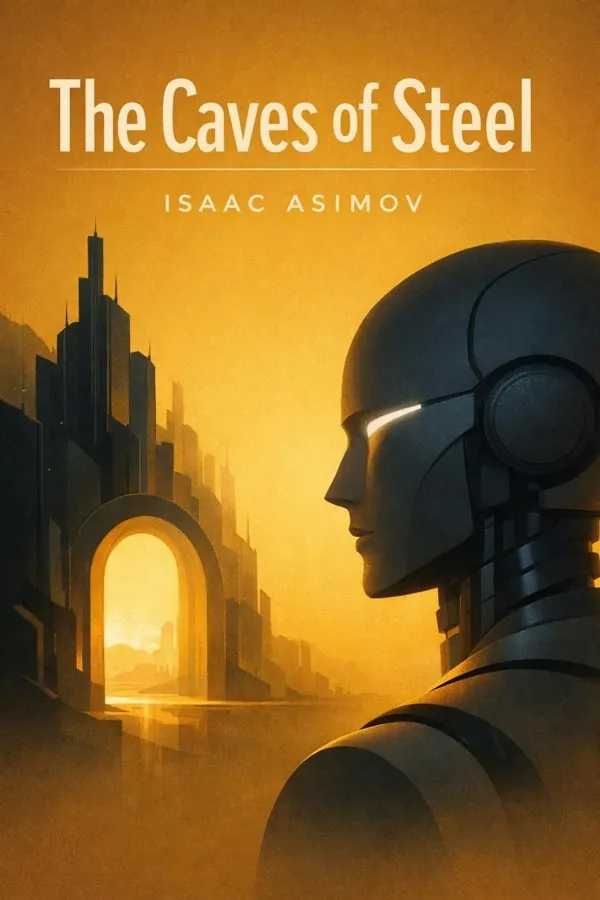
The Caves of Steel: Summary & Key Insights
by Isaac Asimov
 10 min8 chaptersAudio available
Key Takeaways from The Caves of Steel
A society’s architecture reveals its psychology.
The most revealing prison is often an invisible one.
A murder mystery can do more than entertain; it can expose the fault lines of an entire civilization.
Nothing tests prejudice like close cooperation.
We learn what humans are by imagining what humans are not.
What Is The Caves of Steel About?
The Caves of Steel by Isaac Asimov is a scifi_fantasy book spanning 6 pages. What makes The Caves of Steel endure is not just its clever murder mystery, but the way Isaac Asimov turns a detective story into a profound study of fear, progress, and what it means to be human. Set in a future where Earth’s population has retreated into immense enclosed cities, the novel follows New York detective Elijah Baley as he investigates the murder of a Spacer scientist. His unwilling partner is R. Daneel Olivaw, a humanoid robot so lifelike that Baley’s deepest assumptions about machines, society, and identity are constantly challenged. On the surface, this is a gripping whodunit. Beneath that, it is a remarkably modern exploration of automation, prejudice, overcrowding, class tension, and resistance to change. Asimov brings unusual authority to these themes: he was not only one of science fiction’s greatest storytellers, but also a trained scientist with a gift for making speculative ideas feel logical and immediate. The result is a novel that helped define science fiction as a literature of ideas while remaining suspenseful, accessible, and emotionally sharp.
This FizzRead summary covers all 8 key chapters of The Caves of Steel in approximately 10 minutes, distilling the most important ideas, arguments, and takeaways from Isaac Asimov's work. Also available as an audio summary and Key Quotes Podcast.
The Caves of Steel
What makes The Caves of Steel endure is not just its clever murder mystery, but the way Isaac Asimov turns a detective story into a profound study of fear, progress, and what it means to be human. Set in a future where Earth’s population has retreated into immense enclosed cities, the novel follows New York detective Elijah Baley as he investigates the murder of a Spacer scientist. His unwilling partner is R. Daneel Olivaw, a humanoid robot so lifelike that Baley’s deepest assumptions about machines, society, and identity are constantly challenged. On the surface, this is a gripping whodunit. Beneath that, it is a remarkably modern exploration of automation, prejudice, overcrowding, class tension, and resistance to change. Asimov brings unusual authority to these themes: he was not only one of science fiction’s greatest storytellers, but also a trained scientist with a gift for making speculative ideas feel logical and immediate. The result is a novel that helped define science fiction as a literature of ideas while remaining suspenseful, accessible, and emotionally sharp.
Who Should Read The Caves of Steel?
This book is perfect for anyone interested in scifi_fantasy and looking to gain actionable insights in a short read. Whether you're a student, professional, or lifelong learner, the key ideas from The Caves of Steel by Isaac Asimov will help you think differently.
- ✓Readers who enjoy scifi_fantasy and want practical takeaways
- ✓Professionals looking to apply new ideas to their work and life
- ✓Anyone who wants the core insights of The Caves of Steel in just 10 minutes
Want the full summary?
Get instant access to this book summary and 100K+ more with Fizz Moment.
Get Free SummaryAvailable on App Store • Free to download
Key Chapters
A society’s architecture reveals its psychology. In The Caves of Steel, Earth’s giant enclosed cities are not merely futuristic scenery; they are physical expressions of collective fear, adaptation, and compromise. Centuries of overpopulation, scarcity, and social conditioning have pushed humanity underground and under domes, where life is orderly, regulated, and technologically mediated. New York is no longer a city of neighborhoods under open skies, but an immense artificial habitat in which food, transport, work, and even human movement are carefully managed.
Asimov uses this enclosed environment to ask a powerful question: what happens when convenience and survival slowly become confinement? The people of Earth depend on systems that keep them alive, but these same systems make them suspicious of risk, novelty, and independence. The steel caves feel safe, yet they also trap the imagination. Citizens are taught to accept limited living space, endless routines, and rigid social expectations. The outside world becomes alien, even terrifying.
This idea remains strikingly relevant. Modern life also takes place inside designed systems: offices, digital platforms, transportation networks, supply chains, and algorithmic environments that shape what we see and do. Like Asimov’s Earthmen, people often confuse the familiar with the natural. A workflow, a bureaucracy, or a technological interface can become so normal that alternatives feel threatening.
The novel invites readers to notice how environments influence thought. If you live in a crowded schedule, a closed professional culture, or a routine built entirely around efficiency, you may also begin to fear disruption more than stagnation. Asimov’s steel cities are exaggerated, but the psychological pattern is real.
Actionable takeaway: examine one “system” in your life that feels inevitable—your routine, workplace norms, or dependence on certain technologies—and ask whether it is protecting you, limiting you, or both.
The most revealing prison is often an invisible one. Elijah Baley is not a grand hero in the traditional science fiction mold. He is a capable detective, a husband, a father, and a decent man, but he is also deeply conditioned by the society around him. He fears open spaces, distrusts robots, worries constantly about his job status, and clings to the routines that define urban Earth life. Through Baley, Asimov shows how ordinary intelligence can coexist with inherited prejudice and emotional rigidity.
Baley’s strength is that he thinks. His weakness is that he begins the novel thinking within strict limits. He sees the world through categories he has rarely questioned: Earthmen versus Spacers, humans versus robots, familiar versus threatening. His investigation forces him to confront how much of his identity depends on social assumptions rather than truth. In that sense, Baley’s detective work is also self-detection. Every clue in the case pushes him toward a larger realization about his own mind.
This makes him a compelling and believable protagonist. He does not transform instantly. He resists, rationalizes, and grows uncomfortable before he grows wiser. That gradual change is part of the novel’s realism. People rarely abandon long-held beliefs because of one argument; they change when reality keeps exposing the cost of those beliefs.
In practical terms, Baley represents anyone whose worldview has been shaped by environment, class, upbringing, or institutional pressure. A manager threatened by automation, a worker distrustful of outsiders, or a citizen who equates stability with sameness may recognize something in him. His character reminds us that intelligence without self-examination can still become a cage.
Actionable takeaway: identify one belief you hold strongly because it feels normal or inherited, and test it against evidence rather than habit.
A murder mystery can do more than entertain; it can expose the fault lines of an entire civilization. The central crime in The Caves of Steel is the killing of a prominent Spacer scientist, Dr. Roj Nemennuh Sarton, in Spacetown, the enclave where advanced off-world humans maintain a tense presence on Earth. The murder is not just a personal tragedy or a legal puzzle. It threatens diplomatic relations between Earth and the Spacers and raises the possibility of political upheaval on a planetary scale.
Asimov structures the novel like a classic detective story. There is a victim, a limited field of suspects, institutional pressure, misleading assumptions, and a highly intelligent investigator forced to reason his way through uncertainty. Yet he adds science-fictional depth by making the social setting part of the evidence. The murder cannot be understood apart from the historical resentment between Earthmen and Spacers, or from the presence of robots, which many Earth people fear and despise.
The case gains suspense because Baley must solve it under conditions of discomfort and surveillance. He is assigned a partner he does not want, enters places he dislikes, and cannot rely on his usual instincts because the crime touches worlds beyond his direct experience. This is crucial: the mystery works because the detective must investigate not only an event, but also an unfamiliar culture.
In real life, complex problems often look simple until context is examined. Workplace conflict may actually stem from structural incentives. A public scandal may reflect deep institutional tensions. Asimov shows that good investigation requires more than collecting facts; it requires understanding the system in which those facts acquire meaning.
Actionable takeaway: when facing a difficult problem, do not ask only “what happened?” Ask “what larger environment made this possible?”
Nothing tests prejudice like close cooperation. One of the novel’s most memorable achievements is the relationship between Elijah Baley and R. Daneel Olivaw, the humanoid robot assigned to assist him. Baley begins with intense discomfort. Daneel is too calm, too precise, too artificial, and too closely associated with the Spacer world that Earthmen resent. More disturbing still, Daneel looks almost human, forcing Baley to confront a machine that cannot be easily dismissed as a mere tool.
Their partnership becomes the emotional and philosophical center of the book. At first, Baley treats Daneel as a threat, a symbol of robotic replacement and Spacer arrogance. But as they work together, Baley discovers qualities in Daneel that challenge his assumptions: intelligence, reliability, courtesy, moral constraint, and an absence of ego. Daneel, in turn, studies Baley’s emotional complexity with curiosity rather than contempt. The result is not a sentimental friendship, but a gradual dismantling of simplistic categories.
Asimov uses this dynamic to explore how prejudice survives. It often depends on distance, abstraction, and inherited narratives. People fear groups they have never truly encountered, or they interpret every interaction through prior suspicion. Partnership interrupts that process. Shared work forces both attention and nuance. A stereotype becomes harder to maintain when one must rely on the supposedly inferior or dangerous other.
The idea applies far beyond robots. Teams divided by profession, generation, nationality, politics, or social class often discover that practical collaboration reveals hidden competence and shared purpose. The novel does not suggest that differences disappear; it shows that understanding grows when people move from symbolic opposition to concrete engagement.
Actionable takeaway: if you mistrust a group, technology, or perspective, seek one direct and sustained interaction that replaces abstract fear with firsthand knowledge.
We learn what humans are by imagining what humans are not. In The Caves of Steel, robots are not just futuristic gadgets or threats; they are philosophical instruments. R. Daneel Olivaw, in particular, functions as a mirror that reflects human strengths and weaknesses. His logic, emotional restraint, and obedience to the famous Three Laws of Robotics highlight the inconsistency, fear, and moral ambiguity of the people around him.
Asimov’s genius lies in refusing a simplistic machine-versus-human conflict. Daneel is not a monster, but neither is he merely a mechanical servant. He occupies a liminal space that unsettles everyone. Because he appears human while operating under different principles, he forces characters to ask what truly defines personhood. Is it biology? Emotion? Free will? Fallibility? Compassion? Rationality? The novel does not reduce these questions to a single answer, which is why it remains intellectually rich.
Importantly, the robot theme also speaks to labor and social anxiety. Earthmen fear robots partly because robots embody efficiency. Machines might replace human work, alter power structures, and make familiar roles obsolete. That fear is recognizably modern in an age of AI, automation, and algorithmic management. Asimov does not dismiss such concerns, but he shows how fear can become irrational when people stop evaluating actual function and instead react to symbols.
A useful modern parallel is the introduction of new software or automation tools in a workplace. Employees may assume the technology is hostile before understanding how it works or what problems it solves. The deeper issue may be loss of dignity, control, or relevance rather than the machine itself. Asimov understood that technology debates are always also human debates.
Actionable takeaway: when evaluating a new technology, separate the tool’s real capabilities from the fears and status anxieties people project onto it.
The truth is often hidden not by complexity alone, but by the stories people are eager to believe. As Baley investigates the murder, he confronts layers of deception, political maneuvering, and collective bias. The crime appears at first to support familiar suspicions: perhaps the Spacers are involved, perhaps the robots conceal something, perhaps Earth’s tensions have finally exploded. But the more Baley reasons through the evidence, the more he sees that easy explanations are dangerous because they align too neatly with existing prejudice.
This section of the novel demonstrates Asimov’s faith in disciplined thinking. Baley succeeds not because he has superior physical courage or access to spectacular technology, but because he learns to question assumptions, track motives, and recognize when emotional reactions distort interpretation. The conspiracy surrounding the murder is significant because it emerges from political fear. Individuals and institutions act defensively to preserve influence, manage perception, or block unwanted social change.
That pattern appears in every era. Organizations hide failures to protect status. Political groups exploit incidents to reinforce narratives. People cling to misleading explanations because those explanations validate what they already feel. Asimov’s detective plot therefore becomes a lesson in epistemology: how do we know what is true when truth is entangled with ideology?
One of the novel’s most practical insights is that evidence alone is not enough if the investigator lacks courage to follow it where it leads. Baley must risk professional embarrassment and psychological discomfort in order to solve the case. He cannot remain loyal to convenience and still discover reality.
Actionable takeaway: when analyzing a contentious situation, list the explanation you most want to be true, then deliberately test the evidence against an alternative you find uncomfortable.
The hardest walls to break are the ones people mistake for common sense. By the end of The Caves of Steel, the image of enclosed cities takes on a broader meaning. The steel caves are physical barriers, but they also represent mental boundaries: fear of the outdoors, fear of robots, fear of cultural change, fear of contact with the unfamiliar. Baley’s journey is compelling because he does not merely help solve a murder; he begins to imagine that life beyond these walls might be possible.
This is the novel’s most hopeful movement. Asimov does not offer utopian optimism or easy reconciliation. Earthmen and Spacers remain divided. Social systems remain entrenched. Yet the story opens a pathway toward change by showing that one person can revise his mental map of reality. Baley starts as a man constrained by habit and anxiety. He ends with greater intellectual freedom, not because the world has become simpler, but because he has become more capable of facing complexity.
The phrase “breaking the walls” applies to all forms of growth. A person may need to challenge professional identity, inherited ideology, or a narrow sense of what is possible. Communities may need to dismantle prejudice. Organizations may need to open themselves to innovation. The first wall broken is often interpretive: the realization that the current arrangement is not inevitable.
Asimov’s achievement is to make this philosophical shift feel earned through plot. The detective solution matters, but the larger resolution is psychological and civilizational. The novel suggests that humanity’s future depends less on its machines than on its willingness to think beyond confinement.
Actionable takeaway: identify one fear-based boundary in your life—social, intellectual, or practical—and take a concrete step that proves the boundary is more flexible than it appears.
All Chapters in The Caves of Steel
About the Author
Isaac Asimov (1920–1992) was a Russian-born American writer, scientist, and professor of biochemistry whose work helped define modern science fiction. Raised in Brooklyn, he developed an early passion for reading and began publishing stories while still young. Over the course of his career, he wrote or edited more than 500 books, ranging from science fiction and mystery to history and popular science. He is best known for the Foundation series and the Robot novels and stories, where he introduced the influential Three Laws of Robotics. Asimov’s writing is celebrated for its clarity, intelligence, and focus on big ideas—especially the relationship between science, society, and human behavior. Few authors have matched his combination of productivity, accessibility, and lasting cultural impact.
Get This Summary in Your Preferred Format
Read or listen to the The Caves of Steel summary by Isaac Asimov anytime, anywhere. FizzRead offers multiple formats so you can learn on your terms — all free.
Available formats: App · Audio · PDF · EPUB — All included free with FizzRead
Download The Caves of Steel PDF and EPUB Summary
Key Quotes from The Caves of Steel
“A society’s architecture reveals its psychology.”
“The most revealing prison is often an invisible one.”
“A murder mystery can do more than entertain; it can expose the fault lines of an entire civilization.”
“Nothing tests prejudice like close cooperation.”
“We learn what humans are by imagining what humans are not.”
Frequently Asked Questions about The Caves of Steel
The Caves of Steel by Isaac Asimov is a scifi_fantasy book that explores key ideas across 8 chapters. What makes The Caves of Steel endure is not just its clever murder mystery, but the way Isaac Asimov turns a detective story into a profound study of fear, progress, and what it means to be human. Set in a future where Earth’s population has retreated into immense enclosed cities, the novel follows New York detective Elijah Baley as he investigates the murder of a Spacer scientist. His unwilling partner is R. Daneel Olivaw, a humanoid robot so lifelike that Baley’s deepest assumptions about machines, society, and identity are constantly challenged. On the surface, this is a gripping whodunit. Beneath that, it is a remarkably modern exploration of automation, prejudice, overcrowding, class tension, and resistance to change. Asimov brings unusual authority to these themes: he was not only one of science fiction’s greatest storytellers, but also a trained scientist with a gift for making speculative ideas feel logical and immediate. The result is a novel that helped define science fiction as a literature of ideas while remaining suspenseful, accessible, and emotionally sharp.
More by Isaac Asimov



You Might Also Like

Red Rising
Pierce Brown
10 min
Stranger in a Strange Land
Robert A. Heinlein
10 min
AI Valley
Chen Qiufan
10 min
Bloodchild
Octavia E. Butler
10 min
Do Androids Dream of Electric Sheep?
Philip K. Dick
10 min
Jujutsu Kaisen, Vol. 24
Gege Akutami
10 minBrowse by Category
Ready to read The Caves of Steel?
Get the full summary and 100K+ more books with Fizz Moment.