
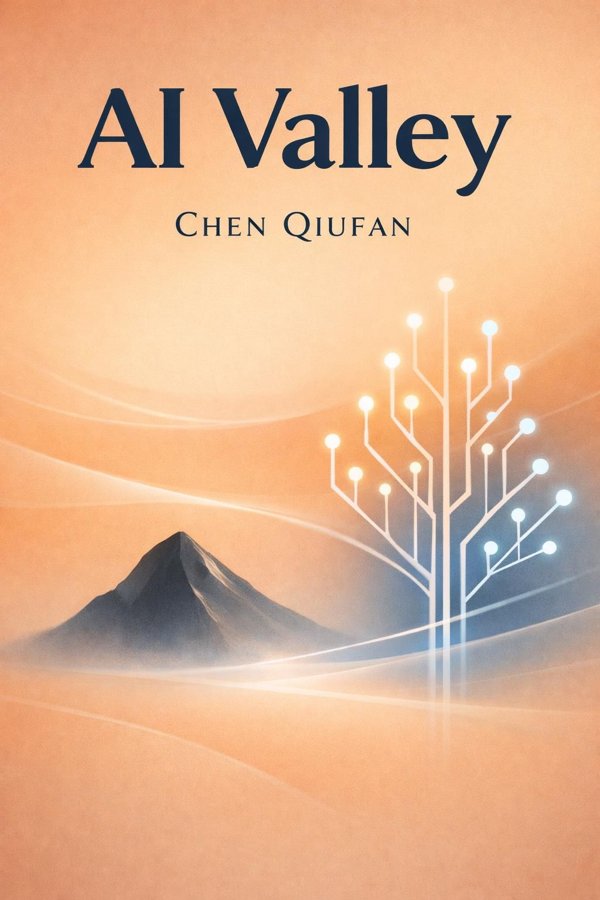
AI Valley: Summary & Key Insights
by Chen Qiufan
 10 min8 chaptersAudio available
Key Takeaways from AI Valley
A machine may seem neutral, but every system reflects the people and institutions that design it.
The most exciting breakthroughs can create the most unsettling harms when ethical reflection lags behind technical progress.
People often talk about the future as if it arrives naturally, but AI Valley reminds us that futures are constructed by those with money, influence, and institutional control.
When intelligent systems take over more tasks, the real disruption is not only economic but existential.
The most powerful technologies often work invisibly, and AI Valley highlights how data collection quietly transforms the conditions of everyday existence.
What Is AI Valley About?
AI Valley by Chen Qiufan is a scifi_fantasy book. AI Valley by Chen Qiufan is a sharp, imaginative science fiction novel set in a near-future China where artificial intelligence has become inseparable from daily life, corporate power, and personal identity. At first glance, it reads like a fast-moving techno-thriller filled with startups, data systems, machine learning, and social disruption. But beneath the futuristic setting, the novel asks older and deeper questions: What happens when innovation outruns ethics? Who controls the systems that increasingly shape human choices? And what remains uniquely human in a world built around intelligent machines? Chen Qiufan is one of the most important contemporary Chinese science fiction writers, often praised for combining literary ambition with acute technological insight. His work stands out because he does not treat AI as abstract speculation. Instead, he grounds it in labor, politics, urban development, inequality, and the emotional lives of ordinary people. AI Valley matters because it turns the global conversation about artificial intelligence into a vivid human story. For readers interested in technology, society, and the future of power, it offers not just a compelling narrative, but a meaningful lens on the world already emerging around us.
This FizzRead summary covers all 8 key chapters of AI Valley in approximately 10 minutes, distilling the most important ideas, arguments, and takeaways from Chen Qiufan's work. Also available as an audio summary and Key Quotes Podcast.
AI Valley
AI Valley by Chen Qiufan is a sharp, imaginative science fiction novel set in a near-future China where artificial intelligence has become inseparable from daily life, corporate power, and personal identity. At first glance, it reads like a fast-moving techno-thriller filled with startups, data systems, machine learning, and social disruption. But beneath the futuristic setting, the novel asks older and deeper questions: What happens when innovation outruns ethics? Who controls the systems that increasingly shape human choices? And what remains uniquely human in a world built around intelligent machines?
Chen Qiufan is one of the most important contemporary Chinese science fiction writers, often praised for combining literary ambition with acute technological insight. His work stands out because he does not treat AI as abstract speculation. Instead, he grounds it in labor, politics, urban development, inequality, and the emotional lives of ordinary people. AI Valley matters because it turns the global conversation about artificial intelligence into a vivid human story. For readers interested in technology, society, and the future of power, it offers not just a compelling narrative, but a meaningful lens on the world already emerging around us.
Who Should Read AI Valley?
This book is perfect for anyone interested in scifi_fantasy and looking to gain actionable insights in a short read. Whether you're a student, professional, or lifelong learner, the key ideas from AI Valley by Chen Qiufan will help you think differently.
- ✓Readers who enjoy scifi_fantasy and want practical takeaways
- ✓Professionals looking to apply new ideas to their work and life
- ✓Anyone who wants the core insights of AI Valley in just 10 minutes
Want the full summary?
Get instant access to this book summary and 100K+ more with Fizz Moment.
Get Free SummaryAvailable on App Store • Free to download
Key Chapters
A machine may seem neutral, but every system reflects the people and institutions that design it. One of the central insights of AI Valley is that artificial intelligence does not arrive in society as a pure tool. It carries assumptions about efficiency, control, risk, profit, and even what kinds of lives are worth optimizing. In the novel’s world, AI is not merely a background technology; it actively shapes work, communication, mobility, and governance. That makes its design profoundly political.
Chen Qiufan shows that algorithms are never detached from culture or power. A recommendation system changes what people see. A surveillance network changes how they behave. A predictive model changes who gets trusted, hired, watched, or excluded. The novel invites readers to look beyond the glamorous language of innovation and ask who benefits, who pays the cost, and who gets ignored in the process. This is what makes the story feel realistic rather than fantastical. AI is presented not as magic, but as infrastructure with consequences.
In practical terms, this insight applies well beyond fiction. When a company uses AI in hiring, customer service, education, or policing, leaders should examine the values embedded in the system. What does it reward? What does it erase? What forms of bias might it scale? Even on an individual level, readers can question the platforms they use every day, from social feeds to navigation apps, and recognize that convenience often comes with hidden trade-offs.
Actionable takeaway: Whenever you encounter a new technology, ask not only what it does, but whose values it encodes and whose interests it serves.
The most exciting breakthroughs can create the most unsettling harms when ethical reflection lags behind technical progress. AI Valley repeatedly explores the tension between invention and responsibility. In the novel, the race to develop advanced AI systems is fueled by ambition, competition, investment, and prestige. Yet the very forces that accelerate innovation also discourage caution. People are rewarded for building quickly, scaling widely, and dominating markets, not for slowing down to consider social fallout.
Chen Qiufan avoids simplistic warnings and instead dramatizes a familiar pattern: technologies developed with optimistic intent can still deepen inequality, reduce autonomy, or make accountability harder. AI systems promise efficiency, personalization, and predictive power, but they can also normalize surveillance, devalue human judgment, and transfer critical decisions to opaque processes. The novel’s power lies in showing how ethical questions do not appear after deployment; they exist from the beginning, even if institutions choose to ignore them.
This matters in real-world contexts such as facial recognition, automated content moderation, and AI-generated media. A startup may see only commercial opportunity, while the public experiences privacy loss, misinformation, or discrimination. The lesson is not that innovation should stop, but that ethics must be built into design, testing, regulation, and public discussion from the outset.
Actionable takeaway: Treat ethical review as a first-stage requirement of innovation, not as a public-relations fix added after damage has already been done.
People often talk about the future as if it arrives naturally, but AI Valley reminds us that futures are constructed by those with money, influence, and institutional control. The novel’s vision of an AI-driven world is not simply the result of scientific progress. It emerges from corporate strategy, political ambition, labor structures, and global competition. This makes the future less inevitable than many technology narratives suggest.
Chen Qiufan is especially effective at showing how technological ecosystems are shaped by unequal power. The companies that collect the most data can train the most powerful systems. The organizations closest to regulators can influence the rules. The actors who control infrastructure can define the terms of participation for everyone else. In such an environment, AI does not just transform society; it reorganizes who gets to make decisions about society.
This insight is useful for readers trying to understand why technological change can feel both thrilling and coercive. New tools are often presented as liberating, yet they may lock users into platforms, reduce transparency, or shift public resources toward private interests. In workplaces, schools, and cities, supposedly smart systems can centralize authority while appearing objective and modern.
For practical application, citizens, professionals, and policymakers can challenge the assumption that technological adoption is always neutral or unavoidable. Communities can ask whether an AI system truly serves public needs, whether alternatives were considered, and whether governance mechanisms exist to check abuse.
Actionable takeaway: When evaluating any vision of the future, identify who is building it, who governs it, and who has the power to say no.
When intelligent systems take over more tasks, the real disruption is not only economic but existential. AI Valley explores how automation affects the human sense of purpose, competence, and uniqueness. In a world where machines can predict, recommend, classify, and even imitate forms of creativity or care, people begin to confront an uncomfortable possibility: if a system can perform my role more efficiently, what exactly defines my value?
The novel does not frame this as a narrow jobs debate. Instead, it expands the question into identity itself. Work often gives people status, belonging, and narrative coherence. Social platforms mediate self-presentation. Data profiles stand in for personality. As AI grows more capable, the boundary between person and system becomes less stable. That instability produces anxiety, but also opportunities for reinvention.
This theme resonates strongly today. Professionals in writing, design, coding, customer support, and logistics already face versions of this challenge. The healthiest response is neither denial nor surrender. Readers can recognize that human worth should not be measured solely by comparative efficiency. Empathy, moral judgment, trust-building, and contextual understanding remain crucial, especially in messy situations where rules alone are insufficient.
The novel encourages a more durable idea of humanity: not superiority over machines, but the ability to reflect, care, and choose responsibly amid complexity. That is a more demanding standard, but also a more meaningful one.
Actionable takeaway: Invest in distinctly human capacities such as judgment, empathy, adaptability, and ethical reasoning rather than defining your value only by tasks that can be automated.
The most powerful technologies often work invisibly, and AI Valley highlights how data collection quietly transforms the conditions of everyday existence. In the novel’s near-future setting, information is constantly captured, processed, and monetized. Daily actions become inputs. Preferences become profiles. Movement, attention, and behavior become assets. This is not portrayed as a distant dystopia but as an extension of patterns already familiar in platform economies.
Chen Qiufan helps readers see that data extraction is not only a technical process; it is a social arrangement. People trade privacy for convenience, often without understanding the full terms of the exchange. Organizations promise personalization, safety, or optimization while building detailed models of human behavior. Over time, these systems do more than observe reality. They begin to shape it by nudging decisions, filtering information, and anticipating choices before individuals fully make them.
This has practical relevance in fields ranging from health apps to smart cities. A wellness platform may gather intimate information under the banner of self-improvement. A retail app may personalize offers while manipulating impulse behavior. A city may deploy sensors for efficiency while expanding surveillance capacity. The issue is not data itself, but asymmetry: institutions know far more about individuals than individuals know about institutional use.
Readers can apply this lesson by becoming more deliberate about digital consent, platform dependence, and information sharing. Even small habits, such as reviewing permissions or diversifying digital tools, can reduce passive exposure.
Actionable takeaway: Audit the apps, devices, and platforms you rely on and ask what data they collect, why they collect it, and what degree of control you truly retain.
Technological progress does not affect all people equally, and AI Valley underscores how globalization creates layered, uneven experiences of modernity. Some groups enjoy convenience, speed, and enhanced services, while others absorb displacement, precarity, and environmental or psychological burden. Chen Qiufan is particularly skilled at showing that high technology does not erase old inequalities; it often reorganizes them into new forms.
The novel’s world is shaped by transnational flows of capital, labor, expertise, and competition. AI development appears futuristic, but its supply chains remain deeply material. Workers, cities, infrastructures, and social classes all bear different parts of the cost. This broadens the conversation beyond gadgets and software. It asks readers to consider who mines, assembles, moderates, cleans, labels, transports, and maintains the systems marketed as frictionless.
In today’s world, similar patterns are visible in global cloud infrastructure, content moderation labor, electronics manufacturing, and low-wage logistics. A user may experience an app as elegant and seamless while remaining detached from the hidden labor and extraction behind it. The novel’s insight is that technological sophistication can coexist with social invisibility.
For readers, this means learning to think systemically. Instead of evaluating AI only by user-facing features, we can consider labor conditions, environmental impact, access disparities, and downstream harms. That perspective leads to a more honest understanding of what innovation really costs.
Actionable takeaway: Judge new technologies not just by how convenient they are for end users, but by how fairly their benefits and burdens are distributed across society.
The easiest systems to adopt are sometimes the hardest to question. A major idea in AI Valley is that convenience can become the preferred language of control. Technologies rarely impose themselves by force alone. More often, they enter life by solving small frustrations, reducing effort, and making daily routines smoother. Once embedded, however, they can shape choices so thoroughly that opting out becomes difficult or socially costly.
Chen Qiufan’s portrayal of AI-rich environments demonstrates how control can feel voluntary. Smart assistants streamline tasks. Predictive services anticipate needs. Automated systems remove uncertainty. Yet each layer of convenience increases dependence on infrastructures that users do not govern. This can narrow agency while preserving the illusion of freedom. If every decision is guided, scored, or prefiltered, people may stop noticing how much of life has been pre-structured.
This idea has strong real-world relevance. Consider navigation apps that determine routes, streaming platforms that shape taste, or workplace dashboards that define productivity. In each case, users gain efficiency but may lose transparency, experimentation, or self-directed judgment. The danger is not only domination from above, but the quiet erosion of personal initiative.
The novel encourages resistance through awareness rather than paranoia. Readers do not need to reject useful tools entirely, but they can preserve space for friction, reflection, and independent choice. Deliberate pauses matter in environments designed to optimize behavior continuously.
Actionable takeaway: Notice where convenience has replaced conscious choice in your life, and intentionally retain some practices that require your own attention, judgment, and decision-making.
Facts can describe a technology, but stories reveal what it feels like to live with it. One of the lasting strengths of AI Valley is its ability to turn abstract debates about artificial intelligence into emotionally legible human experience. Rather than offering theory alone, Chen Qiufan uses fiction to show how AI changes relationships, ambitions, fears, and social norms. That makes the novel not just entertainment, but a tool for public understanding.
Science fiction plays a special role in periods of rapid change. It gives society a rehearsal space for imagining consequences before they become irreversible. Through characters, tensions, and scenarios, readers can explore ethical dilemmas in concrete terms. They can ask how a new system might alter family life, labor, intimacy, trust, or political power. This emotional and moral testing ground is especially valuable when technical discussions become too specialized for the public to access easily.
In practical settings, stories like AI Valley can enrich conversations in classrooms, companies, and policy environments. A manager introducing automation can use fiction to explore worker anxieties. A teacher can pair the novel with AI ethics discussions. A product team can use its themes to surface overlooked risks. Narrative does not replace technical analysis, but it broadens the scope of what responsible analysis includes.
The novel therefore demonstrates that imaginative literature remains essential in technological cultures. It helps readers ask better questions before systems become normalized.
Actionable takeaway: Use fiction as a serious lens for thinking about technology, and discuss stories like AI Valley alongside news, policy, and technical developments to deepen your judgment.
All Chapters in AI Valley
About the Author
Chen Qiufan is a leading Chinese science fiction author known for exploring the social, ethical, and political consequences of rapid technological change. His work often focuses on artificial intelligence, globalization, digital labor, environmental stress, and the hidden costs of modern consumer culture. He has gained international recognition for fiction that combines speculative imagination with sharp realism, helping bring contemporary Chinese science fiction to a wider global audience. Chen is especially admired for grounding futuristic ideas in ordinary human experience, showing how technology reshapes identity, work, and power. Through novels and shorter fiction, he has established himself as an important literary voice for readers interested in how innovation transforms society from the inside out.
Get This Summary in Your Preferred Format
Read or listen to the AI Valley summary by Chen Qiufan anytime, anywhere. FizzRead offers multiple formats so you can learn on your terms — all free.
Available formats: App · Audio · PDF · EPUB — All included free with FizzRead
Download AI Valley PDF and EPUB Summary
Key Quotes from AI Valley
“A machine may seem neutral, but every system reflects the people and institutions that design it.”
“The most exciting breakthroughs can create the most unsettling harms when ethical reflection lags behind technical progress.”
“People often talk about the future as if it arrives naturally, but AI Valley reminds us that futures are constructed by those with money, influence, and institutional control.”
“When intelligent systems take over more tasks, the real disruption is not only economic but existential.”
“The most powerful technologies often work invisibly, and AI Valley highlights how data collection quietly transforms the conditions of everyday existence.”
Frequently Asked Questions about AI Valley
AI Valley by Chen Qiufan is a scifi_fantasy book that explores key ideas across 8 chapters. AI Valley by Chen Qiufan is a sharp, imaginative science fiction novel set in a near-future China where artificial intelligence has become inseparable from daily life, corporate power, and personal identity. At first glance, it reads like a fast-moving techno-thriller filled with startups, data systems, machine learning, and social disruption. But beneath the futuristic setting, the novel asks older and deeper questions: What happens when innovation outruns ethics? Who controls the systems that increasingly shape human choices? And what remains uniquely human in a world built around intelligent machines? Chen Qiufan is one of the most important contemporary Chinese science fiction writers, often praised for combining literary ambition with acute technological insight. His work stands out because he does not treat AI as abstract speculation. Instead, he grounds it in labor, politics, urban development, inequality, and the emotional lives of ordinary people. AI Valley matters because it turns the global conversation about artificial intelligence into a vivid human story. For readers interested in technology, society, and the future of power, it offers not just a compelling narrative, but a meaningful lens on the world already emerging around us.
More by Chen Qiufan
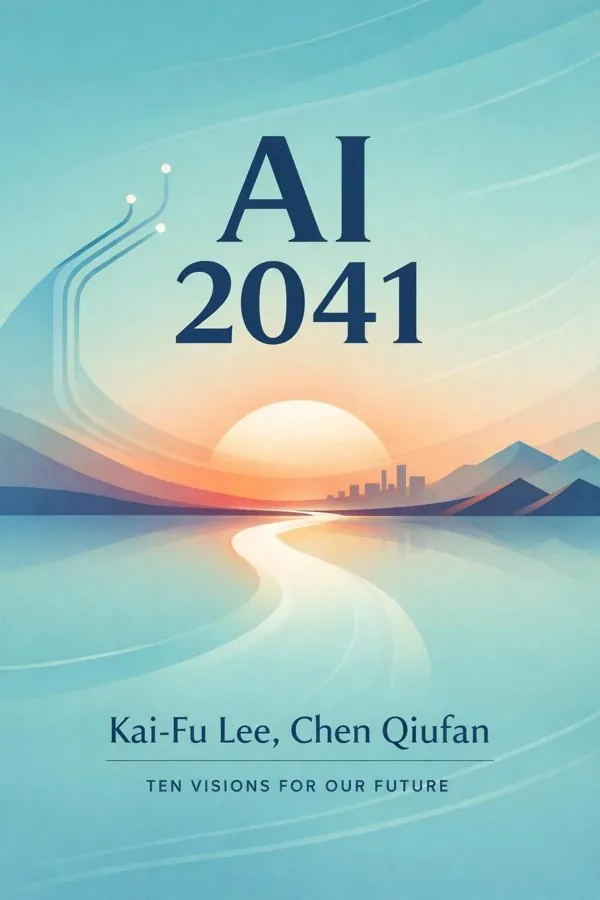
You Might Also Like

Red Rising
Pierce Brown
10 min
Stranger in a Strange Land
Robert A. Heinlein
10 min
Bloodchild
Octavia E. Butler
10 min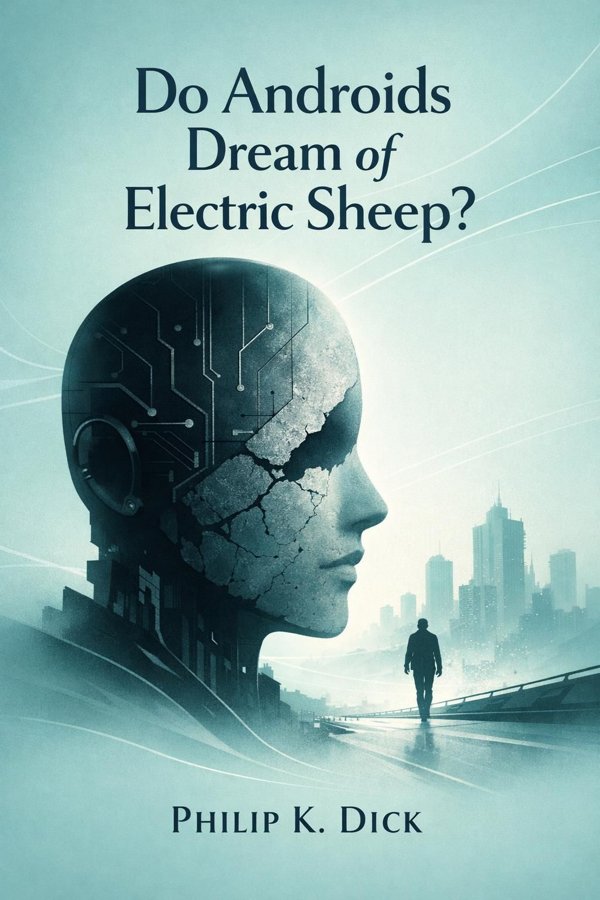
Do Androids Dream of Electric Sheep?
Philip K. Dick
10 min
Jujutsu Kaisen, Vol. 24
Gege Akutami
10 min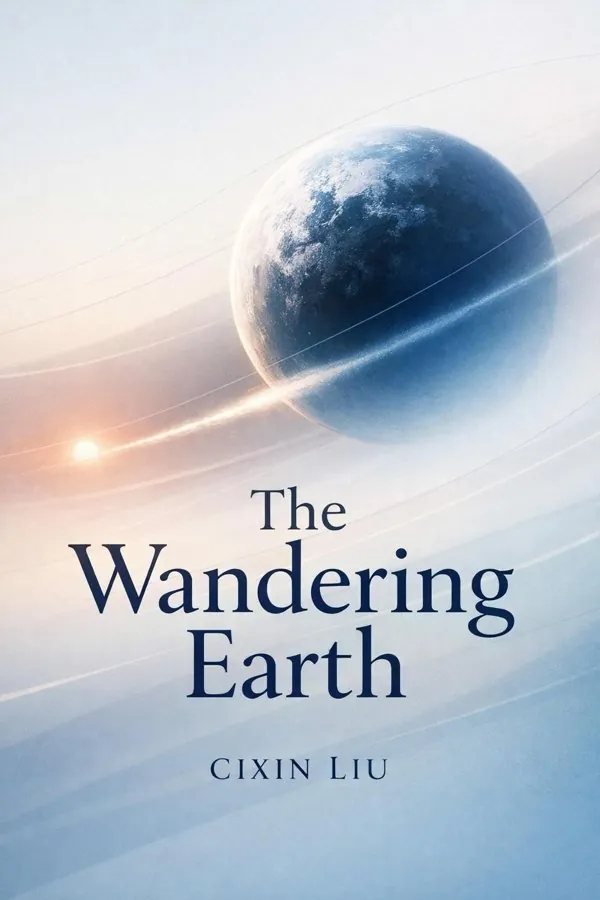
The Wandering Earth
Cixin Liu
10 minBrowse by Category
Ready to read AI Valley?
Get the full summary and 100K+ more books with Fizz Moment.