
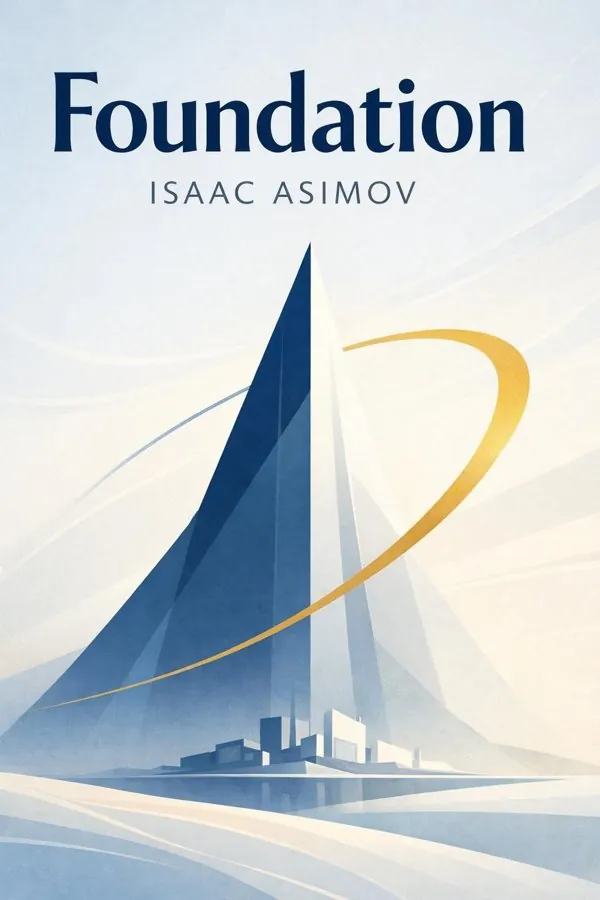
Foundation: Summary & Key Insights
by Isaac Asimov
 10 min9 chaptersAudio available
Key Takeaways from Foundation
The most unsettling idea in Foundation is that history may not be random at all.
Civilization often survives not through armies, but through memory.
One of Foundation’s sharpest insights is that idealism without political realism rarely survives first contact with the world.
One of Asimov’s most brilliant reversals is his treatment of religion.
A society does not need the largest army if it becomes economically indispensable.
What Is Foundation About?
Foundation by Isaac Asimov is a scifi_fantasy book spanning 6 pages. What if the fate of entire civilizations could be predicted with mathematics? That bold question drives Foundation, Isaac Asimov’s landmark science fiction novel and the opening chapter of one of the genre’s most influential series. Set in the waning days of a vast Galactic Empire, the book begins with mathematician Hari Seldon’s discovery of psychohistory, a statistical science that can forecast the broad movements of human society. His conclusion is terrifying: the Empire will fall, and a dark age lasting thirty thousand years will follow. His solution is even more audacious: create a Foundation at the edge of the galaxy to preserve knowledge and compress that collapse into a single millennium. More than a space epic, Foundation is a novel about power, institutions, strategy, and the long game of history. Asimov replaces the usual heroes and battles with ideas, political maneuvering, and the logic of systems. That approach is exactly why the book still feels fresh. Asimov, one of the twentieth century’s great science fiction writers and a master explainer of complex concepts, turns abstract questions about civilization into a gripping story about foresight, adaptation, and survival.
This FizzRead summary covers all 9 key chapters of Foundation in approximately 10 minutes, distilling the most important ideas, arguments, and takeaways from Isaac Asimov's work. Also available as an audio summary and Key Quotes Podcast.
Foundation
What if the fate of entire civilizations could be predicted with mathematics? That bold question drives Foundation, Isaac Asimov’s landmark science fiction novel and the opening chapter of one of the genre’s most influential series. Set in the waning days of a vast Galactic Empire, the book begins with mathematician Hari Seldon’s discovery of psychohistory, a statistical science that can forecast the broad movements of human society. His conclusion is terrifying: the Empire will fall, and a dark age lasting thirty thousand years will follow. His solution is even more audacious: create a Foundation at the edge of the galaxy to preserve knowledge and compress that collapse into a single millennium.
More than a space epic, Foundation is a novel about power, institutions, strategy, and the long game of history. Asimov replaces the usual heroes and battles with ideas, political maneuvering, and the logic of systems. That approach is exactly why the book still feels fresh. Asimov, one of the twentieth century’s great science fiction writers and a master explainer of complex concepts, turns abstract questions about civilization into a gripping story about foresight, adaptation, and survival.
Who Should Read Foundation?
This book is perfect for anyone interested in scifi_fantasy and looking to gain actionable insights in a short read. Whether you're a student, professional, or lifelong learner, the key ideas from Foundation by Isaac Asimov will help you think differently.
- ✓Readers who enjoy scifi_fantasy and want practical takeaways
- ✓Professionals looking to apply new ideas to their work and life
- ✓Anyone who wants the core insights of Foundation in just 10 minutes
Want the full summary?
Get instant access to this book summary and 100K+ more with Fizz Moment.
Get Free SummaryAvailable on App Store • Free to download
Key Chapters
The most unsettling idea in Foundation is that history may not be random at all. Hari Seldon’s great breakthrough, psychohistory, rests on a powerful premise: while individual human actions are unpredictable, the behavior of enormous populations can be modeled statistically. In other words, one person is chaotic, but trillions of people together form patterns. Seldon uses this science to foresee the collapse of the Galactic Empire and the thirty-thousand-year barbarism that would follow its fall.
This concept matters because it shifts the story from individual destiny to systemic forces. Asimov asks readers to think like historians, economists, and strategists rather than warriors. Empires do not merely collapse because of one bad ruler; they decay through accumulated inertia, overexpansion, institutional weakness, and the loss of adaptive capacity. Seldon is not predicting every detail. He is identifying large-scale probabilities and designing interventions that can guide history toward a less catastrophic outcome.
In modern life, psychohistory resembles the way leaders use data and trend analysis. Governments forecast demographic shifts. Businesses track consumer behavior. Public health experts model the spread of disease. No model is perfect, but patterns still shape better decisions than intuition alone. The lesson is not that people can control everything, but that informed preparation beats wishful thinking.
Foundation begins, then, with a radical form of responsibility: if decline can be anticipated, it can also be mitigated. Seldon’s genius lies not just in prediction, but in acting before the crisis fully arrives.
Actionable takeaway: When facing uncertainty, look for long-term patterns instead of reacting only to short-term events, and build plans around probable trends rather than hopeful assumptions.
Civilization often survives not through armies, but through memory. The first public purpose of the Foundation is simple and humble: compile the Encyclopedia Galactica, a massive repository of human knowledge. Exiled to the remote planet Terminus, the Foundation’s settlers appear weak. They possess no meaningful military strength, little political leverage, and almost no natural resources. What they do possess is expertise.
At first, the Encyclopedia project seems like the entire mission. It gives the colonists a shared identity and a respectable reason for their existence. Yet Asimov subtly reveals that preservation is never enough on its own. Knowledge stored in books or databases does not automatically save societies. It must be organized, protected, applied, and renewed. Terminus is a harsh lesson in the difference between collecting knowledge and wielding it effectively.
This idea translates directly to institutions today. Companies often mistake documentation for capability. Schools can confuse information with understanding. Nations may archive best practices while failing to implement them. A disaster plan that sits unread is no plan at all. An organization that knows what to do but cannot act will still fail when crisis comes.
The Encyclopedia Foundation also shows how narratives can stabilize a fragile community. Even if the stated mission is incomplete, it creates discipline, purpose, and legitimacy during an uncertain beginning. People endure hardship more effectively when they believe they are serving something larger than themselves.
Asimov’s deeper point is that survival starts with preserving what matters, but it does not end there. Knowledge is the seed of resilience, not the whole tree.
Actionable takeaway: Preserve critical knowledge in your work and life, but go one step further by turning information into systems, training, and practical readiness.
One of Foundation’s sharpest insights is that idealism without political realism rarely survives first contact with the world. On Terminus, the scholarly leaders believe their intelligence and moral seriousness will be enough to protect them. Salvor Hardin, the city mayor, sees what they do not: neighboring kingdoms are not interested in academic virtue. They are interested in leverage.
Hardin understands that the Foundation’s weakness is also its opportunity. Terminus lacks military power and natural resources, but it possesses advanced scientific knowledge that surrounding regions have lost. Rather than confronting enemies directly, Hardin reframes the contest. He uses diplomacy, timing, and institutional control to keep the Foundation independent while the old scholars remain trapped in ceremonial thinking.
His famous attitude, that violence is the last refuge of the incompetent, is not naive pacifism. It is strategic sophistication. Hardin prefers methods that are cheaper, smarter, and more sustainable than war. He recognizes that legitimacy, information, and the ability to shape perceptions can be stronger than fleets.
This is highly relevant in modern leadership. A startup may not outspend a giant competitor, but it can outmaneuver one. A local leader may not control every resource, but can build coalitions and shift incentives. In office politics, community organizing, and negotiations, success often comes from understanding the true structure of power rather than reacting emotionally.
Hardin marks a turning point in the novel because he replaces passive preservation with active statecraft. The Foundation survives not because it deserves to, but because someone learns how power actually works.
Actionable takeaway: In any conflict, identify the real sources of leverage before acting, and choose strategy over force whenever a smarter path exists.
One of Asimov’s most brilliant reversals is his treatment of religion. In Foundation, faith is not presented primarily as a spiritual truth, but as a political instrument built around technological dependence. The Foundation provides neighboring worlds with advanced devices they barely understand, then wraps the maintenance of that technology in ritual, priesthood, and sacred authority. What appears to be religion is also infrastructure management.
This strategy is unsettling because it reveals how power often works through interpretation. If a population cannot distinguish between technical expertise and divine legitimacy, whoever controls the system controls the society. The Foundation’s priests are effectively technicians, but they are perceived as religious intermediaries. That perception gives Terminus immense influence without requiring occupation or conquest.
The idea extends far beyond the novel. In the real world, many systems acquire invisible authority because ordinary users cannot see how they work. Financial systems, software platforms, legal structures, and bureaucratic procedures often feel mysterious to outsiders. Experts who understand them can create trust, but they can also shape dependence. When people stop asking how a system functions, they may begin treating it as unquestionable.
Asimov is not simply mocking religion. He is exploring how institutions use symbols, narratives, and controlled access to stabilize power. He shows that belief is strongest when tied to practical necessity. People obey not only because they are persuaded, but because their daily life depends on the machinery behind the belief.
The Foundation thrives because it recognizes that influence is cultural as much as technical. Whoever defines meaning often governs outcomes.
Actionable takeaway: Whenever you rely on a system you do not fully understand, ask who controls the expertise behind it and how that dependency shapes your choices.
A society does not need the largest army if it becomes economically indispensable. As the Foundation matures, it shifts from religious influence to commercial expansion. Traders carry miniature technologies, scientific tools, and high-value goods into surrounding regions, creating networks of dependency that are harder to break than treaties. Commerce becomes the Foundation’s quiet empire.
This transformation matters because it shows the evolution of power. In the early crises, Terminus survives through clever politics and symbolic authority. Later, it discovers that markets can achieve what doctrine cannot. If neighboring systems come to depend on Foundation technology for energy, communication, medicine, or prestige, they become less likely to oppose it. Trade alters incentives from the inside.
Asimov anticipates a truth central to modern geopolitics and business: standards, supply chains, and platforms can be more influential than military threats. A company that owns the operating system, payment rails, or logistics network shapes behavior across entire industries. A nation that controls critical technologies gains leverage even without direct rule. Dependence creates compliance.
The traders in Foundation are especially important because they are entrepreneurial diplomats. They read local conditions, form relationships, and spread influence one transaction at a time. They show that large systems are often changed by practical intermediaries, not only by official leaders.
For readers, this is a lesson in strategic value creation. If you solve a problem others repeatedly face, your importance grows. If your contribution becomes embedded in their daily functioning, your position strengthens. Power built on usefulness is often more durable than power built on intimidation.
Actionable takeaway: Increase your influence by becoming genuinely useful to others in ways that are hard to replace, whether through expertise, service, or essential solutions.
One of the most intriguing features of Foundation is the Seldon Crisis: recurring moments when events narrow into only a few viable outcomes, and the Foundation’s survival depends on choosing correctly. Each crisis reveals the deeper logic of the Seldon Plan. History, in Asimov’s vision, has momentum. Systems accumulate pressures until they reach a turning point, and then a small number of decisions can redirect the future.
This structure gives the book its unusual dramatic energy. There are few traditional battle scenes because the real suspense lies in interpretation. Have the leaders understood the crisis correctly? Are they solving the present problem while also staying aligned with larger historical forces? The prerecorded appearances of Hari Seldon reinforce the idea that sound strategy often looks like prophecy in hindsight.
In practical terms, the Seldon Plan resembles long-range planning under uncertainty. Good leaders cannot predict every disruption, but they can identify bottlenecks, likely pressure points, and moments when preparation matters most. A family preparing for financial stress, a company anticipating industry disruption, or a government strengthening institutions before instability all operate on similar logic.
The novel also warns against overconfidence. The Plan works only under certain assumptions, especially that mass behavior remains statistically normal. It is powerful, but not omnipotent. This balance keeps Asimov’s idea compelling: systems matter immensely, yet they remain vulnerable to conditions outside the model.
Foundation teaches that history rewards those who prepare before crisis becomes obvious. It is easier to navigate turning points when infrastructure, talent, and purpose are already in place.
Actionable takeaway: Identify the likely pressure points in your future, prepare for them in advance, and treat calm periods as the best time to build resilience.
For much of Foundation, Asimov emphasizes large-scale forces over personal heroics. Then comes the disruptive counterexample: the Mule. Though the Mule properly belongs to later Foundation stories collected in subsequent volumes, the idea is essential to understanding the series as a whole because it exposes the limits of psychohistory. The Mule is a singular mutant whose emotional powers allow him to reshape human behavior on a massive scale. He is the outlier the model did not expect.
The importance of the Mule is philosophical as much as narrative. If psychohistory assumes that no individual can significantly alter the course of trillions, the Mule proves that assumptions are where predictive systems break. Models are strongest when conditions remain within expected boundaries. Once a rare variable enters the system, confidence can become blindness.
This insight has obvious modern parallels. Forecasts fail when black swan events occur. Businesses collapse after unexpected technological shifts. Political systems are destabilized by charismatic disruptors, pandemics, or sudden financial shocks. The problem is not that planning is useless. It is that all planning contains hidden assumptions about what kinds of change are possible.
Asimov’s genius lies in refusing a simplistic answer. The Mule does not make psychohistory worthless; he makes it humbler. Systems thinking remains crucial, but it must be paired with vigilance for anomalies, concentration of power, and emerging exceptions.
For readers, the lesson is liberating and cautionary at once. Trends shape the world, yet rare individuals and unexpected forces can still redirect it. Wisdom lies in respecting both patterns and exceptions.
Actionable takeaway: Use forecasts and systems models, but regularly ask what assumptions they depend on and what rare event could overturn them.
Perhaps the broadest lesson of Foundation is that civilizations survive when their institutions can adapt faster than their problems grow. The Galactic Empire is not destroyed overnight. It becomes rigid, ceremonial, overextended, and unable to respond creatively to decline. The Foundation, by contrast, begins tiny and vulnerable but repeatedly reinvents its methods. It moves from scholarship to politics, from politics to religion, from religion to trade, and from trade to broader strategic dominance.
This pattern is the real engine of the novel. The Foundation is not successful because its leaders know the future in detail. It is successful because each generation learns how to use the assets available in its own historical moment. Adaptation, not purity, becomes the key to endurance.
This idea applies everywhere. Careers thrive when people update skills instead of clinging to old credentials. Businesses endure when they pivot before customers disappear. Communities remain healthy when they revise traditions without losing core values. Even personal growth depends on this principle: identity must have continuity, but not rigidity.
Asimov’s achievement is to frame adaptation as a civilizational virtue. He suggests that decline is not merely a loss of power; it is a failure of institutional imagination. The strongest systems are not the ones that never face disruption. They are the ones that convert disruption into a new form of order.
Foundation endures because it does not confuse its tools with its mission. The mission is continuity of civilization. The tools can change.
Actionable takeaway: Clarify your core purpose, then stay flexible about the methods you use to achieve it, especially when conditions change.
All Chapters in Foundation
About the Author
Isaac Asimov (1920–1992) was a Russian-born American writer, biochemistry professor, and one of the defining voices of modern science fiction. Raised in Brooklyn, he developed an early love of reading and went on to build an astonishingly prolific career, writing or editing more than 500 books. He became famous not only for the Foundation series, but also for his Robot stories and for formulating the influential Three Laws of Robotics. Beyond fiction, Asimov wrote extensively on science, history, and language, earning a reputation for making complex ideas accessible and entertaining. His work is marked by intellectual clarity, curiosity, and confidence in reason. Few authors have done more to shape the way readers imagine the future of technology, civilization, and human knowledge.
Get This Summary in Your Preferred Format
Read or listen to the Foundation summary by Isaac Asimov anytime, anywhere. FizzRead offers multiple formats so you can learn on your terms — all free.
Available formats: App · Audio · PDF · EPUB — All included free with FizzRead
Download Foundation PDF and EPUB Summary
Key Quotes from Foundation
“The most unsettling idea in Foundation is that history may not be random at all.”
“Civilization often survives not through armies, but through memory.”
“One of Foundation’s sharpest insights is that idealism without political realism rarely survives first contact with the world.”
“One of Asimov’s most brilliant reversals is his treatment of religion.”
“A society does not need the largest army if it becomes economically indispensable.”
Frequently Asked Questions about Foundation
Foundation by Isaac Asimov is a scifi_fantasy book that explores key ideas across 9 chapters. What if the fate of entire civilizations could be predicted with mathematics? That bold question drives Foundation, Isaac Asimov’s landmark science fiction novel and the opening chapter of one of the genre’s most influential series. Set in the waning days of a vast Galactic Empire, the book begins with mathematician Hari Seldon’s discovery of psychohistory, a statistical science that can forecast the broad movements of human society. His conclusion is terrifying: the Empire will fall, and a dark age lasting thirty thousand years will follow. His solution is even more audacious: create a Foundation at the edge of the galaxy to preserve knowledge and compress that collapse into a single millennium. More than a space epic, Foundation is a novel about power, institutions, strategy, and the long game of history. Asimov replaces the usual heroes and battles with ideas, political maneuvering, and the logic of systems. That approach is exactly why the book still feels fresh. Asimov, one of the twentieth century’s great science fiction writers and a master explainer of complex concepts, turns abstract questions about civilization into a gripping story about foresight, adaptation, and survival.
More by Isaac Asimov

You Might Also Like
Red Rising
Pierce Brown
10 min
Stranger in a Strange Land
Robert A. Heinlein
10 min
AI Valley
Chen Qiufan
10 min
Bloodchild
Octavia E. Butler
10 min
Do Androids Dream of Electric Sheep?
Philip K. Dick
10 min
Jujutsu Kaisen, Vol. 24
Gege Akutami
10 minBrowse by Category
Ready to read Foundation?
Get the full summary and 100K+ more books with Fizz Moment.