
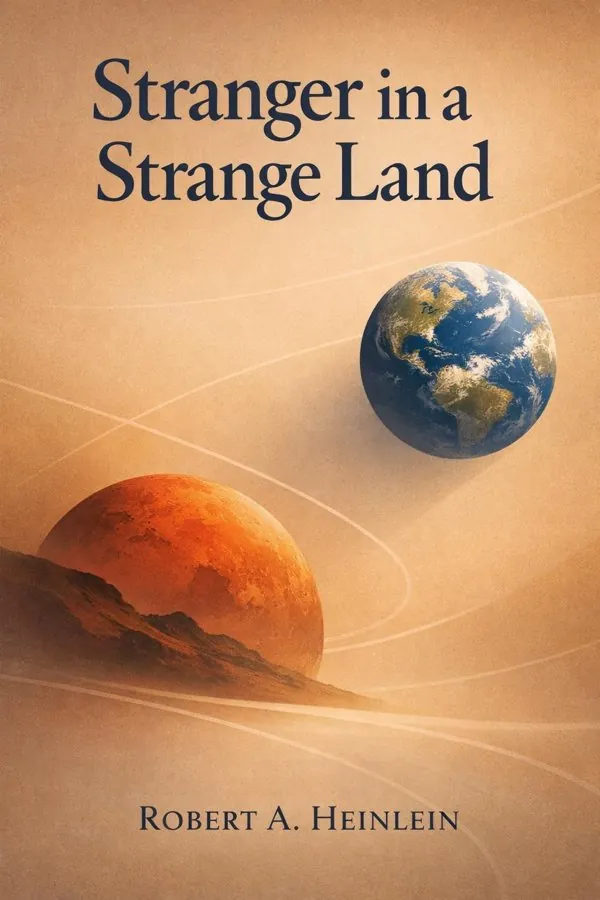
Stranger in a Strange Land: Summary & Key Insights
 10 min9 chaptersAudio available
Key Takeaways from Stranger in a Strange Land
Sometimes the sharpest way to understand humanity is to look at it through the eyes of someone who does not belong to it.
Education is not just the transfer of information; it is the painful and liberating process of learning how a society thinks.
The words available to us do more than describe reality; they train us to notice some parts of experience and ignore others.
Religions often become most powerful when they satisfy needs that official institutions ignore.
One of Heinlein’s most controversial claims is that many human ideas about love are distorted by ownership.
What Is Stranger in a Strange Land About?
Stranger in a Strange Land by Robert A. Heinlein is a scifi_fantasy book published in 1961 spanning 4 pages. What would human society look like if examined by someone who was biologically human but culturally alien? That is the provocative premise of Robert A. Heinlein’s Stranger in a Strange Land, one of the most influential science fiction novels of the twentieth century. First published in 1961, the book follows Valentine Michael Smith, the sole surviving child of a lost Mars mission, who is raised by Martians and later returned to Earth. His encounter with human law, politics, religion, sex, and social custom becomes a powerful lens through which Heinlein challenges what most people take for granted. More than a story about first contact, this novel is a philosophical thought experiment disguised as speculative fiction. Heinlein uses Smith’s innocence and otherworldly perspective to ask unsettling questions: Why do people obey systems they barely understand? Why are love and possession so often confused? Why do religion and power become entangled? Heinlein, one of science fiction’s defining voices, brings his trademark mix of intellectual daring, social criticism, and narrative provocation to every page. The result is a book that remains controversial, ambitious, and deeply memorable.
This FizzRead summary covers all 9 key chapters of Stranger in a Strange Land in approximately 10 minutes, distilling the most important ideas, arguments, and takeaways from Robert A. Heinlein's work. Also available as an audio summary and Key Quotes Podcast.
Stranger in a Strange Land
What would human society look like if examined by someone who was biologically human but culturally alien? That is the provocative premise of Robert A. Heinlein’s Stranger in a Strange Land, one of the most influential science fiction novels of the twentieth century. First published in 1961, the book follows Valentine Michael Smith, the sole surviving child of a lost Mars mission, who is raised by Martians and later returned to Earth. His encounter with human law, politics, religion, sex, and social custom becomes a powerful lens through which Heinlein challenges what most people take for granted.
More than a story about first contact, this novel is a philosophical thought experiment disguised as speculative fiction. Heinlein uses Smith’s innocence and otherworldly perspective to ask unsettling questions: Why do people obey systems they barely understand? Why are love and possession so often confused? Why do religion and power become entangled? Heinlein, one of science fiction’s defining voices, brings his trademark mix of intellectual daring, social criticism, and narrative provocation to every page. The result is a book that remains controversial, ambitious, and deeply memorable.
Who Should Read Stranger in a Strange Land?
This book is perfect for anyone interested in scifi_fantasy and looking to gain actionable insights in a short read. Whether you're a student, professional, or lifelong learner, the key ideas from Stranger in a Strange Land by Robert A. Heinlein will help you think differently.
- ✓Readers who enjoy scifi_fantasy and want practical takeaways
- ✓Professionals looking to apply new ideas to their work and life
- ✓Anyone who wants the core insights of Stranger in a Strange Land in just 10 minutes
Want the full summary?
Get instant access to this book summary and 100K+ more with Fizz Moment.
Get Free SummaryAvailable on App Store • Free to download
Key Chapters
Sometimes the sharpest way to understand humanity is to look at it through the eyes of someone who does not belong to it. Valentine Michael Smith begins as exactly that kind of outsider. Born to human parents on the first manned expedition to Mars, he survives after the mission fails and is raised by the planet’s ancient, mentally disciplined Martian civilization. When he is finally brought back to Earth as a young man, he is legally human but culturally incomprehensible. He does not understand money, jealousy, ownership, government, or even many of the emotional reflexes most people consider normal.
This premise gives Heinlein an extraordinary tool. Michael is not merely a visitor from another world; he is a mirror held up to Earth. Through his questions and confusion, familiar institutions begin to look strange. Why should one person own another’s loyalty? Why should custom outrank compassion? Why do societies treat inherited rules as natural law? Michael’s existence also creates immediate political tension, because as the heir to the Mars expedition, he may possess legal claims of immense financial and diplomatic importance.
In practical terms, this idea remains relevant whenever we examine our own assumptions as if we were outsiders. Anthropologists do this across cultures. Good leaders do it within organizations by asking why a process exists before defending it. Individuals can do it in everyday life by interrogating habits around work, relationships, and identity.
Actionable takeaway: Pick one belief you treat as obvious—about success, love, religion, or authority—and ask, “Would this still seem natural to someone raised in a completely different culture?”
Education is not just the transfer of information; it is the painful and liberating process of learning how a society thinks. After Michael is rescued from government control, he finds refuge in the home of Jubal Harshaw, a wealthy, sharp-tongued doctor, lawyer, writer, and professional skeptic. Harshaw’s house becomes a kind of experimental classroom where Michael can begin to understand human behavior without being immediately exploited by the state, the media, or religious opportunists.
Jubal is one of Heinlein’s most important vehicles for argument. He is witty, cynical, and intellectually aggressive, but he also serves as a patient translator between Michael and Earth. He explains law, custom, language, sexuality, property, and politics, while also teaching readers to question each of those things. Michael’s education is not simply about becoming normal. It is about gaining enough understanding to choose what to accept and what to reject.
This matters because socialization often happens invisibly. Most people absorb values from family, nation, religion, and peers long before they are capable of evaluating them. Michael’s delayed exposure makes the process visible. He learns not just what humans do, but why they rationalize it. In modern life, this resembles what happens when someone enters a new workplace, emigrates to a new country, or leaves a strict community and must decode unfamiliar expectations.
Actionable takeaway: When entering a new environment, find a “Jubal”—someone intelligent and candid who can explain the rules, while also helping you distinguish between what is necessary and what is merely conventional.
The words available to us do more than describe reality; they train us to notice some parts of experience and ignore others. One of the novel’s most famous ideas is the Martian concept of “grok,” a term Michael introduces that means far more than understanding in an intellectual sense. To grok something is to know it so fully, deeply, and completely that observer and observed are no longer separate. It combines comprehension, empathy, spiritual union, and total presence.
Through this idea, Heinlein explores the relationship between language and worldview. Martian thought is radically unlike human thought, and because its categories are different, so are its values. Michael’s struggle to translate Martian concepts into human terms shows how limited ordinary language can be when trying to describe altered consciousness, mystical insight, or profound intimacy. A culture’s vocabulary can either expand its moral imagination or confine it.
This insight applies well beyond science fiction. In psychology, naming an emotion can make it easier to regulate. In organizations, the language used to describe customers, employees, or “resources” influences behavior. In personal relationships, saying “I hear you” is different from actually understanding another person’s inner reality. New language can open new forms of attention.
Heinlein is not claiming that words magically create truth, but he is showing that they can structure perception. If our vocabulary is shallow, our moral and emotional life may become shallow too.
Actionable takeaway: Add one richer word or concept to your life—whether from philosophy, therapy, or another culture—and use it to deepen how you observe yourself and others.
Religions often become most powerful when they satisfy needs that official institutions ignore. Michael eventually founds the Church of All Worlds, a movement that blends spiritual ritual, communal belonging, disciplined learning, and unconventional sexual ethics. To many readers, this is one of the novel’s most provocative developments. Heinlein is not simply inventing a strange cult for dramatic effect; he is examining why people are drawn to religious communities at all.
The Church of All Worlds offers what many people lack: meaning, fellowship, initiation, and a sense of direct participation in something larger than themselves. It also reflects Michael’s Martian-influenced understanding of shared identity, where love is not rooted in possession but in mutual recognition. Yet the church also raises difficult questions. When does spiritual innovation become manipulation? When does charisma become authority? Can a liberating movement avoid reproducing the same structures it criticizes?
Heinlein treats organized religion with both fascination and suspicion. He is critical of institutions that weaponize guilt or trade salvation for obedience, but he recognizes that humans hunger for ritual and transcendence. In that sense, the church is both a satire and a serious experiment in social design.
Modern parallels are everywhere: intentional communities, wellness movements, start-up cultures with quasi-religious zeal, and online groups that provide belonging while shaping identity. Any system that offers meaning deserves scrutiny as well as openness.
Actionable takeaway: Before committing to any community, ask three questions: Does it increase your freedom, deepen your responsibility, and allow honest dissent?
One of Heinlein’s most controversial claims is that many human ideas about love are distorted by ownership. Through Michael’s Martian perspective and the social practices he later develops, the novel challenges possessiveness, jealousy, and exclusivity as inevitable features of intimacy. For Michael, genuine love does not mean controlling another person or limiting their freedom. It means recognizing their full being and willing their flourishing without fear-driven attachment.
Heinlein uses this idea to critique conventional romance and the legalistic structures surrounding sex and marriage. Whether readers agree or not, the challenge is significant: how much of what people call love is actually anxiety about loss, status, or control? The novel suggests that jealousy is not proof of devotion but evidence of insecurity and scarcity thinking. That was a radical position in 1961 and remains provocative today.
At the same time, the book is best read as an exploration rather than a universal blueprint. Not everyone will embrace its sexual ethics, and many readers rightly debate how successfully Heinlein handles gender and power. Still, the underlying question is valuable. Healthy relationships require trust, honesty, and respect for personhood, not just emotional intensity.
In contemporary terms, this idea appears in conversations about boundaries, attachment styles, consent, and emotional maturity. Even in traditional monogamy, partners benefit when they stop equating love with ownership and start practicing communication and generosity.
Actionable takeaway: In your closest relationship, identify one possessive habit—checking, controlling, assuming, demanding—and replace it with one explicit act of trust or honest conversation.
Societies often present their systems as rational, but Heinlein repeatedly shows how law and power are shaped by self-interest, image management, and fear. Michael’s return to Earth immediately becomes a legal and political crisis because he is not just a person; he is a symbol, an asset, and a threat. Governments want to control access to him, legal authorities dispute his status, and powerful groups attempt to use his uniqueness to advance their own agendas.
This storyline demonstrates a central theme of the novel: institutions do not simply serve truth or justice. They protect themselves. Bureaucracies classify what they do not understand. States secure strategic advantage. Media amplify spectacle. Religious establishments defend authority. Michael’s innocence makes these mechanisms easier to see because he has no instinctive reverence for them.
Jubal Harshaw’s role becomes crucial here. His legal and rhetorical skill protects Michael long enough for him to gain agency. Heinlein seems to argue that freedom is not preserved by trust alone but by intelligence, skepticism, and the ability to navigate systems that can easily consume the individual.
This is highly applicable today. Whether dealing with contracts, digital platforms, schools, or governments, people often assume institutions are neutral when they are actually structured by incentives. Understanding those incentives is part of being free.
Actionable takeaway: When facing any institution, ask not only “What does it say it wants?” but also “What incentives shape its behavior?” That question will often reveal more than official language ever does.
Many readers notice the novel’s celebration of freedom, but Heinlein insists that freedom without inner discipline quickly becomes chaos. Michael possesses extraordinary abilities, including unusual mental powers learned from the Martians, yet what makes him significant is not raw power. It is the ethical and spiritual framework through which he uses it. Martian culture trains patience, attention, self-command, and a long view of existence. Human culture, by contrast, often appears impulsive, noisy, and emotionally uncontrolled.
This contrast lets Heinlein make an important point: liberation is not the same as indulgence. A person who rejects social norms but cannot govern desire, fear, anger, or vanity is not truly free. They are simply captive to different forces. Michael’s journey involves learning human emotion while retaining Martian depth, creating a model of freedom rooted in consciousness rather than mere rebellion.
That lesson is relevant anywhere people confuse autonomy with lack of restraint. In creative work, discipline enables originality. In politics, liberty depends on citizens capable of self-government. In personal life, boundaries and habits often create the very conditions for meaningful choice.
Heinlein’s broader social vision may be debated, but this insight endures: power over oneself matters more than opposition to external rules. The individual who understands attention, restraint, and purpose can move through a manipulative world without being wholly shaped by it.
Actionable takeaway: Choose one daily practice—meditation, journaling, exercise, or focused reading—that strengthens self-command. Real freedom begins with habits that keep your mind from being ruled by impulse.
Society often rejects the people who expose its contradictions most clearly. As Michael’s influence grows, so does resistance to him. He becomes admired, feared, mocked, and mythologized all at once. His difference, once a curiosity, turns into a threat because his way of living undermines accepted norms around religion, morality, and authority. The novel’s final movement turns toward martyrdom, suggesting that transformative figures are often destroyed by the very cultures they try to awaken.
Heinlein draws here on clear religious parallels, especially the pattern of the spiritual teacher who gathers followers, teaches a radical ethic of love and new perception, and is ultimately killed by a society unable to absorb his message. Yet the novel does not end in mere tragedy. Michael’s death carries a sense of transcendence, as if his influence survives through the consciousness he awakened in others. In this way, Heinlein blends satire, mysticism, and social criticism into a meditation on what it means to change a civilization.
The practical insight is sobering. New ideas rarely succeed because they are logically superior. They succeed when communities are prepared to carry them forward. Reformers, artists, whistleblowers, and founders all face the same problem: if your message threatens identity, many people will reject it before they understand it.
Actionable takeaway: If you want to introduce change, do not focus only on the idea itself. Build relationships, language, and communities that can sustain the idea after resistance inevitably appears.
All Chapters in Stranger in a Strange Land
About the Author
Robert A. Heinlein (1907–1988) was a pioneering American science fiction writer whose work helped transform the genre into a serious vehicle for philosophical and social inquiry. A graduate of the U.S. Naval Academy, he brought technical credibility, political curiosity, and a willingness to challenge convention to his fiction. Heinlein wrote across a wide range of styles, from juvenile adventures to complex adult novels exploring liberty, citizenship, sexuality, religion, and human evolution. His best-known books include Stranger in a Strange Land, Starship Troopers, and The Moon Is a Harsh Mistress. Often called one of the “Big Three” science fiction authors, alongside Isaac Asimov and Arthur C. Clarke, Heinlein remains one of the genre’s most influential and debated figures.
Get This Summary in Your Preferred Format
Read or listen to the Stranger in a Strange Land summary by Robert A. Heinlein anytime, anywhere. FizzRead offers multiple formats so you can learn on your terms — all free.
Available formats: App · Audio · PDF · EPUB — All included free with FizzRead
Download Stranger in a Strange Land PDF and EPUB Summary
Key Quotes from Stranger in a Strange Land
“Sometimes the sharpest way to understand humanity is to look at it through the eyes of someone who does not belong to it.”
“Education is not just the transfer of information; it is the painful and liberating process of learning how a society thinks.”
“The words available to us do more than describe reality; they train us to notice some parts of experience and ignore others.”
“Religions often become most powerful when they satisfy needs that official institutions ignore.”
“One of Heinlein’s most controversial claims is that many human ideas about love are distorted by ownership.”
Frequently Asked Questions about Stranger in a Strange Land
Stranger in a Strange Land by Robert A. Heinlein is a scifi_fantasy book that explores key ideas across 9 chapters. What would human society look like if examined by someone who was biologically human but culturally alien? That is the provocative premise of Robert A. Heinlein’s Stranger in a Strange Land, one of the most influential science fiction novels of the twentieth century. First published in 1961, the book follows Valentine Michael Smith, the sole surviving child of a lost Mars mission, who is raised by Martians and later returned to Earth. His encounter with human law, politics, religion, sex, and social custom becomes a powerful lens through which Heinlein challenges what most people take for granted. More than a story about first contact, this novel is a philosophical thought experiment disguised as speculative fiction. Heinlein uses Smith’s innocence and otherworldly perspective to ask unsettling questions: Why do people obey systems they barely understand? Why are love and possession so often confused? Why do religion and power become entangled? Heinlein, one of science fiction’s defining voices, brings his trademark mix of intellectual daring, social criticism, and narrative provocation to every page. The result is a book that remains controversial, ambitious, and deeply memorable.
More by Robert A. Heinlein


You Might Also Like



Featured In
Browse by Category
Ready to read Stranger in a Strange Land?
Get the full summary and 100K+ more books with Fizz Moment.