
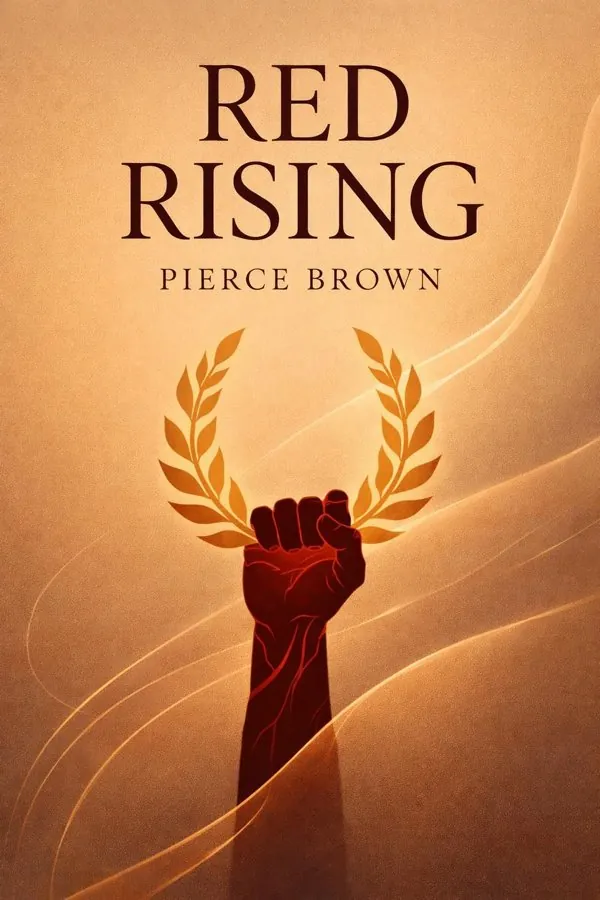
Red Rising: Summary & Key Insights
by Pierce Brown
 10 min9 chaptersAudio available
Key Takeaways from Red Rising
Oppression becomes most powerful when it disguises itself as purpose.
Revolution often begins not with ideology, but with a wound that can no longer be ignored.
To overthrow a system from within, Darrow must become what he hates.
Systems reproduce themselves by training the next generation to mistake cruelty for excellence.
The most dangerous battles in Red Rising are not always fought with weapons; many are fought through trust.
What Is Red Rising About?
Red Rising by Pierce Brown is a scifi_fantasy book published in 2014 spanning 9 pages. What if the society that gave your life meaning was built on a lie? Red Rising begins with that devastating question and turns it into a relentless, emotionally charged science-fantasy saga about class, power, identity, and revolt. Set in a future solar system ruled by a rigid hierarchy of color-coded castes, the novel follows Darrow, a Red laborer on Mars who believes he is helping terraform the planet for future generations. When he discovers that Mars has long since been made livable and that Reds remain enslaved only to enrich the ruling Gold elite, his grief and rage become the spark for a dangerous mission: infiltrate the masters and destroy their world from within. Pierce Brown brings enormous force to this premise, blending dystopian politics, Roman-inspired aristocracy, brutal survival games, and intimate character conflict into a story that feels both mythic and personal. Red Rising matters because it is not only a thrilling rebellion narrative; it is also a sharp examination of how injustice is normalized, how identity can be weaponized, and how leadership demands both cunning and sacrifice.
This FizzRead summary covers all 9 key chapters of Red Rising in approximately 10 minutes, distilling the most important ideas, arguments, and takeaways from Pierce Brown's work. Also available as an audio summary and Key Quotes Podcast.
Red Rising
What if the society that gave your life meaning was built on a lie? Red Rising begins with that devastating question and turns it into a relentless, emotionally charged science-fantasy saga about class, power, identity, and revolt. Set in a future solar system ruled by a rigid hierarchy of color-coded castes, the novel follows Darrow, a Red laborer on Mars who believes he is helping terraform the planet for future generations. When he discovers that Mars has long since been made livable and that Reds remain enslaved only to enrich the ruling Gold elite, his grief and rage become the spark for a dangerous mission: infiltrate the masters and destroy their world from within. Pierce Brown brings enormous force to this premise, blending dystopian politics, Roman-inspired aristocracy, brutal survival games, and intimate character conflict into a story that feels both mythic and personal. Red Rising matters because it is not only a thrilling rebellion narrative; it is also a sharp examination of how injustice is normalized, how identity can be weaponized, and how leadership demands both cunning and sacrifice.
Who Should Read Red Rising?
This book is perfect for anyone interested in scifi_fantasy and looking to gain actionable insights in a short read. Whether you're a student, professional, or lifelong learner, the key ideas from Red Rising by Pierce Brown will help you think differently.
- ✓Readers who enjoy scifi_fantasy and want practical takeaways
- ✓Professionals looking to apply new ideas to their work and life
- ✓Anyone who wants the core insights of Red Rising in just 10 minutes
Want the full summary?
Get instant access to this book summary and 100K+ more with Fizz Moment.
Get Free SummaryAvailable on App Store • Free to download
Key Chapters
Oppression becomes most powerful when it disguises itself as purpose. At the start of Red Rising, Darrow lives as a Red, the lowest caste in a vast color-coded society. His people labor beneath the surface of Mars, mining helium-3 under brutal conditions while being told they are noble pioneers preparing the planet for future generations. That story gives suffering a shape. It turns exploitation into duty and keeps rebellion at bay. Darrow works hard, loves deeply, and believes that hardship means something because he has been taught to connect sacrifice with hope.
Pierce Brown uses this setup to show how systems of control survive not only through force, but through narrative. If people can be convinced that their pain serves a higher cause, they may defend the structure that imprisons them. This idea stretches beyond fiction. In workplaces, institutions, and even cultures, unfair systems often survive by rewarding obedience with dignity, slogans, or myths of eventual reward. People may endure exploitation longer when they are told they are essential, chosen, or part of something historic.
Darrow's early life also grounds the novel emotionally. He is not initially a revolutionary philosopher. He is a husband, a worker, and a believer. That matters because the story is not about abstract injustice alone, but about how ordinary people awaken to the truth of their condition. The Red songs, rituals, and tight-knit communities make their suffering feel human rather than symbolic.
Actionable takeaway: examine the stories that justify sacrifice in your own life, and ask who truly benefits from them.
Revolution often begins not with ideology, but with a wound that can no longer be ignored. Darrow's turning point comes after the execution of his wife, Eo, whose defiance exposes the cruelty of the system more clearly than any speech could. Her death shatters his faith in the order he once accepted. Soon after, Darrow learns the deeper truth: Mars has already been terraformed, the surface is livable, and Reds are not heroic builders of the future but enslaved laborers maintained in ignorance. The dream that sustained his people was manufactured.
This revelation is paired with the arrival of the Sons of Ares, a rebel network determined to break Gold's rule. Their importance is not simply that they oppose the regime. They provide Darrow with a framework for his rage. Pain becomes strategy. Grief becomes mission. Brown shows that truth alone is not enough to create change; people also need organization, leadership, and a story powerful enough to rival the one that held them captive.
In practical terms, this mirrors how change happens in real societies. Exposing corruption, inequality, or abuse matters, but exposure must connect to a movement or structure that can act on it. Isolated outrage burns hot and dies fast. Coordinated resistance lasts. The Sons of Ares also remind us that movements are morally complex. They recruit, manipulate, and ask Darrow to surrender much of himself for the cause.
Actionable takeaway: when confronting injustice, pair emotional conviction with clear strategy, trusted allies, and a realistic understanding of the cost of change.
To overthrow a system from within, Darrow must become what he hates. One of the novel's most striking ideas is that transformation is both physical and psychological. Through an extreme, dangerous process, Darrow is remade from a Red into someone who can pass as a Gold: taller, stronger, sharper, trained in elite manners, language, and combat. This is not a simple disguise. It is a rebirth that blurs the line between performance and identity.
Brown uses this transformation to explore the unsettling price of infiltration. Darrow gains access to power only by adopting the appearance and behaviors of the ruling class. He must learn their codes, understand their ambitions, and present himself as one of them. That gives him opportunity, but it also risks contamination. The closer he gets to Gold society, the more complicated his mission becomes. He starts seeing individuals rather than symbols. He learns that even within oppressive classes, there are rivalries, vulnerabilities, and contradictions.
This idea applies beyond espionage or revolution. In many professional and social environments, people reshape themselves to enter institutions not built for them. They change speech, dress, posture, or attitude to gain acceptance. That adaptation can be useful, even necessary, but it may also create inner strain. The question becomes: how much can you change before you lose the part of yourself that gave your effort meaning?
Darrow's transformation is therefore empowering and tragic at once. He becomes capable of striking at the system, yet every gain is purchased with personal fragmentation.
Actionable takeaway: adapt strategically when entering powerful spaces, but define in advance which core values you will not trade away.
Systems reproduce themselves by training the next generation to mistake cruelty for excellence. The Institute, where Darrow is sent after passing Gold's tests, is one of Red Rising's most memorable settings because it distills the values of the ruling class into a savage educational experiment. Young Golds are divided into Houses, stripped into a staged primitive conflict, and forced to compete through war, manipulation, endurance, and domination. The message is clear: leadership belongs to those who can seize it.
What makes the Institute compelling is that it is not chaos for chaos's sake. It is a machine designed to reveal and reward a specific worldview. Strength matters, but so do cunning, charisma, and the ability to inspire or break others. Gold society does not simply produce tyrants by accident; it educates them systematically. Brown thereby critiques elite institutions that speak the language of merit while actually teaching hierarchy, aggression, and entitlement.
Readers can see parallels in real-world environments where competition is treated as inherently noble and empathy as weakness. Certain schools, corporations, or political systems may celebrate high performers while quietly rewarding those most comfortable with domination, image management, and selective loyalty. The Institute asks whether a society can remain humane if it trains its leaders to equate worth with conquest.
For Darrow, survival requires more than force. He must learn how the game works without wholly becoming its product. That tension drives much of the novel's suspense and moral complexity.
Actionable takeaway: whenever an institution claims to identify the best leaders, look closely at the behaviors it actually rewards.
The most dangerous battles in Red Rising are not always fought with weapons; many are fought through trust. Darrow's relationships with characters like Cassius, Mustang, and Roque reveal how power and intimacy collide inside the Institute. Cassius offers companionship and charisma, making friendship feel possible in a brutal environment. Mustang brings intelligence, independence, and a more nuanced understanding of leadership. Roque represents sensitivity, loyalty, and the pull of beauty in a savage world. Each bond humanizes Darrow, but each also creates risk.
Brown excels at showing that alliances are never purely tactical and never purely emotional. The closer Darrow becomes to others, the more his hidden identity threatens both his mission and his conscience. He is forced to ask whether using people for a greater cause can ever remain morally clean. At the same time, these relationships teach him that leadership is not merely about command. It depends on reading people accurately, respecting their strengths, and understanding what they fear, value, or love.
This is one of the novel's most practical insights. In life, teams rarely fail because of strategy alone. They fail because trust erodes, motives are misread, or people feel unseen. Strong leaders do not only calculate outcomes; they manage relationships with honesty where possible and care where necessary. Darrow cannot always be truthful, but the pain caused by his secrecy underscores the cost of instrumental thinking.
The Institute becomes a laboratory for emotional intelligence as much as military skill. The alliances Darrow builds shape who he becomes and reveal that no rebellion can succeed without human connection.
Actionable takeaway: build alliances on genuine understanding, because trust is a stronger force multiplier than fear.
Victory belongs not simply to the strongest, but to those who can turn scattered people into a shared cause. Once the Institute's war games intensify, Darrow rises within House Mars by doing more than winning fights. He organizes, inspires, improvises, and reframes what leadership can look like. Rather than relying only on aristocratic arrogance or brute force, he begins forging a more effective kind of command: one rooted in earned loyalty and practical adaptation.
Brown uses these sequences to show the difference between domination and leadership. Many Gold students assume authority is their birthright. Darrow, because he comes from oppression, understands something they do not: people follow most fully when they feel seen, valued, and united by purpose. He rewards competence, recognizes hidden strengths, and learns to use symbols, victories, and discipline to create momentum. House Mars rises because Darrow creates order from humiliation and fragmentation.
This idea has clear real-world application. Whether in business, community work, sports, or activism, struggling groups often improve not because conditions suddenly become ideal, but because someone builds cohesion. A capable leader names reality honestly, creates quick wins, sets standards, and helps individuals believe they matter to a larger mission. Darrow does all of this under extreme pressure.
At the same time, the war games reveal his growing appetite for command. Success can seduce. The person who begins by resisting hierarchy may discover an unsettling talent for wielding it. Brown never lets that tension disappear.
Actionable takeaway: if you want a team to rise, create purpose, assign clear roles, and earn loyalty through competence rather than status.
Power reveals character, but betrayal reveals conviction. As Red Rising progresses, Darrow faces painful reversals that test not just his plans, but the values beneath them. Friendships fracture, hidden motives surface, and the gap widens between who Darrow pretends to be and who he is trying to remain. These betrayals matter because they force him to confront whether ends truly justify means. If he uses deception to dismantle a monstrous system, how much deception can he live with before becoming monstrous himself?
Brown does not offer easy moral comfort. Darrow's mission requires manipulation, and some of his choices have genuine human cost. People trust him without knowing the full truth. Enemies become more complex. Allies become vulnerable. Betrayal in the novel is not always the act of villains; sometimes it emerges from clashing loyalties, wounded pride, or competing visions of honor. That complexity gives the book emotional depth and prevents it from collapsing into a simple oppressed-versus-oppressor fable.
In practical life, this idea speaks to leadership under pressure. Difficult environments often tempt people to cut ethical corners in the name of necessity. Short-term gains may seem to justify secrecy, exclusion, or coercion. Yet trust, once damaged, is difficult to rebuild. The novel suggests that strategic compromise may be unavoidable, but moral numbness is far more dangerous.
Darrow's struggle becomes a warning: if your methods constantly violate the future you claim to seek, your victory may reproduce the very system you opposed.
Actionable takeaway: when pursuing a difficult goal, regularly ask whether your methods still align with the kind of world you want to build.
No ascent through power leaves the climber untouched. By the end of Red Rising, Darrow has gained status, influence, and access, yet those victories come with profound emotional and moral costs. He carries grief for Eo, guilt over manipulation, and the growing burden of maintaining multiple identities at once. The dream of justice remains alive, but the path toward it is stained with compromise, secrecy, and loneliness.
This final idea gives the novel much of its staying power. Brown refuses to romanticize revolution as a simple cleansing fire. He shows that resistance can require violence, performance, and difficult tradeoffs. Even righteous causes can wound the people who carry them. Darrow's hidden fire, then, is not merely anger at oppression. It is the stubborn willingness to keep moving despite internal fracture. He becomes powerful not because he is unscarred, but because he can still act while scarred.
That insight resonates in ordinary life. Ambition, advocacy, leadership, and transformation all demand sacrifice. Promotions cost time. Public causes strain private bonds. Reinventing oneself can create distance from one's origins. The critical question is not whether striving has a price, but whether the price is being paid consciously and for something worthy.
Red Rising ends by opening a larger horizon. Darrow has not completed the revolution. He has only entered the arena where history can be changed. The emotional complexity of that position is what elevates the book above a simple underdog adventure.
Actionable takeaway: before pursuing power or change, decide what costs you are willing to bear and what losses would hollow out the very purpose of your struggle.
All Chapters in Red Rising
About the Author
Pierce Brown is an American author best known for the bestselling Red Rising saga, a science-fantasy series that blends dystopian politics, classical influences, and emotionally intense character drama. Born in 1988, Brown studied political science and economics and later worked in politics and technology before turning to fiction. Those experiences helped shape his interest in power, hierarchy, and institutional control, themes that run strongly through his novels. Red Rising, published in 2014, was his debut and quickly gained a large international readership for its propulsive storytelling and bold worldbuilding. Brown has since expanded the series into a larger epic known for its scale, moral complexity, and fierce loyal fan base. He is widely recognized as one of the standout contemporary voices in action-driven speculative fiction.
Get This Summary in Your Preferred Format
Read or listen to the Red Rising summary by Pierce Brown anytime, anywhere. FizzRead offers multiple formats so you can learn on your terms — all free.
Available formats: App · Audio · PDF · EPUB — All included free with FizzRead
Download Red Rising PDF and EPUB Summary
Key Quotes from Red Rising
“Oppression becomes most powerful when it disguises itself as purpose.”
“Revolution often begins not with ideology, but with a wound that can no longer be ignored.”
“To overthrow a system from within, Darrow must become what he hates.”
“Systems reproduce themselves by training the next generation to mistake cruelty for excellence.”
“The most dangerous battles in Red Rising are not always fought with weapons; many are fought through trust.”
Frequently Asked Questions about Red Rising
Red Rising by Pierce Brown is a scifi_fantasy book that explores key ideas across 9 chapters. What if the society that gave your life meaning was built on a lie? Red Rising begins with that devastating question and turns it into a relentless, emotionally charged science-fantasy saga about class, power, identity, and revolt. Set in a future solar system ruled by a rigid hierarchy of color-coded castes, the novel follows Darrow, a Red laborer on Mars who believes he is helping terraform the planet for future generations. When he discovers that Mars has long since been made livable and that Reds remain enslaved only to enrich the ruling Gold elite, his grief and rage become the spark for a dangerous mission: infiltrate the masters and destroy their world from within. Pierce Brown brings enormous force to this premise, blending dystopian politics, Roman-inspired aristocracy, brutal survival games, and intimate character conflict into a story that feels both mythic and personal. Red Rising matters because it is not only a thrilling rebellion narrative; it is also a sharp examination of how injustice is normalized, how identity can be weaponized, and how leadership demands both cunning and sacrifice.
You Might Also Like

Stranger in a Strange Land
Robert A. Heinlein
10 min
AI Valley
Chen Qiufan
10 min
Bloodchild
Octavia E. Butler
10 min
Do Androids Dream of Electric Sheep?
Philip K. Dick
10 min
Jujutsu Kaisen, Vol. 24
Gege Akutami
10 min
The Wandering Earth
Cixin Liu
10 minFeatured In
Browse by Category
Ready to read Red Rising?
Get the full summary and 100K+ more books with Fizz Moment.