
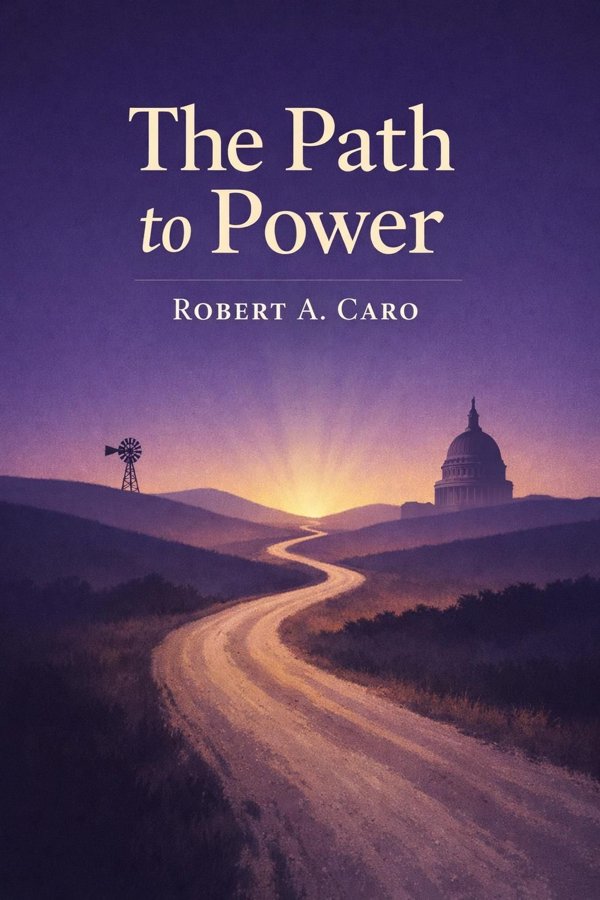
The Path to Power: Summary & Key Insights
 10 min9 chaptersAudio available
Key Takeaways from The Path to Power
Ambition often begins not in comfort, but in exposure to limits.
Nothing shapes a child’s view of power more than watching power fail at close range.
Leadership is often recognized first in miniature settings, where personality can overpower structure.
Sometimes ambition is sharpened not only by personal hunger, but by witnessing structural injustice up close.
Power is rarely seized in one dramatic moment; more often it is learned through apprenticeship.
What Is The Path to Power About?
The Path to Power by Robert A. Caro is a biographies book spanning 7 pages. The Path to Power is the first volume of Robert A. Caro’s monumental biography of Lyndon B. Johnson, and it is far more than a political life story. It is an investigation into how power is formed long before a person reaches office—through family history, hardship, humiliation, ambition, social inequality, and an almost obsessive will to rise. Caro begins in the Texas Hill Country, where Johnson’s childhood unfolded amid poverty, pride, and the stark divisions of early twentieth-century rural life. From there, he traces Johnson’s path through teaching, college politics, Washington patronage, marriage, and his first congressional campaign. What makes the book so important is Caro’s method: he does not simply recount events, he reconstructs the world that produced Johnson and the systems he learned to master. The result is a biography that reads like a study of character, class, and political machinery all at once. Caro’s authority comes from unmatched research, hundreds of interviews, and a lifelong commitment to understanding political power in all its grandeur and ruthlessness.
This FizzRead summary covers all 9 key chapters of The Path to Power in approximately 10 minutes, distilling the most important ideas, arguments, and takeaways from Robert A. Caro's work. Also available as an audio summary and Key Quotes Podcast.
The Path to Power
The Path to Power is the first volume of Robert A. Caro’s monumental biography of Lyndon B. Johnson, and it is far more than a political life story. It is an investigation into how power is formed long before a person reaches office—through family history, hardship, humiliation, ambition, social inequality, and an almost obsessive will to rise. Caro begins in the Texas Hill Country, where Johnson’s childhood unfolded amid poverty, pride, and the stark divisions of early twentieth-century rural life. From there, he traces Johnson’s path through teaching, college politics, Washington patronage, marriage, and his first congressional campaign. What makes the book so important is Caro’s method: he does not simply recount events, he reconstructs the world that produced Johnson and the systems he learned to master. The result is a biography that reads like a study of character, class, and political machinery all at once. Caro’s authority comes from unmatched research, hundreds of interviews, and a lifelong commitment to understanding political power in all its grandeur and ruthlessness.
Who Should Read The Path to Power?
This book is perfect for anyone interested in biographies and looking to gain actionable insights in a short read. Whether you're a student, professional, or lifelong learner, the key ideas from The Path to Power by Robert A. Caro will help you think differently.
- ✓Readers who enjoy biographies and want practical takeaways
- ✓Professionals looking to apply new ideas to their work and life
- ✓Anyone who wants the core insights of The Path to Power in just 10 minutes
Want the full summary?
Get instant access to this book summary and 100K+ more with Fizz Moment.
Get Free SummaryAvailable on App Store • Free to download
Key Chapters
Ambition often begins not in comfort, but in exposure to limits. Caro shows that Lyndon Johnson’s defining drive cannot be understood without first understanding the Texas Hill Country: a place of rocky soil, recurring hardship, isolation, and fierce personal pride. This was a landscape where families worked brutally hard yet remained vulnerable to drought, debt, and sudden reversals. In such an environment, power was not an abstraction. It meant survival, status, and the ability to protect your family from humiliation.
Johnson grew up surrounded by people who had very little material security but a great deal of emotional intensity. The Hill Country valued toughness, memory, loyalty, and public standing. Caro makes clear that this culture taught Johnson two lasting lessons. First, weakness carries a cost. Second, those who can command institutions—government, money, networks, votes—shape everyone else’s fate. Johnson did not merely want success; he wanted insulation from powerlessness.
This idea has broad application beyond politics. Many leaders are shaped by environments where scarcity sharpens attention and social rank feels intensely visible. People from unstable backgrounds may develop extraordinary energy, charisma, and resilience, but also anxiety, control needs, and a fear of losing ground. Understanding the pressure of origin helps explain later behavior that might otherwise seem excessive.
A practical way to apply this insight is to examine the conditions that formed your own ambitions. Ask what early experiences taught you about security, recognition, and control. Actionable takeaway: identify one hidden fear beneath your biggest goal, because that fear may be the real engine of your drive.
Nothing shapes a child’s view of power more than watching power fail at close range. Lyndon’s father, Sam Ealy Johnson Jr., was once a respected Texas legislator with principles, eloquence, and a reputation for progressive causes. Yet he was also financially reckless, politically vulnerable, and ultimately unable to shield his family from decline. Caro presents Sam as both admirable and tragic: a man rich in conviction but poor in worldly calculation.
For Lyndon, this was a formative contradiction. He saw that idealism could win admiration, but not necessarily security. He witnessed his father’s standing erode, his finances collapse, and his authority weaken at home and in public life. The family’s social embarrassment left deep marks on Johnson, who developed a fierce aversion to dependency and defeat. If Sam represented dignity without durable power, Lyndon resolved to pursue power without the same naïveté.
Caro’s portrait suggests a larger truth: children often construct their adult identities in reaction to parental strengths and failures. Some inherit values; others inherit warnings. Johnson absorbed politics from his father, but he also learned that charm, speeches, and moral positioning are not enough unless backed by organization, leverage, and relentless attention to advantage.
In modern terms, this pattern appears in business, leadership, and family life. People raised around financial instability, public embarrassment, or parental inconsistency often become unusually strategic. They may overcorrect toward control, achievement, or status. Actionable takeaway: reflect on one family pattern you are still reacting against, and decide consciously whether it is guiding you wisely or driving you blindly.
Leadership is often recognized first in miniature settings, where personality can overpower structure. In Johnson’s school years and early college period, Caro traces the emergence of traits that would define his political ascent: intensity, theatrical energy, a hunger to dominate a room, and an uncanny sensitivity to what others wanted. Johnson did not simply seek approval. He sought command.
He could inspire, flatter, pressure, and overwhelm. Teachers, classmates, and later peers often experienced him as impossible to ignore. This is one of Caro’s central insights: Johnson’s political gifts were visible long before he held formal office. He grasped instinctively that influence is emotional before it is procedural. People follow not only ideas, but force of presence.
At the same time, Caro refuses to romanticize these traits. Johnson’s charisma was tied to manipulation. He could be generous and bullying, attentive and self-serving, idealistic and opportunistic. His student years show a leader in formation who already understood that attention is a currency, and that public life rewards those who can seize it.
This has practical relevance for anyone building influence. Technical competence matters, but so do energy, timing, emotional reading, and the ability to make others feel seen. Yet the same skills can become coercive when detached from principle. In workplaces, teams often elevate the most vivid personality without asking what values actually direct that force. Actionable takeaway: strengthen your ability to communicate with energy, but pair it with one explicit ethical boundary you will not cross to win support.
Sometimes ambition is sharpened not only by personal hunger, but by witnessing structural injustice up close. One of the most important episodes in The Path to Power is Johnson’s time teaching Mexican American children in Cotulla, Texas. Caro treats this period not as a sentimental detour, but as a decisive encounter with deprivation and exclusion. Johnson saw students who were bright, eager, and disciplined, yet trapped by a system that had already assigned them to the margins.
This experience mattered because it exposed him to powerlessness in institutional form. These children were not failing because of individual defects. They were being constrained by poverty, prejudice, and a society that did not expect them to advance. Johnson responded intensely, throwing himself into teaching with unusual energy and trying to make his students believe they could matter. Caro suggests that this was one of the rare moments when Johnson’s emotional force aligned with a genuine democratic impulse.
The episode also helps explain a later paradox in Johnson’s life. He could be ruthless in pursuit of office and still feel authentic outrage at social inequality. Caro refuses the easy choice between cynicism and idealism. Johnson contained both. His later support for civil rights and anti-poverty legislation did not emerge from nowhere; part of their emotional origin lay in Cotulla.
For readers today, the lesson is clear: direct contact with inequality can transform abstract beliefs into lasting commitments. If you want to understand a system, go where its effects are most visible. Actionable takeaway: spend time close to a problem you care about, because proximity often produces the conviction that distant opinion cannot.
Power is rarely seized in one dramatic moment; more often it is learned through apprenticeship. When Johnson entered Washington as a congressional aide, he found the environment that would refine his gifts. Caro shows how he studied hierarchy, patronage, procedure, and personal access with extraordinary concentration. He learned who mattered, who only appeared to matter, and how influence flowed through offices, committees, favors, and information.
This was where Johnson moved from raw ambition to tactical sophistication. He attached himself to powerful figures, especially Congressman Richard Kleberg and later Franklin Roosevelt’s circle through New Deal networks. He understood that proximity could be converted into authority if managed aggressively. He cultivated relationships, answered needs quickly, worked tirelessly, and made himself useful to people above him. But usefulness was never his final goal; it was his ladder.
Caro’s larger point is that institutions reward those who understand both formal and informal systems. Titles tell only part of the story. Real power often lies in who controls access, who solves problems, who gathers intelligence, and who can make others dependent. Johnson excelled because he noticed these invisible mechanics faster than most people.
This insight applies in any organization. New employees often focus on job descriptions, while the most effective operators learn incentives, alliances, and decision pathways. That does not require cynicism; it requires attention. To influence outcomes, you must understand how things actually get done. Actionable takeaway: map the real power structure in your workplace or field—who decides, who influences, who blocks, and who connects—before making your next major move.
Political ascent often appears individual from a distance, but Caro shows that Johnson’s rise was deeply reinforced by partnership. Claudia “Lady Bird” Johnson was not merely a spouse standing beside an ambitious man. She brought emotional steadiness, social intelligence, financial resources, and practical support that proved critical to Johnson’s development. Their marriage was unequal in many ways, but it was also politically consequential.
Lady Bird had money from her family, and that financial independence mattered. It helped provide security at moments when Johnson’s position was uncertain. Just as important, she offered patience and discipline where he was volatile. Caro portrays her as perceptive, dutiful, and often quietly resilient in the face of Johnson’s demands. She understood people, read situations well, and contributed to the cultivation of networks that sustained his career.
The broader lesson is that major careers are frequently built on invisible labor. Emotional management, logistical organization, social hosting, encouragement, damage control, and financial cushioning rarely get equal historical credit, yet they can make high-risk ambition possible. Caro’s treatment of Lady Bird widens the biography from the mythology of the solitary political genius to the reality of interdependent success.
In contemporary life, this applies to founders, executives, creators, and public figures alike. Behind visible performance is often someone carrying hidden weight. Recognizing that support changes how we think about merit and achievement. Actionable takeaway: identify one person whose behind-the-scenes contribution strengthens your work, and acknowledge or support them in a concrete, meaningful way.
Elections are tests not only of popularity, but of organizational ferocity. Johnson’s 1937 congressional campaign, launched after a sudden vacancy, was the defining breakthrough of his early career. Caro presents it as a vivid example of Johnson’s ability to convert preparation, speed, and intensity into victory. He acted immediately, mobilized networks fast, and campaigned with astonishing stamina across a large Texas district.
What distinguished Johnson was not just effort but totality. He pursued votes as if each one could alter history. He mastered the local concerns of communities, tailored appeals, managed endorsements, and projected urgency wherever he went. This was the campaign style that would become legendary: no half measures, no wasted hours, no emotional moderation. He treated politics as a contest won by those willing to outwork and outmaneuver everyone else.
Caro also shows the tension at the heart of Johnson’s method. Such intensity can inspire followers because it signals belief, competence, and momentum. But it can also normalize pressure, opportunism, and ethical stretching. Johnson’s campaign demonstrated that democratic systems often reward the candidate who best organizes attention and commitment, not necessarily the one with the purest motives.
The practical application is straightforward. In any competitive field, timing and execution matter as much as talent. Many opportunities are decided by who responds fastest, prepares deepest, and sustains energy longest. Still, ambition should not become an excuse for erasing all limits. Actionable takeaway: when a rare opportunity appears, move decisively and prepare obsessively—but define in advance the standards you will keep under pressure.
One of Caro’s most unsettling achievements is showing how concern for ordinary people can coexist with a powerful desire to dominate them. Johnson emerged from a populist political culture, spoke the language of the common man, and often identified with those left behind. Yet he also wanted obedience, control, and personal ascendancy. This duality is not a side note; it is central to understanding him.
Caro avoids simplistic categories. Johnson was not merely a hypocrite using public language for private gain, nor a misunderstood idealist forced into rough tactics. He was both sincerely moved by suffering and relentlessly committed to winning. That combination helps explain how he could later become a champion of transformative social legislation while operating through intimidation, pressure, and deep political calculation.
This paradox matters because it challenges comfortable assumptions about moral character. We often want leaders to be internally coherent, but many are not. They may carry genuine commitments alongside vanity, empathy alongside manipulation. Caro’s Johnson suggests that political effectiveness often grows from this unstable mix rather than from purity.
For readers today, the lesson is not to excuse bad behavior because a leader produces good outcomes. It is to become more discerning. Evaluate public figures by both what they achieve and how they pursue it. Ask whether a leader’s methods corrode the very values they claim to defend. Actionable takeaway: when assessing leadership, create a two-part standard—judge both results and conduct—so charisma or policy success does not blind you to the full picture.
The deepest message of The Path to Power is that power is not something a person suddenly acquires after election or appointment. It is assembled gradually through habits of attention, relationship building, psychological formation, strategic patience, and the ability to read systems. By ending this volume with Johnson’s arrival in Congress, Caro emphasizes that the true story is already underway long before national prominence.
Johnson’s early life reveals that power has roots in memory and emotion as much as in institutions. His fear of humiliation, hunger for recognition, responsiveness to inequality, and genius for personal influence all predate formal authority. Office gave him a larger stage, but it did not create the man. It amplified patterns already formed.
This idea makes Caro’s biography valuable beyond historical interest. It invites readers to think of leadership development as cumulative. The conversations you initiate, the discipline you practice, the reputations you build, the environments you study, and the motives you fail to examine—all of these become part of your future capacity to influence others.
In professional life, people often wait for a title before acting like leaders. Caro’s portrait suggests the opposite approach. Influence is built in advance through reliability, observation, emotional intelligence, and strategic investment in relationships. Position then enlarges what is already there. Actionable takeaway: choose one leadership habit to practice before you “need” it—such as preparation, listening, or follow-through—because the path to power begins long before recognition arrives.
All Chapters in The Path to Power
About the Author
Robert A. Caro is an American journalist and biographer renowned for his unmatched studies of political power. Born in 1935, he began his career in journalism before turning to long-form biography and history. He achieved major acclaim with The Power Broker, his monumental account of New York power broker Robert Moses, and later with The Years of Lyndon Johnson, the multi-volume series that includes The Path to Power. Caro is celebrated for exhaustive reporting, years of archival work, and hundreds of interviews that allow him to reconstruct not only lives, but the systems those lives shaped. His writing blends narrative force with analytical depth, making complex political history vivid and human. Widely honored with Pulitzer Prizes and National Book Awards, Caro is considered one of the greatest biographers of the modern era.
Get This Summary in Your Preferred Format
Read or listen to the The Path to Power summary by Robert A. Caro anytime, anywhere. FizzRead offers multiple formats so you can learn on your terms — all free.
Available formats: App · Audio · PDF · EPUB — All included free with FizzRead
Download The Path to Power PDF and EPUB Summary
Key Quotes from The Path to Power
“Ambition often begins not in comfort, but in exposure to limits.”
“Nothing shapes a child’s view of power more than watching power fail at close range.”
“Leadership is often recognized first in miniature settings, where personality can overpower structure.”
“Sometimes ambition is sharpened not only by personal hunger, but by witnessing structural injustice up close.”
“Power is rarely seized in one dramatic moment; more often it is learned through apprenticeship.”
Frequently Asked Questions about The Path to Power
The Path to Power by Robert A. Caro is a biographies book that explores key ideas across 9 chapters. The Path to Power is the first volume of Robert A. Caro’s monumental biography of Lyndon B. Johnson, and it is far more than a political life story. It is an investigation into how power is formed long before a person reaches office—through family history, hardship, humiliation, ambition, social inequality, and an almost obsessive will to rise. Caro begins in the Texas Hill Country, where Johnson’s childhood unfolded amid poverty, pride, and the stark divisions of early twentieth-century rural life. From there, he traces Johnson’s path through teaching, college politics, Washington patronage, marriage, and his first congressional campaign. What makes the book so important is Caro’s method: he does not simply recount events, he reconstructs the world that produced Johnson and the systems he learned to master. The result is a biography that reads like a study of character, class, and political machinery all at once. Caro’s authority comes from unmatched research, hundreds of interviews, and a lifelong commitment to understanding political power in all its grandeur and ruthlessness.
More by Robert A. Caro
The Passage Of Power: The Years of Lyndon Johnson, Volume 4
Robert A. Caro
10 min
Means of Ascent: The Years of Lyndon Johnson, Volume II
Robert A. Caro
10 min
Master of the Senate: The Years of Lyndon Johnson, Volume III
Robert A. Caro
10 min
The Power Broker: Robert Moses and the Fall of New York
Robert A. Caro
10 minYou Might Also Like

An American Marriage
Tayari Jones
10 min
Benjamin Franklin: An American Life
Walter Isaacson
10 min
I Know Why The Caged Bird Sings
Maya Angelou
10 min
Long Walk to Freedom
Nelson Mandela
10 min
Persepolis
Marjane Satrapi
10 min
Surely You're Joking, Mr. Feynman!
Richard P. Feynman
10 minBrowse by Category
Ready to read The Path to Power?
Get the full summary and 100K+ more books with Fizz Moment.