
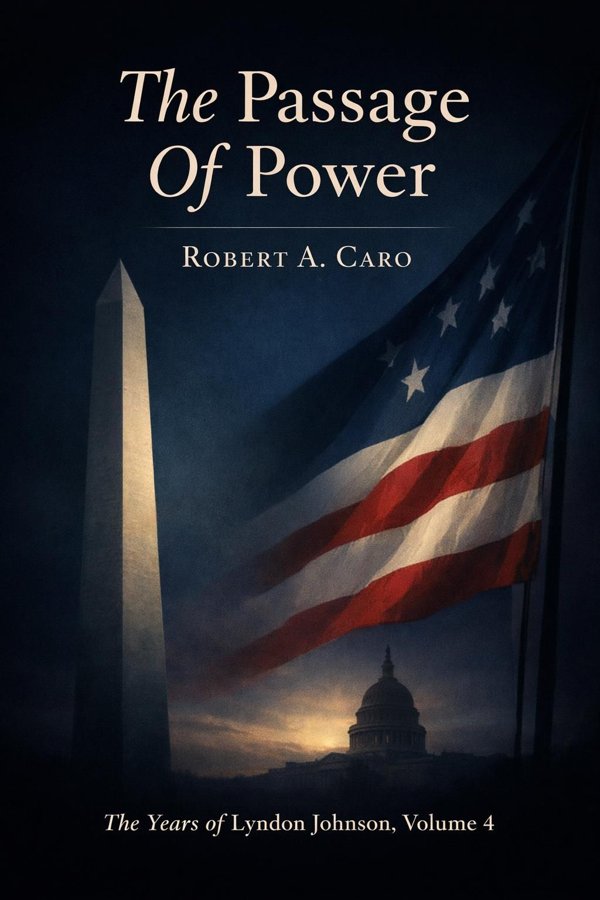
The Passage Of Power: The Years of Lyndon Johnson, Volume 4: Summary & Key Insights
 10 min9 chaptersAudio available
Key Takeaways from The Passage Of Power: The Years of Lyndon Johnson, Volume 4
A leader’s greatest strength can become the source of his deepest miscalculation.
Titles often look more powerful from a distance than they feel from inside.
History can turn in seconds, and when it does, the prepared actor matters most.
The most consequential leaders know that emotion and action do not have to be opposites.
Political exile can become preparation if the person in exile keeps learning.
What Is The Passage Of Power: The Years of Lyndon Johnson, Volume 4 About?
The Passage Of Power: The Years of Lyndon Johnson, Volume 4 by Robert A. Caro is a biographies book spanning 5 pages. Robert A. Caro’s The Passage Of Power is the fourth installment of his towering multivolume study of Lyndon B. Johnson, and it captures one of the most dramatic transitions in American political history. Covering Johnson’s failed 1960 presidential bid, his humiliating years as John F. Kennedy’s vice president, and his sudden ascent to the presidency after the assassination in Dallas, the book shows power not as an abstraction but as something seized, lost, disguised, and used under immense pressure. Caro is interested not only in what Johnson did, but in how his character—ruthless, insecure, brilliant, empathetic, domineering—shaped the exercise of power at every stage. What makes this volume matter is that it turns a familiar historical period into a close study of leadership in crisis. Caro reveals how Johnson, diminished and isolated for much of the early 1960s, was able to transform national grief into legislative force and political momentum. With unmatched archival research, vivid interviews, and a storyteller’s precision, Caro offers far more than biography. He provides a masterclass in ambition, institutional power, and the astonishing speed with which history can change.
This FizzRead summary covers all 9 key chapters of The Passage Of Power: The Years of Lyndon Johnson, Volume 4 in approximately 10 minutes, distilling the most important ideas, arguments, and takeaways from Robert A. Caro's work. Also available as an audio summary and Key Quotes Podcast.
The Passage Of Power: The Years of Lyndon Johnson, Volume 4
Robert A. Caro’s The Passage Of Power is the fourth installment of his towering multivolume study of Lyndon B. Johnson, and it captures one of the most dramatic transitions in American political history. Covering Johnson’s failed 1960 presidential bid, his humiliating years as John F. Kennedy’s vice president, and his sudden ascent to the presidency after the assassination in Dallas, the book shows power not as an abstraction but as something seized, lost, disguised, and used under immense pressure. Caro is interested not only in what Johnson did, but in how his character—ruthless, insecure, brilliant, empathetic, domineering—shaped the exercise of power at every stage.
What makes this volume matter is that it turns a familiar historical period into a close study of leadership in crisis. Caro reveals how Johnson, diminished and isolated for much of the early 1960s, was able to transform national grief into legislative force and political momentum. With unmatched archival research, vivid interviews, and a storyteller’s precision, Caro offers far more than biography. He provides a masterclass in ambition, institutional power, and the astonishing speed with which history can change.
Who Should Read The Passage Of Power: The Years of Lyndon Johnson, Volume 4?
This book is perfect for anyone interested in biographies and looking to gain actionable insights in a short read. Whether you're a student, professional, or lifelong learner, the key ideas from The Passage Of Power: The Years of Lyndon Johnson, Volume 4 by Robert A. Caro will help you think differently.
- ✓Readers who enjoy biographies and want practical takeaways
- ✓Professionals looking to apply new ideas to their work and life
- ✓Anyone who wants the core insights of The Passage Of Power: The Years of Lyndon Johnson, Volume 4 in just 10 minutes
Want the full summary?
Get instant access to this book summary and 100K+ more with Fizz Moment.
Get Free SummaryAvailable on App Store • Free to download
Key Chapters
A leader’s greatest strength can become the source of his deepest miscalculation. At the start of this volume, Lyndon Johnson believes his command of the Senate, his legislative achievements, and his reputation within the Democratic Party make him the natural choice for the 1960 presidential nomination. He has spent years mastering backroom persuasion, building loyalties, and turning Congress into his instrument. But Johnson mistakes one kind of power for another. The political environment has changed. Television matters more. Image matters more. Youth, style, and public charisma now rival legislative accomplishment. John F. Kennedy understands this transformation better than Johnson does.
Caro shows that Johnson’s error was not simply tactical. It was conceptual. He believed the old system of influence, alliances, and institutional weight would still determine the outcome. Instead, he entered a race whose rules had changed beneath him. His campaign lacked clarity, speed, and emotional appeal. He remained formidable, but no longer matched to the moment. The result was not merely defeat. It was a shattering realization that power in America was moving away from congressional mastery toward media-driven national appeal.
This idea extends far beyond politics. Executives, founders, and managers often assume that what made them successful in one era will guarantee success in the next. A sales leader may fail as a brand builder. A superb operator may struggle in a consumer-facing role. Strength becomes weakness when conditions shift.
The practical lesson is to regularly ask whether your model of success still fits reality. Don’t assume yesterday’s authority translates automatically into tomorrow’s relevance. Actionable takeaway: identify one area where your environment has changed, and adjust your strategy before your old strengths become liabilities.
Titles often look more powerful from a distance than they feel from inside. After the 1960 Democratic convention, Johnson accepts the vice-presidential nomination in a climate of pressure, calculation, and uncertainty. Publicly, the role appears prestigious: second-highest office in the nation, close to the president, central to governance. In practice, Caro reveals it as a political cage. Johnson, who had dominated the Senate with force of personality and procedural genius, suddenly finds himself excluded, managed, and diminished within the Kennedy White House.
The humiliation is especially sharp because of who Johnson had been. In the Senate he shaped events; as vice president he often waits for instructions. Kennedy’s inner circle distrusts him, resents him, and deliberately keeps him away from meaningful influence. He is assigned ceremonial trips, politically awkward tasks, and public roles that preserve the appearance of importance while stripping away substance. Caro makes clear that Johnson’s suffering was not just personal. It was a lesson in institutional reality: formal rank does not guarantee actual leverage.
This dynamic appears in many organizations. Someone may be promoted to a lofty title but lose control over resources, decisions, or trusted relationships. A founder turned chairman, a division head moved into an advisory role, or a senior executive placed under a new leadership team may discover that prestige has increased while agency has collapsed. The emotional cost can be severe, especially when identity is tied to usefulness.
Caro also shows Johnson absorbing, watching, waiting. Even in frustration, he studies the presidency from close range. That patience matters.
Actionable takeaway: when evaluating any role, look past status and ask three practical questions—what decisions can I make, what information will I receive, and what outcomes can I actually influence?
History can turn in seconds, and when it does, the prepared actor matters most. The assassination of John F. Kennedy in Dallas is the emotional and political center of The Passage Of Power. Caro reconstructs the chaos, fear, confusion, and shock of that day with extraordinary detail, but his larger point is about the mechanics of transition. In moments of national trauma, symbols, timing, and procedural clarity become crucial. Johnson must move instantly from subordinate to sovereign, from a marginal vice president to commander in chief.
The challenge is immense. The country is grieving, rumors are spreading, security fears are everywhere, and constitutional continuity must be visibly preserved. Johnson understands that delay carries danger. He insists on taking the oath quickly, not out of vanity, but because the nation must see that authority has passed cleanly. Caro shows how Johnson balances human feeling with political necessity. He offers respect to Jacqueline Kennedy, acknowledges the scale of the tragedy, and simultaneously acts to prevent a vacuum at the center of government.
This episode offers a larger lesson about leadership under sudden change. Whether in government, business, or community institutions, crises often expose whether succession planning is real or merely decorative. A company loses a CEO unexpectedly. A nonprofit leader resigns during scandal. A family business confronts a health emergency. In such moments, readiness matters more than ideal conditions.
Johnson did not choose the moment, but he recognized what the moment required: legitimacy, speed, calm, and visible authority.
Actionable takeaway: build a transition plan before you need it. Identify who acts, what must be communicated first, and how continuity will be demonstrated when the unexpected happens.
The most consequential leaders know that emotion and action do not have to be opposites. After Kennedy’s assassination, Johnson faces a delicate problem: how to honor a slain president without allowing grief to paralyze government. Caro shows him turning mourning into motion. He invokes Kennedy’s memory not as a passive tribute, but as a call to finish what Kennedy had begun. This is not merely rhetorical elegance. It is strategic statecraft. Johnson understands that sorrow can create a rare opening in which resistance softens, public attention sharpens, and previously stalled legislation can be recast as a moral obligation.
The genius of Johnson’s approach lies in its dual nature. He appears humble before the nation’s grief, yet behind the scenes he is already calculating votes, pressuring legislators, and aligning the machinery of government. He speaks the language of continuity—“Let us continue”—while exercising distinctly Johnsonian force. Caro does not romanticize this process. He shows that Johnson was using grief politically. But he also shows that he was using it to achieve genuine public ends, including the advancement of civil rights legislation that had languished.
This pattern appears in many arenas of leadership. A new executive inherits an organization after a founder’s death. A school principal takes over after a community tragedy. A team suffers a major loss. The strongest response is not to suppress emotion or exploit it crudely, but to connect shared feeling to meaningful next steps.
The practical application is to frame action as a form of respect. Don’t ask people to “move on” too quickly. Show how purposeful work can honor what has been lost.
Actionable takeaway: in moments of collective grief, define one concrete mission that channels emotion into progress and gives people a dignified way to move forward together.
Political exile can become preparation if the person in exile keeps learning. One of Caro’s most striking achievements is showing how Johnson’s apparent weakness as vice president masked a deeper process of accumulation. On the surface, he had been reduced. He was mocked by the Kennedy circle, deprived of meaningful authority, and often treated as an outsider in an administration he was supposed to help lead. Yet Johnson was not inert. He observed the presidency closely, noted the limitations of style without legislative mastery, and stored away lessons about staffing, symbolism, timing, and bureaucratic control.
When he becomes president, the transformation appears sudden, but Caro demonstrates that it was built on long habit and hidden discipline. Johnson instantly shifts posture, language, and command presence. He knows the levers of Congress better than anyone alive. He knows whom to call, how to pressure, how to flatter, and how to create momentum. Most important, he understands that the presidency is not just an office but an amplifier. Once he occupies it, the same abilities that had made him dominant in the Senate become exponentially more potent.
The lesson is relevant to anyone who feels sidelined. Careers often include periods when talent is underused, recognition disappears, or formal authority shrinks. Those seasons can produce bitterness—or preparation. The people who emerge strongest are often those who continue studying the system while waiting for their opening.
Johnson’s return to central power was not magic. It was readiness meeting opportunity.
Actionable takeaway: if you are in a diminished role, use the period to deepen your understanding of the larger system so that when responsibility returns, you can act faster and more effectively than anyone expects.
Vision matters, but without procedural skill it often dies in committee. Caro argues that one of Johnson’s defining gifts was his extraordinary ability to convert broad intentions into enacted law. Once in the presidency, he does not merely give speeches about national purpose. He goes to work on Congress with a precision that reflects decades of experience. He knows personalities, grudges, ambitions, fears, regional constraints, and the hidden rhythms of negotiation. Where others see an institution, Johnson sees a map of human pressure points.
This is especially important in the struggle over civil rights. Kennedy had endorsed civil rights legislation, but his approach to Congress had often been cautious and indirect. Johnson, by contrast, knows that success requires intensity, sequencing, and relentless follow-up. He combines moral language with vote counting. He invokes history while bargaining with individuals. Caro’s account reminds us that democratic change is not driven by ideals alone. It requires someone capable of moving a resistant system.
In modern organizations, many people have strategy decks but few understand execution at this depth. A manager may declare transformation without knowing how budgets are approved. A nonprofit leader may promise reform without building board support. A founder may announce priorities without understanding internal incentives. The result is aspiration without implementation.
Johnson’s example suggests that influence depends on fluency in institutions. To change a system, you must know how the system actually works, not how you wish it worked.
Actionable takeaway: choose one major goal and map the real decision process behind it—who must agree, what objections matter, what sequence is required, and where momentum is most likely to stall.
Power does not erase character; it magnifies it. Throughout The Passage Of Power, Caro refuses to flatten Johnson into either hero or villain. Instead, he presents a man of startling contradictions: generous and cruel, visionary and petty, deeply empathetic toward the suffering of the poor yet often manipulative toward colleagues, capable of grandeur and bullying within the same day. This complexity is not a side note. It is central to Caro’s understanding of political life. The question is never just whether someone gains power, but what in that person is released once power is available.
Johnson’s background matters here. His experiences with poverty in the Texas Hill Country and his time teaching poor Mexican American students shaped a real emotional understanding of deprivation. That empathy helps explain his urgency on issues of justice and opportunity. At the same time, his hunger for control, fear of humiliation, and lifelong insecurity fueled coercive, sometimes ruthless behavior. Caro’s achievement is to show that both dimensions were true at once.
This insight applies beyond politics. In every domain, authority amplifies latent tendencies. A generous person with power can become transformative. An insecure person with power can become destructive. Most leaders are mixtures, which is why self-knowledge matters so much. The stresses of high office, executive responsibility, or public authority do not create character from scratch—they expose it.
Readers are therefore invited to examine themselves as much as Johnson. What habits become stronger when you are tired, threatened, praised, or obeyed? What motives hide beneath your stated ideals?
Actionable takeaway: before seeking more authority, identify the traits in yourself that power would most likely enlarge, and build disciplines that strengthen your best impulses while restraining your worst ones.
Leadership at the highest level requires both visible symbolism and invisible management. Caro shows that Johnson understood the presidency as an office of theater as well as administration. Public images—the oath aboard Air Force One, the language of continuity, the posture of steadiness—were not ornamental. They were part of governing. In a shaken country, the president had to be seen embodying continuity, resolve, and national purpose. Yet Caro equally emphasizes the hidden side: phone calls, pressure campaigns, scheduling choices, staff positioning, and constant management of information.
Johnson’s gift was that he could move between these worlds with uncommon speed. He knew when a phrase needed to reassure the public and when a private conversation needed to extract commitment. He recognized that symbols without organization become empty, while organization without symbols fails to inspire. That combination helps explain why his early presidency felt so forceful. He was not simply occupying the office; he was using every dimension of it.
This lesson is highly practical for contemporary leaders. A department head, founder, or public official often underestimates one side of the equation. Some focus on messaging but neglect operations. Others manage details brilliantly but fail to communicate meaning. Effective leadership needs both: narrative that aligns people and systems that convert alignment into results.
When teams are uncertain, they look not only for plans but for signs. They want evidence that someone is in command and knows what comes next.
Actionable takeaway: for any major initiative, pair one visible act of leadership communication with one behind-the-scenes operational step that ensures the message is supported by real execution.
Institutions matter, but individual relationships often decide how institutions behave. One of Caro’s signature strengths is his attention to the texture of personal ties—alliances, resentments, loyalties, rivalries, and mutual dependencies. In this volume, Johnson’s story is inseparable from his relationships with John F. Kennedy, Robert Kennedy, congressional leaders, aides, donors, and old political allies. Formal structures define possibilities, but personal trust and animosity often determine outcomes within those structures.
The Johnson-Kennedy relationship is especially revealing. It is marked by rivalry, calculation, and mutual usefulness rather than warmth. Johnson’s relationship with Robert Kennedy is far worse, characterized by disdain and hostility that deepen his isolation as vice president. Yet when Johnson becomes president, those human currents continue shaping decisions, access, and political risk. Caro’s broader point is that power never operates in a purely mechanical environment. It flows through people, and people carry memory.
This is true in every workplace. A reorganization chart may look tidy, but actual cooperation depends on who trusts whom, who feels slighted, who has history together, and who can call in favors. A leader who ignores those realities will be repeatedly surprised by resistance that appears irrational on paper but makes perfect sense emotionally.
Caro does not suggest that relationships replace principles or systems. He shows instead that durable results require understanding both.
Actionable takeaway: before pushing a major decision, assess the human landscape as carefully as the formal structure—who supports you, who feels excluded, where old conflicts linger, and which relationship needs repair before progress is possible.
All Chapters in The Passage Of Power: The Years of Lyndon Johnson, Volume 4
About the Author
Robert A. Caro is an American journalist, historian, and biographer celebrated for his unmatched studies of political power. Born in 1935, he began his career as a reporter, where he developed the investigative habits that would later define his books: exhaustive archival research, on-the-ground reporting, and extensive interviews. He achieved major acclaim with The Power Broker, his monumental biography of Robert Moses, and deepened that reputation with The Years of Lyndon Johnson, one of the most ambitious political biographies ever undertaken. Caro’s work is known for combining historical rigor with novelistic narrative force. Rather than merely recounting events, he examines how power is accumulated, exercised, and experienced by ordinary people. His many honors include Pulitzer Prizes and National Book Awards, and he is widely regarded as one of the greatest nonfiction writers of the modern era.
Get This Summary in Your Preferred Format
Read or listen to the The Passage Of Power: The Years of Lyndon Johnson, Volume 4 summary by Robert A. Caro anytime, anywhere. FizzRead offers multiple formats so you can learn on your terms — all free.
Available formats: App · Audio · PDF · EPUB — All included free with FizzRead
Download The Passage Of Power: The Years of Lyndon Johnson, Volume 4 PDF and EPUB Summary
Key Quotes from The Passage Of Power: The Years of Lyndon Johnson, Volume 4
“A leader’s greatest strength can become the source of his deepest miscalculation.”
“Titles often look more powerful from a distance than they feel from inside.”
“History can turn in seconds, and when it does, the prepared actor matters most.”
“The most consequential leaders know that emotion and action do not have to be opposites.”
“Political exile can become preparation if the person in exile keeps learning.”
Frequently Asked Questions about The Passage Of Power: The Years of Lyndon Johnson, Volume 4
The Passage Of Power: The Years of Lyndon Johnson, Volume 4 by Robert A. Caro is a biographies book that explores key ideas across 9 chapters. Robert A. Caro’s The Passage Of Power is the fourth installment of his towering multivolume study of Lyndon B. Johnson, and it captures one of the most dramatic transitions in American political history. Covering Johnson’s failed 1960 presidential bid, his humiliating years as John F. Kennedy’s vice president, and his sudden ascent to the presidency after the assassination in Dallas, the book shows power not as an abstraction but as something seized, lost, disguised, and used under immense pressure. Caro is interested not only in what Johnson did, but in how his character—ruthless, insecure, brilliant, empathetic, domineering—shaped the exercise of power at every stage. What makes this volume matter is that it turns a familiar historical period into a close study of leadership in crisis. Caro reveals how Johnson, diminished and isolated for much of the early 1960s, was able to transform national grief into legislative force and political momentum. With unmatched archival research, vivid interviews, and a storyteller’s precision, Caro offers far more than biography. He provides a masterclass in ambition, institutional power, and the astonishing speed with which history can change.
More by Robert A. Caro
Means of Ascent: The Years of Lyndon Johnson, Volume II
Robert A. Caro
10 min
Master of the Senate: The Years of Lyndon Johnson, Volume III
Robert A. Caro
10 min
The Power Broker: Robert Moses and the Fall of New York
Robert A. Caro
10 min
The Path to Power
Robert A. Caro
10 minYou Might Also Like

An American Marriage
Tayari Jones
10 min
Benjamin Franklin: An American Life
Walter Isaacson
10 min
I Know Why The Caged Bird Sings
Maya Angelou
10 min
Long Walk to Freedom
Nelson Mandela
10 min
Persepolis
Marjane Satrapi
10 min
Surely You're Joking, Mr. Feynman!
Richard P. Feynman
10 minBrowse by Category
Ready to read The Passage Of Power: The Years of Lyndon Johnson, Volume 4?
Get the full summary and 100K+ more books with Fizz Moment.