
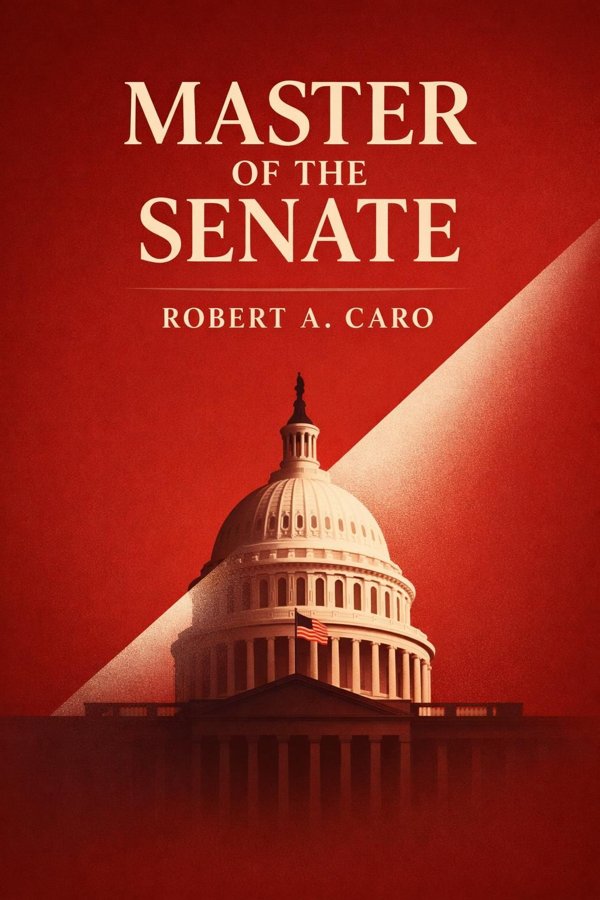
Master of the Senate: The Years of Lyndon Johnson, Volume III: Summary & Key Insights
 10 min9 chaptersAudio available
Key Takeaways from Master of the Senate: The Years of Lyndon Johnson, Volume III
Before Lyndon Johnson mastered the Senate, he mastered something even more fundamental: the study of power itself.
An institution can be prestigious and still fail at its most important job.
Leadership contests are rarely won by charisma alone; they are won by arithmetic, anticipation, and pressure.
Titles do not create power on their own; people create power by redefining what a title can do.
Power is most effective when it can switch registers instantly.
What Is Master of the Senate: The Years of Lyndon Johnson, Volume III About?
Master of the Senate: The Years of Lyndon Johnson, Volume III by Robert A. Caro is a biographies book spanning 11 pages. Robert A. Caro’s Master of the Senate is both a biography of Lyndon B. Johnson and a sweeping study of how political power actually works inside democratic institutions. Covering Johnson’s rise from ambitious congressman to Senate Majority Leader, the book shows how he entered a chamber paralyzed by tradition, seniority, and obstruction and then bent it to his will through strategy, intimidation, charm, and relentless labor. At the center of the narrative is a profound question: how does one individual transform a stagnant institution into an engine of action? What makes this volume so important is that Caro does not present power as an abstraction. He reveals it in procedure, personality, timing, alliances, and the hidden bargains that shape public life. Johnson emerges as both brilliant and troubling: a leader capable of advancing legislation, including the Civil Rights Act of 1957, while also compromising and manipulating to achieve his ends. Caro’s authority comes from extraordinary research, deep archival work, and his unmatched ability to connect personal ambition with national consequence. The result is a landmark account of leadership, moral compromise, and the making of modern American politics.
This FizzRead summary covers all 9 key chapters of Master of the Senate: The Years of Lyndon Johnson, Volume III in approximately 10 minutes, distilling the most important ideas, arguments, and takeaways from Robert A. Caro's work. Also available as an audio summary and Key Quotes Podcast.
Master of the Senate: The Years of Lyndon Johnson, Volume III
Robert A. Caro’s Master of the Senate is both a biography of Lyndon B. Johnson and a sweeping study of how political power actually works inside democratic institutions. Covering Johnson’s rise from ambitious congressman to Senate Majority Leader, the book shows how he entered a chamber paralyzed by tradition, seniority, and obstruction and then bent it to his will through strategy, intimidation, charm, and relentless labor. At the center of the narrative is a profound question: how does one individual transform a stagnant institution into an engine of action?
What makes this volume so important is that Caro does not present power as an abstraction. He reveals it in procedure, personality, timing, alliances, and the hidden bargains that shape public life. Johnson emerges as both brilliant and troubling: a leader capable of advancing legislation, including the Civil Rights Act of 1957, while also compromising and manipulating to achieve his ends. Caro’s authority comes from extraordinary research, deep archival work, and his unmatched ability to connect personal ambition with national consequence. The result is a landmark account of leadership, moral compromise, and the making of modern American politics.
Who Should Read Master of the Senate: The Years of Lyndon Johnson, Volume III?
This book is perfect for anyone interested in biographies and looking to gain actionable insights in a short read. Whether you're a student, professional, or lifelong learner, the key ideas from Master of the Senate: The Years of Lyndon Johnson, Volume III by Robert A. Caro will help you think differently.
- ✓Readers who enjoy biographies and want practical takeaways
- ✓Professionals looking to apply new ideas to their work and life
- ✓Anyone who wants the core insights of Master of the Senate: The Years of Lyndon Johnson, Volume III in just 10 minutes
Want the full summary?
Get instant access to this book summary and 100K+ more with Fizz Moment.
Get Free SummaryAvailable on App Store • Free to download
Key Chapters
Before Lyndon Johnson mastered the Senate, he mastered something even more fundamental: the study of power itself. Caro shows that Johnson’s years in the House of Representatives were not a warm-up but an apprenticeship in institutional survival. He arrived in Washington with little money, enormous hunger, and an almost frightening sensitivity to hierarchy. He watched who mattered, who controlled access, who shaped outcomes, and who was merely performing importance. That habit of observation became one of his greatest assets.
Johnson learned that influence did not come simply from speeches or ideals. It came from understanding rules, relationships, timing, and personal weakness. He cultivated older lawmakers, made himself useful, remembered favors, and studied procedure with an intensity that others reserved for ideology. He understood early that people could be moved by praise, fear, debt, vanity, or urgency, and he stored these lessons for future use.
This idea matters beyond politics. In any organization, the formal chart rarely tells the whole story. Real power often lies in who controls information, who decides priorities, and who can turn relationships into action. Johnson’s example shows the value of patient observation before bold moves. He did not begin by trying to dominate the system. He began by decoding it.
A practical application is to spend time mapping how your own institution really works: who influences decisions, what incentives drive behavior, and where bottlenecks actually lie. Johnson’s early career reminds us that ambition without study is noise, but ambition combined with institutional understanding can become decisive force.
Actionable takeaway: before trying to lead a system, learn its hidden structure better than anyone else.
An institution can be prestigious and still fail at its most important job. One of Caro’s central achievements is his portrait of the mid-century United States Senate as a grand chamber trapped by its own rituals. It possessed enormous constitutional authority, yet it was frequently incapable of action. Seniority gave committee chairmen near-feudal power, debate rules enabled endless delay, and the filibuster allowed determined minorities to suffocate change, especially on civil rights.
Caro does not merely describe a dysfunctional legislature; he explains why its dysfunction endured. Tradition gave obstruction a noble appearance. Decorum masked avoidance. Members often prized clubbiness and status over effectiveness. In that environment, moral urgency could be neutralized by procedure. Reformers could win public arguments and still lose in committee rooms.
This matters because many modern institutions operate the same way. Organizations often preserve ceremonies of seriousness while becoming resistant to actual performance. Meetings substitute for decisions. Rules designed for deliberation become tools of inertia. Leaders then face a difficult challenge: how do you restore action without simply becoming authoritarian?
Johnson recognized that the Senate’s weakness was also an opportunity. A chamber waiting for direction could be reorganized by someone willing to work harder, count more carefully, and impose momentum on a drifting body. He saw that institutional decay often creates a vacuum, and vacuums invite power.
In practical terms, this idea applies to workplaces, nonprofits, universities, and governments alike. If your organization feels stuck, look for the procedural habits causing paralysis. Which customs protect excellence, and which merely protect comfort?
Actionable takeaway: diagnose whether your institution’s traditions still serve its mission, and challenge the ones that have become excuses for inaction.
Leadership contests are rarely won by charisma alone; they are won by arithmetic, anticipation, and pressure. Johnson’s rise to Senate Majority Leader, as Caro presents it, was a tactical masterpiece built on exact knowledge of personalities and votes. He did not leave outcomes to mood or chance. He counted supporters obsessively, tracked wavering senators, and tailored his approach to each individual. Some needed flattery. Others needed reassurance. Others needed reminders of future debts.
Johnson’s genius was that he understood politics as both structure and theater. Publicly, he could appear collaborative and energetic, almost inevitable. Privately, he was calculating every angle. He knew that formal votes are often decided long before they are cast, in private conversations, strategic concessions, and carefully managed expectations. His victory was not just about convincing people that he should lead; it was about making it hard for them to imagine any other workable arrangement.
This lesson extends to any competitive environment. Successful negotiations, promotions, and coalition-building efforts often depend less on dramatic persuasion than on disciplined preparation. People frequently fail because they argue well but prepare poorly. Johnson prepared relentlessly.
A practical example: before a major proposal at work, don’t rely on the meeting itself. Speak to stakeholders in advance, identify objections, secure informal commitments, and understand what each person needs to say yes. Build the decision before the decision.
Caro also shows the moral ambiguity of this method. Tactical brilliance can produce effective leadership, but it can also normalize manipulation. Johnson’s success forces readers to ask not only how power is won, but what ethical lines are crossed in the process.
Actionable takeaway: major decisions are usually determined before the formal moment—prepare early, count carefully, and never assume support without verification.
Titles do not create power on their own; people create power by redefining what a title can do. Before Johnson, the Senate Majority Leader was not the commanding position it later became. Caro shows how Johnson transformed the office from a relatively limited role into the nerve center of the chamber. He centralized information, coordinated schedules, monitored committee movement, and made himself indispensable to senators, presidents, and reporters alike.
Johnson’s insight was simple but profound: in a fragmented institution, the person who connects the fragments can become the true center of authority. He turned access into leverage. If senators needed floor time, help with legislation, strategic advice, or mediation, they came to him. If the White House needed something moved, it came through him. He made himself the essential intermediary between competing ambitions.
This is a classic lesson in organizational leadership. You do not always need the highest formal rank to become powerful. Often the most influential person is the one who reduces chaos, solves coordination problems, and becomes the trusted route through which things get done. Operational mastery often outweighs ceremonial prestige.
In practical settings, this can mean becoming the person who links teams, translates between executives and specialists, or anticipates obstacles before others see them. Such people gain influence because they lower the cost of action for everyone around them.
Yet Caro reminds us that efficiency and domination can blur together. Johnson’s redesign of the role made the Senate function better, but it also concentrated influence in one man’s hands to an extraordinary degree.
Actionable takeaway: if you want greater influence, become essential at the point where people, information, and decisions converge.
Power is most effective when it can switch registers instantly. One moment Johnson offered warmth, loyalty, and opportunity; the next he could threaten isolation, embarrassment, or political damage. Caro famously illustrates how Johnson’s legendary personal style worked not because he was merely charming or merely intimidating, but because he fused both. He studied people closely enough to know which emotional lever would move each one.
Johnson’s method rested on total engagement. He invaded physical space, dominated conversations, showered attention, invoked shared history, offered favors, and suggested consequences. He made others feel, often at the same time, chosen and cornered. This was not accidental charisma. It was deliberate pressure calibrated to personality.
The larger insight is uncomfortable but important: persuasion is rarely purely rational. People decide through emotion, identity, fear of loss, social belonging, and personal recognition. Effective leaders understand that. Ethical leaders use that understanding carefully; unethical ones exploit it without restraint.
A modern application can be seen in management and negotiation. If you want commitment, facts matter, but so does making people feel seen, significant, and safe. At the same time, the dark side of Johnson’s example warns against leadership cultures built on anxiety. Fear can produce short-term obedience, but it often damages trust and independence over time.
Caro’s portrait is valuable because it strips away the fantasy that high politics is detached from human psychology. It is not. Institutions are made of people, and people are moved by more than logic.
Actionable takeaway: learn how people are actually motivated, but use influence to build durable commitment rather than dependence or fear.
The hardest political test is not whether a leader can gain power, but what he is willing to risk once he has it. In Caro’s account, civil rights becomes the issue that most clearly reveals both Johnson’s brilliance and his limits. As a Southerner with national ambitions, Johnson stood at the fault line between the Southern bloc that dominated key Senate machinery and the moral necessity of confronting segregation. He understood the depth of Southern resistance and the procedural weapons available to defenders of white supremacy.
Johnson’s balancing act was extraordinarily delicate. He wanted progress, but he also wanted to preserve his standing, maintain Senate control, and keep open the path to the presidency. This tension culminates in the Civil Rights Act of 1957, the first civil rights legislation since Reconstruction. Caro shows how Johnson maneuvered, negotiated, and reframed the bill to secure passage. It was a historic breakthrough because it cracked the long legislative silence around civil rights. Yet it was also weakened by compromise, leaving many reformers frustrated.
This duality is one of the book’s deepest lessons. Political progress often comes through imperfect victories. Purity can lose; compromise can pass. But compromise can also dilute justice and postpone real change. Johnson’s achievement cannot be understood in simple heroic terms. It was simultaneously historic and inadequate.
For readers today, this is highly relevant. In public life, organizational reform, or activism, leaders constantly face the question of whether to accept partial gains or hold out for more. Caro offers no easy formula, but he makes the stakes vivid.
Actionable takeaway: when pursuing change, distinguish between strategic compromise that opens the door and compromise that quietly locks it again.
Great leaders do more than win individual battles; they alter the tempo of an institution. One of the most striking themes in Master of the Senate is that Johnson did not merely accumulate personal power. He changed how the Senate moved. Under his leadership, a body known for drift, delay, and ceremonial self-importance began to behave more like an instrument of coordinated action. Legislation was scheduled more effectively, votes were managed more tightly, and internal relationships were organized around movement rather than stasis.
Caro’s point is not that Johnson made the Senate pure or consistently admirable. Rather, he made it function. That distinction matters. Many institutions suffer less from lack of talent than from lack of momentum. People are capable, but no one aligns them. Priorities remain unclear. Deadlines slip. Responsibility diffuses. In such environments, progress feels accidental.
Johnson’s example shows the power of imposed momentum. By concentrating attention, reducing uncertainty, and forcing choices, a leader can make a stagnant system feel alive again. This is one reason even those who disliked Johnson often found themselves operating within a rhythm he created.
A practical application is in project leadership. Teams often stall because too many decisions remain open at once. A strong coordinator can sequence the work, clarify next steps, and maintain pressure toward completion. Momentum itself becomes persuasive; people start acting because action has become the norm.
Still, Caro invites a caution: once an institution becomes dependent on one individual’s force, it may struggle without him. Sustainable systems need structure, not just personality.
Actionable takeaway: create momentum by clarifying priorities, sequencing decisions, and making forward movement easier than delay.
The public often sees ambition as glamorous, but Caro insists on showing its private price. Johnson’s rise was not only a story of victory; it was a story of strain, exhaustion, insecurity, and damage to those around him. His need for control was relentless. He monitored, pressed, and maneuvered with such intensity that power became not an achievement to enjoy but a condition he had to constantly defend. The same drive that made him formidable also made him unable to rest.
This had consequences in his marriage, his health, and his emotional life. Caro portrays a man whose hunger for advancement repeatedly overrode intimacy and peace. Lady Bird Johnson’s role becomes especially significant: she provided stability, support, and sacrifice that made his ascent possible, often at personal cost to herself. The book therefore broadens from political biography into a meditation on what ambition consumes.
This theme is broadly applicable. In many professions, especially elite ones, people confuse total commitment with healthy excellence. They normalize burnout, emotional absence, and the instrumental treatment of relationships. Johnson’s life warns that extraordinary achievement can coexist with profound imbalance.
A practical lesson for contemporary readers is to ask what success is requiring from them offstage. Are professional gains eroding health, family trust, or inner stability? Ambition can be productive and even noble, but only if its costs are consciously examined rather than silently accepted.
Caro does not sentimentalize Johnson, but he does humanize him. Mastery looked commanding from the outside. From the inside, it often looked lonely and unsustainable.
Actionable takeaway: define success not only by what you gain in public, but by what you are unwilling to destroy in private.
National leadership is often prepared long before the nation notices. By the end of this volume, Caro makes clear that Johnson’s Senate years were not an interlude before the presidency; they were the forge in which his presidential capacity was created. In the Senate, Johnson learned how to move legislation, manage rival factions, communicate urgency, and convert procedural knowledge into national consequence. He also learned the limits of his own methods, especially when moral questions collided with strategic calculation.
These years elevated Johnson from regional politician to national figure. His command of the Senate gave him visibility, credibility, and the aura of indispensability. He became known not simply as a man with opinions, but as a man who could make things happen. That reputation would matter enormously when he later entered the White House and pursued transformative legislation.
The deeper insight is that leadership at the highest level depends on accumulated craft. Publics often focus on elections, speeches, and image. Caro focuses on the years of backstage learning that make visible leadership effective. Johnson’s eventual presidential successes and failures cannot be understood without the Senate laboratory in which he refined his methods.
This matters for readers because it reframes career development. Big responsibilities are rarely handled well by those who have not mastered smaller but related arenas first. The habits built in one role become the instincts used in the next.
If you aspire to greater leadership, your current environment is not a waiting room. It is training ground. The skills you build now in negotiation, coordination, judgment, and endurance may later define your effectiveness at a much larger scale.
Actionable takeaway: treat every current responsibility as preparation for future leadership, and build the operational skills that higher roles will demand.
All Chapters in Master of the Senate: The Years of Lyndon Johnson, Volume III
About the Author
Robert A. Caro is an American journalist, historian, and biographer renowned for his monumental studies of political power. Born in 1935, he began his career in journalism before turning to long-form biography, where his meticulous research and narrative skill set a new standard for the genre. He is best known for The Power Broker, his landmark book on Robert Moses, and for The Years of Lyndon Johnson, a multi-volume life of the 36th U.S. president. Caro is famous for immersive reporting, extensive archival investigation, and his ability to show how institutions and individuals shape each other. His work has earned major honors, including Pulitzer Prizes and National Book Awards, and he is widely regarded as one of the greatest biographers of the modern era.
Get This Summary in Your Preferred Format
Read or listen to the Master of the Senate: The Years of Lyndon Johnson, Volume III summary by Robert A. Caro anytime, anywhere. FizzRead offers multiple formats so you can learn on your terms — all free.
Available formats: App · Audio · PDF · EPUB — All included free with FizzRead
Download Master of the Senate: The Years of Lyndon Johnson, Volume III PDF and EPUB Summary
Key Quotes from Master of the Senate: The Years of Lyndon Johnson, Volume III
“Before Lyndon Johnson mastered the Senate, he mastered something even more fundamental: the study of power itself.”
“An institution can be prestigious and still fail at its most important job.”
“Leadership contests are rarely won by charisma alone; they are won by arithmetic, anticipation, and pressure.”
“Titles do not create power on their own; people create power by redefining what a title can do.”
“Power is most effective when it can switch registers instantly.”
Frequently Asked Questions about Master of the Senate: The Years of Lyndon Johnson, Volume III
Master of the Senate: The Years of Lyndon Johnson, Volume III by Robert A. Caro is a biographies book that explores key ideas across 9 chapters. Robert A. Caro’s Master of the Senate is both a biography of Lyndon B. Johnson and a sweeping study of how political power actually works inside democratic institutions. Covering Johnson’s rise from ambitious congressman to Senate Majority Leader, the book shows how he entered a chamber paralyzed by tradition, seniority, and obstruction and then bent it to his will through strategy, intimidation, charm, and relentless labor. At the center of the narrative is a profound question: how does one individual transform a stagnant institution into an engine of action? What makes this volume so important is that Caro does not present power as an abstraction. He reveals it in procedure, personality, timing, alliances, and the hidden bargains that shape public life. Johnson emerges as both brilliant and troubling: a leader capable of advancing legislation, including the Civil Rights Act of 1957, while also compromising and manipulating to achieve his ends. Caro’s authority comes from extraordinary research, deep archival work, and his unmatched ability to connect personal ambition with national consequence. The result is a landmark account of leadership, moral compromise, and the making of modern American politics.
More by Robert A. Caro
The Passage Of Power: The Years of Lyndon Johnson, Volume 4
Robert A. Caro
10 min
Means of Ascent: The Years of Lyndon Johnson, Volume II
Robert A. Caro
10 min
The Power Broker: Robert Moses and the Fall of New York
Robert A. Caro
10 min
The Path to Power
Robert A. Caro
10 minYou Might Also Like

An American Marriage
Tayari Jones
10 min
Benjamin Franklin: An American Life
Walter Isaacson
10 min
I Know Why The Caged Bird Sings
Maya Angelou
10 min
Long Walk to Freedom
Nelson Mandela
10 min
Persepolis
Marjane Satrapi
10 min
Surely You're Joking, Mr. Feynman!
Richard P. Feynman
10 minBrowse by Category
Ready to read Master of the Senate: The Years of Lyndon Johnson, Volume III?
Get the full summary and 100K+ more books with Fizz Moment.