
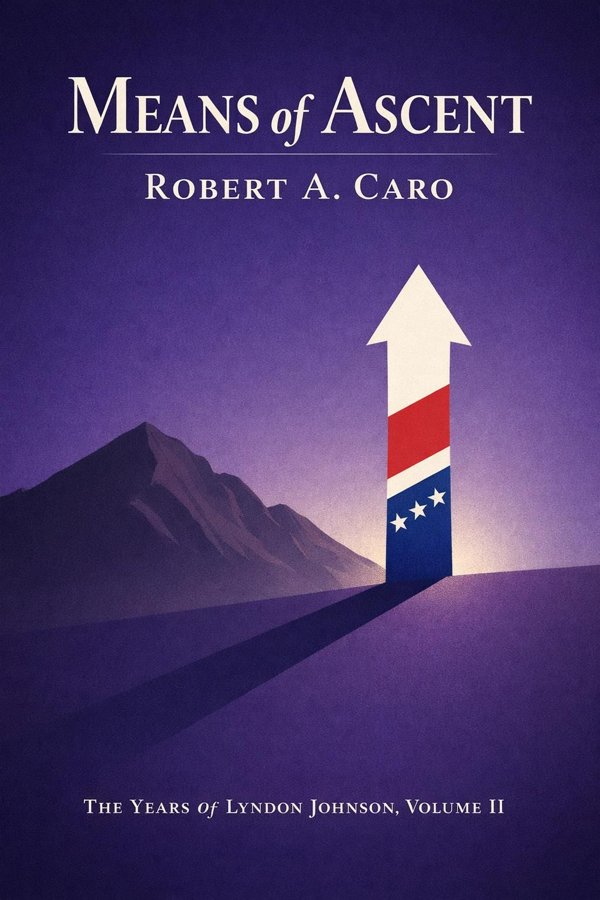
Means of Ascent: The Years of Lyndon Johnson, Volume II: Summary & Key Insights
 10 min9 chaptersAudio available
Key Takeaways from Means of Ascent: The Years of Lyndon Johnson, Volume II
A striking truth runs through Johnson’s early congressional years: before a politician can shape events, he must first get close enough to power to matter.
Behind Lyndon Johnson’s relentless rise stood a quieter force without whom that rise might have collapsed.
In postwar Texas, radio, aircraft, and modern campaign logistics allowed Johnson to campaign on a scale that older political traditions could not match.
A central achievement of Means of Ascent is that it explains Lyndon Johnson’s rise by placing it inside a transforming Texas.
Caro turns Coke Stevenson into more than a political opponent.
What Is Means of Ascent: The Years of Lyndon Johnson, Volume II About?
Means of Ascent: The Years of Lyndon Johnson, Volume II by Robert A. Caro is a biographies book spanning 12 pages. Robert A. Caro’s Means of Ascent, the second volume of The Years of Lyndon Johnson, is far more than a political biography. It is an investigation into how ambition operates when it is stripped of sentiment and directed toward power with extraordinary discipline. Covering the years from 1941 to 1948, the book follows Lyndon B. Johnson from a promising congressman to a man willing to push every moral boundary in pursuit of a Senate seat. At its center is the infamous 1948 Democratic primary in Texas, one of the most controversial elections in American history. What makes this book so powerful is Caro’s method. He combines archival research, court records, interviews, campaign detail, and social history to show not only what Johnson did, but also the world that made his rise possible. Texas itself becomes a character: a state moving from rural honor codes into machine politics, media manipulation, and modern money-driven campaigning. Caro’s authority rests on unmatched reporting and narrative precision. The result is a gripping, unsettling portrait of political ascent and a profound meditation on what power reveals about character.
This FizzRead summary covers all 9 key chapters of Means of Ascent: The Years of Lyndon Johnson, Volume II in approximately 10 minutes, distilling the most important ideas, arguments, and takeaways from Robert A. Caro's work. Also available as an audio summary and Key Quotes Podcast.
Means of Ascent: The Years of Lyndon Johnson, Volume II
Robert A. Caro’s Means of Ascent, the second volume of The Years of Lyndon Johnson, is far more than a political biography. It is an investigation into how ambition operates when it is stripped of sentiment and directed toward power with extraordinary discipline. Covering the years from 1941 to 1948, the book follows Lyndon B. Johnson from a promising congressman to a man willing to push every moral boundary in pursuit of a Senate seat. At its center is the infamous 1948 Democratic primary in Texas, one of the most controversial elections in American history.
What makes this book so powerful is Caro’s method. He combines archival research, court records, interviews, campaign detail, and social history to show not only what Johnson did, but also the world that made his rise possible. Texas itself becomes a character: a state moving from rural honor codes into machine politics, media manipulation, and modern money-driven campaigning. Caro’s authority rests on unmatched reporting and narrative precision. The result is a gripping, unsettling portrait of political ascent and a profound meditation on what power reveals about character.
Who Should Read Means of Ascent: The Years of Lyndon Johnson, Volume II?
This book is perfect for anyone interested in biographies and looking to gain actionable insights in a short read. Whether you're a student, professional, or lifelong learner, the key ideas from Means of Ascent: The Years of Lyndon Johnson, Volume II by Robert A. Caro will help you think differently.
- ✓Readers who enjoy biographies and want practical takeaways
- ✓Professionals looking to apply new ideas to their work and life
- ✓Anyone who wants the core insights of Means of Ascent: The Years of Lyndon Johnson, Volume II in just 10 minutes
Want the full summary?
Get instant access to this book summary and 100K+ more with Fizz Moment.
Get Free SummaryAvailable on App Store • Free to download
Key Chapters
A striking truth runs through Johnson’s early congressional years: before a politician can shape events, he must first get close enough to power to matter. Caro shows that when Lyndon Johnson entered the House of Representatives, he was not driven primarily by doctrine or by philosophical consistency. He was driven by access. He studied who mattered, how influence moved, and where decisions were really made. In Washington, that meant attaching himself to the Roosevelt orbit, mastering relationships, and becoming useful to those above him.
Johnson’s genius was practical rather than abstract. He understood that political capital often comes not from speeches but from service, timing, and visibility. He learned to anticipate needs, flatter egos, relay information, and position himself as indispensable. This was not glamorous work, but it was effective. Caro uses these years to reveal Johnson’s core operating principle: ideology could be adjusted, but access had to be secured at all costs.
This idea extends beyond politics. In any institution, formal titles rarely tell the whole story. Influence belongs to those who understand the network behind the chart. A young professional, entrepreneur, or civic leader can learn from Johnson’s tactical awareness without copying his ethics. It matters to know who makes decisions, who shapes opinion, and who is trusted when urgent choices arise.
The larger lesson, however, is cautionary. Proximity to power can become an end in itself. Once access becomes the main goal, principles are easily treated as negotiable. Caro invites readers to see both the effectiveness and the danger of this mindset.
Actionable takeaway: map the real centers of influence in your field, build genuine relationships with decision-makers, and decide in advance which values you will not trade for access.
Behind Lyndon Johnson’s relentless rise stood a quieter force without whom that rise might have collapsed. Caro presents Lady Bird Johnson not as a decorative political spouse but as a stabilizing, enabling, and often financially crucial partner. Her emotional steadiness, social intelligence, and willingness to absorb strain made possible a life organized around Lyndon’s appetite for advancement. In a story dominated by aggression, she represents endurance.
Lady Bird’s role was practical as well as personal. She helped preserve order amid chaos, smoothed relationships, and contributed economic resources at moments when Johnson’s ambitions outran his means. She also provided a calm public contrast to his volatility. Where he could be overbearing, insecure, and explosive, she often appeared composed and gracious. That difference mattered politically because campaigns are sustained not only by strategy but by households, networks, and private resilience.
Caro’s treatment of Lady Bird broadens the meaning of political biography. Great public careers are rarely solitary achievements. They are built on invisible labor: financial sacrifices, emotional management, logistical support, and the maintenance of social trust. In business and public life, the same pattern often holds. High performers may appear self-made while relying heavily on partners, colleagues, or family members whose contribution remains underacknowledged.
The book also raises a harder question: when does support become complicity? Lady Bird’s loyalty helped sustain a project whose moral dimensions were often troubling. Caro does not reduce her to a victim or saint; instead, he shows the complexity of devotion within power.
Actionable takeaway: if you are building anything ambitious, identify the unseen people sustaining your effort, acknowledge their contribution openly, and create boundaries so loyalty does not force others to carry the cost of your decisions.
One of Caro’s most illuminating insights is that Johnson understood earlier than many rivals that technology changes politics not merely by speeding communication, but by changing who can be reached, persuaded, and emotionally activated. In postwar Texas, radio, aircraft, and modern campaign logistics allowed Johnson to campaign on a scale that older political traditions could not match. He used these tools not as novelties, but as weapons.
Texas had long favored the politics of personal reputation, regional loyalty, and courthouse networks. Johnson recognized that this model was weakening. A candidate who could fly rapidly between towns, coordinate messaging, and speak through modern media could overwhelm opponents still relying on slower methods and inherited prestige. He became a candidate of velocity. His campaign style reflected a broader transition from intimate politics to mass-mediated politics.
Caro’s account feels contemporary because the principle remains unchanged. New tools do not simply enhance old strategies; they reward different kinds of actors. In today’s terms, social platforms, targeted outreach, data systems, and rapid-response messaging can alter the balance between established institutions and agile operators. Those who embrace the new environment early often gain disproportionate advantages.
But Caro also shows the ethical problem. Technology amplifies message and reach regardless of whether the content is honest. Modernization does not purify politics; it often increases the efficiency of manipulation. Johnson’s mastery of campaign tools helped him connect with voters, but it also helped him overpower scrutiny and frame reality on his own terms.
Actionable takeaway: adopt emerging tools early, but pair speed and reach with clear ethical standards, because technology magnifies both competence and misconduct.
A central achievement of Means of Ascent is that it explains Lyndon Johnson’s rise by placing it inside a transforming Texas. Caro shows a state caught between frontier ideals and modern political machinery. Old Texas celebrated personal honor, rural independence, and figures like Coke Stevenson, whose public image rested on simplicity, integrity, and plainspoken strength. But beneath that mythology, economic modernization, urban growth, wartime expansion, and new business interests were creating a different political order.
Johnson thrived because he sensed this transition more clearly than many of his rivals. He did not merely campaign in Texas; he read the direction in which Texas was moving. The state’s oil wealth, regional inequalities, shifting media landscape, and growing appetite for modern infrastructure created openings for a more energetic, transactional style of leadership. Johnson positioned himself as the man of the future in a culture that still used the language of the past.
Caro’s portrait of Texas is valuable far beyond this biography. It demonstrates how political character is shaped by historical transition. Leaders often seem uniquely brilliant or uniquely corrupt when, in reality, they are also products of moments when old rules are losing force and new ones have not yet been fully established. Such periods reward adaptability, boldness, and sometimes ruthlessness.
This pattern appears in organizations and societies alike. When systems are in transition, people who understand both the old norms and the emerging mechanics can dominate the field. Yet they may do so by exploiting uncertainty rather than serving the public good.
Actionable takeaway: when evaluating any leader, study the system in transition around them; understanding the changing environment will reveal why certain tactics suddenly become powerful.
Caro turns Coke Stevenson into more than a political opponent. He becomes the embodiment of an older moral style in Texas public life. Stevenson was austere, disciplined, and reputedly honest to an almost archaic degree. His life story, rooted in hardship and self-mastery, gave him an authenticity that voters recognized. He did not need theatrical charm; his reputation itself functioned as political currency. In many ways, he stood for a world where character was expected to restrain ambition.
That is precisely why his conflict with Johnson matters so much. The 1948 Senate race was not merely a contest between two men but between two political sensibilities. Stevenson believed public trust rested on personal integrity and straightforward dealing. Johnson believed victory depended on energy, organization, media, money, and the ruthless exploitation of every opening. Caro does not pretend Stevenson was politically flawless or universally effective, but he treats him as a real moral counterweight.
By juxtaposing these men, Caro asks a haunting question: what happens when an ethic of honor confronts a system increasingly governed by technique? Stevenson’s virtues inspired admiration, yet they also left him vulnerable. He underestimated how thoroughly modern campaigning could bypass traditional credibility. In contemporary terms, expertise in persuasion, logistics, and legal maneuvering can overwhelm reputational decency if institutions are weak.
The lesson is uncomfortable. Integrity remains essential, but integrity without operational awareness can be defeated by more aggressive actors. Good people and good institutions must be able to defend themselves in the real conditions they inhabit.
Actionable takeaway: value character deeply, but do not assume virtue is self-executing; pair integrity with strategy, vigilance, and institutional competence.
One of the clearest lessons in Caro’s narrative is that Johnson’s 1948 Senate campaign was won, in part, long before most voters were paying attention. He prepared obsessively. He studied counties, relationships, donor channels, voting patterns, local brokers, and the mechanics of turnout. He built networks that could be activated under pressure. Caro makes plain that Johnson did not rely on charisma alone; he relied on infrastructure.
This preparation distinguished him from opponents who leaned too heavily on prestige or broad popularity. Johnson approached politics as a total system. He understood that success depends on aligning message, logistics, money, transportation, endorsements, and contingency plans. Campaigns are often described through speeches and headlines, but Caro insists that outcomes frequently depend on what happens backstage: who keeps lists, who counts, who calls, who pays, and who shows up in the last 48 hours.
This insight applies broadly. In careers, negotiations, product launches, and leadership transitions, visible performance usually rests on invisible preparation. The person who appears spontaneous may simply have prepared more thoroughly than everyone else. Preparation creates optionality. It allows faster response, calmer judgment, and better use of opportunity when conditions shift.
At the same time, Caro shows the moral neutrality of preparation. The same discipline that can support admirable goals can also support deeply compromised ones. Organization is a force multiplier, not a moral compass. Johnson’s meticulous planning helped him outmaneuver rivals, but it also gave him the capacity to press beyond ethical limits when the race tightened.
Actionable takeaway: invest heavily in preparation before high-stakes moments, but define ethical guardrails in advance so efficiency never outruns conscience.
Caro strips away comforting illusions about democratic purity by showing how deeply Johnson’s rise depended on money and influence. Campaigns require travel, advertising, staffing, favors, and organization, and Johnson proved remarkably adept at securing support from wealthy backers and power brokers. He cultivated people who could finance movement, open doors, and legitimize his candidacy. In Caro’s telling, money is never incidental; it is one of the main engines of political possibility.
What makes this so important is that Johnson did not treat donors merely as benefactors. He understood them as nodes in a larger structure of reciprocal advantage. Financial support, endorsements, access to media, and local influence reinforced one another. Politics was not simply candidate versus candidate, but network versus network. The strongest network could shape narratives, mobilize turnout, and withstand setbacks that would sink a more isolated campaign.
This remains relevant in every field where formal merit competes with organized support. The best idea does not always win. The most qualified person does not always advance. Outcomes often depend on whether talent is attached to a coalition capable of sustaining it. That is why institutions need transparency and accountability: without them, hidden influence can dominate public procedure.
Caro’s account also reminds readers that resentment toward money in politics is not enough. The practical challenge is building systems where resources can support communication and competition without enabling capture and distortion.
Actionable takeaway: build strong, ethical networks around your work, understand the role of resources in shaping outcomes, and insist on transparency whenever money and decision-making intersect.
The most famous and disturbing section of Means of Ascent concerns the 1948 Senate primary and the disputed vote count that ultimately gave Johnson victory by an astonishingly narrow margin. Caro reconstructs the process with investigative rigor, showing how procedural ambiguity, local control, partisan pressure, and manipulated returns created the conditions for fraud. The notorious late-reported ballots from Box 13 became emblematic not just of one scandal, but of how vulnerable democratic systems can be when those administering them lack independence.
This episode matters because it reveals that elections do not fail only through dramatic coups or open violence. They can be bent through paperwork, delayed reporting, selective certification, legal maneuvering, and the exploitation of public confusion. Johnson’s team understood the machinery well enough to fight in every arena at once: political, legal, procedural, and psychological. Stevenson, despite his reputation, struggled to match that intensity.
Caro’s contribution is not simply to accuse. It is to show mechanism. He demonstrates how close contests create incentives for pressure, how local officials become pivotal, and how legitimacy can be contested even when institutions formally continue to function. That insight remains deeply relevant in modern democracies, corporations, associations, and universities alike. Rules are only as strong as the culture and enforcement supporting them.
The broader lesson is sobering: trust in systems must be earned through verification, not assumed through tradition. Fairness requires design, scrutiny, and independent review.
Actionable takeaway: whenever a process matters, insist on documentation, transparent oversight, and auditable procedures, because integrity depends on systems that can withstand pressure.
The deepest question in Means of Ascent is not whether Lyndon Johnson was talented. Caro leaves no doubt that he was. The deeper question is what happens when enormous talent is fused with ambition so intense that moral boundaries become tactical inconveniences. Johnson wanted power not casually, but existentially. He needed victory with a hunger that made compromise with conscience increasingly likely. Caro’s portrait is powerful because it refuses easy simplification: Johnson was energetic, visionary, hardworking, and often politically brilliant, yet those strengths were inseparable from a willingness to coerce, manipulate, and cross lines.
This is the book’s enduring contribution. It suggests that ambition is not automatically admirable. Modern culture often celebrates drive as though intensity itself were a virtue. Caro argues, implicitly and through narrative evidence, that the value of ambition depends on the means it authorizes. A person may rise by discipline and intelligence while still damaging institutions, degrading norms, and corrupting the very sphere he seeks to lead.
This tension exists well beyond politics. In business, academia, media, and personal life, people are rewarded for outcomes and often forgiven for methods. Yet short-term victories gained through intimidation, deceit, or rule-bending carry long-term costs: distrust, institutional cynicism, and personal corrosion. Caro’s title itself points to the issue. Means matter because they shape both the winner and the world the winner inherits.
Actionable takeaway: pursue excellence and advancement fiercely, but audit your methods regularly; if success requires you to become someone you would not trust, the price is already too high.
All Chapters in Means of Ascent: The Years of Lyndon Johnson, Volume II
About the Author
Robert A. Caro is an American journalist, historian, and biographer celebrated for his unmatched depth of research and powerful narrative style. Born in 1935, he began his career in journalism, where he developed the investigative habits that later defined his books. Caro is best known for The Power Broker, his monumental biography of New York master builder Robert Moses, and for The Years of Lyndon Johnson, his multivolume study of Lyndon B. Johnson. His work explores not only the lives of major public figures but also the nature of political power itself: how it is accumulated, exercised, and justified. Caro has received numerous honors, including Pulitzer Prizes and National Book Awards, and is widely regarded as one of the greatest biographers of the modern era.
Get This Summary in Your Preferred Format
Read or listen to the Means of Ascent: The Years of Lyndon Johnson, Volume II summary by Robert A. Caro anytime, anywhere. FizzRead offers multiple formats so you can learn on your terms — all free.
Available formats: App · Audio · PDF · EPUB — All included free with FizzRead
Download Means of Ascent: The Years of Lyndon Johnson, Volume II PDF and EPUB Summary
Key Quotes from Means of Ascent: The Years of Lyndon Johnson, Volume II
“A striking truth runs through Johnson’s early congressional years: before a politician can shape events, he must first get close enough to power to matter.”
“Behind Lyndon Johnson’s relentless rise stood a quieter force without whom that rise might have collapsed.”
“In postwar Texas, radio, aircraft, and modern campaign logistics allowed Johnson to campaign on a scale that older political traditions could not match.”
“A central achievement of Means of Ascent is that it explains Lyndon Johnson’s rise by placing it inside a transforming Texas.”
“Caro turns Coke Stevenson into more than a political opponent.”
Frequently Asked Questions about Means of Ascent: The Years of Lyndon Johnson, Volume II
Means of Ascent: The Years of Lyndon Johnson, Volume II by Robert A. Caro is a biographies book that explores key ideas across 9 chapters. Robert A. Caro’s Means of Ascent, the second volume of The Years of Lyndon Johnson, is far more than a political biography. It is an investigation into how ambition operates when it is stripped of sentiment and directed toward power with extraordinary discipline. Covering the years from 1941 to 1948, the book follows Lyndon B. Johnson from a promising congressman to a man willing to push every moral boundary in pursuit of a Senate seat. At its center is the infamous 1948 Democratic primary in Texas, one of the most controversial elections in American history. What makes this book so powerful is Caro’s method. He combines archival research, court records, interviews, campaign detail, and social history to show not only what Johnson did, but also the world that made his rise possible. Texas itself becomes a character: a state moving from rural honor codes into machine politics, media manipulation, and modern money-driven campaigning. Caro’s authority rests on unmatched reporting and narrative precision. The result is a gripping, unsettling portrait of political ascent and a profound meditation on what power reveals about character.
More by Robert A. Caro
The Passage Of Power: The Years of Lyndon Johnson, Volume 4
Robert A. Caro
10 min
Master of the Senate: The Years of Lyndon Johnson, Volume III
Robert A. Caro
10 min
The Power Broker: Robert Moses and the Fall of New York
Robert A. Caro
10 min
The Path to Power
Robert A. Caro
10 minYou Might Also Like

An American Marriage
Tayari Jones
10 min
Benjamin Franklin: An American Life
Walter Isaacson
10 min
I Know Why The Caged Bird Sings
Maya Angelou
10 min
Long Walk to Freedom
Nelson Mandela
10 min
Persepolis
Marjane Satrapi
10 min
Surely You're Joking, Mr. Feynman!
Richard P. Feynman
10 minBrowse by Category
Ready to read Means of Ascent: The Years of Lyndon Johnson, Volume II?
Get the full summary and 100K+ more books with Fizz Moment.