
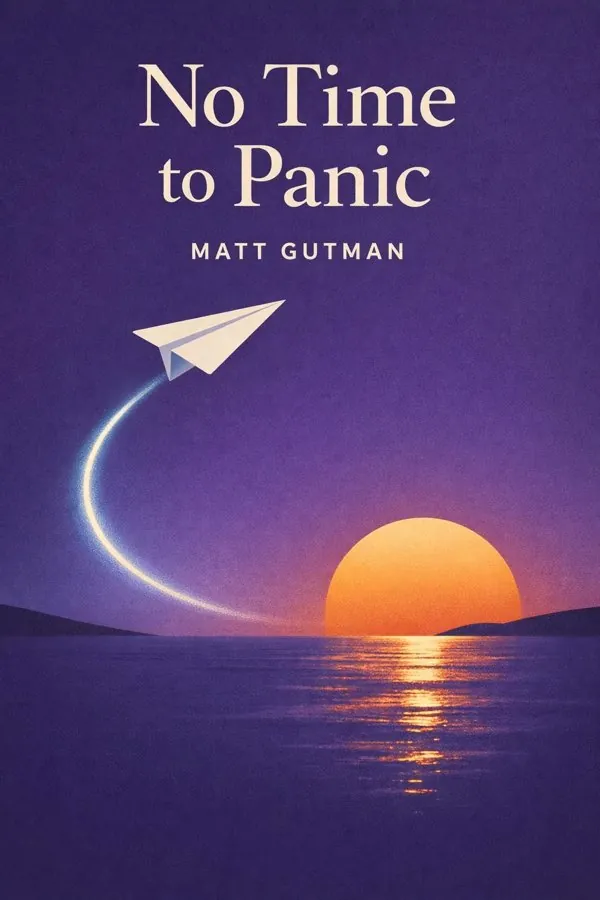
No Time to Panic: How to Stop Worrying and Embrace Life: Summary & Key Insights
by Matt Gutman
 10 min9 chaptersAudio available
Key Takeaways from No Time to Panic: How to Stop Worrying and Embrace Life
One of the most unsettling truths about anxiety is that it often coexists with outward competence.
A panic attack may last minutes, but its memory can shape years.
Fear becomes more dangerous when it feels inexplicable.
What we run from often grows larger in our minds.
Panic thrives in secrecy because shame convinces people they must conceal what they most need help with.
What Is No Time to Panic: How to Stop Worrying and Embrace Life About?
No Time to Panic: How to Stop Worrying and Embrace Life by Matt Gutman is a mental_health book. What if the fear you spend years hiding could become the very thing that helps you understand yourself? In No Time to Panic, journalist Matt Gutman tells the story of his lifelong struggle with anxiety and panic attacks, beginning with a terrifying episode as a teenager and continuing through a successful career that, from the outside, looked fearless. The book blends memoir, science, and practical self-inquiry to show that panic is not simply irrational weakness, but a deeply human response that can be understood, managed, and transformed. What makes this book especially powerful is Gutman’s credibility. As a veteran ABC News correspondent, he has reported from war zones, disaster sites, and high-pressure environments where composure matters. Yet behind that public image, he lived with private fear. His willingness to expose that contrast gives the book both emotional honesty and authority. Rather than offering simplistic positivity, Gutman investigates the biology of panic, the habits that feed it, and the tools that can loosen its grip. For anyone who worries excessively, feels trapped by anxious thoughts, or wants a more compassionate understanding of mental health, this book offers insight, relief, and hope.
This FizzRead summary covers all 9 key chapters of No Time to Panic: How to Stop Worrying and Embrace Life in approximately 10 minutes, distilling the most important ideas, arguments, and takeaways from Matt Gutman's work. Also available as an audio summary and Key Quotes Podcast.
No Time to Panic: How to Stop Worrying and Embrace Life
What if the fear you spend years hiding could become the very thing that helps you understand yourself? In No Time to Panic, journalist Matt Gutman tells the story of his lifelong struggle with anxiety and panic attacks, beginning with a terrifying episode as a teenager and continuing through a successful career that, from the outside, looked fearless. The book blends memoir, science, and practical self-inquiry to show that panic is not simply irrational weakness, but a deeply human response that can be understood, managed, and transformed.
What makes this book especially powerful is Gutman’s credibility. As a veteran ABC News correspondent, he has reported from war zones, disaster sites, and high-pressure environments where composure matters. Yet behind that public image, he lived with private fear. His willingness to expose that contrast gives the book both emotional honesty and authority. Rather than offering simplistic positivity, Gutman investigates the biology of panic, the habits that feed it, and the tools that can loosen its grip. For anyone who worries excessively, feels trapped by anxious thoughts, or wants a more compassionate understanding of mental health, this book offers insight, relief, and hope.
Who Should Read No Time to Panic: How to Stop Worrying and Embrace Life?
This book is perfect for anyone interested in mental_health and looking to gain actionable insights in a short read. Whether you're a student, professional, or lifelong learner, the key ideas from No Time to Panic: How to Stop Worrying and Embrace Life by Matt Gutman will help you think differently.
- ✓Readers who enjoy mental_health and want practical takeaways
- ✓Professionals looking to apply new ideas to their work and life
- ✓Anyone who wants the core insights of No Time to Panic: How to Stop Worrying and Embrace Life in just 10 minutes
Want the full summary?
Get instant access to this book summary and 100K+ more with Fizz Moment.
Get Free SummaryAvailable on App Store • Free to download
Key Chapters
One of the most unsettling truths about anxiety is that it often coexists with outward competence. Matt Gutman’s story challenges the assumption that panic only affects people who appear fragile or incapacitated. He built a demanding career in broadcast journalism, reporting in dangerous situations and projecting calm under pressure, while privately battling episodes of terror that felt uncontrollable. This contrast is central to the book’s power: panic does not always announce itself visibly, and many high achievers are quietly carrying it.
Gutman shows how this hidden struggle can become exhausting. When someone fears panic itself, daily life turns into a series of calculations: What if it happens in public? What if I lose control? What if people notice? The result is often a double life, where a person performs confidence while internally preparing for disaster. That split can intensify shame, because success may make the sufferer feel even more alone. Others assume everything is fine, so the anxious person concludes that something must be uniquely wrong with them.
A practical lesson here is that functioning well does not mean you are well. Many people dismiss their anxiety because they are still meeting deadlines, showing up for work, parenting, or caring for others. But private distress matters, even when life appears intact. Recognizing this can be liberating. It allows people to seek help earlier instead of waiting until they collapse.
In everyday life, this idea applies to professionals who seem polished but dread presentations, parents who hold things together while spiraling internally, or students who excel academically while suffering physically from stress. The takeaway is simple: stop measuring mental health by appearances alone. If fear is shaping your life in secret, that is reason enough to acknowledge it and begin addressing it honestly.
A panic attack may last minutes, but its memory can shape years. Gutman describes how an early terrifying episode became more than a bad moment; it became a reference point his mind kept returning to. That is one of the book’s most important insights: often, it is not only the original panic that causes suffering, but the anticipatory fear that follows. Once the brain has learned that intense fear can erupt suddenly, it begins scanning for signs that it might happen again.
This is how panic becomes self-reinforcing. A fast heartbeat, lightheadedness, or shortness of breath might be normal bodily sensations, but for someone with panic history, they can feel like a warning siren. The body reacts to that fear with even more adrenaline, which intensifies symptoms, which then confirms the fear. A vicious loop forms. Gutman helps readers see that the problem is not weakness or madness, but conditioning. The nervous system has learned a pattern.
That perspective matters because conditioned responses can be changed. If fear is learned, it can also be unlearned or softened through awareness, repetition, and treatment. Readers can apply this by identifying their own panic blueprint. What bodily sensation triggers alarm? What thought follows? What behavior comes next? For example, if dizziness leads to catastrophic thinking and immediate escape, mapping that chain can reduce its mystery.
The actionable takeaway is to write down your panic sequence in detail: trigger, body sensation, thought, behavior, aftermath. Seeing the pattern on paper helps transform panic from a chaotic enemy into a recognizable process, which is the first step toward interrupting it.
Fear becomes more dangerous when it feels inexplicable. One of Gutman’s most useful contributions is his exploration of the biology behind panic. He examines how the body’s alarm system, designed to protect us from threats, can misfire in modern life. Racing heart, sweating, tunnel vision, trembling, nausea, and hyperventilation can feel like signs of death, insanity, or collapse, but they are often the predictable outcomes of a stress response that has become oversensitive.
This scientific framing does not erase suffering, but it changes the interpretation of symptoms. Instead of thinking, “I am dying,” a person can learn to think, “My nervous system is flooding me with survival chemistry.” That shift is subtle but powerful. Catastrophic interpretations amplify panic, while informed interpretations can reduce secondary fear. Gutman’s reporting instincts help him translate clinical ideas into accessible language, allowing readers to see anxiety less as a moral failing and more as a mind-body event.
In practical terms, understanding biology can change how you respond during an episode. If your heart pounds before a meeting, during a flight, or in a crowded store, knowing that adrenaline naturally speeds the heart can keep the sensation from becoming a full spiral. If your breathing becomes shallow, recognizing hyperventilation as common in panic can help you pause instead of assuming the worst.
This insight also supports self-compassion. Bodies are not betraying us; they are overprotecting us. The actionable takeaway is to create a short factual script you can use in anxious moments, such as: “This is a stress response. It feels intense, but it is temporary. My body is trying to protect me, not destroy me.” Repeating facts can weaken fear’s exaggerations.
What we run from often grows larger in our minds. Gutman makes clear that one of panic’s cruelest dynamics is the way avoidance seems helpful in the short term while strengthening anxiety in the long term. If you leave a room, cancel a trip, skip a social event, or avoid exercise because it might trigger symptoms, you may feel immediate relief. But that relief teaches the brain an unfortunate lesson: escape worked, therefore the situation must have been dangerous.
Over time, life can shrink. The person is not merely avoiding panic attacks; they are avoiding uncertainty, bodily sensations, embarrassment, and loss of control. This is how anxiety becomes a lifestyle rather than an occasional event. Gutman’s honesty about his own efforts to manage and conceal panic helps readers see how rational these choices can feel at first. Avoidance is not laziness. It is an attempt at self-protection that eventually becomes self-imprisonment.
A practical application is to notice your “just in case” behaviors. Do you sit near exits? Carry unnecessary items for reassurance? Rehearse escape plans before entering a meeting? Decline opportunities because they might activate your symptoms? These habits may seem small, but they often keep fear alive by preventing you from learning that discomfort is survivable.
The key is not reckless exposure or forcing yourself into overwhelming situations all at once. It is gradual, compassionate re-entry. For example, someone afraid of crowded places might begin with a brief visit to a small store, then slowly increase difficulty. Someone who fears public speaking might start by contributing one comment in a meeting.
The actionable takeaway is to choose one avoidance habit this week and reduce it slightly. Small, repeated acts of staying teach the nervous system a new lesson: discomfort is not the same as danger.
Panic thrives in secrecy because shame convinces people they must conceal what they most need help with. Gutman writes with unusual candor about how humiliating panic can feel, especially for someone whose identity is tied to competence, courage, or control. This is a crucial insight for readers: the suffering of anxiety is often doubled by the belief that having it says something embarrassing about who you are.
Shame distorts perspective. Instead of seeing panic as a common human struggle, people interpret it as evidence that they are defective, weak, or incapable. They hide symptoms from colleagues, friends, partners, and even doctors. Yet silence usually intensifies fear. Without language for what is happening, every episode feels more alien and personal. In contrast, naming anxiety can reduce its power. It creates context, invites support, and reminds sufferers that they are not uniquely broken.
The book suggests, implicitly and explicitly, that telling the truth can be therapeutic. This does not mean disclosing everything to everyone. It means choosing safe people and accurate words. A person might tell a partner, “Sometimes I experience panic, and when it happens I may need reassurance or a few minutes to regroup.” A manager might not need all the details, but a trusted coworker might benefit from understanding why certain situations are difficult.
In everyday life, shame can be interrupted by normalizing language. Saying “I deal with anxiety” is very different from saying “I’m a mess.” One describes an experience; the other becomes an identity. The actionable takeaway is to tell one trusted person something true and specific about your anxiety. Honest connection often dissolves shame faster than private self-criticism ever can.
When anxiety strikes, many people respond with anger toward themselves: Why am I like this? What is wrong with me? Why can’t I just be normal? Gutman’s journey points toward a more productive stance: curiosity. Instead of treating panic as an enemy to be crushed through willpower, he investigates it from multiple angles, including personal history, body chemistry, patterns of thought, and coping behaviors. That investigative mindset creates room for understanding, and understanding makes change possible.
Curiosity does not mean passivity. It means replacing harsh judgment with careful observation. If panic appears before travel, conflict, performance, or transitions, that pattern may reveal meaningful vulnerabilities. If poor sleep, alcohol, caffeine, overwork, or emotional suppression worsen symptoms, those connections matter too. By becoming a student of your anxiety rather than merely its victim, you reclaim agency.
This approach is especially helpful because self-attack usually fuels the very arousal it tries to stop. Harsh inner dialogue increases tension, hopelessness, and physiological activation. Curiosity, by contrast, lowers defensiveness. It asks, “What is my system responding to?” rather than “How do I bully myself into calm?” For example, after an anxious day, instead of concluding that you failed, you might notice that you skipped lunch, slept poorly, and had back-to-back stressful interactions.
The practical application is simple journaling with neutral language. Record when symptoms appeared, what was happening, what you felt physically, what you thought, and what helped. Over time, patterns emerge that make anxiety less mysterious and more manageable.
The actionable takeaway is to replace one self-critical question this week with a curious one. Swap “Why am I so weak?” for “What might have activated my nervous system today?”
Many people begin the search for relief believing recovery means never feeling panic again. Gutman’s story suggests a more realistic and freeing definition: recovery is not permanent serenity, but a different relationship to fear. This distinction matters because chasing total control can become another anxious project. If the goal is to eliminate every symptom, then each flutter of discomfort feels like failure. But if the goal is to respond differently, progress becomes possible even before anxiety disappears.
This idea reframes success. A recovered or improving person may still feel their heart race before a flight, during a difficult interview, or in a crowded room. The difference is that they no longer automatically interpret those sensations as catastrophic or life-limiting. They may stay present, use tools, ride out the wave, and continue with what matters. That is genuine change. It shifts the focus from symptom eradication to functional freedom.
In practical life, this means measuring improvement by behaviors, not just feelings. Did you attend the event despite discomfort? Did you remain in the room a little longer? Did you recover more quickly after an episode? Did you speak more kindly to yourself? Those are meaningful victories. They show that anxiety is losing its authority, even if it still visits.
This perspective is especially helpful for people who get discouraged by setbacks. A rough week does not erase progress. Panic often fluctuates, and healing is rarely linear. The actionable takeaway is to define your own recovery in behavioral terms. Write one sentence that begins, “I will know I am healing when I can...” and base it on living more fully, not feeling perfectly calm.
One of the book’s clearest messages is that anxiety should not be treated as a private burden you simply endure forever. Gutman explores therapy, medical perspectives, and evidence-based strategies in a way that helps demystify seeking support. This is important because many people delay treatment for years, assuming they should be able to handle panic alone or fearing that needing help reflects weakness. In reality, getting help is often the turning point that interrupts long-established patterns.
Professional support matters for several reasons. First, panic symptoms can be frightening and confusing, and proper evaluation can rule out other medical issues while clarifying what is happening. Second, therapists trained in anxiety treatment can teach approaches that are hard to discover alone, such as cognitive restructuring, exposure-based work, body regulation techniques, and behavior tracking. Third, a skilled professional provides structure. Anxiety often feels chaotic; treatment offers a map.
This does not mean there is one universal cure. Different people benefit from different combinations of therapy, lifestyle changes, medication, psychoeducation, and support systems. Gutman’s broader point is that meaningful improvement often comes from engaging seriously with the problem rather than merely coping around it. For example, someone who has spent years avoiding flights might make more progress through targeted anxiety treatment than through endless reassurance rituals.
The actionable takeaway is to treat anxiety as a legitimate health issue. If panic or chronic worry is interfering with your work, relationships, sleep, travel, or sense of freedom, schedule one concrete next step: a doctor’s appointment, a therapy consultation, or a session with a licensed mental health professional who specializes in anxiety disorders.
At the heart of No Time to Panic is a deeply human challenge: whether fear will become the organizing principle of your life. Gutman’s journey is not just about reducing symptoms; it is about reclaiming the ability to engage with work, love, travel, responsibility, and meaning without constantly negotiating with dread. Anxiety narrows attention until survival feels like the only goal. The book argues, implicitly and emotionally, that life must become bigger than the fear surrounding it.
This does not mean dismissing anxiety or pretending it is insignificant. It means refusing to let it make all your decisions. People often wait to live until they feel completely ready, completely calm, or completely in control. But that day rarely arrives. Courage, as Gutman’s example suggests, is not the absence of panic. It is movement in the presence of vulnerability.
In daily terms, this could mean taking the trip despite apprehension, speaking honestly in a relationship even when your chest tightens, applying for the role that intimidates you, or attending the family gathering you would rather avoid. These are not dramatic cinematic moments. They are the ordinary places where fear loses territory and life gains it.
Anxiety tends to ask, “How do I stay safe?” A richer question is, “What kind of life do I want to build?” When values become more compelling than avoidance, decisions start changing. The actionable takeaway is to identify one meaningful activity anxiety has been limiting and take a small concrete step toward it this week. Let purpose, not panic, set the direction.
All Chapters in No Time to Panic: How to Stop Worrying and Embrace Life
About the Author
Matt Gutman is an American journalist, television correspondent, and author best known for his work with ABC News. Over the course of his career, he has reported from war zones, disaster areas, and major breaking news events around the world, building a reputation for calm, courageous field reporting under extreme pressure. That public image makes his writing about anxiety especially compelling. In No Time to Panic, Gutman reveals the private struggle with panic attacks that existed alongside his professional success, using both personal experience and investigative rigor to explore the subject. His work stands out for combining clear storytelling, emotional honesty, and a reporter’s instinct for explaining complex issues in accessible terms.
Get This Summary in Your Preferred Format
Read or listen to the No Time to Panic: How to Stop Worrying and Embrace Life summary by Matt Gutman anytime, anywhere. FizzRead offers multiple formats so you can learn on your terms — all free.
Available formats: App · Audio · PDF · EPUB — All included free with FizzRead
Download No Time to Panic: How to Stop Worrying and Embrace Life PDF and EPUB Summary
Key Quotes from No Time to Panic: How to Stop Worrying and Embrace Life
“One of the most unsettling truths about anxiety is that it often coexists with outward competence.”
“A panic attack may last minutes, but its memory can shape years.”
“Fear becomes more dangerous when it feels inexplicable.”
“What we run from often grows larger in our minds.”
“Panic thrives in secrecy because shame convinces people they must conceal what they most need help with.”
Frequently Asked Questions about No Time to Panic: How to Stop Worrying and Embrace Life
No Time to Panic: How to Stop Worrying and Embrace Life by Matt Gutman is a mental_health book that explores key ideas across 9 chapters. What if the fear you spend years hiding could become the very thing that helps you understand yourself? In No Time to Panic, journalist Matt Gutman tells the story of his lifelong struggle with anxiety and panic attacks, beginning with a terrifying episode as a teenager and continuing through a successful career that, from the outside, looked fearless. The book blends memoir, science, and practical self-inquiry to show that panic is not simply irrational weakness, but a deeply human response that can be understood, managed, and transformed. What makes this book especially powerful is Gutman’s credibility. As a veteran ABC News correspondent, he has reported from war zones, disaster sites, and high-pressure environments where composure matters. Yet behind that public image, he lived with private fear. His willingness to expose that contrast gives the book both emotional honesty and authority. Rather than offering simplistic positivity, Gutman investigates the biology of panic, the habits that feed it, and the tools that can loosen its grip. For anyone who worries excessively, feels trapped by anxious thoughts, or wants a more compassionate understanding of mental health, this book offers insight, relief, and hope.
You Might Also Like
Big Feelings: How to Be Okay When Things Are Not Okay
Liz Fosslien, Mollie West Duffy
10 min
Creative Arts Therapies Handbook: Art, Music and Dance Therapy Practices for Wellbeing
Susan I. Buchalter
10 min
Emotional First Aid: Healing Rejection, Guilt, Failure, and Other Everyday Hurts
Guy Winch
10 min
Lost Connections: Why You're Depressed and How to Find Hope
Johann Hari
10 min
Overcoming Mobbing: A Recovery Guide for Workplace Aggression and Bullying
Maureen Duffy, Len Sperry
10 min
Sexual Detox: A Guide for Guys Who Are Sick of Porn
Tim Challies
10 minBrowse by Category
Ready to read No Time to Panic: How to Stop Worrying and Embrace Life?
Get the full summary and 100K+ more books with Fizz Moment.