
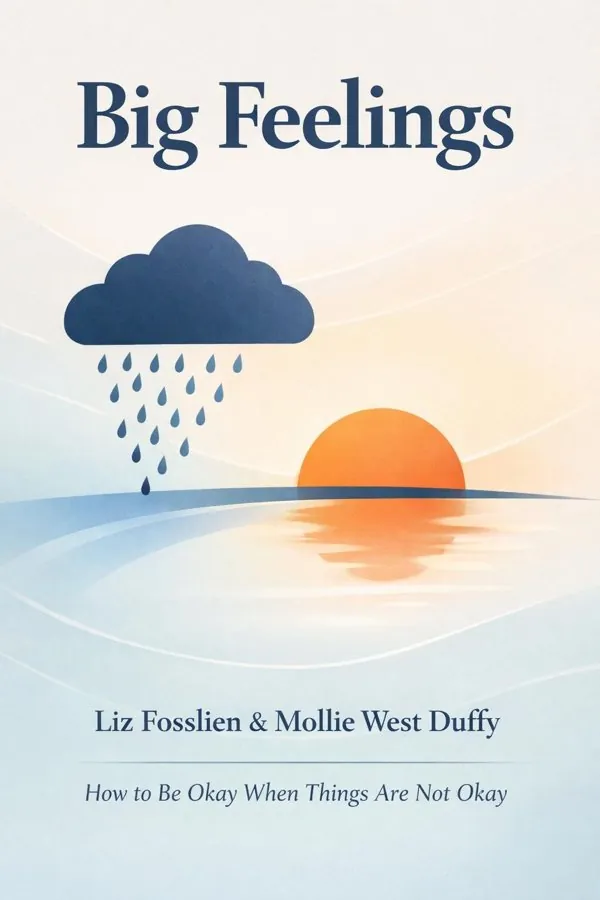
Big Feelings: How to Be Okay When Things Are Not Okay: Summary & Key Insights
by Liz Fosslien, Mollie West Duffy
 10 min9 chaptersAudio available
Key Takeaways from Big Feelings: How to Be Okay When Things Are Not Okay
A difficult emotion often feels like proof that something is wrong with you, when it is more often evidence that something meaningful is happening.
Two people can live through the same event and emerge with very different emotional outcomes because meaning matters as much as circumstance.
Vague fear expands in the absence of clarity.
Comparison is painful not because other people succeed, but because we compare our inner complexity to their curated surface.
Perfectionism often disguises itself as high standards, but beneath the polished exterior is usually fear: fear of judgment, failure, rejection, or not being enough.
What Is Big Feelings: How to Be Okay When Things Are Not Okay About?
Big Feelings: How to Be Okay When Things Are Not Okay by Liz Fosslien, Mollie West Duffy is a mental_health book. Big Feelings: How to Be Okay When Things Are Not Okay is a practical, deeply reassuring guide to navigating the emotions that can derail daily life: uncertainty, comparison, burnout, perfectionism, despair, and anger. Instead of offering vague encouragement to “stay positive,” Liz Fosslien and Mollie West Duffy explain why difficult emotions are normal, informative, and manageable when we learn how to work with them rather than suppress them. The book combines behavioral science, psychology research, workplace insight, personal stories, and Fosslien’s signature illustrations to make emotional intelligence feel useful instead of abstract. What makes this book especially relevant is its honesty. It recognizes that many people are trying to function in demanding jobs, complicated relationships, and unstable times while carrying emotional weight they cannot simply think away. Fosslien and West Duffy write with credibility: both have studied emotions in professional settings and built careers translating research into accessible tools for real life. Their central promise is not constant happiness. It is something more realistic and more valuable: the ability to survive hard moments with more self-awareness, more compassion, and better strategies. For anyone feeling overwhelmed, stuck, or emotionally exhausted, this book offers language, perspective, and practical relief.
This FizzRead summary covers all 9 key chapters of Big Feelings: How to Be Okay When Things Are Not Okay in approximately 10 minutes, distilling the most important ideas, arguments, and takeaways from Liz Fosslien, Mollie West Duffy's work. Also available as an audio summary and Key Quotes Podcast.
Big Feelings: How to Be Okay When Things Are Not Okay
Big Feelings: How to Be Okay When Things Are Not Okay is a practical, deeply reassuring guide to navigating the emotions that can derail daily life: uncertainty, comparison, burnout, perfectionism, despair, and anger. Instead of offering vague encouragement to “stay positive,” Liz Fosslien and Mollie West Duffy explain why difficult emotions are normal, informative, and manageable when we learn how to work with them rather than suppress them. The book combines behavioral science, psychology research, workplace insight, personal stories, and Fosslien’s signature illustrations to make emotional intelligence feel useful instead of abstract.
What makes this book especially relevant is its honesty. It recognizes that many people are trying to function in demanding jobs, complicated relationships, and unstable times while carrying emotional weight they cannot simply think away. Fosslien and West Duffy write with credibility: both have studied emotions in professional settings and built careers translating research into accessible tools for real life. Their central promise is not constant happiness. It is something more realistic and more valuable: the ability to survive hard moments with more self-awareness, more compassion, and better strategies. For anyone feeling overwhelmed, stuck, or emotionally exhausted, this book offers language, perspective, and practical relief.
Who Should Read Big Feelings: How to Be Okay When Things Are Not Okay?
This book is perfect for anyone interested in mental_health and looking to gain actionable insights in a short read. Whether you're a student, professional, or lifelong learner, the key ideas from Big Feelings: How to Be Okay When Things Are Not Okay by Liz Fosslien, Mollie West Duffy will help you think differently.
- ✓Readers who enjoy mental_health and want practical takeaways
- ✓Professionals looking to apply new ideas to their work and life
- ✓Anyone who wants the core insights of Big Feelings: How to Be Okay When Things Are Not Okay in just 10 minutes
Want the full summary?
Get instant access to this book summary and 100K+ more with Fizz Moment.
Get Free SummaryAvailable on App Store • Free to download
Key Chapters
A difficult emotion often feels like proof that something is wrong with you, when it is more often evidence that something meaningful is happening. One of the book’s most liberating ideas is that so-called “big feelings” are not character defects to eliminate. They are signals: information from the mind and body about loss, uncertainty, unmet needs, pressure, fear, or change. The real problem begins when people judge themselves for having emotions in the first place. That secondary layer of shame, avoidance, or self-criticism can make the original feeling much harder to process.
Fosslien and West Duffy argue that many of us have been taught two unhelpful responses: either suppress emotions and push through, or get completely absorbed by them. Neither works well. Suppression tends to intensify stress over time, while overidentifying with a feeling can make it seem permanent and all-defining. A healthier response is to name the emotion, understand its context, and respond with curiosity. For example, if you feel disproportionate anger after a meeting, the anger may be masking embarrassment, exhaustion, or a sense of disrespect. If you feel envy after seeing a friend’s promotion online, the feeling may be pointing to your own neglected ambitions.
This reframing matters because it shifts the goal from “How do I stop feeling this?” to “What is this feeling trying to tell me?” That question creates room for reflection and action. You might discover that anxiety is signaling lack of preparation, or that resentment is exposing a boundary you failed to set.
Actionable takeaway: the next time a big feeling appears, pause and label it as specifically as possible, then ask, “What is this emotion pointing to, and what need or value might be underneath it?”
Two people can live through the same event and emerge with very different emotional outcomes because meaning matters as much as circumstance. The book emphasizes that while we cannot control every experience, we do influence the stories we build around those experiences. A setback can become evidence that you are inadequate, or it can become proof that you are learning in public. Rejection can mean “I am not enough,” or “This wasn’t the right fit.” The event hurts either way, but the interpretation affects whether pain hardens into despair.
This does not mean forced optimism or pretending everything happens for a reason. Fosslien and West Duffy are careful not to promote toxic positivity. Instead, they encourage what might be called honest reframing: acknowledging reality while resisting catastrophic narratives. When something goes wrong, the mind often fills in dramatic conclusions. A curt email becomes “My boss thinks I’m incompetent.” A delayed text becomes “They are losing interest.” A mistake becomes “I always ruin everything.” These stories feel true because emotions narrow perception.
A more grounded approach is to separate facts from interpretation. Facts are observable: the presentation had issues, the message was brief, the job application was rejected. Interpretation is the layer we add. By challenging automatic narratives, we loosen the grip of all-or-nothing thinking. This can involve asking: What else might be true? What evidence do I have? Am I predicting the future or reading minds?
In daily life, this practice is useful after conflict, disappointment, or embarrassment. Instead of spiraling, you build a more flexible narrative. That flexibility supports resilience because it keeps one hard moment from defining your identity.
Actionable takeaway: when you feel overwhelmed by a situation, write down the facts in one column and your interpretation in another. Then revise the interpretation into something accurate, compassionate, and less absolute.
Vague fear expands in the absence of clarity. One reason uncertainty is so emotionally exhausting is that the mind hates unfinished information. When outcomes are unknown, we instinctively imagine worst-case scenarios, treating ambiguity as danger. Big Feelings shows that uncertainty itself is often more draining than bad news, because ambiguity keeps the nervous system activated without resolution. We rehearse possibilities, scan for clues, and burn energy trying to predict what cannot yet be known.
The authors suggest that the antidote is not certainty, which is usually unavailable, but specificity. If you are anxious about an upcoming decision, identify what exactly is uncertain. Is it whether you will keep your job, whether your relationship will last, whether you can handle a change, or whether others will judge you? Narrowing the unknown reduces its power. Once uncertainty is defined, you can distinguish between what is controllable, influenceable, and outside your control.
For example, someone waiting to hear back after interviews may spiral into generalized panic. But if they break the situation down, they may see that they cannot control the company’s decision, but they can prepare for multiple outcomes, follow up professionally, continue applying elsewhere, and update their budget. Similarly, in a health scare, you may not know the diagnosis yet, but you can list questions for the doctor, ask someone to come with you, and create a small support plan.
The book also highlights the value of routines during uncertain times. Small repeated actions, such as taking a walk, eating regularly, or limiting doomscrolling, give the body evidence of stability even when life feels unsettled.
Actionable takeaway: when uncertainty spikes, define the unknown in one sentence, sort it into what you can control, influence, or accept, and choose one stabilizing action for today.
Comparison is painful not because other people succeed, but because we compare our inner complexity to their curated surface. One of the book’s sharpest insights is that envy often emerges from incomplete information. We see someone else’s accomplishment, confidence, relationship, or lifestyle, but not the trade-offs, timing, private struggles, or support systems behind it. Social media intensifies this distortion by presenting polished snapshots that invite unfair self-measurement.
Fosslien and West Duffy do not tell readers to stop comparing entirely, which would be unrealistic. Instead, they show how to make comparison less corrosive. First, identify whether the feeling is envy, admiration, insecurity, or grief over a path not taken. Those are different experiences requiring different responses. If a colleague’s success triggers envy, the feeling may reveal a dormant goal of your own. If a friend’s life milestone brings sadness, the issue may be your own timeline anxiety rather than resentment toward them.
The authors also encourage paying attention to “highlight reel thinking.” When you assume others are advancing without struggle, you erase the hidden realities of their lives. Maybe the promoted colleague had years of invisible preparation. Maybe the friend with the beautiful house has debt, family pressure, or far less freedom than you imagine. This perspective is not meant to diminish others, but to restore context.
Practically, comparison can be redirected into information. Instead of asking, “Why am I behind?” ask, “What specifically do I admire here, and do I want the whole package that comes with it?” You may want recognition, creative freedom, or financial security, but not the exact life you are envying.
Actionable takeaway: when comparison strikes, identify the precise quality you are reacting to, then turn envy into a question: “What desire of mine is this revealing, and what is one small step toward it?”
Perfectionism often disguises itself as high standards, but beneath the polished exterior is usually fear: fear of judgment, failure, rejection, or not being enough. Big Feelings explains that perfectionism can look admirable from the outside because it is socially rewarded. The perfectionist is responsible, prepared, and conscientious. Yet internally, the experience is rigid and exhausting. Nothing feels finished, mistakes feel catastrophic, and self-worth becomes tied to flawless performance.
The authors make an important distinction between healthy excellence and perfectionism. Excellence is about care, growth, and effort. Perfectionism is about control and self-protection. The first says, “I want to do this well.” The second says, “If this is not impeccable, I will not be safe, respected, or lovable.” That belief leads to procrastination, overworking, micromanaging, and chronic dissatisfaction. Ironically, perfectionism can reduce creativity because experimentation requires tolerance for imperfection.
A practical way to interrupt perfectionism is to define what “good enough” looks like before starting. For example, if you are writing a report, decide in advance how much time it deserves and what success criteria actually matter. If you are hosting friends, identify the elements that create warmth rather than obsessing over every detail. Another useful strategy is to treat first drafts and practice attempts as intentionally incomplete. This creates psychological permission to begin.
The book also reminds readers that perfectionism is often relational. We imagine how others might judge us and then overcorrect. Naming that imagined audience can weaken its hold. Whose approval are you chasing? Is that standard realistic, necessary, or even yours?
Actionable takeaway: choose one task this week and set a “good enough” standard before you begin, including a time limit, a clear outcome, and one thing you will intentionally not overpolish.
Burnout is not simply being tired; it is the deep depletion that comes from sustained stress without adequate recovery, control, meaning, or support. The book pushes back against the idea that burnout can be solved with a weekend off, a bath, or better morning routines. Those may help temporarily, but burnout usually reflects a larger mismatch between demands and resources. If the system causing the stress remains unchanged, recovery will be shallow and short-lived.
Fosslien and West Duffy describe burnout as emotional, cognitive, and physical. It can show up as cynicism, numbness, irritability, reduced concentration, dread, or the inability to care about work you once valued. Many people miss burnout because they assume productivity problems mean they need to try harder, when in fact they need to reduce load, reset expectations, or reclaim agency.
The authors emphasize boundaries as a core intervention. Boundaries are not punishments; they are structures that protect energy. This might mean defining work hours, turning off notifications, saying no to low-value commitments, asking for clearer priorities, or renegotiating timelines. Burnout also improves when you reconnect effort to meaning. If your work feels endless and detached from purpose, even small reminders of impact can matter.
Just as important is recognizing that individual coping has limits. Some burnout is personal, but much of it is organizational and cultural. If a workplace rewards constant availability, ignores staffing shortages, or treats exhaustion as commitment, no amount of mindfulness will fully fix the problem.
Actionable takeaway: identify one recurring source of depletion in your life, then create a concrete boundary around it this week, such as a shutdown time, a declined obligation, or a direct request for clearer expectations.
Many emotional conversations fail not because people do not care, but because they lack the language and structure to speak clearly. A central lesson in Big Feelings is that vague statements produce vague support. Saying “I’m stressed” may be true, but it does not tell others whether you need empathy, advice, space, reassurance, help prioritizing, or simply someone to listen. Similarly, asking “How are you?” often invites automatic, shallow responses rather than honest ones.
The authors encourage greater specificity in emotional communication. Instead of broad labels, try naming the exact experience: disappointed, ashamed, resentful, overstimulated, lonely, discouraged, or scared. The more precise the label, the easier it becomes to understand what is happening and what kind of response might help. This is useful in friendships, romantic relationships, families, and workplaces.
They also recommend making support requests explicit. If you tell a friend, “I need to vent for ten minutes and I’m not looking for solutions yet,” you prevent misunderstanding. If you tell a manager, “I’m overwhelmed because three deadlines overlap, and I need help prioritizing,” you transform private panic into a solvable issue. Specificity lowers defensiveness because it focuses on a concrete need rather than implying that someone should automatically know what to do.
Listening matters too. When someone else shares a big feeling, the goal is not to rush them toward silver linings. It is to understand their experience before responding. Questions like “What feels hardest right now?” or “Do you want comfort, brainstorming, or distraction?” create a more useful conversation.
Actionable takeaway: in your next emotionally charged conversation, name your feeling with more precision and add one sentence describing the kind of support you want.
When emotions feel too large, people often assume they need a major breakthrough to feel better. The book offers a gentler truth: small, repeatable rituals can create enough stability to help you get through hard periods. Big feelings are often intensified by physical dysregulation, decision fatigue, and a sense that everything is unraveling at once. Rituals work because they reduce friction, restore predictability, and signal safety to the body.
These rituals do not need to be elaborate. They can be as simple as making tea before a difficult task, taking a short walk after work to mark the transition home, writing down tomorrow’s worries before bed, or texting one trusted person when shame tells you to disappear. The power lies in repetition and meaning. A ritual says, “I know this feeling may come, and I have a way to meet it.”
Fosslien and West Duffy show that coping becomes more effective when it is prepared in advance rather than improvised in crisis. If you know that rejection tends to trigger rumination, create a plan before the next vulnerable moment: limit social media, schedule a comforting activity, write down three people you can contact, and prepare a self-talk script that is realistic but kind. Similarly, if anger often escalates in the evening when you are tired, build in decompression time before sensitive conversations.
Rituals also help externalize progress. Even if the emotion has not vanished, following a familiar sequence can remind you that you have survived similar states before. That memory itself is regulating.
Actionable takeaway: create one “emotional first-aid ritual” for a recurring difficult feeling, using three simple steps you can repeat whenever that feeling appears.
Many people believe self-criticism is what keeps them accountable, but the book argues the opposite: harshness may create urgency, yet compassion creates endurance. When you are already struggling, attacking yourself for struggling adds emotional friction without increasing wisdom. Self-compassion is not self-excuse. It is the ability to respond to difficulty with honesty, perspective, and care rather than contempt.
Fosslien and West Duffy note that people often reserve empathy for others while denying it to themselves. A friend who makes a mistake deserves understanding, context, and encouragement; you, on the other hand, get an internal lecture. This double standard is damaging because shame tends to narrow behavior. It makes people hide, avoid, and spiral. Compassion makes repair more likely because it keeps you engaged with reality.
In practice, self-compassion can sound like: “This is painful, and it makes sense that I’m upset,” or “I did not handle that well, but one moment does not define me.” It allows accountability without identity collapse. This is especially important when dealing with perfectionism, grief, failure, or emotional exhaustion. Compassion also helps regulate the nervous system. Feeling internally safe makes it easier to think clearly, apologize sincerely, and try again.
The authors do not present self-compassion as sentimental. It is a practical skill for resilience. It acknowledges that life includes mess, and that growth rarely happens through relentless self-punishment. People change more sustainably when they feel supported rather than threatened, even by themselves.
Actionable takeaway: the next time you make a mistake or feel overwhelmed, write a brief response to yourself using the tone you would use with a close friend, including one sentence of accountability and one sentence of kindness.
All Chapters in Big Feelings: How to Be Okay When Things Are Not Okay
About the Authors
Liz Fosslien and Mollie West Duffy are authors known for making complex emotional and workplace topics accessible, practical, and engaging. Liz Fosslien is a writer and illustrator whose work on emotions, modern work, and mental health has reached a broad audience through widely shared visual insights. Mollie West Duffy is an expert in organizational behavior, leadership, and workplace culture, with a strong focus on how emotions shape performance and well-being. Together, they previously coauthored No Hard Feelings, a well-regarded book about emotions at work. Their collaboration combines research, storytelling, and real-world experience, allowing them to translate psychology into tools readers can actually use. In Big Feelings, they bring that same strength to the broader emotional struggles of everyday life.
Get This Summary in Your Preferred Format
Read or listen to the Big Feelings: How to Be Okay When Things Are Not Okay summary by Liz Fosslien, Mollie West Duffy anytime, anywhere. FizzRead offers multiple formats so you can learn on your terms — all free.
Available formats: App · Audio · PDF · EPUB — All included free with FizzRead
Download Big Feelings: How to Be Okay When Things Are Not Okay PDF and EPUB Summary
Key Quotes from Big Feelings: How to Be Okay When Things Are Not Okay
“A difficult emotion often feels like proof that something is wrong with you, when it is more often evidence that something meaningful is happening.”
“Two people can live through the same event and emerge with very different emotional outcomes because meaning matters as much as circumstance.”
“Vague fear expands in the absence of clarity.”
“Comparison is painful not because other people succeed, but because we compare our inner complexity to their curated surface.”
“Perfectionism often disguises itself as high standards, but beneath the polished exterior is usually fear: fear of judgment, failure, rejection, or not being enough.”
Frequently Asked Questions about Big Feelings: How to Be Okay When Things Are Not Okay
Big Feelings: How to Be Okay When Things Are Not Okay by Liz Fosslien, Mollie West Duffy is a mental_health book that explores key ideas across 9 chapters. Big Feelings: How to Be Okay When Things Are Not Okay is a practical, deeply reassuring guide to navigating the emotions that can derail daily life: uncertainty, comparison, burnout, perfectionism, despair, and anger. Instead of offering vague encouragement to “stay positive,” Liz Fosslien and Mollie West Duffy explain why difficult emotions are normal, informative, and manageable when we learn how to work with them rather than suppress them. The book combines behavioral science, psychology research, workplace insight, personal stories, and Fosslien’s signature illustrations to make emotional intelligence feel useful instead of abstract. What makes this book especially relevant is its honesty. It recognizes that many people are trying to function in demanding jobs, complicated relationships, and unstable times while carrying emotional weight they cannot simply think away. Fosslien and West Duffy write with credibility: both have studied emotions in professional settings and built careers translating research into accessible tools for real life. Their central promise is not constant happiness. It is something more realistic and more valuable: the ability to survive hard moments with more self-awareness, more compassion, and better strategies. For anyone feeling overwhelmed, stuck, or emotionally exhausted, this book offers language, perspective, and practical relief.
More by Liz Fosslien, Mollie West Duffy
You Might Also Like
Creative Arts Therapies Handbook: Art, Music and Dance Therapy Practices for Wellbeing
Susan I. Buchalter
10 min
Emotional First Aid: Healing Rejection, Guilt, Failure, and Other Everyday Hurts
Guy Winch
10 min
Lost Connections: Why You're Depressed and How to Find Hope
Johann Hari
10 min
No Time to Panic: How to Stop Worrying and Embrace Life
Matt Gutman
10 min
Overcoming Mobbing: A Recovery Guide for Workplace Aggression and Bullying
Maureen Duffy, Len Sperry
10 min
Sexual Detox: A Guide for Guys Who Are Sick of Porn
Tim Challies
10 minFeatured In
Browse by Category
Ready to read Big Feelings: How to Be Okay When Things Are Not Okay?
Get the full summary and 100K+ more books with Fizz Moment.