
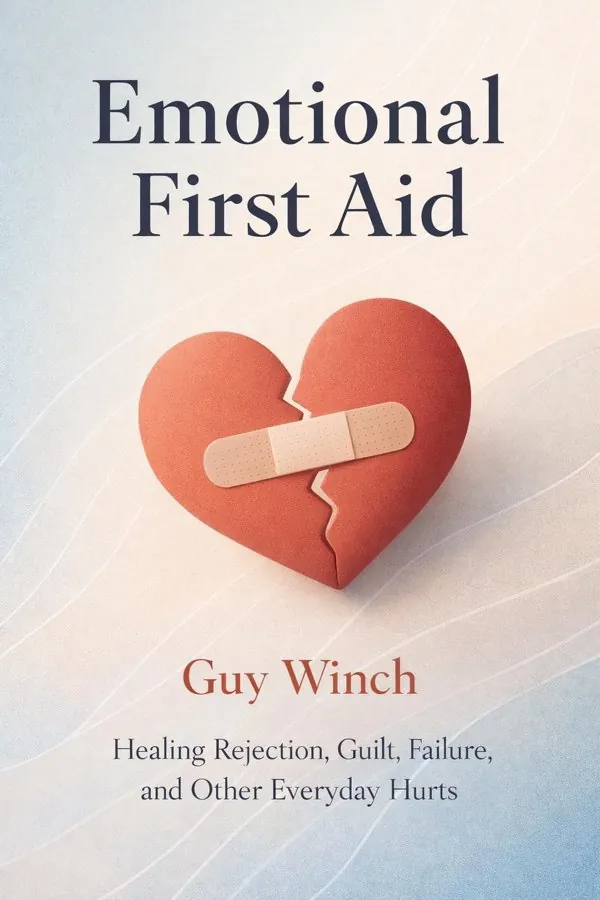
Emotional First Aid: Healing Rejection, Guilt, Failure, and Other Everyday Hurts: Summary & Key Insights
by Guy Winch
 10 min8 chaptersAudio available
Key Takeaways from Emotional First Aid: Healing Rejection, Guilt, Failure, and Other Everyday Hurts
One of the book’s most powerful ideas is that emotional injuries should be treated with the same seriousness and urgency as physical ones.
Rejection is not just disappointing—it can shake a person’s sense of belonging, value, and identity within minutes.
Loneliness is often misunderstood as merely being alone, but Winch shows it is better understood as a psychological state that changes perception, expectation, and behavior.
Failure is a normal part of learning, but emotionally it often feels like a verdict rather than an event.
Guilt is uncomfortable, but Winch treats it as a potentially constructive emotion when handled correctly.
What Is Emotional First Aid: Healing Rejection, Guilt, Failure, and Other Everyday Hurts About?
Emotional First Aid: Healing Rejection, Guilt, Failure, and Other Everyday Hurts by Guy Winch is a mental_health book. Emotional pain is often treated as something we should simply “get over,” yet it can affect our thoughts, behavior, health, and relationships just as strongly as a physical injury. In Emotional First Aid, psychologist Guy Winch argues that everyday psychological wounds—rejection, loneliness, failure, guilt, rumination, and low self-esteem—deserve immediate, practical care. Instead of waiting until emotional distress becomes overwhelming, he offers tools to treat these common hurts early, before they deepen into lasting damage. The book matters because most people know how to clean a cut or ice a sprain, but far fewer know how to respond constructively when their confidence collapses, when they are excluded, or when shame keeps replaying a mistake. Winch brings clinical experience, psychological research, and accessible language together to create a guide that feels both compassionate and actionable. His core insight is simple but powerful: emotional wounds are real, common, and treatable. For anyone who has ever felt stuck after criticism, heartbreak, disappointment, or self-blame, this book offers a practical mental health toolkit for everyday life.
This FizzRead summary covers all 8 key chapters of Emotional First Aid: Healing Rejection, Guilt, Failure, and Other Everyday Hurts in approximately 10 minutes, distilling the most important ideas, arguments, and takeaways from Guy Winch's work. Also available as an audio summary and Key Quotes Podcast.
Emotional First Aid: Healing Rejection, Guilt, Failure, and Other Everyday Hurts
Emotional pain is often treated as something we should simply “get over,” yet it can affect our thoughts, behavior, health, and relationships just as strongly as a physical injury. In Emotional First Aid, psychologist Guy Winch argues that everyday psychological wounds—rejection, loneliness, failure, guilt, rumination, and low self-esteem—deserve immediate, practical care. Instead of waiting until emotional distress becomes overwhelming, he offers tools to treat these common hurts early, before they deepen into lasting damage.
The book matters because most people know how to clean a cut or ice a sprain, but far fewer know how to respond constructively when their confidence collapses, when they are excluded, or when shame keeps replaying a mistake. Winch brings clinical experience, psychological research, and accessible language together to create a guide that feels both compassionate and actionable. His core insight is simple but powerful: emotional wounds are real, common, and treatable. For anyone who has ever felt stuck after criticism, heartbreak, disappointment, or self-blame, this book offers a practical mental health toolkit for everyday life.
Who Should Read Emotional First Aid: Healing Rejection, Guilt, Failure, and Other Everyday Hurts?
This book is perfect for anyone interested in mental_health and looking to gain actionable insights in a short read. Whether you're a student, professional, or lifelong learner, the key ideas from Emotional First Aid: Healing Rejection, Guilt, Failure, and Other Everyday Hurts by Guy Winch will help you think differently.
- ✓Readers who enjoy mental_health and want practical takeaways
- ✓Professionals looking to apply new ideas to their work and life
- ✓Anyone who wants the core insights of Emotional First Aid: Healing Rejection, Guilt, Failure, and Other Everyday Hurts in just 10 minutes
Want the full summary?
Get instant access to this book summary and 100K+ more with Fizz Moment.
Get Free SummaryAvailable on App Store • Free to download
Key Chapters
One of the book’s most powerful ideas is that emotional injuries should be treated with the same seriousness and urgency as physical ones. Most people would not ignore a deep cut, yet they routinely dismiss rejection, failure, or guilt as things they should “tough out.” Guy Winch argues that this neglect often makes psychological pain worse. Small emotional hurts can quickly become infected by rumination, self-criticism, withdrawal, or hopelessness if they are left untreated.
Winch’s point is not that every difficult feeling is a crisis. Rather, he shows that common emotional setbacks have predictable consequences. Rejection can lower self-esteem and provoke anger. Loneliness can distort perception and make people expect more disconnection. Failure can lead to helplessness. Guilt can either guide repair or trap people in shame. In each case, the initial injury is often manageable, but the secondary damage becomes the real problem.
A practical example is a job applicant who is turned down after several interviews. The pain of disappointment is normal. But if that person starts replaying the experience endlessly, calling themselves incompetent, avoiding future applications, and isolating from supportive friends, the emotional wound grows deeper. The problem is no longer just one rejection; it becomes a broader crisis of confidence.
Winch encourages readers to build a habit of psychological self-care: identify the wound, interrupt harmful mental habits, and apply a fitting remedy. This could mean seeking perspective, reconnecting socially, challenging distorted thoughts, or practicing self-compassion. The key is speed and intention.
Actionable takeaway: when you experience an emotional setback, name it as a real injury and ask, “What first aid does this wound need right now?”
Rejection is not just disappointing—it can shake a person’s sense of belonging, value, and identity within minutes. Winch explains that social rejection activates many of the same systems involved in physical pain, which helps explain why a breakup, exclusion, or dismissal can feel so intense. Yet people often respond badly to rejection by criticizing themselves, obsessing over what happened, or lashing out at others.
The danger of rejection is not only the sting itself but the story we build around it. After being ignored by friends or passed over for an opportunity, people often conclude that something is fundamentally wrong with them. They replay conversations, search for hidden flaws, and magnify the significance of one event. Winch argues that this reaction deepens the injury and can quickly damage self-esteem.
A healthier response is to resist personalization and restore self-worth deliberately. For example, if someone is not invited to an event, they might instinctively assume they are disliked. But there may be many explanations that have nothing to do with their value. Instead of rehearsing self-blame, Winch suggests turning attention toward evidence of meaningful relationships, personal strengths, and contexts where one is appreciated.
Another useful strategy is self-affirmation. Writing down qualities you value in yourself—kindness, persistence, humor, competence—can help stabilize identity when rejection threatens it. Reaching out to supportive people also matters, even when rejection creates the urge to withdraw.
Actionable takeaway: after a rejection, do not ask, “What is wrong with me?” Ask, “What false conclusion am I about to draw, and how can I reconnect with my real worth?”
Loneliness is often misunderstood as merely being alone, but Winch shows it is better understood as a psychological state that changes perception, expectation, and behavior. When people feel lonely, they become more sensitive to social threat. They may interpret neutral interactions as dismissive, expect rejection before it happens, and pull back just when connection is most needed. This creates a self-reinforcing cycle: loneliness increases defensive behavior, and defensive behavior makes closeness harder.
An important insight in the book is that loneliness is not always solved by adding more people around you. Someone can be surrounded by coworkers, family, or social media contacts and still feel unseen or emotionally disconnected. What matters is meaningful connection. Yet loneliness can make that harder because it encourages hypervigilance. A lonely person may delay returning messages, avoid invitations, or stay guarded in conversation, unintentionally signaling distance.
Winch emphasizes the need to challenge these automatic patterns. For example, someone who has recently moved to a new city may assume that others already have established friendships and are not interested in them. That assumption can lead to isolation. A better strategy is to treat connection as a skillful practice: initiate contact, tolerate small moments of awkwardness, and remember that familiarity usually grows gradually rather than instantly.
He also suggests anthropomorphizing the emotion itself—seeing loneliness as a misleading inner alarm rather than a reliable guide. This can help people question the bleak narrative it produces and act against it.
Actionable takeaway: when you feel lonely, do one concrete thing that increases meaningful contact—send the message, accept the invitation, or start the conversation before loneliness talks you out of it.
Failure is a normal part of learning, but emotionally it often feels like a verdict rather than an event. Winch argues that the most damaging aspect of failure is not the mistake itself but the way people interpret it. A setback in work, relationships, school, or personal goals can quickly become evidence of permanent inadequacy. Once that belief takes hold, people stop trying, lower expectations, and protect themselves from future disappointment by avoiding challenge.
The book distinguishes between useful reflection and identity collapse. Useful reflection asks what went wrong, what can be improved, and what remains possible. Identity collapse says, “I failed, therefore I am a failure.” That shift from behavior to identity is psychologically corrosive. It undermines motivation and invites helplessness.
Winch encourages readers to think of failure in specific, limited terms. If a business pitch fails, the problem may be timing, preparation, audience fit, or strategy—not proof that the person lacks talent or potential. By breaking failure into components, people regain agency. They can adapt rather than surrender.
He also highlights the value of realistic self-talk. Empty positivity is not very helpful, but balanced thinking is. For instance: “This went badly. It hurts. But it is one outcome, not my whole future.” That kind of inner language preserves dignity while allowing learning.
A practical application is to conduct a post-failure review with three columns: what was outside my control, what I could improve, and what I will try next. This turns emotional paralysis into deliberate action.
Actionable takeaway: after a failure, describe it as specifically as possible and identify one adjustment for your next attempt before your mind turns the event into an identity.
Guilt is uncomfortable, but Winch treats it as a potentially constructive emotion when handled correctly. Unlike shame, which says “I am bad,” guilt says “I did something wrong.” That distinction matters. Healthy guilt can motivate accountability, empathy, and repair. Unhealthy guilt, however, can spiral into chronic self-punishment, emotional stuckness, and distorted responsibility.
Many people respond to guilt in one of two unhelpful ways: they either deny it to avoid discomfort, or they drown in it and keep replaying the offense without taking meaningful action. Winch argues that the healthiest response is neither avoidance nor self-torment, but repair. If you hurt someone, apologize sincerely, acknowledge the impact, and make amends where possible. If the situation cannot be fixed directly, you can still honor the lesson by changing future behavior.
A useful example is snapping at a loved one during stress. The guilt might lead someone to brood all day about being a terrible partner or parent. But that energy is better spent on repair: admit what happened, apologize without excuses, and put a better stress-management plan in place. That transforms guilt from a trap into a guide.
Winch also reminds readers that some guilt is misplaced. People often feel guilty for circumstances they did not cause, for setting healthy boundaries, or for failing to meet unrealistic expectations. In those cases, guilt should be examined rather than obeyed.
Actionable takeaway: when guilt appears, ask two questions—“What am I truly responsible for?” and “What repair or change would honor this feeling better than self-punishment?”
Many emotional injuries fade with time, but rumination acts like scratching at a wound until it cannot heal. Winch describes rumination as the repetitive mental replay of distressing events, usually framed as analysis but rarely leading to clarity. People revisit the same rejection, argument, embarrassment, or failure believing they are solving it, when in fact they are reinforcing pain and helplessness.
What makes rumination so seductive is that it feels productive. The mind says, “If I think about it one more time, I will understand it.” But repeated mental loops usually generate the same conclusions: self-blame, resentment, anxiety, or regret. Instead of producing insight, they deepen emotional grooves.
Winch recommends interrupting rumination actively rather than waiting for it to fade. Distraction, often underrated, can be highly effective when used intentionally. A mentally engaging activity—exercise, conversation, puzzles, work requiring focus, or even a change of environment—can break the cycle long enough for emotional intensity to come down. Once the mind is calmer, constructive reflection becomes more possible.
He also suggests setting boundaries around thinking. If a problem genuinely needs attention, schedule a short period to address it directly: write down the issue, possible lessons, and next steps. Outside that window, redirect your attention. This trains the mind to distinguish processing from compulsive replay.
A practical example is after an awkward social moment. Instead of rehearsing it all evening, choose a competing activity that demands concentration and remind yourself that endless replay is not the same as growth.
Actionable takeaway: when you catch yourself looping, interrupt the cycle immediately with a focused activity and return only for brief, structured reflection if it is truly useful.
Self-esteem is not a luxury; it is psychological infrastructure. When it weakens, people become more vulnerable to rejection, more discouraged by failure, and more likely to accept poor treatment. Winch explains that low self-esteem often behaves like an internal bias: it filters experience in ways that confirm inadequacy and dismiss strengths. Compliments are minimized, successes are explained away, and criticism is treated as proof.
A central lesson of the book is that self-esteem rarely improves through vague encouragement alone. It needs active rebuilding. That means noticing distorted self-assessments and deliberately strengthening a more balanced self-view. Winch encourages readers to identify attributes, values, and abilities they genuinely possess, not as empty affirmations but as evidence-based reminders of worth.
He also emphasizes behavior. Confidence often grows from competence and self-respectful action. If someone feels worthless but keeps commitments, practices a skill, helps others, and maintains standards for how they are treated, their self-concept gradually gains firmer ground. In this sense, self-esteem is not just a feeling; it is reinforced by daily choices.
For example, a person recovering from a breakup may feel deeply undesirable. Listing supportive friendships, professional strengths, acts of generosity, and previous resilience can counter the brain’s narrow negative focus. Pairing that exercise with actions such as returning to routines, pursuing goals, and setting boundaries creates stronger recovery.
Actionable takeaway: create a written inventory of your real strengths and revisit it after setbacks, while also choosing one daily behavior that reflects self-respect rather than self-doubt.
A major contribution of Emotional First Aid is the idea that resilience is not simply a personality trait but a set of habits. People often admire emotionally strong individuals as if they were born with unusual toughness, but Winch shows that many protective responses can be practiced. Resilience grows when people learn to respond to emotional pain with skill instead of instinct.
Instinct often pushes in the wrong direction. After rejection, people isolate. After failure, they generalize. After guilt, they self-attack. After loneliness, they expect more exclusion. Emotional first aid means replacing these automatic patterns with healthier habits: seek support, challenge catastrophic thinking, repair damage, engage meaningfully, and preserve self-worth.
What makes this framework useful is its practicality. Rather than offering abstract advice to “be positive,” Winch gives readers a model for recognizing common wounds and choosing targeted responses. Over time, these responses become protective routines. Someone who learns to treat setbacks early may recover faster, maintain better relationships, and prevent small hurts from becoming larger crises.
This idea is especially relevant in modern life, where people face constant evaluation, digital comparison, and social unpredictability. Emotional resilience is not about never getting hurt. It is about shortening the distance between injury and recovery.
A helpful application is to build a personal emotional first-aid kit: a list of grounding activities, supportive contacts, self-affirming reminders, reflective questions, and actions that restore perspective. Having these tools prepared makes it easier to use them under stress.
Actionable takeaway: identify your most common emotional wound and create a repeatable response plan so resilience becomes a habit, not a hope.
All Chapters in Emotional First Aid: Healing Rejection, Guilt, Failure, and Other Everyday Hurts
About the Author
Guy Winch is a psychologist, author, and public speaker best known for translating psychological science into practical advice for everyday life. Trained in clinical psychology, he has built a reputation for helping people understand how common emotional experiences—such as rejection, failure, guilt, and loneliness—can significantly affect wellbeing if left untreated. His work emphasizes “emotional hygiene,” the idea that people should care for their mental and emotional health as routinely as they care for their bodies. Winch is widely appreciated for his clear, compassionate communication style and for offering tools that readers can apply immediately. Through books, talks, and educational content, he has become an influential voice in making mental health guidance more accessible to general audiences.
Get This Summary in Your Preferred Format
Read or listen to the Emotional First Aid: Healing Rejection, Guilt, Failure, and Other Everyday Hurts summary by Guy Winch anytime, anywhere. FizzRead offers multiple formats so you can learn on your terms — all free.
Available formats: App · Audio · PDF · EPUB — All included free with FizzRead
Download Emotional First Aid: Healing Rejection, Guilt, Failure, and Other Everyday Hurts PDF and EPUB Summary
Key Quotes from Emotional First Aid: Healing Rejection, Guilt, Failure, and Other Everyday Hurts
“One of the book’s most powerful ideas is that emotional injuries should be treated with the same seriousness and urgency as physical ones.”
“Rejection is not just disappointing—it can shake a person’s sense of belonging, value, and identity within minutes.”
“Loneliness is often misunderstood as merely being alone, but Winch shows it is better understood as a psychological state that changes perception, expectation, and behavior.”
“Failure is a normal part of learning, but emotionally it often feels like a verdict rather than an event.”
“Guilt is uncomfortable, but Winch treats it as a potentially constructive emotion when handled correctly.”
Frequently Asked Questions about Emotional First Aid: Healing Rejection, Guilt, Failure, and Other Everyday Hurts
Emotional First Aid: Healing Rejection, Guilt, Failure, and Other Everyday Hurts by Guy Winch is a mental_health book that explores key ideas across 8 chapters. Emotional pain is often treated as something we should simply “get over,” yet it can affect our thoughts, behavior, health, and relationships just as strongly as a physical injury. In Emotional First Aid, psychologist Guy Winch argues that everyday psychological wounds—rejection, loneliness, failure, guilt, rumination, and low self-esteem—deserve immediate, practical care. Instead of waiting until emotional distress becomes overwhelming, he offers tools to treat these common hurts early, before they deepen into lasting damage. The book matters because most people know how to clean a cut or ice a sprain, but far fewer know how to respond constructively when their confidence collapses, when they are excluded, or when shame keeps replaying a mistake. Winch brings clinical experience, psychological research, and accessible language together to create a guide that feels both compassionate and actionable. His core insight is simple but powerful: emotional wounds are real, common, and treatable. For anyone who has ever felt stuck after criticism, heartbreak, disappointment, or self-blame, this book offers a practical mental health toolkit for everyday life.
You Might Also Like

Big Feelings: How to Be Okay When Things Are Not Okay
Liz Fosslien, Mollie West Duffy
10 min
Creative Arts Therapies Handbook: Art, Music and Dance Therapy Practices for Wellbeing
Susan I. Buchalter
10 min
Lost Connections: Why You're Depressed and How to Find Hope
Johann Hari
10 min
No Time to Panic: How to Stop Worrying and Embrace Life
Matt Gutman
10 min
Overcoming Mobbing: A Recovery Guide for Workplace Aggression and Bullying
Maureen Duffy, Len Sperry
10 min
Sexual Detox: A Guide for Guys Who Are Sick of Porn
Tim Challies
10 minBrowse by Category
Ready to read Emotional First Aid: Healing Rejection, Guilt, Failure, and Other Everyday Hurts?
Get the full summary and 100K+ more books with Fizz Moment.