
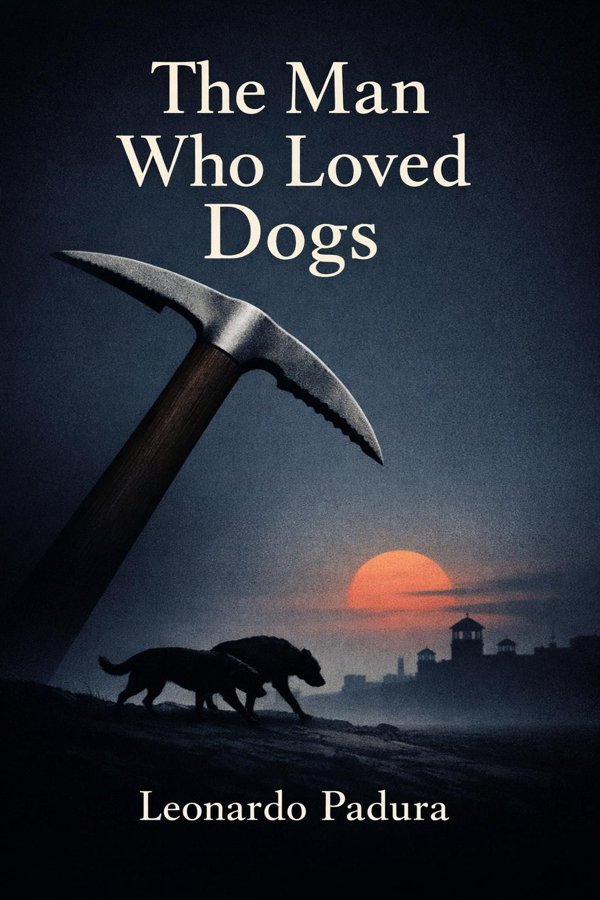
The Man Who Loved Dogs: Summary & Key Insights
 10 min8 chaptersAudio available
Key Takeaways from The Man Who Loved Dogs
History often returns not as a grand revelation, but as a chance encounter that disturbs an already broken life.
Few political tragedies are as bitter as being destroyed by the movement you helped create.
Political murder rarely begins with hatred alone; more often, it is built through manipulation, belonging, fear, and the promise of purpose.
The most chilling crimes are often committed not in spite of ideals, but in their name.
Betrayal is rarely a single act; it is usually a system of compromises that teaches people to live against themselves.
What Is The Man Who Loved Dogs About?
The Man Who Loved Dogs by Leonardo Padura is a world_history book spanning 5 pages. What happens when political ideals become so absolute that they devour the very people who once believed in them? Leonardo Padura’s The Man Who Loved Dogs answers that question through an ambitious, deeply human novel that interweaves three lives across decades and continents: Leon Trotsky in exile, Ramón Mercader on his path to becoming Trotsky’s assassin, and Iván, a disappointed Cuban writer who slowly uncovers their story. More than a historical reconstruction, the book is a moral investigation into how fanaticism is created, how fear distorts truth, and how entire societies learn to live with silence. Padura writes with the authority of a novelist, journalist, and Cuban intellectual shaped by the aftershocks of twentieth-century revolutionary politics. His command of history gives the narrative weight, but his real achievement is emotional: he shows how ideology reaches into private lives, corrupting love, friendship, ambition, and memory. The result is both sweeping and intimate. The Man Who Loved Dogs matters because it refuses easy heroes and villains. Instead, it asks readers to confront a harder reality: that betrayal often wears the face of conviction, and that the cost of lies can echo for generations.
This FizzRead summary covers all 8 key chapters of The Man Who Loved Dogs in approximately 10 minutes, distilling the most important ideas, arguments, and takeaways from Leonardo Padura's work. Also available as an audio summary and Key Quotes Podcast.
The Man Who Loved Dogs
What happens when political ideals become so absolute that they devour the very people who once believed in them? Leonardo Padura’s The Man Who Loved Dogs answers that question through an ambitious, deeply human novel that interweaves three lives across decades and continents: Leon Trotsky in exile, Ramón Mercader on his path to becoming Trotsky’s assassin, and Iván, a disappointed Cuban writer who slowly uncovers their story. More than a historical reconstruction, the book is a moral investigation into how fanaticism is created, how fear distorts truth, and how entire societies learn to live with silence.
Padura writes with the authority of a novelist, journalist, and Cuban intellectual shaped by the aftershocks of twentieth-century revolutionary politics. His command of history gives the narrative weight, but his real achievement is emotional: he shows how ideology reaches into private lives, corrupting love, friendship, ambition, and memory. The result is both sweeping and intimate. The Man Who Loved Dogs matters because it refuses easy heroes and villains. Instead, it asks readers to confront a harder reality: that betrayal often wears the face of conviction, and that the cost of lies can echo for generations.
Who Should Read The Man Who Loved Dogs?
This book is perfect for anyone interested in world_history and looking to gain actionable insights in a short read. Whether you're a student, professional, or lifelong learner, the key ideas from The Man Who Loved Dogs by Leonardo Padura will help you think differently.
- ✓Readers who enjoy world_history and want practical takeaways
- ✓Professionals looking to apply new ideas to their work and life
- ✓Anyone who wants the core insights of The Man Who Loved Dogs in just 10 minutes
Want the full summary?
Get instant access to this book summary and 100K+ more with Fizz Moment.
Get Free SummaryAvailable on App Store • Free to download
Key Chapters
History often returns not as a grand revelation, but as a chance encounter that disturbs an already broken life. Iván Cárdenas Maturell, a frustrated Cuban writer living through the stagnation and shortages of late twentieth-century Havana, meets a mysterious man on a beach walking two borzois. That meeting opens a hidden corridor into one of the darkest political crimes of the century. Iván is not presented as a heroic investigator. He is tired, compromised, and diminished by censorship, failed expectations, and the slow erosion of hope. That is exactly why he matters.
Through Iván, Padura shows how authoritarian systems do not only imprison dissidents or eliminate rivals; they also shrink ordinary lives. Iván’s abandoned literary ambitions reflect a wider social damage: the internalization of silence. He has learned to lower his voice, reduce his dreams, and survive by accepting less. The dog walker’s story becomes important not only because it concerns Trotsky and Mercader, but because it revives Iván’s buried need to understand the truth.
This thread gives the novel one of its strongest contemporary meanings. Many readers know what it feels like to live amid half-truths, institutional pressure, or public narratives that do not match lived reality. Iván’s situation is an example of how historical curiosity can become moral recovery. To seek facts is also to reclaim dignity.
A practical lesson emerges here: pay attention to the stories that official culture ignores or suppresses. They often illuminate the deeper structure of power. Actionable takeaway: when a society teaches resignation, begin by asking what histories have been left untold and why.
Few political tragedies are as bitter as being destroyed by the movement you helped create. Padura follows Leon Trotsky through his long exile after losing the struggle against Stalin, transforming a famous historical figure into a deeply vulnerable human being. Once a central architect of the Russian Revolution and commander of the Red Army, Trotsky is pushed from the Soviet Union and forced into a restless existence across Turkey, France, Norway, and finally Mexico. Each relocation narrows his circle, increases his danger, and confirms the reach of Stalin’s vengeance.
The novel uses exile to explore more than geography. Trotsky becomes a symbol of intellectual and moral isolation. He still believes in revolutionary principles, but he must watch as those principles are twisted into bureaucratic terror, purges, lies, and mass repression. Padura does not turn him into a saint. Trotsky remains proud, severe, and capable of political blindness. Yet his solitude reveals a larger truth: ideological systems often punish dissent most cruelly when it comes from former insiders.
This section of the novel matters because it clarifies how totalitarianism works. It cannot tolerate alternative interpretations of history, even from those who once helped shape it. Readers can apply this insight beyond Soviet history. In workplaces, movements, and institutions, the harshest attacks often fall on people who expose betrayal from within.
The practical example is familiar: whistleblowers, reformers, and principled critics are frequently portrayed as traitors rather than conscience-bearers. Padura invites us to recognize that pattern. Actionable takeaway: when a system treats honest disagreement as treason, examine the system before condemning the dissenter.
Political murder rarely begins with hatred alone; more often, it is built through manipulation, belonging, fear, and the promise of purpose. Ramón Mercader’s transformation into Trotsky’s assassin is one of the novel’s most disturbing achievements. Padura traces how a young man from Spain, shaped by the violence of the Spanish Civil War and the influence of his fiercely ideological mother, is gradually recruited, trained, and remade by Soviet intelligence. His identity is stripped and reconstructed until personal morality becomes secondary to mission.
Mercader is not born a monster. That is what makes his story so unsettling. He is vulnerable to authority, eager for significance, and susceptible to emotional control. The novel shows how fanaticism can be manufactured when private loyalties and political narratives become fused. His mother’s expectations, revolutionary romanticism, and the secret police’s discipline combine to create a man who can commit murder while believing himself historically justified.
Padura’s portrayal offers a useful framework for understanding radicalization in any era. Whether in politics, religion, nationalism, or online extremism, the process often follows similar steps: isolate the individual, offer certainty, sanctify obedience, and redefine cruelty as duty. Mercader’s tragedy is that he sacrifices his independent self long before he kills Trotsky.
Readers can see modern echoes in cult-like organizations, propaganda ecosystems, or environments where moral complexity is replaced by slogans. The lesson is not that conviction is dangerous, but that conviction without self-questioning is easily weaponized.
Actionable takeaway: be wary of any cause that demands total obedience, treats doubt as weakness, or asks you to surrender your moral judgment to a leader, party, or ideology.
The most chilling crimes are often committed not in spite of ideals, but in their name. The assassination of Trotsky in Mexico is the historical center of the novel, yet Padura treats it as more than a suspenseful endpoint. He presents it as the culmination of a political logic in which human beings become expendable instruments of doctrine. Trotsky is murdered with an ice axe by Mercader, but the act has been prepared by years of lies, surveillance, infiltration, and ideological conditioning. The killer is not simply an individual criminal; he is the final tool of a system built to eliminate contradiction.
What follows is just as important as the murder itself. Mercader does not emerge triumphant. Instead, he enters a life marked by prison, manipulation, emotional ruin, and a hollow recognition from the regime he served. Padura exposes the false promise behind fanatic obedience: even the loyal executioner is ultimately disposable. Totalitarian power consumes enemies, critics, and servants alike.
This idea extends beyond twentieth-century communism. Any movement that defines purity through exclusion can slide toward the same logic, even if in less violent forms. Organizations may destroy reputations rather than lives, but the mechanism remains recognizable: simplify truth, identify a contaminant, authorize punishment, and call it justice.
A practical application lies in how we evaluate political rhetoric. When leaders present opponents as obstacles to history rather than fellow humans, violence becomes easier to justify. Moral language can become a cover for cruelty.
Actionable takeaway: judge political ideals not only by their promises, but by what they permit followers to do to dissenters, doubters, and inconvenient human beings.
Betrayal is rarely a single act; it is usually a system of compromises that teaches people to live against themselves. As Iván learns more about Mercader and Trotsky, he also comes to understand the emotional architecture of the world around him. The novel gradually reveals that betrayal works on multiple levels: Stalin betrays the revolution’s emancipatory claims, Mercader betrays his own conscience, institutions betray truth, and ordinary citizens betray themselves when silence becomes habitual.
Iván’s revelation is painful because it is not purely historical. The story he uncovers casts light on his own Cuban reality, where ideology has also shaped language, aspiration, and fear. Padura suggests that the damage of authoritarian politics is not measured only in prisons or executions, but in stunted lives, delayed speech, and inherited caution. People begin to anticipate punishment and censor themselves before power even intervenes.
This idea is highly applicable in everyday life. Betrayal can exist in workplaces where employees repeat what they know is false to protect status, in families where uncomfortable truths are buried, or in public culture where official myths override experience. The point is not to equate all forms of compromise with tyranny, but to recognize how moral surrender often becomes normalized step by step.
Iván’s role reminds readers that understanding betrayal is itself a form of resistance. Naming patterns of deception weakens their hold.
Actionable takeaway: examine where silence has become routine in your environment. Ask which truths everyone privately knows but publicly avoids, and begin restoring integrity by speaking one of them carefully and clearly.
Sometimes the most revealing symbol in a political novel is not a flag or a manifesto, but an animal. The dogs in The Man Who Loved Dogs are far more than a memorable detail. They introduce tenderness into a book dominated by suspicion, exile, and ideological violence. The mysterious dog walker first attracts Iván through the grace of his borzois, and the title itself points toward a paradox: a man capable of intimacy with animals can also be implicated in one of history’s most notorious murders.
Padura uses dogs to complicate moral judgment. They represent loyalty, instinct, companionship, and a realm of experience untouched by political abstractions. In their presence, the novel briefly leaves behind slogans and enters something more elemental. This does not redeem Mercader, but it does humanize him enough to make the larger tragedy sharper. Evil in the novel is not cartoonish. It coexists with sensitivity, memory, affection, and private wounds.
That matters because simplistic depictions of villains can become comforting and false. Padura insists that history is made by damaged, divided people, not by monsters from another species. This insight has practical importance. In modern public life, we often reduce opponents to total identities. Yet understanding human complexity is essential if we want to grasp how destructive systems recruit ordinary individuals.
The dogs also symbolize memory itself: persistent, bodily, non-ideological. They draw Iván toward a story that official narratives have obscured.
Actionable takeaway: resist the temptation to divide the world into pure heroes and pure villains. Moral clarity is necessary, but it becomes wiser and more useful when joined to an honest understanding of human complexity.
The past does not remain powerful simply because events occurred; it remains powerful because stories about those events continue to be fought over. One of Padura’s central achievements is to show history as a contested narrative space rather than a settled archive. Trotsky’s life, Stalin’s dominance, Mercader’s identity, and even Iván’s understanding of Cuba are all shaped by competing versions of reality. Official histories simplify, erase, glorify, or demonize depending on who controls the telling.
This makes the novel especially valuable for readers interested in world history. It dramatizes how regimes manufacture legitimacy. Stalinism did not rely only on force; it also required falsification, staged truth, strategic forgetting, and the constant rewriting of revolutionary memory. Trotsky had to be defeated not merely politically, but historically. His image, words, and legacy had to be recoded so that future generations would inherit obedience instead of debate.
Readers can apply this framework widely. National myths, school curricula, media narratives, and even corporate storytelling often highlight some facts while burying others. The question is not whether interpretation exists, but who benefits from a given interpretation and what it asks us to ignore.
A practical example is the way controversial public figures are remembered differently depending on the political needs of the moment. Padura encourages skepticism toward narratives that feel too neat, too unanimous, or too morally convenient.
Actionable takeaway: whenever you encounter an authoritative historical narrative, ask three questions: what has been emphasized, what has been omitted, and whose power is reinforced by this version of the story?
To lose faith in a political ideal is painful, but to lose faith in the possibility of truth is even worse. One of the novel’s deepest strengths is that it portrays disillusionment without collapsing into emptiness. Iván, Trotsky, and even Mercader each in different ways confront the breakdown of belief. Trotsky watches the revolution betray itself. Iván lives amid the exhaustion of failed promises. Mercader discovers that absolute loyalty yields neither meaning nor freedom. Yet Padura does not suggest that all ideals are fraudulent or that moral seriousness is futile.
Instead, he distinguishes between principled hope and ideological blindness. The novel criticizes systems that demand certainty, sanctify violence, and erase individuals in the name of history. But it also honors the human need to seek justice, coherence, and dignity. That balance is important for contemporary readers who may swing between naive political faith and total cynicism. Padura offers a third path: remain committed to truth and humane values, while distrusting any doctrine that claims infallibility.
This is a practical lesson in civic maturity. Disappointment with institutions should not automatically lead to passivity. A betrayed ideal can still teach us what was worth defending in the first place. Readers can apply this in public life by supporting causes while refusing hero worship, demanding accountability from leaders they agree with, and preserving moral independence.
The novel’s emotional power lies in this refusal to let corruption have the final word. To see clearly is not to give up; it is to begin again with fewer illusions.
Actionable takeaway: let disillusionment refine your beliefs rather than destroy them. Keep your values, but hold every movement, leader, and ideology accountable to them.
All Chapters in The Man Who Loved Dogs
About the Author
Leonardo Padura, born in Havana in 1955, is one of Cuba’s most acclaimed contemporary writers. A novelist, journalist, essayist, and screenwriter, he first gained wide international recognition through his Mario Conde detective series, which combines crime fiction with sharp social observation and a nuanced portrait of Cuban life. Padura’s work frequently explores memory, political disillusionment, identity, and the tension between official narratives and personal truth. His background in journalism informs the documentary richness and historical precision of novels like The Man Who Loved Dogs. Over his career, he has received numerous literary honors, including the 2015 Princess of Asturias Award for Literature. Widely translated and read around the world, Padura is admired for blending historical investigation with emotional depth and moral complexity.
Get This Summary in Your Preferred Format
Read or listen to the The Man Who Loved Dogs summary by Leonardo Padura anytime, anywhere. FizzRead offers multiple formats so you can learn on your terms — all free.
Available formats: App · Audio · PDF · EPUB — All included free with FizzRead
Download The Man Who Loved Dogs PDF and EPUB Summary
Key Quotes from The Man Who Loved Dogs
“History often returns not as a grand revelation, but as a chance encounter that disturbs an already broken life.”
“Few political tragedies are as bitter as being destroyed by the movement you helped create.”
“Political murder rarely begins with hatred alone; more often, it is built through manipulation, belonging, fear, and the promise of purpose.”
“The most chilling crimes are often committed not in spite of ideals, but in their name.”
“Betrayal is rarely a single act; it is usually a system of compromises that teaches people to live against themselves.”
Frequently Asked Questions about The Man Who Loved Dogs
The Man Who Loved Dogs by Leonardo Padura is a world_history book that explores key ideas across 8 chapters. What happens when political ideals become so absolute that they devour the very people who once believed in them? Leonardo Padura’s The Man Who Loved Dogs answers that question through an ambitious, deeply human novel that interweaves three lives across decades and continents: Leon Trotsky in exile, Ramón Mercader on his path to becoming Trotsky’s assassin, and Iván, a disappointed Cuban writer who slowly uncovers their story. More than a historical reconstruction, the book is a moral investigation into how fanaticism is created, how fear distorts truth, and how entire societies learn to live with silence. Padura writes with the authority of a novelist, journalist, and Cuban intellectual shaped by the aftershocks of twentieth-century revolutionary politics. His command of history gives the narrative weight, but his real achievement is emotional: he shows how ideology reaches into private lives, corrupting love, friendship, ambition, and memory. The result is both sweeping and intimate. The Man Who Loved Dogs matters because it refuses easy heroes and villains. Instead, it asks readers to confront a harder reality: that betrayal often wears the face of conviction, and that the cost of lies can echo for generations.
More by Leonardo Padura
You Might Also Like
The Age of Capital
Eric Hobsbawm
10 min
The Gulag Archipelago
Aleksandr Solzhenitsyn
10 min
Jerusalem: The Biography
Simon Sebag Montefiore
10 min
The Anglo-Saxons
James Campbell
10 min
The Boer War
Thomas Pakenham
10 min
The Industrial Revolutionaries: The Making of the Modern World 1776–1914
Gavin Weightman
10 minBrowse by Category
Ready to read The Man Who Loved Dogs?
Get the full summary and 100K+ more books with Fizz Moment.