
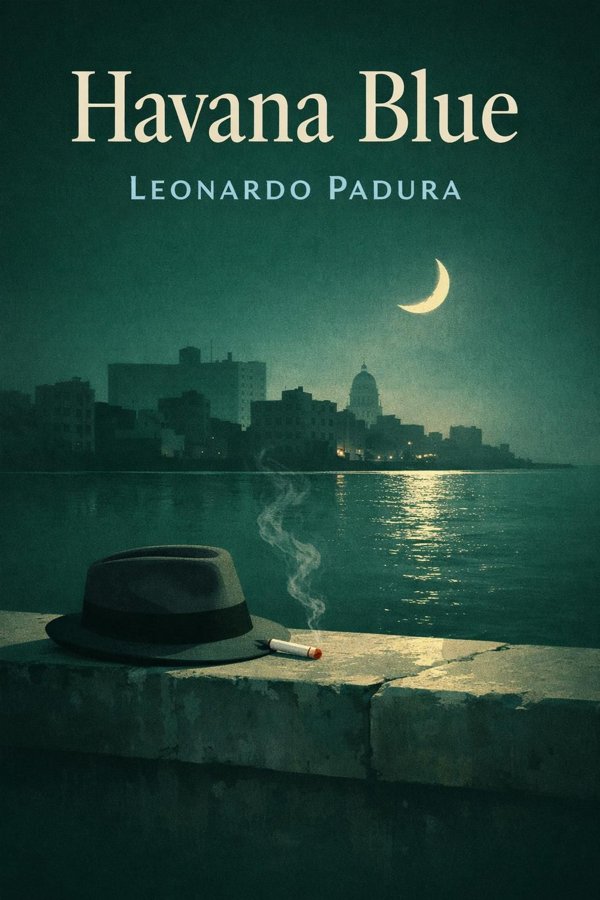
Havana Blue: Summary & Key Insights
 10 min9 chaptersAudio available
Key Takeaways from Havana Blue
A disappearance can expose more truth than a confession.
Sometimes the most unsettling part of an investigation is not what it uncovers about others, but what it revives in oneself.
Every city has two maps: the official one and the lived one.
Truth is rarely difficult because it is hidden; more often, it is difficult because seeing it clearly has consequences.
The most compelling detectives are not just problem-solvers; they are instruments for seeing a damaged world.
What Is Havana Blue About?
Havana Blue by Leonardo Padura is a mystery book spanning 4 pages. Leonardo Padura’s Havana Blue, the first novel in the celebrated Havana Quartet, is far more than a detective story. On the surface, it follows police lieutenant Mario Conde as he investigates the disappearance of Rafael Morín, a prominent government official who seems to embody success, discipline, and ideological purity. But as the case unfolds through the heat, decay, and beauty of late-1980s Havana, the novel becomes a portrait of a society losing faith in its own promises. Crime is only the entry point; the real subject is disillusionment. Through Conde’s weary intelligence, Padura explores corruption, memory, class, desire, and the painful gap between youthful ideals and adult reality. The book matters because it turns noir into social diagnosis, using one missing man to reveal the spiritual exhaustion of an entire era. Padura brings unusual authority to this world. Born in Havana and trained as a journalist, he writes with the observational precision of a reporter and the emotional depth of a novelist. The result is a mystery that satisfies as a plot while lingering as a meditation on Cuba, conscience, and what remains when certainty has faded.
This FizzRead summary covers all 9 key chapters of Havana Blue in approximately 10 minutes, distilling the most important ideas, arguments, and takeaways from Leonardo Padura's work. Also available as an audio summary and Key Quotes Podcast.
Havana Blue
Leonardo Padura’s Havana Blue, the first novel in the celebrated Havana Quartet, is far more than a detective story. On the surface, it follows police lieutenant Mario Conde as he investigates the disappearance of Rafael Morín, a prominent government official who seems to embody success, discipline, and ideological purity. But as the case unfolds through the heat, decay, and beauty of late-1980s Havana, the novel becomes a portrait of a society losing faith in its own promises. Crime is only the entry point; the real subject is disillusionment. Through Conde’s weary intelligence, Padura explores corruption, memory, class, desire, and the painful gap between youthful ideals and adult reality. The book matters because it turns noir into social diagnosis, using one missing man to reveal the spiritual exhaustion of an entire era. Padura brings unusual authority to this world. Born in Havana and trained as a journalist, he writes with the observational precision of a reporter and the emotional depth of a novelist. The result is a mystery that satisfies as a plot while lingering as a meditation on Cuba, conscience, and what remains when certainty has faded.
Who Should Read Havana Blue?
This book is perfect for anyone interested in mystery and looking to gain actionable insights in a short read. Whether you're a student, professional, or lifelong learner, the key ideas from Havana Blue by Leonardo Padura will help you think differently.
- ✓Readers who enjoy mystery and want practical takeaways
- ✓Professionals looking to apply new ideas to their work and life
- ✓Anyone who wants the core insights of Havana Blue in just 10 minutes
Want the full summary?
Get instant access to this book summary and 100K+ more with Fizz Moment.
Get Free SummaryAvailable on App Store • Free to download
Key Chapters
A disappearance can expose more truth than a confession. That is the power of Rafael Morín’s vanishing in Havana Blue: the missing man becomes a negative image through which everyone else is revealed. Morín appears, at first, to be an exemplary figure of revolutionary success—disciplined, respectable, politically reliable, and socially elevated. Yet the deeper Mario Conde investigates, the more this polished public image begins to crack. Morín is not just a bureaucrat gone missing; he is a symbol of the split between official virtue and private compromise.
Padura uses the case to show how institutions protect appearances. Morín’s status makes his disappearance politically sensitive, which means the investigation is never simply about finding facts. It is also about navigating power, silence, and self-interest. Conde must read what is omitted as carefully as what is said. Colleagues hesitate, acquaintances distort, and the city itself seems to conspire in half-truths. This makes the mystery richer than a standard procedural: the question is not only where Morín has gone, but what kind of man he really was and why so many people need him to remain an illusion.
In practical terms, the novel offers a lesson in how systems hide decay beneath ritual respectability. Whether in politics, business, or family life, a carefully maintained image can postpone scrutiny but cannot eliminate contradiction. Padura suggests that when someone disappears from a structure built on appearances, the resulting void often exposes the structure itself.
Actionable takeaway: when assessing a person or institution, look beyond reputation and examine the pressures, incentives, and silences that sustain it.
Sometimes the most unsettling part of an investigation is not what it uncovers about others, but what it revives in oneself. Tamara serves this role in Havana Blue. She is not merely a character linked to the case; she is the emotional fault line running through Mario Conde’s inner life. Once the object of his youthful love, she reappears as a living reminder of what he dreamed, what he surrendered, and what time has transformed beyond repair.
Padura uses Tamara to make memory active rather than nostalgic. Conde does not simply remember youth as a pleasant past. Through Tamara, he confronts the shock of seeing old hopes embodied in altered form. She represents tenderness, beauty, and possibility, but also compromise, social ambition, and the blunt reality that life does not preserve our ideal versions of people. Her connection to Rafael Morín intensifies this effect. She stands at the point where personal longing and political-social reality meet, forcing Conde to reckon with both.
This emotional thread deepens the mystery because it clouds and clarifies Conde’s vision at the same time. He is vulnerable to sentiment, yet that same vulnerability gives him access to truths a colder investigator might miss. Padura suggests that objectivity is never complete; our histories shape what we can perceive. In everyday life, this is equally true. Encounters with former partners, old friends, or childhood places often reveal who we have become more vividly than any deliberate self-analysis.
Actionable takeaway: treat moments of emotional return not as distractions from truth, but as opportunities to examine how your past still influences your present judgments.
Every city has two maps: the official one and the lived one. In Havana Blue, Padura guides readers through the second. Havana is not a decorative backdrop for the crime; it is an active force that shapes motive, mood, and meaning. The city’s crumbling buildings, humid streets, coastal light, overcrowded homes, bureaucratic spaces, and improvised social economies create a world where scarcity and performance coexist. Beneath slogans and public order lies a messy, vibrant, wounded reality.
Conde’s investigation moves through neighborhoods, bars, offices, and domestic spaces that reveal social layers often hidden by ideology. Padura shows a city of gossip, private bargains, sexual tensions, old resentments, and practical survival. What emerges is a portrait of urban life under pressure, where people adapt outwardly while inwardly carrying frustration, irony, and fatigue. The “underneath” of Havana is not only criminal. It includes the emotional and moral underground where disappointment accumulates.
This idea has broad relevance. Societies often maintain official narratives about themselves—meritocratic, moral, unified, successful—while everyday experience tells a more contradictory story. To understand any place fully, you must notice how people actually live: what they joke about, what they hide, what they trade, what they endure, and what they stop believing in. Padura excels at this social reading. His journalism-trained eye lets him notice textures that make the city legible as evidence.
For readers, Havana Blue becomes a reminder to interpret environments carefully. Offices, cities, and communities all communicate through infrastructure, habits, and absences. Their truth is usually found below declared values.
Actionable takeaway: when trying to understand a place, pay attention to ordinary routines and unofficial networks—they often reveal more than formal statements ever will.
Truth is rarely difficult because it is hidden; more often, it is difficult because seeing it clearly has consequences. This tension sits at the center of Havana Blue. As Mario Conde gets closer to understanding Rafael Morín’s disappearance, he is forced to weigh loyalty against honesty—loyalty to colleagues, to old friendships, to institutional expectations, and even to his own emotional self-protectiveness.
Padura resists the comforting idea that truth automatically liberates. In this novel, truth can humiliate, destabilize, and isolate. To expose what has happened is also to expose the networks of vanity, corruption, compromise, and self-deception that made it possible. Conde is not a triumphant truth machine; he is a man who knows that every revelation costs someone something, including himself. That gives the novel moral complexity. Justice is necessary, but it is not clean.
This matters beyond detective fiction. In workplaces, families, and civic life, people often avoid clarity not because they cannot perceive reality, but because acknowledging it would require action. A failing leader, a dishonest friend, a stagnant institution, a dead relationship—these truths persist when convenience outweighs courage. Padura’s insight is that moral adulthood involves learning to endure the discomfort of recognition.
Conde’s struggle also shows that loyalty is not always virtuous. Sometimes it protects dignity and human bonds; sometimes it merely shields rot. The challenge is learning to distinguish compassionate discretion from cowardly complicity.
Actionable takeaway: when faced with an uncomfortable truth, ask not only “Is it real?” but also “What am I afraid will change if I admit it?” That question often reveals the real obstacle.
The most compelling detectives are not just problem-solvers; they are instruments for seeing a damaged world. Mario Conde is exactly that. He is intelligent, ironic, melancholic, and chronically dissatisfied, a police officer who often seems temperamentally closer to a writer than to a bureaucratic enforcer. His dissatisfaction is essential to the novel’s force. He notices too much, remembers too vividly, and believes too little in official language to move through Havana without friction.
Padura builds Conde as a disillusioned witness to his generation. He once had dreams—literary ambitions, romantic ideals, a more meaningful future—but life has pushed him into a role that keeps him adjacent to disappointment. Yet this failure of belief is also what makes him effective. Because he is not fully invested in the myths around him, he can detect the gaps between rhetoric and reality. His skepticism becomes a method.
Readers can see in Conde a broader human type: the person who keeps functioning inside a system he no longer fully trusts. This gives the novel emotional resonance. Many people know what it feels like to continue performing duties while quietly mourning the life, ideals, or institutions they once believed in. Conde’s weariness is not passivity; it is a bruised form of moral awareness.
Practically, his character shows that sensitivity and fatigue can coexist with competence. One need not be emotionally untouched to perceive accurately. In fact, some forms of disappointment sharpen vision.
Actionable takeaway: if you feel disillusioned, do not assume that has made you useless. It may have made you more capable of noticing realities that optimism tends to overlook.
People do not live only in the present; they live among the ruins of earlier versions of themselves. Havana Blue is saturated with this insight. Mario Conde’s investigation is constantly shadowed by memory—school years, youthful friendships, old desires, and political hopes that once seemed stable. The novel’s emotional power comes from showing how the past does not disappear. It remains active, measuring the distance between what was imagined and what was achieved.
Padura treats regret with unusual subtlety. He does not romanticize youth as a pure golden age. Instead, he shows that youthful certainty is often naïve, but losing it can still feel like an amputation. Conde’s memories make him vulnerable, yet they also keep him morally alive. He suffers because he can compare the present to something once believed possible. In this sense, memory becomes both burden and resistance. A person who remembers better dreams is harder to fully domesticate.
This tension speaks to anyone who has reached adulthood and felt the quiet grief of compromise. Careers drift, relationships harden, social ideals weaken, and whole generations discover that history does not reward sincerity. Yet Padura suggests that facing this honestly is more dignified than retreating into denial. Broken ideals still matter because they reveal what once inspired commitment.
In practical life, reflection on regret can either paralyze or instruct. The novel pushes toward the second option. Memory should not be used to punish oneself endlessly, but to understand recurring patterns and recover neglected values.
Actionable takeaway: revisit your regrets not to indulge sadness, but to identify which abandoned ideals still deserve a place in your life today.
Social systems often claim equality while quietly reproducing hierarchy through access, reputation, and privilege. Havana Blue captures this contradiction with precision. Rafael Morín’s position, the circles he moves in, and the deference surrounding him reveal that status has not disappeared in revolutionary Havana; it has simply taken altered forms. Political legitimacy, bureaucratic advancement, and personal influence create a class-like structure that shapes who is protected, who is scrutinized, and whose failures can be hidden.
Padura is especially sharp on private hypocrisy. Characters who outwardly embody discipline and ideological correctness often turn out to be driven by vanity, resentment, opportunism, or desire. This does not make them uniquely monstrous; it makes them recognizable. The novel argues that when public morality becomes performative, private corruption thrives in its shadow. The wider the gap between what people must say and what they actually want, the more distorted social life becomes.
This idea applies in many contexts. Organizations frequently use noble language—service, mission, integrity, equality—while rewarding strategic self-protection and symbolic compliance. Over time, members learn to manage appearances instead of confronting dysfunction. Padura’s world feels believable because it understands that hypocrisy is rarely an individual flaw alone; it is often a survival skill cultivated by institutions.
Readers can use this insight to become better interpreters of power. Ask who is insulated, who is watched, and what behaviors are tolerated from the well connected but punished in others. That is often where the real social order becomes visible.
Actionable takeaway: evaluate systems by how they distribute protection and consequence, not by the ideals they publicly proclaim.
One of the great achievements of Havana Blue is its refusal to separate beauty from decay. Havana appears as sensuous, luminous, sea-washed, musical, and deeply alive, yet also tired, cracked, burdened, and morally drained. This tension gives the novel its singular atmosphere. The city is seductive without being romanticized. Padura makes readers feel how beauty can persist even when collective energy has been depleted.
This matters because settings often become moral arguments in literature. Havana’s physical charm does not redeem its disappointments, nor do those disappointments erase its vitality. Instead, the coexistence of both realities creates a more honest portrait of lived experience. Many places people love are also places that wound them. Attachment becomes inseparable from frustration. Conde’s relationship to Havana mirrors this contradiction: he sees its failures clearly, but he remains bound to it by memory, habit, and emotional truth.
In a broader sense, the novel speaks to anyone living amid institutional or cultural decline while still feeling loyalty to the world around them. It is possible to love a place and still indict what it has become. In fact, deep criticism often arises from attachment, not detachment. Padura understands that civic sorrow is a form of intimacy.
Practically, this encourages a mature way of seeing. Rather than reducing places, people, or institutions to either admiration or contempt, we can hold both affection and judgment together. Such doubleness is not indecision; it is realism.
Actionable takeaway: practice describing what you love in full complexity, including its failures. Honest attachment is stronger than idealization.
All Chapters in Havana Blue
About the Author
Leonardo Padura is a Cuban novelist, screenwriter, and journalist born in Havana in 1955. He studied literature at the University of Havana and began his career in cultural journalism, a background that shaped his sharp observational style and deep engagement with Cuban society. Padura achieved international acclaim with his Mario Conde series, a cycle of detective novels that blends crime fiction with literary realism, political insight, and social critique. His work often explores memory, exile, history, and the contradictions of life in Cuba. Beyond the Conde books, he has written major historical and literary novels, including The Man Who Loved Dogs. Padura has received numerous honors, among them the 2015 Princess of Asturias Award for Literature. He is widely considered one of the most important contemporary Spanish-language writers.
Get This Summary in Your Preferred Format
Read or listen to the Havana Blue summary by Leonardo Padura anytime, anywhere. FizzRead offers multiple formats so you can learn on your terms — all free.
Available formats: App · Audio · PDF · EPUB — All included free with FizzRead
Download Havana Blue PDF and EPUB Summary
Key Quotes from Havana Blue
“A disappearance can expose more truth than a confession.”
“Sometimes the most unsettling part of an investigation is not what it uncovers about others, but what it revives in oneself.”
“Every city has two maps: the official one and the lived one.”
“Truth is rarely difficult because it is hidden; more often, it is difficult because seeing it clearly has consequences.”
“The most compelling detectives are not just problem-solvers; they are instruments for seeing a damaged world.”
Frequently Asked Questions about Havana Blue
Havana Blue by Leonardo Padura is a mystery book that explores key ideas across 9 chapters. Leonardo Padura’s Havana Blue, the first novel in the celebrated Havana Quartet, is far more than a detective story. On the surface, it follows police lieutenant Mario Conde as he investigates the disappearance of Rafael Morín, a prominent government official who seems to embody success, discipline, and ideological purity. But as the case unfolds through the heat, decay, and beauty of late-1980s Havana, the novel becomes a portrait of a society losing faith in its own promises. Crime is only the entry point; the real subject is disillusionment. Through Conde’s weary intelligence, Padura explores corruption, memory, class, desire, and the painful gap between youthful ideals and adult reality. The book matters because it turns noir into social diagnosis, using one missing man to reveal the spiritual exhaustion of an entire era. Padura brings unusual authority to this world. Born in Havana and trained as a journalist, he writes with the observational precision of a reporter and the emotional depth of a novelist. The result is a mystery that satisfies as a plot while lingering as a meditation on Cuba, conscience, and what remains when certainty has faded.
More by Leonardo Padura

You Might Also Like





Browse by Category
Ready to read Havana Blue?
Get the full summary and 100K+ more books with Fizz Moment.