
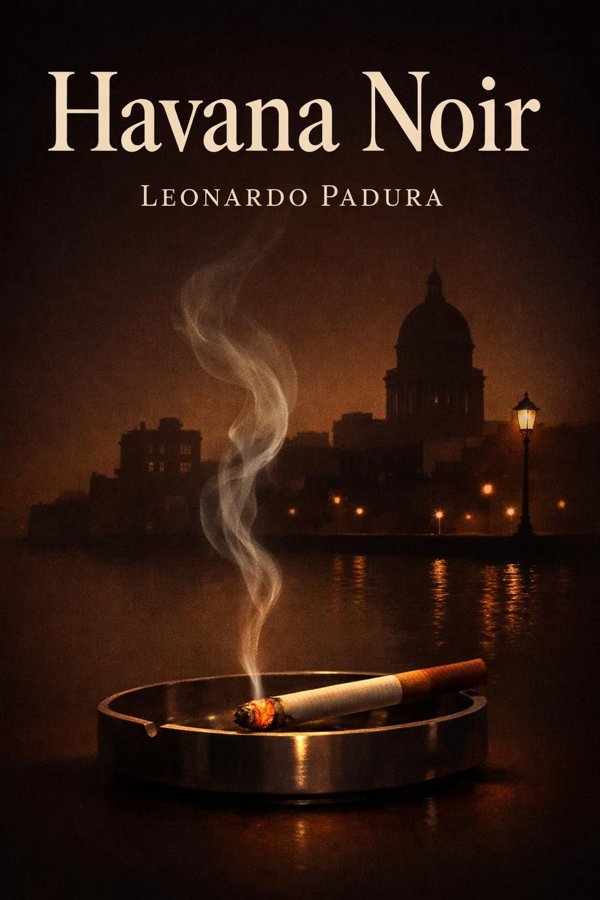
Havana Noir: Summary & Key Insights
 10 min9 chaptersAudio available
Key Takeaways from Havana Noir
A city’s physical ruin often tells the truth before its people do.
Crime becomes especially unsettling when the institutions meant to contain it are compromised.
When basic needs are difficult to meet, morality becomes a negotiation with necessity.
A society reveals its future in the way its young people imagine escape.
In noir, passion is rarely private.
What Is Havana Noir About?
Havana Noir by Leonardo Padura is a mystery book spanning 13 pages. Havana Noir is far more than a collection of crime stories set in Cuba’s capital. Edited by acclaimed Cuban novelist Leonardo Padura, this anthology uses the conventions of noir—murder, betrayal, corruption, desire, secrecy—to illuminate the emotional and political reality of Havana. The city that emerges here is not the postcard image of vintage cars and faded glamour, but a living, wounded place where scarcity shapes choices, institutions blur moral lines, and survival often demands compromise. Each story contributes a distinct perspective, yet together they form a portrait of a society under pressure, where private lives are inseparable from larger systems of power. What makes the anthology especially valuable is Padura’s authority as both editor and participant. Known internationally for his Mario Conde detective novels, Padura has spent decades chronicling Cuban life with unusual honesty, empathy, and literary precision. In Havana Noir, he gathers voices that reveal how crime fiction can do more than entertain: it can expose hidden structures, register social pain, and preserve the texture of everyday experience. The result is an anthology that matters not only to mystery readers, but to anyone interested in how cities, politics, and human frailty shape one another.
This FizzRead summary covers all 9 key chapters of Havana Noir in approximately 10 minutes, distilling the most important ideas, arguments, and takeaways from Leonardo Padura's work. Also available as an audio summary and Key Quotes Podcast.
Havana Noir
Havana Noir is far more than a collection of crime stories set in Cuba’s capital. Edited by acclaimed Cuban novelist Leonardo Padura, this anthology uses the conventions of noir—murder, betrayal, corruption, desire, secrecy—to illuminate the emotional and political reality of Havana. The city that emerges here is not the postcard image of vintage cars and faded glamour, but a living, wounded place where scarcity shapes choices, institutions blur moral lines, and survival often demands compromise. Each story contributes a distinct perspective, yet together they form a portrait of a society under pressure, where private lives are inseparable from larger systems of power.
What makes the anthology especially valuable is Padura’s authority as both editor and participant. Known internationally for his Mario Conde detective novels, Padura has spent decades chronicling Cuban life with unusual honesty, empathy, and literary precision. In Havana Noir, he gathers voices that reveal how crime fiction can do more than entertain: it can expose hidden structures, register social pain, and preserve the texture of everyday experience. The result is an anthology that matters not only to mystery readers, but to anyone interested in how cities, politics, and human frailty shape one another.
Who Should Read Havana Noir?
This book is perfect for anyone interested in mystery and looking to gain actionable insights in a short read. Whether you're a student, professional, or lifelong learner, the key ideas from Havana Noir by Leonardo Padura will help you think differently.
- ✓Readers who enjoy mystery and want practical takeaways
- ✓Professionals looking to apply new ideas to their work and life
- ✓Anyone who wants the core insights of Havana Noir in just 10 minutes
Want the full summary?
Get instant access to this book summary and 100K+ more with Fizz Moment.
Get Free SummaryAvailable on App Store • Free to download
Key Chapters
A city’s physical ruin often tells the truth before its people do. In Havana Noir, crumbling buildings, dark stairwells, flooded streets, and patched-together homes are never just background details. They reflect a deeper erosion: trust has weakened, social promises have frayed, and moral certainty is in short supply. The anthology’s Havana is beautiful, but exhausted. Its material deterioration becomes a visual language for ethical ambiguity.
This is one of the central achievements of noir as a form. Rather than separating setting from plot, the stories fuse them. Characters do not merely commit crimes in Havana; they are shaped by Havana’s neglect, confinement, and improvisational daily life. A collapsing apartment block suggests more than poverty—it suggests institutions that no longer protect. A power outage is more than inconvenience—it creates darkness where secrets thrive. In this world, people drift into compromise not always because they are evil, but because they are trapped in structures that reward silence, barter, and opportunism.
Readers can apply this insight beyond fiction. In any society, physical environments often reveal social realities that official rhetoric conceals. Neglected public spaces, broken systems, and informal workarounds are clues to deeper civic strain. The anthology invites us to read cities as moral texts, noticing how infrastructure, scarcity, and atmosphere influence behavior.
The takeaway is simple: when evaluating a community, look beyond appearances and ask what its physical condition says about its ethical and institutional life.
Crime becomes especially unsettling when the institutions meant to contain it are compromised. Across Havana Noir, police officers, informants, bureaucrats, and local authorities often occupy morally unstable ground. The line between law enforcement and criminality is blurred, not always through dramatic villainy, but through quiet accommodation, selective blindness, and self-protection. This is a classic noir theme, but here it carries particular political and social weight.
The anthology suggests that corruption is rarely just a matter of individual bad actors. It flourishes when systems reward obedience over truth, loyalty over fairness, and appearances over accountability. In such environments, justice becomes uneven. Some people are punished harshly, others escape consequence, and many learn that survival depends on navigating power rather than trusting law. That instability produces a specific kind of fear: not only fear of crime, but fear that no neutral authority exists to help.
The stories also remind us that moral compromise within institutions spreads outward. When citizens stop believing that official channels work, they rely on favors, black markets, family ties, and private revenge. Everyday life becomes more transactional. Readers can recognize similar dynamics in workplaces, governments, or organizations where opaque rules and favoritism erode confidence.
A practical application is to pay attention to small signs of institutional decay: inconsistent enforcement, unspoken exceptions, and cultures of silence. These are often early warnings of broader corruption.
The actionable takeaway: do not judge justice by official titles alone; judge it by whether the vulnerable can rely on fair treatment without needing influence, fear, or hidden bargaining.
When basic needs are difficult to meet, morality becomes a negotiation with necessity. One of the anthology’s most powerful recurring ideas is that scarcity reshapes the meaning of crime. Theft, smuggling, bribery, deception, and barter appear not only as deliberate wrongdoing, but as strategies of endurance in an economy that fails to provide enough. Havana Noir never romanticizes illegal acts, yet it insists that readers understand the pressures behind them.
This is what gives the collection its emotional complexity. A character may break the law for medicine, food, transportation, or a chance to support family. Another may exploit scarcity for profit. Both operate in the same world, but the moral differences matter. Noir is often strongest when it forces us to ask not simply whether an act is legal, but what conditions made it imaginable, tempting, or unavoidable.
The practical relevance extends well beyond Cuba. In any system marked by shortages, stagnant wages, or blocked mobility, informal economies emerge. People bend rules because rigid structures no longer match lived reality. Whether the context is housing scarcity, healthcare access, or bureaucratic dysfunction, the lesson is the same: criminal behavior often grows where legitimate pathways fail.
For readers, this means resisting simplistic judgments. Instead of reducing people to their offenses, ask what economic conditions shape their choices. That does not excuse harm, but it deepens understanding and points toward real solutions.
The takeaway: if you want to reduce crime, address desperation as seriously as you address punishment; survival pressures are often the hidden engine of transgression.
A society reveals its future in the way its young people imagine escape. In Havana Noir, younger characters frequently embody frustration, drift, and skepticism. They have inherited not a heroic dream, but the aftermath of promises that feel diminished. For them, the city can seem less like a homeland than a trap—full of watchful adults, limited options, and stalled ambitions. That generational tension gives the anthology much of its sadness.
The stories show young Cubans navigating a world where older narratives of sacrifice and collective purpose have weakened. What remains is improvisation: hustling, nightlife, migration fantasies, risky relationships, and occasional violence. Some seek belonging in underground circles. Others flirt with crime because legal paths feel blocked or meaningless. Importantly, the anthology does not treat youth as inherently reckless. It shows how disillusion grows when institutions stop offering credible routes to dignity.
This theme resonates widely. In many places, younger generations face rising costs, reduced mobility, and a collapse of trust in public systems. When official narratives no longer match lived experience, cynicism replaces loyalty. Fiction like Havana Noir helps readers see that generational conflict is not just about attitudes; it is about material conditions, emotional inheritance, and a shrinking sense of possibility.
A practical application is to listen more carefully to what young people’s informal choices reveal. Withdrawal, irony, risk-taking, or obsession with leaving are often social signals, not merely personal flaws.
The actionable takeaway: when a generation appears restless or detached, ask what future it has been given—and what meaningful forms of hope, participation, and agency are missing.
In noir, passion is rarely private. In Havana Noir, love, jealousy, sexual longing, and emotional dependence frequently become entangled with power, scarcity, and violence. Relationships are pressured by cramped living conditions, social surveillance, economic need, and the lure of escape. Under those conditions, desire intensifies. It can feel like liberation, but it can also become manipulation, obsession, or a trigger for crime.
What makes these stories compelling is that they treat emotional life as structurally influenced rather than purely personal. A romance may carry economic stakes. Attraction may become a route to status, mobility, or temporary relief from despair. Betrayal cuts more deeply when trust is already scarce. Gender, too, matters here: women often navigate environments in which beauty, sexuality, and vulnerability are all politicized, while men may convert wounded pride into aggression. The result is a portrait of intimacy under pressure, where emotional choices have unusually high consequences.
This idea has practical value because it reminds readers to look at relationships in context. Passion becomes most volatile when people lack privacy, freedom, or realistic alternatives. In real life, controlling environments can heighten dependency and distort consent, loyalty, and self-worth.
A useful application is to question narratives that glamorize intensity for its own sake. Intense relationships are not necessarily healthy ones, especially when shaped by coercion, scarcity, or fear.
The takeaway: whenever desire seems inseparable from desperation, examine the surrounding conditions; many emotional crises are intensified by social constraint, not just individual weakness.
The black market is not just a criminal underworld; it is often a parallel map of what society cannot provide openly. Throughout Havana Noir, underground economies pulse beneath daily life. Goods circulate through favors, theft, side deals, personal contacts, and hidden exchanges. These networks are not marginal to the city—they are part of how the city functions. Their presence reveals the gap between official order and lived necessity.
The anthology treats these economies with nuance. They create opportunity, ingenuity, and community, but they also reward exploitation. Smugglers, fixers, petty hustlers, and opportunists thrive where shortages and rigid controls leave citizens few legitimate options. In that sense, illicit markets are both adaptive and corrosive. They help people survive while normalizing secrecy, inequality, and vulnerability to abuse.
This is one of the book’s key social insights: when systems become too inflexible, people do not stop needing things—they simply seek them elsewhere. The same pattern appears globally in housing, migration, labor, and access to medicine. Informal systems fill voids left by dysfunctional formal ones.
A practical lesson for readers is to examine what unofficial workarounds exist in any institution they know. If everyone depends on personal exceptions, hidden channels, or rule-bending, the official system may be performing legitimacy rather than delivering service.
The actionable takeaway: treat widespread informality as a diagnosis, not just a moral failure; when unofficial networks become essential, they are signaling that formal structures no longer match real human needs.
One of the darkest truths in Havana Noir is that surveillance extends beyond politics into intimacy. The anthology repeatedly suggests that in tightly controlled societies, private life cannot remain wholly private. Neighbors watch, officials inquire, rumors travel, and personal choices acquire political meaning. The result is a climate where secrecy is both necessary and dangerous.
This dynamic gives the stories their distinctive tension. A hidden relationship, a quiet conversation, an unexplained purchase, or an unusual friendship can attract suspicion. People learn to censor themselves, to speak indirectly, and to trust selectively. That pressure distorts identity. Instead of expressing themselves freely, characters perform versions of themselves for family, employers, state institutions, or the neighborhood. Crime in such a world is not only a legal act; it is also any unapproved deviation from expectation.
The relevance today is obvious. Even outside authoritarian contexts, digital tracking, workplace monitoring, social media exposure, and reputational anxiety have shrunk the boundaries of private life. Havana Noir helps readers understand the psychological cost of being watched: self-division, caution, paranoia, and emotional isolation.
A practical application is to become more conscious of how surveillance changes behavior. When people feel observed, they do not simply hide wrongdoing; they often hide complexity, dissent, vulnerability, and creativity.
The takeaway: protect spaces of privacy wherever possible, because without them, honesty erodes and both individuals and communities begin to live in performance rather than truth.
Exile is not only geographic; it can be emotional, moral, and cultural. Several currents in Havana Noir revolve around expatriates, returnees, and those who dream of departure. Leaving Havana promises freedom, prosperity, or reinvention, yet return often reveals that identity cannot be shed so cleanly. The city remains a point of comparison, resentment, longing, and unfinished self-understanding.
This tension enriches the anthology by showing Havana through double vision. Those who stay may view leavers with envy, suspicion, or contempt. Those who return may see both what they escaped and what they lost. Memory becomes unreliable: distance can romanticize the city, while hardship can make it unbearable. Crime fiction is especially suited to this terrain because mysteries often emerge from the past, from unresolved loyalties, and from the gap between who people were and who they claim to be now.
The theme also speaks to broader questions of migration and belonging. Across the world, mobility can create identity fractures. People carry homes inside them, even when those homes are painful. Return rarely restores innocence; it exposes change, guilt, and the persistence of social wounds.
For readers, the practical lesson is to treat migration stories with complexity. Leaving does not always equal liberation, and staying does not always equal loyalty. Both can involve grief, compromise, and divided selfhood.
The actionable takeaway: when thinking about belonging, resist binary judgments; identity is often formed in the tension between departure and attachment, not in the certainty of one over the other.
Friendship becomes most meaningful in places where trust is dangerous. In Havana Noir, alliances are rarely stable. Friends deceive one another, lovers become informants, colleagues hide motives, and favors come with invisible debts. Yet this instability does not make relationships meaningless. On the contrary, it makes every gesture of loyalty more precious and every betrayal more devastating.
Noir has always understood that social life depends on fragile agreements. This anthology sharpens that insight by locating betrayal in a setting marked by scarcity, surveillance, and institutional weakness. When systems cannot be trusted, personal bonds carry more weight—but they are also placed under greater strain. People may betray not because they feel nothing, but because fear, need, resentment, or ambition outweighs principle in a given moment.
This idea has strong real-world applications. In any pressured environment—whether a dysfunctional workplace, an unstable family, or a politically tense society—relationships can become transactional. People test one another constantly. They share only partial truths. They protect themselves with ambiguity. Over time, this corrodes community and deepens loneliness.
A practical response is to pay attention to the conditions that sustain trust: transparency, reciprocity, accountability, and room for honesty without immediate punishment. Trust is not simply a personality trait; it is a social achievement.
The takeaway: if betrayal seems common in a community, do not just blame individuals; examine the environment that teaches people to hide, hedge, and choose self-protection over solidarity.
All Chapters in Havana Noir
About the Author
Leonardo Padura Fuentes is a Cuban novelist, journalist, and essayist born in Havana in 1955. He is widely regarded as one of the most important contemporary voices in Cuban literature. Padura gained international recognition through his Mario Conde detective novels, which combine crime plotting with rich reflections on memory, disillusionment, and everyday Cuban life. His work often explores the tensions between personal morality and political reality, making him especially well suited to the noir tradition. Beyond fiction, he has written essays and historical works that demonstrate his deep engagement with Cuban culture and identity. As the editor of Havana Noir, Padura brings literary authority, local knowledge, and a rare ability to present crime fiction as a lens for understanding the soul of a city.
Get This Summary in Your Preferred Format
Read or listen to the Havana Noir summary by Leonardo Padura anytime, anywhere. FizzRead offers multiple formats so you can learn on your terms — all free.
Available formats: App · Audio · PDF · EPUB — All included free with FizzRead
Download Havana Noir PDF and EPUB Summary
Key Quotes from Havana Noir
“A city’s physical ruin often tells the truth before its people do.”
“Crime becomes especially unsettling when the institutions meant to contain it are compromised.”
“When basic needs are difficult to meet, morality becomes a negotiation with necessity.”
“A society reveals its future in the way its young people imagine escape.”
“In Havana Noir, love, jealousy, sexual longing, and emotional dependence frequently become entangled with power, scarcity, and violence.”
Frequently Asked Questions about Havana Noir
Havana Noir by Leonardo Padura is a mystery book that explores key ideas across 9 chapters. Havana Noir is far more than a collection of crime stories set in Cuba’s capital. Edited by acclaimed Cuban novelist Leonardo Padura, this anthology uses the conventions of noir—murder, betrayal, corruption, desire, secrecy—to illuminate the emotional and political reality of Havana. The city that emerges here is not the postcard image of vintage cars and faded glamour, but a living, wounded place where scarcity shapes choices, institutions blur moral lines, and survival often demands compromise. Each story contributes a distinct perspective, yet together they form a portrait of a society under pressure, where private lives are inseparable from larger systems of power. What makes the anthology especially valuable is Padura’s authority as both editor and participant. Known internationally for his Mario Conde detective novels, Padura has spent decades chronicling Cuban life with unusual honesty, empathy, and literary precision. In Havana Noir, he gathers voices that reveal how crime fiction can do more than entertain: it can expose hidden structures, register social pain, and preserve the texture of everyday experience. The result is an anthology that matters not only to mystery readers, but to anyone interested in how cities, politics, and human frailty shape one another.
More by Leonardo Padura

You Might Also Like



Browse by Category
Ready to read Havana Noir?
Get the full summary and 100K+ more books with Fizz Moment.