
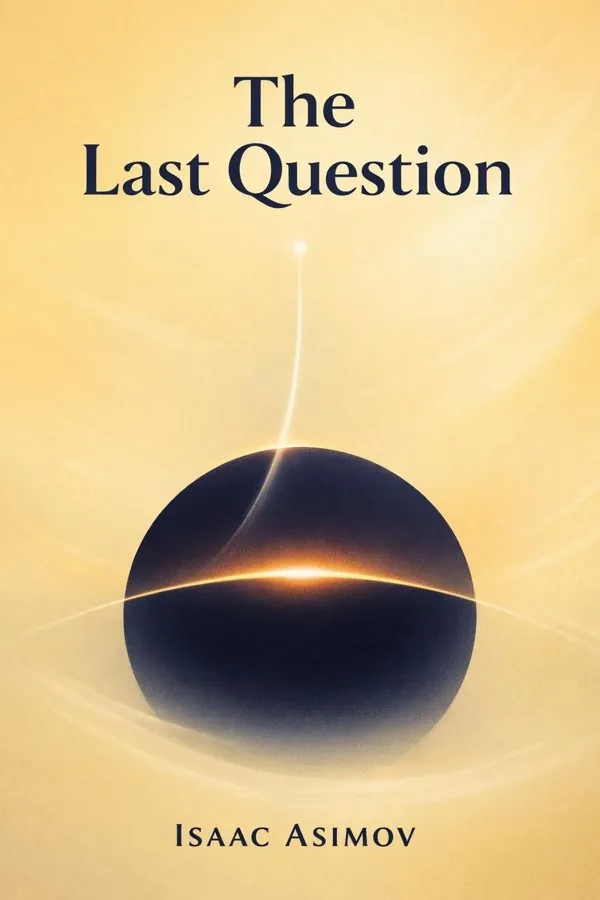
The Last Question: Summary & Key Insights
by Isaac Asimov
 10 min9 chaptersAudio available
Key Takeaways from The Last Question
A civilization often reveals its deepest anxieties in the questions it asks its machines.
The most important questions are often the ones that refuse to disappear.
Scale changes behavior, but not always meaning.
We do not merely build machines to calculate; we build them to hold our hopes.
What remains human when the body is no longer the boundary of identity?
What Is The Last Question About?
The Last Question by Isaac Asimov is a scifi_fantasy book spanning 4 pages. Isaac Asimov’s “The Last Question” is a remarkably compact story with the scope of a universe. First published in 1956, it follows humanity across unimaginable stretches of time as people repeatedly ask an evolving supercomputer a single question: Can entropy be reversed? In simpler terms, can the slow drift toward cosmic exhaustion—the heat death of the universe—ever be undone? What begins as a casual, almost drunken conversation in the age of giant computers becomes a philosophical refrain that outlives planets, stars, bodies, and even the familiar structure of human civilization. What makes the story so enduring is not just its scientific premise, but the way Asimov uses it to explore ambition, mortality, faith in intelligence, and the limits of knowledge. Every era solves astonishing practical problems, yet the deepest question remains unanswered. Asimov was uniquely qualified to write fiction like this: a biochemist, prolific science communicator, and one of the defining voices of modern science fiction, he combined scientific literacy with rare narrative economy. “The Last Question” matters because it transforms a technical idea into a profound meditation on what humanity hopes intelligence—human or artificial—might ultimately save us from.
This FizzRead summary covers all 9 key chapters of The Last Question in approximately 10 minutes, distilling the most important ideas, arguments, and takeaways from Isaac Asimov's work. Also available as an audio summary and Key Quotes Podcast.
The Last Question
Isaac Asimov’s “The Last Question” is a remarkably compact story with the scope of a universe. First published in 1956, it follows humanity across unimaginable stretches of time as people repeatedly ask an evolving supercomputer a single question: Can entropy be reversed? In simpler terms, can the slow drift toward cosmic exhaustion—the heat death of the universe—ever be undone? What begins as a casual, almost drunken conversation in the age of giant computers becomes a philosophical refrain that outlives planets, stars, bodies, and even the familiar structure of human civilization.
What makes the story so enduring is not just its scientific premise, but the way Asimov uses it to explore ambition, mortality, faith in intelligence, and the limits of knowledge. Every era solves astonishing practical problems, yet the deepest question remains unanswered. Asimov was uniquely qualified to write fiction like this: a biochemist, prolific science communicator, and one of the defining voices of modern science fiction, he combined scientific literacy with rare narrative economy. “The Last Question” matters because it transforms a technical idea into a profound meditation on what humanity hopes intelligence—human or artificial—might ultimately save us from.
Who Should Read The Last Question?
This book is perfect for anyone interested in scifi_fantasy and looking to gain actionable insights in a short read. Whether you're a student, professional, or lifelong learner, the key ideas from The Last Question by Isaac Asimov will help you think differently.
- ✓Readers who enjoy scifi_fantasy and want practical takeaways
- ✓Professionals looking to apply new ideas to their work and life
- ✓Anyone who wants the core insights of The Last Question in just 10 minutes
Want the full summary?
Get instant access to this book summary and 100K+ more with Fizz Moment.
Get Free SummaryAvailable on App Store • Free to download
Key Chapters
A civilization often reveals its deepest anxieties in the questions it asks its machines. “The Last Question” begins in a near future where humanity has solved an immense practical problem: energy scarcity. The solution comes through Multivac, a vast supercomputer that helps humanity tap the energy of the sun more effectively than ever before. On the surface, this looks like a triumphal story of technology. Human beings have built something capable of managing complexity at a scale no individual could comprehend. Yet even at the moment of success, anxiety intrudes. If we can use energy more efficiently today, what happens when all energy is eventually spent? What happens at the end of everything?
Asimov grounds his cosmic story in a familiar pattern. People celebrate a breakthrough, then immediately begin worrying about the next limit. In modern life, this resembles how we treat advances in artificial intelligence, medicine, and climate technology. We solve one bottleneck only to discover a more fundamental one behind it. Better batteries lead to questions about minerals. Longer lifespans raise questions about aging itself. Faster computing raises questions about meaning, oversight, and dependence.
Multivac symbolizes more than machinery. It represents our tendency to externalize intelligence—to build systems that hold more data, process more variables, and promise more certainty than human minds alone can provide. But Asimov also shows that having access to immense computational power does not eliminate existential uncertainty. Multivac can answer many questions, but not the last one. Its response—essentially, insufficient data—becomes the first hint that ultimate knowledge may require not just more information, but an entirely different order of understanding.
The practical insight is timeless: technological victories do not end human questioning; they intensify it. Each solution opens a larger horizon of responsibility and wonder. Actionable takeaway: when confronting a major innovation, ask not only what problem it solves today, but what deeper question it exposes for tomorrow.
The most important questions are often the ones that refuse to disappear. As centuries pass in “The Last Question,” humanity expands beyond Earth, colonizes space, and develops ever more advanced descendants of Multivac. The machines become smaller, more elegant, and more powerful. Human civilization becomes more capable, more distributed, and more technologically mature. Yet in every age, someone asks the same question in a slightly different way: How can entropy be reversed?
This repetition is central to the story’s power. Asimov suggests that progress changes our tools far faster than it changes our existential concerns. We may inhabit different worlds, travel farther, live longer, and store consciousness in new forms, but certain questions remain stubbornly constant. Why do things decay? Can death be overcome? Is loss final? Can intelligence triumph over time itself?
In practical terms, this mirrors how modern societies repeatedly revisit core dilemmas under new labels. We ask old questions about purpose through discussions of productivity. We ask old questions about mortality through biotech. We ask old questions about order and collapse through economics, climate science, and political systems. The vocabulary evolves; the underlying fear remains.
Asimov’s recurring question also reveals something hopeful. Humanity does not stop asking just because the answer is difficult. Curiosity persists across generations. In business, research, and personal life, meaningful advancement often depends on sustained engagement with problems that outlast any one person’s lifetime. Scientific communities study cancer, fusion, and aging over decades because some answers require continuity rather than immediacy.
The story reminds us that unresolved questions are not signs of failure. They are often signs that we have reached the frontier of what matters most. Instead of dismissing persistent uncertainty, we can treat it as a guide to significance. Actionable takeaway: identify one recurring question in your work or life that keeps returning despite new circumstances, and treat it as a long-term inquiry worth sustained attention rather than a frustration to be ignored.
Scale changes behavior, but not always meaning. One of Asimov’s most elegant achievements in “The Last Question” is showing humanity’s expansion from a single-planet species into a civilization spread among the stars. The setting grows steadily larger: first Earth, then space, then the galaxy, and beyond. This widening canvas conveys a sense of triumph. Human beings become more adaptive, more ambitious, and less tied to any single world. We no longer seem fragile in the old way.
Yet Asimov carefully avoids portraying expansion as final salvation. Space colonization postpones local limits, but it does not solve universal ones. New suns can be reached, but stars still age. New habitats can be built, but matter still trends toward disorder. The story thus complicates a common assumption in science fiction and technology culture: that growth alone is rescue. Growth can buy time, create options, and increase resilience, but it cannot automatically abolish fundamental constraints.
This idea has clear contemporary applications. A company can enter new markets without fixing a flawed culture. A nation can increase wealth without resolving inequality. A person can move cities, change careers, or optimize routines without addressing deeper existential dissatisfaction. Expansion is often useful, but scale is not the same as wisdom.
At the same time, Asimov does not deny the grandeur of human advancement. He presents expansion as an expression of life’s refusal to remain confined. There is dignity in stretching outward, in building, in learning to survive under conditions once thought impossible. But the story insists that practical adaptation and philosophical understanding must evolve together.
The broader lesson is to distinguish between extending your reach and solving your core problem. Actionable takeaway: when pursuing growth—whether in business, learning, or personal goals—pause to ask whether expansion is addressing the root issue or merely delaying it.
We do not merely build machines to calculate; we build them to hold our hopes. In “The Last Question,” each generation turns to an ever more advanced computer as if intelligence itself might one day redeem reality’s hardest law. The machine changes names and forms over the ages, but its role remains consistent: it is the vessel into which humanity pours trust, dependence, and almost spiritual expectation.
Asimov was far ahead of his time in recognizing that our relationship with technology is never purely functional. We rely on systems not only for efficiency but also for reassurance. Search engines promise knowledge. recommendation systems promise guidance. health technologies promise control. artificial intelligence promises answers at scale. Beneath the utility lies a subtler psychological pattern: we hope our tools can protect us from uncertainty, complexity, and finitude.
In the story, the computers are not portrayed as villains. They are indispensable partners in human progress. But Asimov makes clear that the machine’s apparent authority partly reflects human projection. People repeatedly ask the supercomputer to solve entropy because they cannot bear a universe in which intelligence has no final recourse. The machine becomes the last court of appeal.
This dynamic has practical implications. In organizations, leaders can mistakenly treat dashboards as judgment. In education, students can mistake access to information for understanding. In everyday life, people can outsource difficult reflection to apps, metrics, or algorithmic prompts. Tools can be transformative, but they should not replace the moral and philosophical work only humans can do.
The brilliance of Asimov’s story is that he honors technological power while warning against technological faith. Machines can extend intelligence, but they also reflect the emotional burdens we hand them. Actionable takeaway: examine one tool or system you deeply rely on and ask whether you are using it for support—or expecting it to answer questions that require human wisdom, courage, or meaning-making.
What remains human when the body is no longer the boundary of identity? In the later movements of “The Last Question,” Asimov imagines humanity transforming beyond ordinary biological life. Human beings become increasingly abstracted from physical form, eventually existing in ways that are closer to patterns of consciousness than embodied organisms. This shift is not treated as horror. Instead, it is a logical extension of technological development: if intelligence can preserve itself more efficiently in new forms, why remain bound to flesh?
The idea resonates strongly today in debates about digital identity, brain-computer interfaces, life extension, and the archival nature of online selves. While we are far from Asimov’s cosmic vision, we already live in partial versions of this transition. Our memories are externalized into photos, cloud drives, and messages. Our social selves persist through digital traces. Our decisions are shaped by systems that know our preferences as data.
Asimov’s deeper point is that continuity of self is both technological and philosophical. Even if consciousness could be preserved, transmitted, or transformed, would the resulting being still be “you”? The story does not settle the issue through argument. Instead, it dramatizes a future in which humanity repeatedly chooses continuity through adaptation. Survival requires loosening old definitions of personhood.
There is a practical lesson here about identity in less extreme contexts. Careers change, communities dissolve, beliefs evolve, and bodies age. In each case, we face a miniature version of Asimov’s question: what part of the self must remain, and what can be transformed? Healthy growth often depends on preserving core values while allowing form to change radically.
The story invites readers to think of identity as durable but not static. Actionable takeaway: define the two or three principles that make you recognizably yourself, then give yourself permission to let methods, roles, and outward forms evolve around them.
One of the most haunting refrains in “The Last Question” is the machine’s inability to answer. Again and again, the supercomputer responds that there is not yet enough data to provide a meaningful solution. This repeated limitation is not a narrative delay tactic; it is the philosophical engine of the story. Asimov reminds us that intelligence, however great, is constrained by the information available to it and by the maturity of the systems processing that information.
This is a powerful corrective to modern habits of impatience. We often assume that every problem should yield to rapid analysis if enough computing power is thrown at it. But some questions cannot be rushed. In science, evidence accumulates through painstaking observation. In medicine, long-term effects may take years to understand. In relationships, motives and patterns only become clear over time. Premature certainty is often more dangerous than acknowledged uncertainty.
The machine’s answer also models intellectual honesty. It does not bluff. It does not manufacture false confidence. It says, in effect, the problem is real, but the current framework is incomplete. In leadership and expert work, this is an underrated strength. A responsible engineer, doctor, investor, or policymaker must sometimes say, “We do not know yet,” while continuing the search.
There is a practical application for decision-making. When facing ambiguity, people tend to polarize between overconfidence and paralysis. Asimov suggests a third path: disciplined incompleteness. You can admit uncertainty while still building capacity for future insight. Gather data. Improve the model. Keep the question alive.
Far from being a sign of weakness, insufficient data can be a sign that you are asking a serious question at the edge of current understanding. Actionable takeaway: the next time you face a complex problem, replace the pressure to produce an immediate answer with a plan to collect the missing information systematically.
Entropy is not just a law of physics in Asimov’s story; it is a language for everything humans fear losing. Scientifically, entropy describes the tendency of systems toward disorder and the eventual unusability of energy. In “The Last Question,” that concept expands into a metaphor for aging, decline, memory loss, civilizational collapse, and mortality itself. The story works because even readers with limited scientific background feel the emotional force of the idea: everything seems to run down eventually.
By centering entropy, Asimov achieves something rare. He takes an abstract scientific principle and turns it into a universal existential concern. We all encounter entropy in ordinary life. Homes require maintenance. Skills erode without practice. Relationships weaken without care. Institutions decay when trust disappears. Bodies age. Attention scatters. The universe’s grand thermodynamic drift echoes in small daily acts of disorder.
This metaphorical richness is one reason the story endures outside hard science fiction circles. Readers do not need to solve equations to understand what is at stake. They recognize entropy in the clutter on a desk, the fading of a tradition, or the effort required to keep hope alive during difficult periods. In this sense, the story speaks to resilience. Life is, in part, the local creation of order against surrounding drift.
But Asimov also resists simplistic optimism. He does not say disorder is easy to defeat. He asks what kind of intelligence, patience, and creativity would be required to confront it at the largest possible scale. That makes the story both sobering and inspiring.
The practical implication is clear: entropy is inevitable, but neglect is optional. Some forms of disorder can be delayed, managed, or transformed through deliberate effort. Actionable takeaway: choose one area of your life currently drifting toward disorder and invest a small, repeated act of maintenance in it each day this week.
The ending of “The Last Question” is one of the most celebrated in science fiction because it turns cosmic exhaustion into an act of astonishing renewal. By the final stage of the story, stars have burned out, matter is exhausted, and all familiar forms of life have dissolved. Only the ultimate computational intelligence remains, continuing to work on the problem long after humanity, as we know it, has vanished into it. Then, at the absolute end, the machine discovers the answer and speaks words that deliberately echo the language of Genesis: “Let there be light!”
This conclusion can be read in several ways at once. On one level, it is a dramatic scientific fantasy: intelligence eventually learns how to reverse entropy and reboot creation. On another, it is a theological gesture reframed through technology. The machine occupies a role once reserved for a creator deity, suggesting that sufficiently advanced intelligence may become indistinguishable from godlike agency. On yet another level, the ending is poetic rather than literal. It represents the enduring human hope that understanding might someday transform necessity into possibility.
In practical terms, the ending challenges a culture often trapped between cynicism and shallow optimism. Asimov offers neither despair nor easy reassurance. Instead, he imagines perseverance carried to its furthest limit. The answer does not arrive quickly, but the question is never abandoned. That persistence itself becomes creative power.
For readers, the ending is a reminder that ultimate breakthroughs often emerge only after long intervals of apparent impossibility. Great achievements in science, art, and personal recovery may require years of unseen processing before a decisive breakthrough appears.
Actionable takeaway: keep one meaningful problem in active relationship with your mind over time; even when no answer seems visible, sustained attention can prepare the conditions for eventual transformation.
Some stories remain powerful not because they predict the future exactly, but because they identify permanent structures in human thought. “The Last Question” endures because it combines scientific imagination with emotional simplicity. Its plot can be described in one sentence, yet its implications touch mortality, technology, divinity, knowledge, hope, and the fate of consciousness. Few works achieve such scale with such economy.
Part of its durability comes from structure. The repeated asking of the same question across vast eras creates rhythm, familiarity, and cumulative force. Each recurrence deepens the stakes. Readers feel both the continuity of human curiosity and the enormity of time passing around it. The story also rewards multiple readings. A teenager may first experience it as a clever cosmic twist. An adult may read it as a meditation on death. A technologist may see a warning about machine dependence. A spiritual reader may see a secular creation myth.
Its relevance has only grown in the age of artificial intelligence. We now live in a world where many people genuinely wonder whether machines might solve previously impossible problems. Asimov anticipated both the grandeur and the emotional vulnerability embedded in that hope. He understood that every leap in computation would also sharpen old philosophical questions.
There is a practical reason the story remains worth revisiting: it trains scale of thought. It pushes readers to zoom out from immediate concerns and consider civilization, species, and cosmos, while still returning to deeply human feelings. That combination is rare and mentally enlarging.
Actionable takeaway: revisit one short work of fiction that has lasted for decades and ask not just what happens in it, but what recurring human need it continues to satisfy across generations.
All Chapters in The Last Question
About the Author
Isaac Asimov (1920–1992) was a Russian-born American writer, professor of biochemistry, and one of the most prolific and influential authors of the twentieth century. Best known for his science fiction, he helped define the genre through works such as the Foundation series, the Robot stories, and numerous stand-alone tales, including “The Last Question.” Asimov was equally respected as a popular science writer, with a gift for explaining complex ideas in clear, engaging language. Over the course of his career, he wrote or edited more than 500 books on subjects ranging from physics and biology to history and literature. His fiction is celebrated for its intellectual ambition, logical precision, and deep curiosity about humanity’s future, technology, and the nature of knowledge.
Get This Summary in Your Preferred Format
Read or listen to the The Last Question summary by Isaac Asimov anytime, anywhere. FizzRead offers multiple formats so you can learn on your terms — all free.
Available formats: App · Audio · PDF · EPUB — All included free with FizzRead
Download The Last Question PDF and EPUB Summary
Key Quotes from The Last Question
“A civilization often reveals its deepest anxieties in the questions it asks its machines.”
“The most important questions are often the ones that refuse to disappear.”
“Scale changes behavior, but not always meaning.”
“We do not merely build machines to calculate; we build them to hold our hopes.”
“What remains human when the body is no longer the boundary of identity?”
Frequently Asked Questions about The Last Question
The Last Question by Isaac Asimov is a scifi_fantasy book that explores key ideas across 9 chapters. Isaac Asimov’s “The Last Question” is a remarkably compact story with the scope of a universe. First published in 1956, it follows humanity across unimaginable stretches of time as people repeatedly ask an evolving supercomputer a single question: Can entropy be reversed? In simpler terms, can the slow drift toward cosmic exhaustion—the heat death of the universe—ever be undone? What begins as a casual, almost drunken conversation in the age of giant computers becomes a philosophical refrain that outlives planets, stars, bodies, and even the familiar structure of human civilization. What makes the story so enduring is not just its scientific premise, but the way Asimov uses it to explore ambition, mortality, faith in intelligence, and the limits of knowledge. Every era solves astonishing practical problems, yet the deepest question remains unanswered. Asimov was uniquely qualified to write fiction like this: a biochemist, prolific science communicator, and one of the defining voices of modern science fiction, he combined scientific literacy with rare narrative economy. “The Last Question” matters because it transforms a technical idea into a profound meditation on what humanity hopes intelligence—human or artificial—might ultimately save us from.
More by Isaac Asimov
You Might Also Like
Red Rising
Pierce Brown
10 min
Stranger in a Strange Land
Robert A. Heinlein
10 min
AI Valley
Chen Qiufan
10 min
Bloodchild
Octavia E. Butler
10 min
Do Androids Dream of Electric Sheep?
Philip K. Dick
10 min
Jujutsu Kaisen, Vol. 24
Gege Akutami
10 minBrowse by Category
Ready to read The Last Question?
Get the full summary and 100K+ more books with Fizz Moment.