
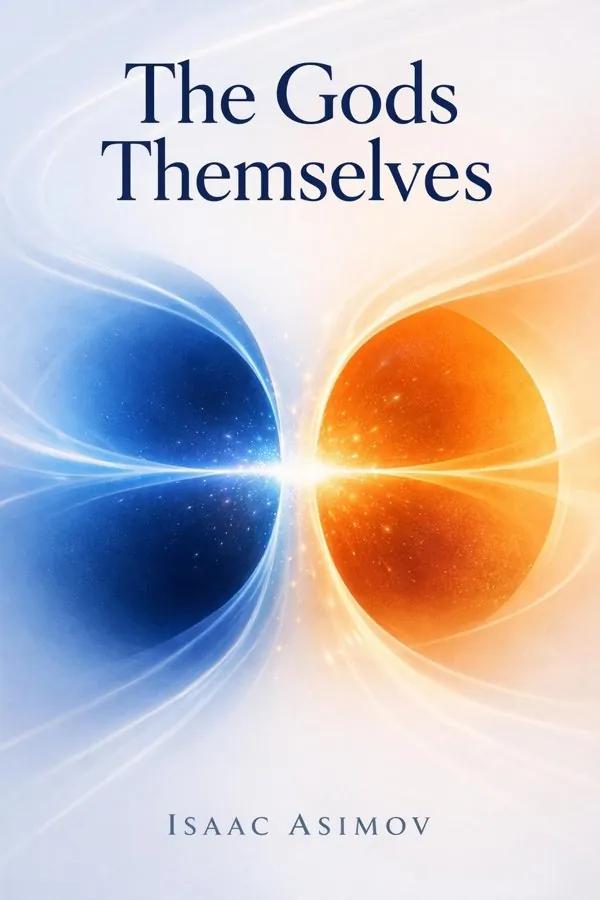
The Gods Themselves: Summary & Key Insights
by Isaac Asimov
 10 min9 chaptersAudio available
Key Takeaways from The Gods Themselves
The most dangerous threat in this novel is not malice but collective unwillingness to think critically.
Abundance can be more blinding than scarcity.
One of the novel’s boldest achievements is that it refuses to keep the parallel universe abstract.
The novel’s title comes from Friedrich Schiller’s line: “Against stupidity the gods themselves contend in vain.
A recurring theme in The Gods Themselves is that discovering truth is only half the battle; the other half is enduring the social cost of speaking it.
What Is The Gods Themselves About?
The Gods Themselves by Isaac Asimov is a scifi_fantasy book spanning 3 pages. What if humanity’s greatest scientific breakthrough was also the mechanism of its destruction? Isaac Asimov’s The Gods Themselves begins with an irresistible premise: a device called the Electron Pump allows Earth to receive nearly limitless, clean energy from a parallel universe. It looks like the ultimate solution to human scarcity, a discovery so transformative that questioning it seems almost absurd. Yet Asimov, with his trademark clarity and intellectual rigor, turns that triumph into a profound warning about complacency, pride, and the hidden costs of progress. Divided into three strikingly different sections, the novel follows human scientists, alien intelligences, and lunar settlers as they confront a crisis that spans universes and challenges the assumptions of science itself. More than a hard science fiction story, this is a meditation on institutional blindness, the ethics of innovation, and the loneliness of those who see danger before everyone else does. Asimov was uniquely equipped to write such a novel: trained in science and gifted as both storyteller and explainer, he built a work that is imaginative, intellectually ambitious, and still remarkably relevant in an age of technological acceleration.
This FizzRead summary covers all 9 key chapters of The Gods Themselves in approximately 10 minutes, distilling the most important ideas, arguments, and takeaways from Isaac Asimov's work. Also available as an audio summary and Key Quotes Podcast.
The Gods Themselves
What if humanity’s greatest scientific breakthrough was also the mechanism of its destruction? Isaac Asimov’s The Gods Themselves begins with an irresistible premise: a device called the Electron Pump allows Earth to receive nearly limitless, clean energy from a parallel universe. It looks like the ultimate solution to human scarcity, a discovery so transformative that questioning it seems almost absurd. Yet Asimov, with his trademark clarity and intellectual rigor, turns that triumph into a profound warning about complacency, pride, and the hidden costs of progress. Divided into three strikingly different sections, the novel follows human scientists, alien intelligences, and lunar settlers as they confront a crisis that spans universes and challenges the assumptions of science itself. More than a hard science fiction story, this is a meditation on institutional blindness, the ethics of innovation, and the loneliness of those who see danger before everyone else does. Asimov was uniquely equipped to write such a novel: trained in science and gifted as both storyteller and explainer, he built a work that is imaginative, intellectually ambitious, and still remarkably relevant in an age of technological acceleration.
Who Should Read The Gods Themselves?
This book is perfect for anyone interested in scifi_fantasy and looking to gain actionable insights in a short read. Whether you're a student, professional, or lifelong learner, the key ideas from The Gods Themselves by Isaac Asimov will help you think differently.
- ✓Readers who enjoy scifi_fantasy and want practical takeaways
- ✓Professionals looking to apply new ideas to their work and life
- ✓Anyone who wants the core insights of The Gods Themselves in just 10 minutes
Want the full summary?
Get instant access to this book summary and 100K+ more with Fizz Moment.
Get Free SummaryAvailable on App Store • Free to download
Key Chapters
The most dangerous threat in this novel is not malice but collective unwillingness to think critically. The story begins with a curious scientific anomaly: a tungsten isotope behaves in a way that should be impossible. From that irregularity emerges the Electron Pump, a device capable of transferring energy between universes. Dr. Frederick Hallam becomes the public face of the discovery, and soon the world celebrates it as a miracle. Energy becomes abundant, institutions reorganize around the technology, and Hallam’s reputation grows. But Asimov quickly reveals a deeper problem: once a discovery becomes politically useful and culturally adored, questioning it becomes socially expensive. Scientists who raise concerns are dismissed, not because their reasoning is weak, but because the system has already decided what it wants to believe.
This is the meaning behind the novel’s first section title, Against Stupidity. Asimov is not attacking ordinary ignorance. He is examining the stubborn form of stupidity that survives in educated systems: bureaucratic vanity, career protection, and the refusal to revisit assumptions after success has arrived. Hallam is not portrayed as a cartoon villain. He is far more realistic than that: ambitious, insecure, and invested in preserving his status. Those traits are enough to make him dangerous.
The idea applies far beyond science fiction. In business, teams cling to profitable products while ignoring warning signs. In public policy, leaders defend failing systems because they built their careers around them. In personal life, people resist evidence that threatens their identity. The lesson is practical: success often weakens skepticism exactly when skepticism is most needed. Build habits that reward dissent, revisit celebrated decisions, and listen seriously to inconvenient experts. The actionable takeaway: whenever a solution seems too beneficial to question, make questioning it your first responsibility.
Abundance can be more blinding than scarcity. The Electron Pump appears to solve one of civilization’s oldest problems by delivering vast quantities of usable energy. It is clean, efficient, and transformative. Entire industries and governments embrace it because it promises prosperity without sacrifice. Asimov understands the seduction perfectly: once a technology offers immediate gains at planetary scale, society becomes emotionally attached to its success. That attachment creates a powerful bias against recognizing long-term harm.
The scientific danger in the novel is that energy transfer between universes is not neutral. The process slowly alters fundamental constants, threatening the structure of matter itself. In other words, the machine that powers civilization may be destabilizing both worlds. This is a classic Asimov move. He takes a hard-science concept and uses it to expose a moral and institutional weakness: humans are often willing to borrow from the future without calculating the real cost.
The idea resonates with modern technological life. Social media platforms can connect billions yet corrode attention and trust. Cheap industrial growth can lift living standards while degrading ecosystems. AI tools can increase efficiency while quietly concentrating power and spreading error at scale. The pattern is familiar: first the benefits are obvious, then the side effects emerge, and finally the system becomes too entrenched to challenge easily.
Asimov is not anti-technology. He is anti-unquestioned technology. He asks readers to distinguish between innovation and wisdom. A good invention is not automatically a good system, and a useful tool is not automatically safe at scale. The actionable takeaway: when evaluating any breakthrough, ask not only what it gives us now, but what hidden structure it may be changing underneath us.
One of the novel’s boldest achievements is that it refuses to keep the parallel universe abstract. In the second section, Asimov shifts perspective and invites us into a world governed by different physical laws and inhabited by beings whose identities are fundamentally unlike our own. The triad of Dua, Odeen, and Tritt is not just a clever science-fiction invention. It is a way of stretching the reader’s imagination beyond human assumptions about personhood, family, sex, emotion, and rationality.
These beings exist in social and biological arrangements that cannot be neatly translated into human categories. Their relationships are cooperative, asymmetrical, and deeply shaped by their universe’s physics. Dua, in particular, becomes crucial because she senses patterns and dangers that others do not fully grasp. Through her, Asimov explores what it means to be different inside a society that prefers stable roles and familiar explanations. Her sensitivity is both gift and burden.
By making the alien world emotionally legible without making it comfortably human, Asimov achieves something rare. He shows that intelligence can be real even when it looks strange, and that social systems can fail to value the very individuals who perceive emerging danger most clearly. This has practical relevance in human organizations. The person who thinks differently, communicates awkwardly, or notices what others overlook may be the one carrying the most important insight.
In workplaces, classrooms, and communities, innovation often comes from minds that do not fit dominant norms. Instead of asking whether someone conforms, a better question is whether they are seeing something others miss. The actionable takeaway: treat unusual perspectives as potential sources of signal, not immediate reasons for exclusion.
The novel’s title comes from Friedrich Schiller’s line: “Against stupidity the gods themselves contend in vain.” Asimov uses that idea with precision. No one in the story, human or alien, possesses complete understanding. Not scientists, not bureaucrats, not social authorities, not even the most sensitive observers. Knowledge is fragmented, and disaster grows in the spaces between disciplines, between worlds, and between people who cannot or will not understand one another fully.
This is one of the book’s deepest insights. Complex systems do not fail merely because information is absent. They fail because information is scattered, poorly translated, politically inconvenient, or emotionally resisted. On Earth, scientists and institutions are trapped by ego and prestige. In the parallel universe, social arrangements and inherited expectations limit what can be said and done. Each side has partial truth, but partial truth is not enough when the mechanism of harm spans universes.
Asimov suggests that intelligence alone cannot save a civilization. What matters is whether institutions can integrate uncomfortable evidence before incentives crush it. This applies directly to modern life. Organizations often hire brilliant people yet create cultures where no one can challenge the dominant narrative. Governments collect data but cannot act because consensus lags behind urgency. Families know something is wrong but avoid naming it because naming it would force change.
The lesson is humbling. Even the smartest among us are constrained by culture, fear, and systems of reward. Wisdom requires not just knowledge, but structures that let knowledge travel and be heard. The actionable takeaway: in any group facing high stakes, create explicit channels for bad news, minority reports, and cross-disciplinary dialogue before crisis makes honesty harder.
A recurring theme in The Gods Themselves is that discovering truth is only half the battle; the other half is enduring the social cost of speaking it. Several characters perceive that the Electron Pump may be dangerous, but acknowledging that danger means challenging reputations, institutions, and an entire civilization’s dependence on a miracle technology. Asimov makes clear that science is not a machine that automatically produces truth. It is a human practice, and therefore vulnerable to vanity, fear, hierarchy, and inertia.
This idea becomes vivid through the contrast between genuine inquiry and bureaucratic science. Real science is provisional, self-correcting, and suspicious of easy triumph. Bureaucratic science seeks certainty, prestige, and administrative convenience. Hallam thrives in the second environment because he knows how to control narratives. The dissenters, by contrast, struggle because truth without power often moves slowly.
The practical relevance is broad. In medicine, researchers may hesitate to challenge established treatments if careers and funding are at risk. In corporations, employees may avoid reporting defects because leadership has already marketed the product as flawless. In everyday life, people often know something is wrong but stay quiet because conflict is costly. Courage, then, is not theatrical heroism. It is the disciplined willingness to keep asking accurate questions when the answers threaten comfort.
Asimov’s point is not cynical. He still believes in science deeply. But he believes in it as a process that must be defended against human weakness. That defense requires character as much as intellect. The actionable takeaway: if you work in any knowledge-driven field, measure integrity not by how confidently people agree, but by how safely and seriously they can disagree.
The novel repeatedly shows that those marginalized by mainstream society may be the ones best equipped to imagine solutions. In the final section, set largely on the Moon, Asimov introduces a culture more experimental and adaptive than Earth’s. Lunar society is less constrained by old assumptions, and its physical environment has forced its people to rethink identity, family, reproduction, and social norms. This makes the Moon not just a setting, but a conceptual counterweight to Earth’s complacency.
Characters like Denison, and the broader lunar environment around him, embody the idea that distance from the center can produce clarity. Because lunar society is not as invested in the Electron Pump’s prestige and because it already lives with practical limits, it can think more flexibly about alternatives. Earth, by contrast, is powerful but rigid. The Moon is peripheral but inventive.
This pattern appears often in real life. Startups can see what incumbents ignore. Outsider researchers can ask questions insiders avoid. Immigrants, neurodivergent thinkers, and people moving between cultures often notice assumptions that natives take for granted. Margins produce insight because they expose the arbitrariness of the center’s norms.
Asimov also links difference to survival. A civilization facing a novel threat may need not only smarter tools, but more varied ways of thinking. Conformity feels efficient until reality changes. Then diversity of thought becomes a practical necessity. The actionable takeaway: when solving a difficult problem, deliberately include people who are structurally distant from the dominant system, because they may be able to see exits the majority cannot.
Scientific capability expands faster than moral consensus. That tension sits at the heart of The Gods Themselves. The Electron Pump is a marvel of ingenuity, but the ethical infrastructure around it is weak. People rush to deploy the technology because it works, not because they understand its full consequences or have agreed on the terms under which it should be used. Asimov shows how easily a civilization can confuse technical success with moral legitimacy.
The central ethical question is not simply whether humans have the right to use the Electron Pump. It is whether any species has the right to benefit from a process that may annihilate another world. Once the universes are linked, the scope of responsibility expands. Actions can no longer be judged only by local convenience. They must be judged by systemic impact across beings who may not even be recognizable to one another.
This anticipates modern debates about global and transgenerational responsibility. Climate policy is not just about current consumers; it affects future populations. Biotechnology decisions can shape ecosystems and descendants. AI development affects labor, information quality, and social stability far beyond the engineers building the systems. The challenge is always the same: our tools now act at scales larger than our habits of moral reasoning.
Asimov argues implicitly that ethics cannot be an afterthought appended once profits or prestige are secured. It must be built into the discovery process itself. Ask who benefits, who bears risk, whose consent matters, and what irreversible damage might occur. The actionable takeaway: before embracing any powerful innovation, require an ethical review as serious and technically informed as the engineering behind it.
The novel is also about loneliness: intellectual loneliness, social loneliness, and the loneliness that comes from inhabiting a body or mind others do not understand. This is especially visible in the alien section and again on the Moon. Characters are often cut off from easy recognition. They desire connection, but their societies impose roles, expectations, and misunderstandings that make true mutual understanding difficult.
Asimov uses this emotional isolation to deepen the scientific stakes. People who are not heard clearly may either withdraw or become desperate. Systems that fail to integrate emotional and social complexity often miss practical danger as well. Dua’s alien sensitivity is treated ambiguously by those around her. Lunar relationships likewise challenge Earth-bound assumptions about intimacy and identity. In both settings, isolation is not merely personal suffering; it affects how information moves, how trust forms, and whether collaboration is possible.
This matters in everyday life because many failures that appear technical are partly relational. Teams collapse because people feel unable to speak honestly. Families repeat harmful patterns because no one feels safe enough to break the script. Leaders misjudge situations because they are insulated from sincere feedback. When people are emotionally isolated, they often make choices under distorted conditions.
The book suggests that empathy is not separate from intelligence. It is part of the machinery by which groups perceive reality accurately. If people cannot express what they notice or need, systems lose data. The actionable takeaway: wherever high-stakes decisions are made, improve not only analytical processes but also the quality of human connection, because clarity depends on both.
The final movement of The Gods Themselves makes a powerful claim: when old frameworks fail, survival depends on imaginative alternatives. Once the threat posed by the Electron Pump becomes undeniable, the question is no longer who was right in theory. The question is whether anyone can envision a path forward that does not simply preserve current arrangements. This is where Asimov’s scientific imagination shines most brightly. He does not resolve the crisis through brute force or sentimental optimism, but through conceptual flexibility.
The Moon becomes central because it represents a social and intellectual environment more willing to experiment. Faced with an existential problem, its people are prepared to consider solutions that Earth’s institutions would initially reject. This is not just plot mechanics. It is Asimov’s argument that entrenched systems often cannot imagine their own replacement, even when adaptation is the only way to endure.
We see this in organizations that try to solve new problems with obsolete structures, or in individuals who respond to life transitions by clinging harder to identities that no longer fit. Real resilience is not stubborn continuity. It is the ability to reframe, redesign, and relinquish. The future rarely rewards the system most invested in appearing correct; it rewards the one most capable of learning.
Asimov’s broader contribution is to show that imagination is not escapism. It is a survival skill. To imagine another arrangement, another model, another way of being, is often the first practical step out of catastrophe. The actionable takeaway: when confronted with a crisis, stop asking only how to preserve the current system and start asking what fundamentally different structure might solve the problem better.
All Chapters in The Gods Themselves
About the Author
Isaac Asimov (1920–1992) was a Russian-born American writer, professor, and one of the defining voices of modern science fiction. Raised in Brooklyn, he trained as a biochemist and later became famous for combining scientific precision with extraordinary storytelling range. Across his career, he wrote or edited more than 500 books, spanning science fiction, popular science, history, literary commentary, and humor. He is best known for the Foundation series, the Robot stories, and the influential Three Laws of Robotics, which helped shape public thinking about artificial intelligence. Asimov’s nonfiction made complex science accessible to general readers, while his fiction explored the social consequences of knowledge, reason, and technological change. The Gods Themselves stands as one of his most inventive standalone novels, showcasing both his scientific imagination and his philosophical depth.
Get This Summary in Your Preferred Format
Read or listen to the The Gods Themselves summary by Isaac Asimov anytime, anywhere. FizzRead offers multiple formats so you can learn on your terms — all free.
Available formats: App · Audio · PDF · EPUB — All included free with FizzRead
Download The Gods Themselves PDF and EPUB Summary
Key Quotes from The Gods Themselves
“The most dangerous threat in this novel is not malice but collective unwillingness to think critically.”
“Abundance can be more blinding than scarcity.”
“One of the novel’s boldest achievements is that it refuses to keep the parallel universe abstract.”
“The novel’s title comes from Friedrich Schiller’s line: “Against stupidity the gods themselves contend in vain.”
“A recurring theme in The Gods Themselves is that discovering truth is only half the battle; the other half is enduring the social cost of speaking it.”
Frequently Asked Questions about The Gods Themselves
The Gods Themselves by Isaac Asimov is a scifi_fantasy book that explores key ideas across 9 chapters. What if humanity’s greatest scientific breakthrough was also the mechanism of its destruction? Isaac Asimov’s The Gods Themselves begins with an irresistible premise: a device called the Electron Pump allows Earth to receive nearly limitless, clean energy from a parallel universe. It looks like the ultimate solution to human scarcity, a discovery so transformative that questioning it seems almost absurd. Yet Asimov, with his trademark clarity and intellectual rigor, turns that triumph into a profound warning about complacency, pride, and the hidden costs of progress. Divided into three strikingly different sections, the novel follows human scientists, alien intelligences, and lunar settlers as they confront a crisis that spans universes and challenges the assumptions of science itself. More than a hard science fiction story, this is a meditation on institutional blindness, the ethics of innovation, and the loneliness of those who see danger before everyone else does. Asimov was uniquely equipped to write such a novel: trained in science and gifted as both storyteller and explainer, he built a work that is imaginative, intellectually ambitious, and still remarkably relevant in an age of technological acceleration.
More by Isaac Asimov
You Might Also Like
Red Rising
Pierce Brown
10 min
Stranger in a Strange Land
Robert A. Heinlein
10 min
AI Valley
Chen Qiufan
10 min
Bloodchild
Octavia E. Butler
10 min
Do Androids Dream of Electric Sheep?
Philip K. Dick
10 min
Jujutsu Kaisen, Vol. 24
Gege Akutami
10 minBrowse by Category
Ready to read The Gods Themselves?
Get the full summary and 100K+ more books with Fizz Moment.