
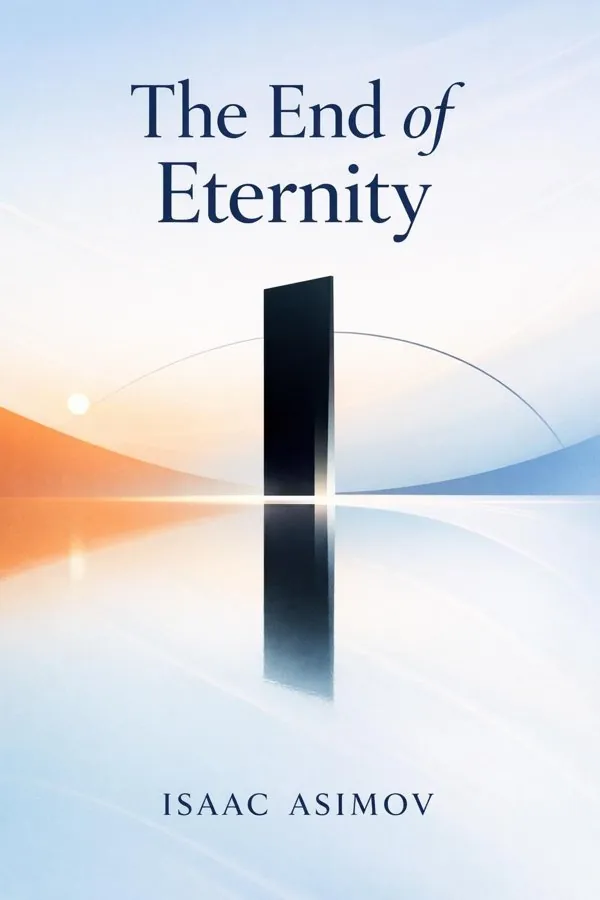
The End of Eternity: Summary & Key Insights
by Isaac Asimov
 10 min9 chaptersAudio available
Key Takeaways from The End of Eternity
The most dangerous systems are often the ones built on good intentions.
Mentors do not merely teach skills; they shape the boundaries of what their students believe is possible.
A single human attachment can expose the emptiness of an entire ideology.
Some systems collapse not because they fail, but because they contain their own contradiction from the beginning.
Trying to remove all risk from human life may also remove what makes human life worth living.
What Is The End of Eternity About?
The End of Eternity by Isaac Asimov is a scifi_fantasy book spanning 4 pages. What if history could be edited like a manuscript? In The End of Eternity, Isaac Asimov imagines a hidden organization operating outside ordinary time, quietly altering the course of human events to reduce suffering, prevent disaster, and steer civilization toward safer outcomes. At the center of this system is Andrew Harlan, a skilled and emotionally disciplined technician whose life is built on calculation, obedience, and faith in Eternity’s mission. But when he falls in love with Noÿs Lambent, a woman from a century marked for change, that faith begins to crack. What starts as a time-travel puzzle becomes a profound inquiry into freedom, progress, sacrifice, and the arrogance of control. This novel matters because it goes far beyond clever paradoxes. Asimov uses temporal engineering to ask enduring human questions: Is safety worth the loss of possibility? Can experts be trusted to redesign society? Do attempts to eliminate pain also erase greatness? A master of idea-driven fiction, Asimov brings scientific rigor, narrative economy, and philosophical depth to a story that remains one of the sharpest explorations of time travel ever written.
This FizzRead summary covers all 9 key chapters of The End of Eternity in approximately 10 minutes, distilling the most important ideas, arguments, and takeaways from Isaac Asimov's work. Also available as an audio summary and Key Quotes Podcast.
The End of Eternity
What if history could be edited like a manuscript? In The End of Eternity, Isaac Asimov imagines a hidden organization operating outside ordinary time, quietly altering the course of human events to reduce suffering, prevent disaster, and steer civilization toward safer outcomes. At the center of this system is Andrew Harlan, a skilled and emotionally disciplined technician whose life is built on calculation, obedience, and faith in Eternity’s mission. But when he falls in love with Noÿs Lambent, a woman from a century marked for change, that faith begins to crack. What starts as a time-travel puzzle becomes a profound inquiry into freedom, progress, sacrifice, and the arrogance of control.
This novel matters because it goes far beyond clever paradoxes. Asimov uses temporal engineering to ask enduring human questions: Is safety worth the loss of possibility? Can experts be trusted to redesign society? Do attempts to eliminate pain also erase greatness? A master of idea-driven fiction, Asimov brings scientific rigor, narrative economy, and philosophical depth to a story that remains one of the sharpest explorations of time travel ever written.
Who Should Read The End of Eternity?
This book is perfect for anyone interested in scifi_fantasy and looking to gain actionable insights in a short read. Whether you're a student, professional, or lifelong learner, the key ideas from The End of Eternity by Isaac Asimov will help you think differently.
- ✓Readers who enjoy scifi_fantasy and want practical takeaways
- ✓Professionals looking to apply new ideas to their work and life
- ✓Anyone who wants the core insights of The End of Eternity in just 10 minutes
Want the full summary?
Get instant access to this book summary and 100K+ more with Fizz Moment.
Get Free SummaryAvailable on App Store • Free to download
Key Chapters
The most dangerous systems are often the ones built on good intentions. Eternity exists outside conventional time, an immense hidden structure connecting countless centuries and allowing its agents, the Eternals, to observe history and make carefully calculated changes. Their mission sounds noble: reduce suffering, prevent catastrophe, and guide humanity toward safer outcomes. Within this organization, Andrew Harlan serves as a Technician, one of the specialists who carries out “Reality Changes” after mathematicians and Computers determine the smallest adjustment needed to reshape an era. Harlan’s life is defined by precision, secrecy, and emotional restraint. He has been trained to think in probabilities rather than loyalties, in outcomes rather than personal attachments.
Asimov presents Eternity as both miracle and prison. It is efficient, rational, and insulated from the chaos of ordinary life. Yet that insulation carries a cost. The Eternals become detached from the very humans they claim to protect. They study centuries as if they were specimens, reducing whole civilizations to charts of risk and benefit. Harlan embodies this mindset at the novel’s beginning. He believes competence and obedience are virtues because they support a higher moral mission. But his confidence rests on a hidden assumption: that history can be managed from above without distorting what makes humanity alive.
This idea applies well beyond science fiction. Institutions today also rely on data, models, and expert intervention to minimize harm, whether in public health, economics, education, or technology. Those tools are valuable, but Asimov warns that a life organized entirely around optimization can ignore dignity, spontaneity, and unintended consequences.
Actionable takeaway: when evaluating any system designed for efficiency or safety, ask not only what problems it solves, but also what forms of human freedom, creativity, or complexity it quietly removes.
Mentors do not merely teach skills; they shape the boundaries of what their students believe is possible. Senior Computer Twissell is one of the most important figures in The End of Eternity, not just because of his authority, but because he represents Eternity at its most intellectually powerful and morally ambiguous. To Harlan, Twissell is brilliant, secretive, and almost infallible. He trusts him with sensitive work, assigns him to unusual tasks, and appears to recognize his rare talent for understanding the hidden mechanics of historical change. That trust flatters Harlan, but it also entangles him in schemes whose full meaning he does not initially grasp.
Twissell’s role reveals how complex systems preserve themselves. Eternity depends on hierarchy, specialized knowledge, and restricted access. Those at the top know more than those below, and that imbalance allows them to direct others while maintaining an appearance of rational necessity. Twissell is not a simple villain; he genuinely believes in Eternity’s purpose. Yet Asimov shows how intelligence can become dangerous when it is paired with institutional secrecy and an assumption of moral entitlement. Harlan’s development is inseparable from Twissell’s influence because he learns, through painful experience, that technical mastery is not the same as wisdom.
In practical terms, this dynamic echoes modern organizations where experts, executives, or policymakers justify decisions through complexity that others cannot easily challenge. Often, subordinates comply not because they fully understand, but because they assume the system’s leaders must know best. Asimov invites readers to notice how easily competence can become authority, and authority can become unexamined power.
Actionable takeaway: respect expertise, but do not surrender judgment to it. Whenever a leader asks for trust without transparency, pause and ask what assumptions, interests, or hidden costs might lie beneath the confidence.
A single human attachment can expose the emptiness of an entire ideology. Harlan’s meeting with Noÿs Lambent marks the turning point of the novel because she awakens in him something Eternity has systematically suppressed: personal loyalty stronger than abstract duty. At first, Noÿs appears to be a woman from a particular century, cultured, intelligent, and vulnerable within a system she barely understands. Harlan is drawn to her with an intensity that surprises him. For a man trained to see individuals as variables within larger historical equations, love is not merely a feeling; it is a threat to his identity.
Their relationship destabilizes the moral logic of Eternity. If a Reality Change can erase Noÿs’s life as Harlan knows it, what does it mean to say the change is “beneficial”? If one person can be sacrificed for a statistical improvement in humanity’s future, who gets to decide that the trade is acceptable? Through Harlan’s inner conflict, Asimov transforms romance into a philosophical challenge. Noÿs is not important simply because Harlan loves her. She matters because she forces him to confront the gap between humane language and inhumane procedure.
This is one of the novel’s most enduring insights: systems often justify harm by making it impersonal. A workplace, government, or algorithm may claim that certain losses are regrettable but necessary. Yet those losses are always borne by actual people with names, desires, and irreplaceable lives. Empathy interrupts abstraction. It does not eliminate the need for hard choices, but it prevents us from pretending that human cost is merely numerical.
Actionable takeaway: whenever a policy or decision seems rational in the abstract, test it against an individual case. Ask what it would feel like if the “acceptable sacrifice” involved someone you love.
Some systems collapse not because they fail, but because they contain their own contradiction from the beginning. As The End of Eternity progresses, Asimov turns the novel into a dazzling paradox puzzle. The deeper Harlan moves into forbidden knowledge, the more he discovers that Eternity’s existence depends on a loop of causation involving its own origin. The institution that claims to stand above history is, in fact, trapped within it. Its authority rests on a self-referential structure sustained by secrecy, manipulation, and selective understanding.
This revelation matters because it destroys Eternity’s claim to neutrality. If the organization emerged through a paradox and perpetuates itself by shaping the conditions of its own creation, then it is not simply managing history; it is protecting a historical arrangement that benefits its own continued existence. What seemed like cosmic stewardship begins to resemble institutional self-preservation. The “end” in the title is therefore both literal and conceptual: the end of a time-manipulating order and the end of the illusion that one can stand outside consequence.
Asimov’s treatment of paradox is elegant because it is not merely a clever trick. He uses temporal logic to explore political and moral questions. Many institutions today also present themselves as inevitable, objective, or self-justifying. Yet when we trace their origins, we often find contingent choices, power struggles, and incentives hidden beneath official narratives.
The practical lesson is to examine any system that claims permanence or necessity. Ask how it began, who benefits from its continuation, and whether its rules are really designed for the common good or for its own survival. Origins matter because they reveal what rhetoric conceals.
Actionable takeaway: when facing a powerful institution, investigate its founding assumptions. Understanding how something came to be is often the first step toward seeing whether it truly deserves to continue.
Trying to remove all risk from human life may also remove what makes human life worth living. Eternity justifies its interventions through the language of benevolence. It does not seek conquest, wealth, or fame; it seeks to reduce suffering. That purpose gives its actions an aura of moral superiority. Yet Asimov steadily reveals the danger of paternalism. Reality Changes may prevent wars, accidents, and instability, but they also steer humanity away from boldness, experimentation, and transformative ambition. By making history safer, Eternity may be making it smaller.
This tension lies at the heart of the novel. The Eternals assume that because they can measure short-term improvements, they understand long-term human flourishing. But flourishing cannot always be reduced to comfort. Some of civilization’s greatest achievements come from uncertainty, struggle, curiosity, and risk. A world optimized against danger may also be optimized against greatness. Asimov does not romanticize suffering; he does not claim pain is good in itself. Instead, he shows that a system obsessed with preventing harm can become blind to higher forms of possibility.
The relevance today is striking. In families, schools, companies, and governments, leaders often overmanage in the name of protection. They remove challenge to prevent failure, but in doing so they may prevent growth. In digital life, recommendation systems shield us from friction yet trap us in narrow loops of predictability. Safety is valuable, but safety without freedom can become stagnation.
Actionable takeaway: when making decisions for yourself or others, distinguish between avoiding needless harm and eliminating meaningful challenge. Leave room for uncertainty where learning, courage, and discovery depend on it.
A machine can process outcomes, but only a person can take responsibility. One of Asimov’s most compelling themes is the clash between individual conscience and historical machinery. Harlan begins the novel as a loyal component in an immense system. He is trained to believe that history is too vast and complex for personal morality to guide it. Better, Eternity argues, to trust procedures, calculations, and experts. But once Harlan’s feelings and doubts intensify, he can no longer hide inside his role. He must decide whether obedience absolves him or whether participating in a harmful system still makes him accountable.
This conflict gives the novel emotional force. Harlan’s awakening is not simply rebellion; it is moral maturation. He moves from technical competence to ethical awareness. That transition is difficult because systems reward compliance. They offer certainty, status, and the relief of not having to question foundational assumptions. To step outside them is to risk confusion, guilt, and loss. Yet Asimov suggests that adulthood, in the fullest sense, begins when we stop outsourcing our conscience.
The theme has obvious real-world applications. Employees carry out corporate strategies they did not design. Citizens comply with political systems they did not create. Professionals implement policies justified by metrics, regulations, or tradition. In each case, individuals are tempted to say, “It is not my decision.” Asimov refuses that comfort. Even inside large structures, people still make choices about what they will support, ignore, or resist.
Actionable takeaway: if you are part of a powerful system, identify one area where your personal values and the system’s incentives might conflict. Do not wait for a crisis; decide in advance what line you will not cross.
The future becomes impoverished when it is managed too tightly by the present. One of the novel’s boldest claims is that humanity’s greatest destiny may require escaping the very controls designed to protect it. Eternity’s interventions shape history toward stability, but that stability limits expansion, originality, and long-range development. Asimov suggests that by continually selecting safer timelines, Eternity prevents humanity from taking the kinds of risks that might lead to extraordinary futures, including large-scale spacefaring potential and civilizational transformation.
This idea gives the novel a grand philosophical horizon. History is not only a record of avoided disasters; it is also a field of unrealized possibilities. If every dangerous branch is pruned away, then so are many fruitful ones. Progress is not linear optimization. It often emerges from uncertainty, missteps, accidents, and visionary gambles that no conservative planner would approve in advance. The tragedy of Eternity is that it mistakes survivability for destiny.
Modern readers can see this principle in innovation, art, and personal development. Breakthroughs rarely come from environments where every variable is controlled. Scientific discovery needs failed experiments. Entrepreneurship needs ventures that may collapse. Creative work needs the freedom to be messy and strange. Even in individual life, overly scripted paths can produce competence without depth.
Asimov’s point is not that all risk is good; reckless chaos is not a solution. The point is that a civilization must preserve enough openness for the genuinely new to emerge. A future worth having cannot be engineered entirely by fear of loss.
Actionable takeaway: build plans that include room for experimentation. Whether in work, study, or personal goals, reserve some time and energy for projects that are uncertain but potentially transformative.
The best time-travel stories are not about gadgets; they are about responsibility. In The End of Eternity, time travel is more than a thrilling premise. Asimov uses it as a disciplined thought experiment to examine causation, unintended consequences, and the ethics of intervention. The ability to move across centuries and alter outcomes makes visible a question that exists in ordinary life as well: how much should we interfere in the development of others, societies, or ourselves? If we could edit away mistakes, would we improve the world or diminish it?
Asimov’s answer is subtle. Intervention is neither automatically noble nor automatically corrupt. Its value depends on humility, scope, and understanding of consequences. The Eternals intervene constantly, but they often act with too much confidence and too little reverence for complexity. They treat history as a mechanism rather than a living process. Time travel magnifies this arrogance, turning policy into destiny. In that sense, the novel anticipates modern debates about predictive systems, social engineering, and technologies that promise control over deeply human domains.
The practical application is broad. Parents intervene in children’s choices. Managers intervene in teams. Governments intervene in markets. Individuals intervene in their own lives through planning, self-improvement, and regret management. The novel asks us to distinguish supportive guidance from domineering correction. Not every problem should be solved by forceful redesign.
Actionable takeaway: before intervening in a situation, ask three questions: What am I trying to preserve? What complexity might I be oversimplifying? And what unintended future might my “fix” silently prevent?
Sometimes the collapse of certainty is the beginning of genuine freedom. By the end of the novel, Harlan is forced to confront a world in which certainty, control, and institutional purpose can no longer sustain him. What remains is choice: frightening, irreversible, and human. Love plays a crucial role in this transition, but not in a sentimental way. It is because Harlan loves that he can no longer remain emotionally anesthetized. It is because he cares for one person in her uniqueness that he becomes able to care about humanity in a less abstract, more truthful sense.
Asimov links freedom with uncertainty. Eternity offered predictability, structure, and the promise that trained minds could shield civilization from chaos. But that promise came at the cost of authentic agency. Once that scaffolding falls, Harlan enters a condition that is both riskier and more meaningful. The novel’s ending therefore carries both loss and liberation. It rejects the fantasy that life can be perfected through total management. Human beings must live forward without guarantees.
This insight resonates in personal life. We often cling to routines, identities, and plans because they protect us from ambiguity. Yet major growth usually requires giving up false certainty: leaving a secure role, admitting a belief was wrong, committing to a relationship, starting a difficult project, or accepting a future we cannot fully control. Certainty can feel safe, but it can also keep us trapped in a smaller version of ourselves.
Actionable takeaway: identify one area of life where you are holding onto certainty at the expense of growth. Take one concrete step toward the more open, uncertain path if it aligns with your deepest values.
All Chapters in The End of Eternity
About the Author
Isaac Asimov (1920–1992) was a Russian-born American writer, professor of biochemistry, and one of the defining voices of twentieth-century science fiction. Raised in the United States, he became famous for combining scientific logic with clear, engaging storytelling. Across a career of astonishing range, he wrote or edited more than 500 books, including the Foundation series, the Robot stories, and numerous works of popular science, history, and literary commentary. Asimov’s fiction is known for its intellectual precision, large-scale ideas, and interest in how systems, technologies, and institutions shape human life. He had a rare gift for making complex concepts accessible without losing their depth. Today, he remains a foundational figure in speculative fiction, admired for both his imagination and his rigorous, humane curiosity about the future.
Get This Summary in Your Preferred Format
Read or listen to the The End of Eternity summary by Isaac Asimov anytime, anywhere. FizzRead offers multiple formats so you can learn on your terms — all free.
Available formats: App · Audio · PDF · EPUB — All included free with FizzRead
Download The End of Eternity PDF and EPUB Summary
Key Quotes from The End of Eternity
“The most dangerous systems are often the ones built on good intentions.”
“Mentors do not merely teach skills; they shape the boundaries of what their students believe is possible.”
“A single human attachment can expose the emptiness of an entire ideology.”
“Some systems collapse not because they fail, but because they contain their own contradiction from the beginning.”
“Trying to remove all risk from human life may also remove what makes human life worth living.”
Frequently Asked Questions about The End of Eternity
The End of Eternity by Isaac Asimov is a scifi_fantasy book that explores key ideas across 9 chapters. What if history could be edited like a manuscript? In The End of Eternity, Isaac Asimov imagines a hidden organization operating outside ordinary time, quietly altering the course of human events to reduce suffering, prevent disaster, and steer civilization toward safer outcomes. At the center of this system is Andrew Harlan, a skilled and emotionally disciplined technician whose life is built on calculation, obedience, and faith in Eternity’s mission. But when he falls in love with Noÿs Lambent, a woman from a century marked for change, that faith begins to crack. What starts as a time-travel puzzle becomes a profound inquiry into freedom, progress, sacrifice, and the arrogance of control. This novel matters because it goes far beyond clever paradoxes. Asimov uses temporal engineering to ask enduring human questions: Is safety worth the loss of possibility? Can experts be trusted to redesign society? Do attempts to eliminate pain also erase greatness? A master of idea-driven fiction, Asimov brings scientific rigor, narrative economy, and philosophical depth to a story that remains one of the sharpest explorations of time travel ever written.
More by Isaac Asimov
You Might Also Like
Red Rising
Pierce Brown
10 min
Stranger in a Strange Land
Robert A. Heinlein
10 min
AI Valley
Chen Qiufan
10 min
Bloodchild
Octavia E. Butler
10 min
Do Androids Dream of Electric Sheep?
Philip K. Dick
10 min
Jujutsu Kaisen, Vol. 24
Gege Akutami
10 minBrowse by Category
Ready to read The End of Eternity?
Get the full summary and 100K+ more books with Fizz Moment.