
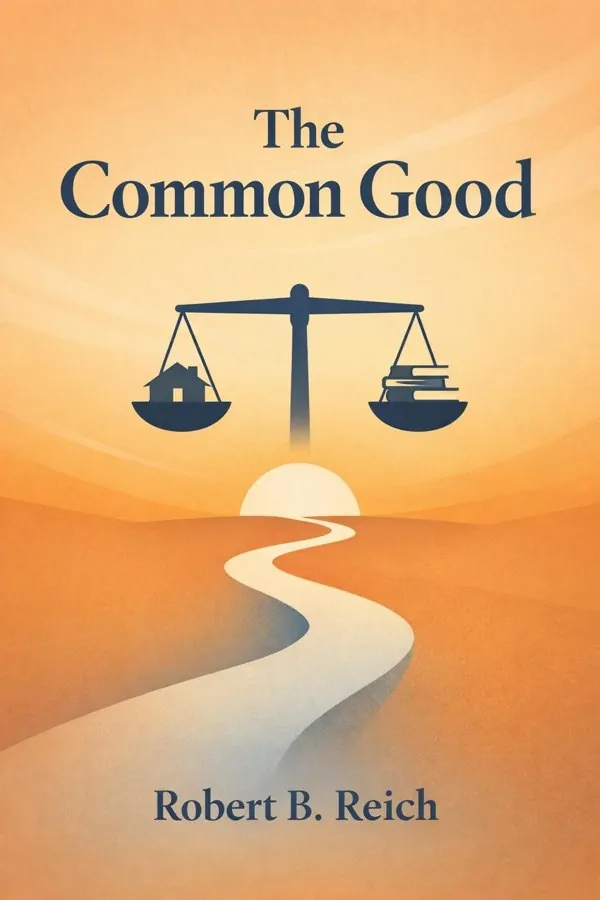
The Common Good: Summary & Key Insights
 10 min7 chaptersAudio available
What Is The Common Good About?
The Common Good by Robert B. Reich is a politics book spanning 7 pages. In this book, Robert B. Reich argues for the restoration of America's moral imagination and civic virtue. He explores how the idea of the common good—once central to American identity—has eroded under the pressures of self-interest, inequality, and political polarization. Through historical examples and contemporary analysis, Reich calls for renewed commitment to shared values and collective responsibility as the foundation of a healthy democracy.
This FizzRead summary covers all 7 key chapters of The Common Good in approximately 10 minutes, distilling the most important ideas, arguments, and takeaways from Robert B. Reich's work. Also available as an audio summary and Key Quotes Podcast.
The Common Good
In this book, Robert B. Reich argues for the restoration of America's moral imagination and civic virtue. He explores how the idea of the common good—once central to American identity—has eroded under the pressures of self-interest, inequality, and political polarization. Through historical examples and contemporary analysis, Reich calls for renewed commitment to shared values and collective responsibility as the foundation of a healthy democracy.
Who Should Read The Common Good?
This book is perfect for anyone interested in politics and looking to gain actionable insights in a short read. Whether you're a student, professional, or lifelong learner, the key ideas from The Common Good by Robert B. Reich will help you think differently.
- ✓Readers who enjoy politics and want practical takeaways
- ✓Professionals looking to apply new ideas to their work and life
- ✓Anyone who wants the core insights of The Common Good in just 10 minutes
Want the full summary?
Get instant access to this book summary and 100K+ more with Fizz Moment.
Get Free SummaryAvailable on App Store • Free to download
Key Chapters
The idea of the common good has deep roots in American life. The Founders, though far from perfect in practice, understood that democracy is sustained not by self-interest alone but by a commitment to shared values. They warned of the dangers of factionalism—what James Madison called the tyranny of the majority and the grasping of narrow interests. In the early republic, civic virtue was a celebrated ideal: citizens served on juries, formed associations, and believed in a duty to the community. Even the robust debates of the nineteenth century were animated by a sense of moral responsibility to the nation.
In the twentieth century, we saw this ethos rise again during periods of crisis. The Great Depression and World War II tested Americans’ will to act collectively, and they responded by building institutions—the New Deal, Social Security, public education—that embodied shared sacrifice and mutual benefit. People understood that progress required cooperation and trust in public life. When John F. Kennedy urged Americans to ask what they could do for their country, he was summoning that enduring spirit of civic duty.
Yet, history also shows the fragility of this ideal. Whenever private greed or fear of the ‘other’ overpowers a sense of solidarity, the nation falters. The Gilded Age, with its robber barons and corruption, gave way to progressive reform only after citizens demanded a government that worked for all. I recount these cycles to remind us that the common good is never a given—it must be rebuilt in every generation through conscious commitment and civic courage.
Somewhere in the last half-century, America’s identity shifted. Where earlier generations spoke of duty, service, and public faith, our rhetoric began to glorify choice, competition, and personal freedom above all else. This transformation was cultural as much as economic. The ‘Me Decade’ of the 1970s and the market fundamentalism of the 1980s reinforced the belief that self-interest, unleashed and unconstrained, would miraculously produce the best outcomes for everyone.
But markets, left to themselves, do not nurture community; they reward power. As corporations grew stronger and unions weaker, the ideal of the citizen gave way to that of the consumer. We were told that happiness could be purchased, that economic success was proof of virtue. The public sector was disparaged as inefficient or even oppressive. Taxes became framed as theft rather than as the price of civilization. Even education, once viewed as a public good, became a private investment.
I do not reject individuality—I celebrate it. But there is a crucial difference between personal freedom exercised within a moral community and unrestrained self-interest that corrodes it. A healthy democracy balances ‘I’ with ‘we.’ When everything becomes transactional—when we approach each other as competitors for scarce rewards rather than as fellow citizens—the social contract collapses. The challenge now is to revive a stronger sense of ‘we’ without losing the creative energy of the individual.
+ 5 more chapters — available in the FizzRead app
All Chapters in The Common Good
About the Author
Robert B. Reich is an American economist, professor, author, and political commentator. He served as U.S. Secretary of Labor under President Bill Clinton and has written extensively on economics, inequality, and social justice. Reich is a professor of public policy at the University of California, Berkeley.
Get This Summary in Your Preferred Format
Read or listen to the The Common Good summary by Robert B. Reich anytime, anywhere. FizzRead offers multiple formats so you can learn on your terms — all free.
Available formats: App · Audio · PDF · EPUB — All included free with FizzRead
Download The Common Good PDF and EPUB Summary
Key Quotes from The Common Good
“The idea of the common good has deep roots in American life.”
“Somewhere in the last half-century, America’s identity shifted.”
Frequently Asked Questions about The Common Good
The Common Good by Robert B. Reich is a politics book that explores key ideas across 7 chapters. In this book, Robert B. Reich argues for the restoration of America's moral imagination and civic virtue. He explores how the idea of the common good—once central to American identity—has eroded under the pressures of self-interest, inequality, and political polarization. Through historical examples and contemporary analysis, Reich calls for renewed commitment to shared values and collective responsibility as the foundation of a healthy democracy.
More by Robert B. Reich
Saving Capitalism: For the Many, Not the Few
Robert B. Reich
10 min
The Work of Nations: Preparing Ourselves for 21st Century Capitalism
Robert B. Reich
10 min
Supercapitalism: The Transformation of Business, Democracy, and Everyday Life
Robert B. Reich
10 min
The System: Who Rigged It, How We Fix It
Robert B. Reich
10 minYou Might Also Like

Antifa: The Anti-Fascist Handbook
Mark Bray
10 min
Attack from Within: How Disinformation Is Sabotaging America
Barbara McQuade
10 min
Coercion, Capital, and European States, AD 990–1992
Charles Tilly
10 min
Digital Democracy: Concepts, Methodologies, Tools, and Applications
Various Authors
10 min
Fascism
Stanley G. Payne
10 min
Fire And Fury: Inside The Trump White House
Michael Wolff
10 minBrowse by Category
Ready to read The Common Good?
Get the full summary and 100K+ more books with Fizz Moment.