
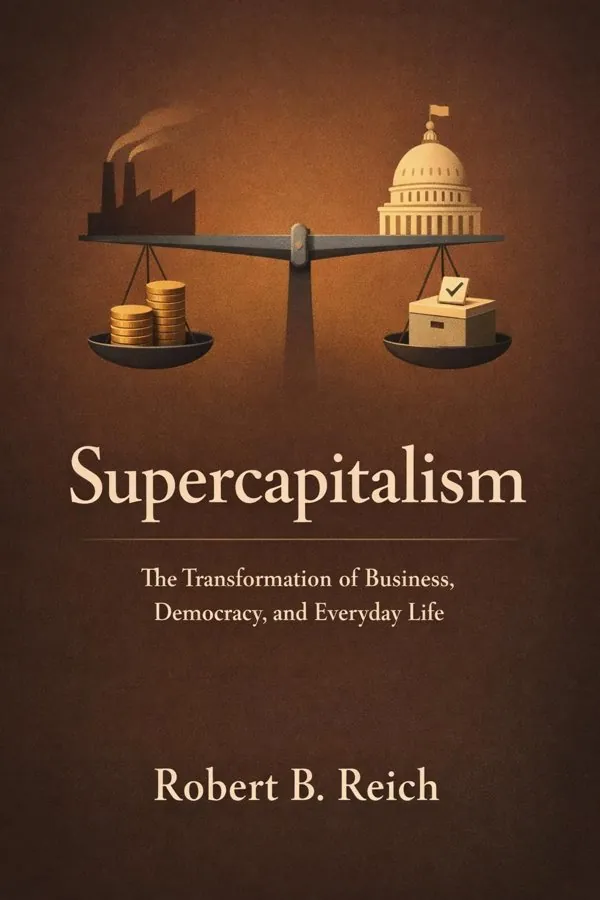
Supercapitalism: The Transformation of Business, Democracy, and Everyday Life: Summary & Key Insights
 10 min5 chaptersAudio available
What Is Supercapitalism: The Transformation of Business, Democracy, and Everyday Life About?
Supercapitalism: The Transformation of Business, Democracy, and Everyday Life by Robert B. Reich is a economics book spanning 5 pages. In Supercapitalism, Robert B. Reich explores how the rise of global capitalism since the 1970s has transformed the relationship between business, government, and citizens. He argues that while markets have become more competitive and efficient, democracy has weakened as corporations and investors gain disproportionate influence over public policy. Reich calls for a renewed distinction between the roles of consumers, investors, and citizens to restore democratic accountability.
This FizzRead summary covers all 5 key chapters of Supercapitalism: The Transformation of Business, Democracy, and Everyday Life in approximately 10 minutes, distilling the most important ideas, arguments, and takeaways from Robert B. Reich's work. Also available as an audio summary and Key Quotes Podcast.
Supercapitalism: The Transformation of Business, Democracy, and Everyday Life
In Supercapitalism, Robert B. Reich explores how the rise of global capitalism since the 1970s has transformed the relationship between business, government, and citizens. He argues that while markets have become more competitive and efficient, democracy has weakened as corporations and investors gain disproportionate influence over public policy. Reich calls for a renewed distinction between the roles of consumers, investors, and citizens to restore democratic accountability.
Who Should Read Supercapitalism: The Transformation of Business, Democracy, and Everyday Life?
This book is perfect for anyone interested in economics and looking to gain actionable insights in a short read. Whether you're a student, professional, or lifelong learner, the key ideas from Supercapitalism: The Transformation of Business, Democracy, and Everyday Life by Robert B. Reich will help you think differently.
- ✓Readers who enjoy economics and want practical takeaways
- ✓Professionals looking to apply new ideas to their work and life
- ✓Anyone who wants the core insights of Supercapitalism: The Transformation of Business, Democracy, and Everyday Life in just 10 minutes
Want the full summary?
Get instant access to this book summary and 100K+ more with Fizz Moment.
Get Free SummaryAvailable on App Store • Free to download
Key Chapters
Looking back at the decades following World War II, I see a period that many Americans recall as the age of democratic capitalism. During those years, business, labor, and government worked together not perfectly, but effectively enough to create growth shared by a broad middle class. Corporations were large and relatively stable, their profits predictable, and their reputations closely tied to their national identities. Unions represented roughly one-third of the workforce, ensuring that productivity gains translated into higher wages. Government, in turn, used its fiscal and regulatory authority to balance competing interests and pursue social goals. The system was not altruistic—it was pragmatic. Everyone benefited from a kind of managed capitalism that kept markets open but contained their excesses.
Democratic capitalism thrived on the principle that corporations had obligations beyond shareholder returns. Executives viewed themselves as stewards not only of companies but of communities. Think of the commitment of mid-century industrial giants to employee welfare or civic contributions. There was a widely shared understanding that business legitimacy depended on fairness, not just on efficiency. As a result, democracy had room to influence the terms of economic exchange. The decisions of business leaders were shaped by norms of responsibility; public policy could embrace ambitious goals like civil rights, education, and infrastructure.
But beneath this apparent stability, forces of change were gathering. Advances in technology, rising global competition, and newly liberalized trade systems began to expose corporations to unprecedented pressures. By the 1970s, maintaining that old social compact became untenable. Firms now faced competitors not only across the street but across oceans. Profit margins narrowed; investors grew impatient. The broader postwar consensus—where capitalism served democracy—started to reverse. It was the beginning of supercapitalism.
If I were to pinpoint a turning point, the 1970s were the decade when everything changed. New technologies revolutionized production and communication. Deregulation, promoted in the name of efficiency, dismantled many of the constraints that had balanced corporate power. Globalization opened markets but also unleashed fierce competition among countries for investment and jobs. Suddenly, corporations could no longer be all things to all stakeholders—they had to appeal above all to investors seeking maximum returns.
In the emerging financial markets, capital moved at breathtaking speed. The old idea of 'stakeholder capitalism' gave way to a new doctrine: the primacy of shareholders. Chief executives were rewarded for meeting quarterly earnings targets, not for maintaining community ties or long-term stability. Meanwhile, consumers benefited enormously: prices fell, product variety exploded, and innovations reached households faster than ever before. On the surface, this looked like an unmitigated triumph of market freedom.
Yet this newfound dynamism came with hidden costs. Workers bore the brunt of corporate restructuring as jobs were outsourced or automated. Unions, once power brokers, lost their leverage. Government found itself shrinking from its regulatory role, reluctant to interfere with markets that seemed to deliver prosperity. The institutions that once moderated capitalism’s inequalities weakened, while financial markets gained disproportionate influence over economic life. What emerged was supercapitalism: a system characterized by hypercompetition and an almost Darwinian struggle for market survival. Everyone—from executives to consumers—was swept into its logic.
+ 3 more chapters — available in the FizzRead app
All Chapters in Supercapitalism: The Transformation of Business, Democracy, and Everyday Life
About the Author
Robert B. Reich is an American economist, professor, author, and political commentator. He served as U.S. Secretary of Labor under President Bill Clinton and has written extensively on inequality, capitalism, and democracy. Reich is a professor of public policy at the University of California, Berkeley.
Get This Summary in Your Preferred Format
Read or listen to the Supercapitalism: The Transformation of Business, Democracy, and Everyday Life summary by Robert B. Reich anytime, anywhere. FizzRead offers multiple formats so you can learn on your terms — all free.
Available formats: App · Audio · PDF · EPUB — All included free with FizzRead
Download Supercapitalism: The Transformation of Business, Democracy, and Everyday Life PDF and EPUB Summary
Key Quotes from Supercapitalism: The Transformation of Business, Democracy, and Everyday Life
“Looking back at the decades following World War II, I see a period that many Americans recall as the age of democratic capitalism.”
“If I were to pinpoint a turning point, the 1970s were the decade when everything changed.”
Frequently Asked Questions about Supercapitalism: The Transformation of Business, Democracy, and Everyday Life
Supercapitalism: The Transformation of Business, Democracy, and Everyday Life by Robert B. Reich is a economics book that explores key ideas across 5 chapters. In Supercapitalism, Robert B. Reich explores how the rise of global capitalism since the 1970s has transformed the relationship between business, government, and citizens. He argues that while markets have become more competitive and efficient, democracy has weakened as corporations and investors gain disproportionate influence over public policy. Reich calls for a renewed distinction between the roles of consumers, investors, and citizens to restore democratic accountability.
More by Robert B. Reich
You Might Also Like
Business Adventures
John Brooks
10 min
Nudge
Richard H. Thaler, Cass R. Sunstein
10 min
The Hitchhiker"s Guide to the Galaxy
Douglas Adams
10 minThe Muqaddimah
Ibn Khaldun
10 minThe Outsiders
William N. Thorndike
10 min
A Little History of Economics
Niall Kishtainy
10 minBrowse by Category
Ready to read Supercapitalism: The Transformation of Business, Democracy, and Everyday Life?
Get the full summary and 100K+ more books with Fizz Moment.