
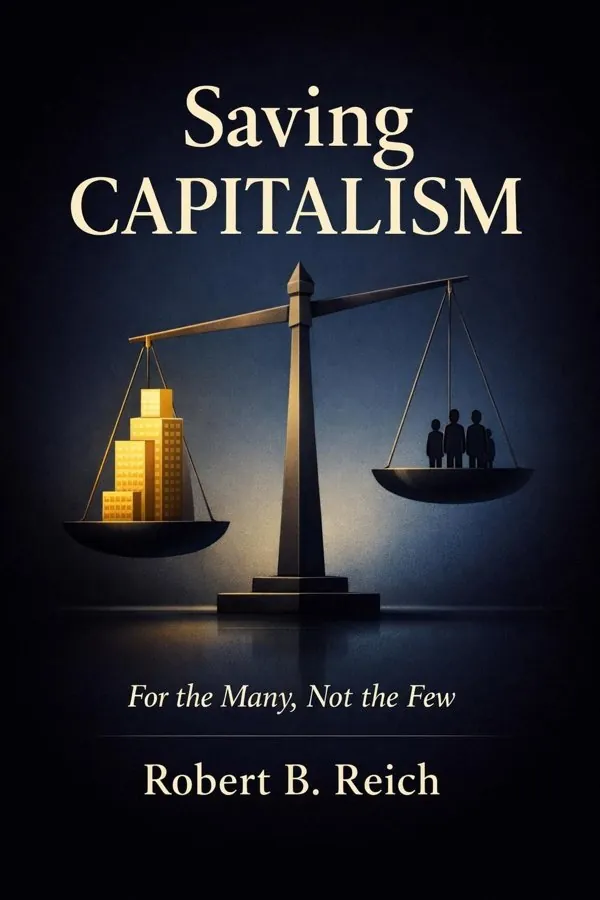
Saving Capitalism: For the Many, Not the Few: Summary & Key Insights
 10 min7 chaptersAudio available
What Is Saving Capitalism: For the Many, Not the Few About?
Saving Capitalism: For the Many, Not the Few by Robert B. Reich is a economics book spanning 7 pages. In this influential work, Robert B. Reich examines how economic power has become concentrated in the hands of a few, undermining democracy and fairness. He argues that capitalism itself is not the problem, but rather the way it has been distorted by political influence and corporate dominance. Reich proposes reforms to restore balance, strengthen the middle class, and ensure that markets serve the public good rather than private interests.
This FizzRead summary covers all 7 key chapters of Saving Capitalism: For the Many, Not the Few in approximately 10 minutes, distilling the most important ideas, arguments, and takeaways from Robert B. Reich's work. Also available as an audio summary and Key Quotes Podcast.
Saving Capitalism: For the Many, Not the Few
In this influential work, Robert B. Reich examines how economic power has become concentrated in the hands of a few, undermining democracy and fairness. He argues that capitalism itself is not the problem, but rather the way it has been distorted by political influence and corporate dominance. Reich proposes reforms to restore balance, strengthen the middle class, and ensure that markets serve the public good rather than private interests.
Who Should Read Saving Capitalism: For the Many, Not the Few?
This book is perfect for anyone interested in economics and looking to gain actionable insights in a short read. Whether you're a student, professional, or lifelong learner, the key ideas from Saving Capitalism: For the Many, Not the Few by Robert B. Reich will help you think differently.
- ✓Readers who enjoy economics and want practical takeaways
- ✓Professionals looking to apply new ideas to their work and life
- ✓Anyone who wants the core insights of Saving Capitalism: For the Many, Not the Few in just 10 minutes
Want the full summary?
Get instant access to this book summary and 100K+ more with Fizz Moment.
Get Free SummaryAvailable on App Store • Free to download
Key Chapters
From the earliest pages, I challenge one of the most persistent myths in modern political discourse — that markets exist somehow outside of government. Whenever someone tells you the market should be left alone, I urge you to ask: whose rules define that market? Property rights, contracts, bankruptcy laws, and corporate charters are not acts of nature; they are political decisions. The powerful have spent decades persuading us that the market is neutral and self-regulating, but behind every supposedly neutral law is a contest of interests and influence.
In this sense, the “free market” is an illusion, a branding strategy that hides deliberate rule-making. For example, corporate executives argue against regulation when it constrains them, yet lobby intensely for patent laws, tax loopholes, or bankruptcy protections that favor their industries. Both sets of interventions reshape the market—but only one side is usually visible. My aim is to unmask this duality and show that freedom in the market means freedom for those who already dominate it unless we insist upon true democratic oversight.
The idea of a natural market has become a shield for social irresponsibility. When wages fall or jobs disappear, the refrain is predictable: “the market has spoken.” Yet markets never speak on their own; they are spoken for, by those who have the resources to dictate their language. Recognizing this truth is the first step toward reclaiming economic fairness.
To understand how markets function and who benefits from them, I examine five foundational areas that define capitalism’s architecture: property, monopoly, contracts, bankruptcy, and enforcement. Each of these institutions forms the scaffolding of the market, and each has been systematically reshaped by concentrated wealth.
Property determines what can be owned and who controls valuable assets like intellectual property or natural resources. Monopoly rules decide when a corporation becomes too dominant; contracts define the terms on which individuals and firms interact; bankruptcy laws determine who bears risk when ventures fail; and enforcement mechanisms decide which rules are actually upheld and for whom.
Over recent decades, each building block has tilted upward. Patent laws have been expanded to grant longer protections to large corporations, suppressing competition. Antitrust policies have grown toothless as mergers across industries consolidate power. Contract laws increasingly favor employers and financiers, leaving ordinary workers and consumers with fewer rights. Even bankruptcy protections have become a privilege of the powerful—giant banks can fail without consequences while ordinary families lose their homes. Enforcement, finally, has become selective: Wall Street bankers escape penalty for systemic irresponsibility while low-level offenders are punished harshly.
If these five pillars define how capitalism operates, then whoever designs them controls the economy. My point is not that the rules themselves are illegitimate, but that their design reflects political and moral choices. To save capitalism, we must make those choices visible and ensure they serve the many, not the few.
+ 5 more chapters — available in the FizzRead app
All Chapters in Saving Capitalism: For the Many, Not the Few
About the Author
Robert B. Reich is an American economist, professor, author, and political commentator. He served as U.S. Secretary of Labor under President Bill Clinton and has written extensively on inequality, economics, and social justice. Reich is a professor of public policy at the University of California, Berkeley.
Get This Summary in Your Preferred Format
Read or listen to the Saving Capitalism: For the Many, Not the Few summary by Robert B. Reich anytime, anywhere. FizzRead offers multiple formats so you can learn on your terms — all free.
Available formats: App · Audio · PDF · EPUB — All included free with FizzRead
Download Saving Capitalism: For the Many, Not the Few PDF and EPUB Summary
Key Quotes from Saving Capitalism: For the Many, Not the Few
“From the earliest pages, I challenge one of the most persistent myths in modern political discourse — that markets exist somehow outside of government.”
“To understand how markets function and who benefits from them, I examine five foundational areas that define capitalism’s architecture: property, monopoly, contracts, bankruptcy, and enforcement.”
Frequently Asked Questions about Saving Capitalism: For the Many, Not the Few
Saving Capitalism: For the Many, Not the Few by Robert B. Reich is a economics book that explores key ideas across 7 chapters. In this influential work, Robert B. Reich examines how economic power has become concentrated in the hands of a few, undermining democracy and fairness. He argues that capitalism itself is not the problem, but rather the way it has been distorted by political influence and corporate dominance. Reich proposes reforms to restore balance, strengthen the middle class, and ensure that markets serve the public good rather than private interests.
More by Robert B. Reich
The Work of Nations: Preparing Ourselves for 21st Century Capitalism
Robert B. Reich
10 min
Supercapitalism: The Transformation of Business, Democracy, and Everyday Life
Robert B. Reich
10 min
The Common Good
Robert B. Reich
10 min
The System: Who Rigged It, How We Fix It
Robert B. Reich
10 minYou Might Also Like

Business Adventures
John Brooks
10 min
Nudge
Richard H. Thaler, Cass R. Sunstein
10 min
The Hitchhiker"s Guide to the Galaxy
Douglas Adams
10 minThe Muqaddimah
Ibn Khaldun
10 minThe Outsiders
William N. Thorndike
10 min
A Little History of Economics
Niall Kishtainy
10 minBrowse by Category
Ready to read Saving Capitalism: For the Many, Not the Few?
Get the full summary and 100K+ more books with Fizz Moment.