
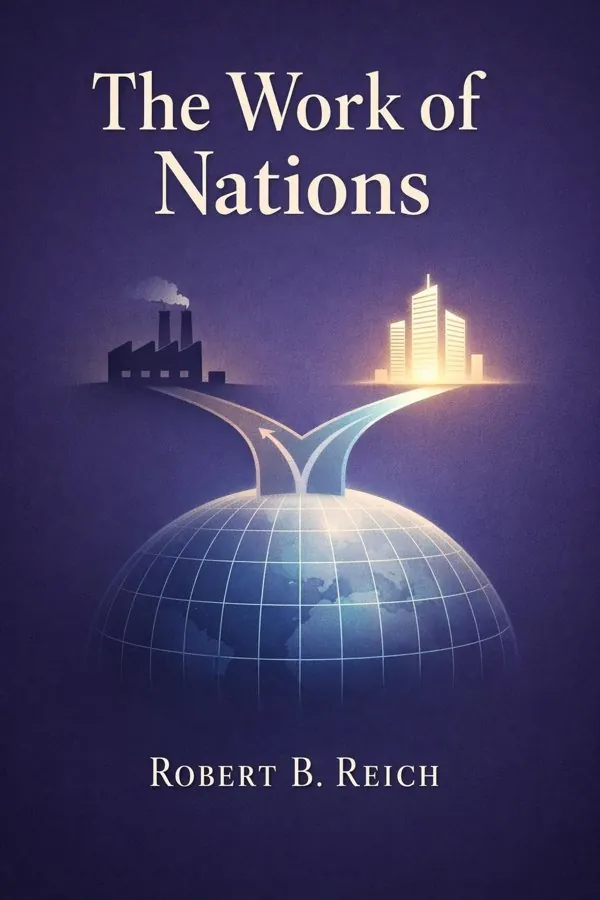
The Work of Nations: Preparing Ourselves for 21st Century Capitalism: Summary & Key Insights
 10 min10 chaptersAudio available
What Is The Work of Nations: Preparing Ourselves for 21st Century Capitalism About?
The Work of Nations: Preparing Ourselves for 21st Century Capitalism by Robert B. Reich is a economics book spanning 10 pages. In this influential work, economist and former U.S. Labor Secretary Robert B. Reich examines how globalization and technological change have transformed the nature of work and the structure of economies. Reich argues that national boundaries are becoming less relevant as production and capital move freely across the world, creating new challenges for workers and governments. He explores the rise of symbolic analysts—those who manipulate information and ideas—and the decline of routine manufacturing jobs, urging societies to adapt through education and policy reform.
This FizzRead summary covers all 10 key chapters of The Work of Nations: Preparing Ourselves for 21st Century Capitalism in approximately 10 minutes, distilling the most important ideas, arguments, and takeaways from Robert B. Reich's work. Also available as an audio summary and Key Quotes Podcast.
The Work of Nations: Preparing Ourselves for 21st Century Capitalism
In this influential work, economist and former U.S. Labor Secretary Robert B. Reich examines how globalization and technological change have transformed the nature of work and the structure of economies. Reich argues that national boundaries are becoming less relevant as production and capital move freely across the world, creating new challenges for workers and governments. He explores the rise of symbolic analysts—those who manipulate information and ideas—and the decline of routine manufacturing jobs, urging societies to adapt through education and policy reform.
Who Should Read The Work of Nations: Preparing Ourselves for 21st Century Capitalism?
This book is perfect for anyone interested in economics and looking to gain actionable insights in a short read. Whether you're a student, professional, or lifelong learner, the key ideas from The Work of Nations: Preparing Ourselves for 21st Century Capitalism by Robert B. Reich will help you think differently.
- ✓Readers who enjoy economics and want practical takeaways
- ✓Professionals looking to apply new ideas to their work and life
- ✓Anyone who wants the core insights of The Work of Nations: Preparing Ourselves for 21st Century Capitalism in just 10 minutes
Want the full summary?
Get instant access to this book summary and 100K+ more with Fizz Moment.
Get Free SummaryAvailable on App Store • Free to download
Key Chapters
Over the last half century, technological innovation and globalization have dissolved the traditional boundaries that once guided work. Factories that once anchored whole communities now operate through networks of contractors scattered across continents. A product designed in California may be assembled in Malaysia using components from Singapore, software from India, and financing from London. The notion that 'our' products reflect 'our' national economy is obsolete. The real distinction in work is no longer between manufacturing and services, but between routine and non‑routine tasks. Microprocessors, automation, and digital platforms can now perform repetitive work more cheaply and reliably than humans. What remains is the work of analysis, interpretation, communication, and creativity. These are the activities that define the new class of workers—the symbolic analysts.
Work once offered predictable paths: your factory, your union, your pension. Today, jobs are projects with uncertain futures. The speed of technological adaptation outpaces most institutions’ ability to protect or re‑train their workers. The implications are personal as well as social: security has shifted from being provided by the organization to being cultivated through individual skill and continuous learning. We are all, increasingly, self‑employed in spirit, if not in name. But this transformation also breeds anxiety—how can ordinary workers keep pace when the rules keep changing? My answer is that our institutions must evolve from preserving jobs to cultivating capacities—teaching people how to learn, unlearn, and re‑learn throughout their lives.
As I analyzed the global restructuring of production, I identified three broad categories of work that now define modern economies. The first is routine production services—assembly line jobs, data entry, and other forms of repetitive labor that follow prescribed procedures. These tasks are easily automated or outsourced to lower‑wage regions. The second category is in‑person services—those functions that must be performed face‑to‑face and cannot be digitized, such as retail sales, health care, maintenance, and hospitality. These roles are anchored in place but often poorly compensated, vulnerable to local economic swings. The third and most dynamic category is symbolic‑analytic services—the creation, manipulation, and communication of symbols: words, numbers, codes, and designs that generate new value. Lawyers, engineers, consultants, scientists, financiers, and designers belong here.
The gulf among these categories is not just about pay; it’s about meaning and power. Symbolic analysts sell solutions and insights; their market is global. Routine and in‑person workers sell time and physical presence; their market is local. The more a person’s work depends on tangible output, the less bargaining power they have in a world where capital can move anywhere. The structural inequality built into these categories explains much of the wage polarization we’ve seen since the 1970s. The challenge before us is not simply to protect existing jobs but to help people ascend into work that taps problem‑solving and symbolic reasoning—where human intelligence is the comparative advantage.
+ 8 more chapters — available in the FizzRead app
All Chapters in The Work of Nations: Preparing Ourselves for 21st Century Capitalism
About the Author
Robert B. Reich is an American economist, professor, author, and political commentator. He served as U.S. Secretary of Labor under President Bill Clinton and has written extensively on inequality, globalization, and labor economics. Reich is a professor of public policy at the University of California, Berkeley.
Get This Summary in Your Preferred Format
Read or listen to the The Work of Nations: Preparing Ourselves for 21st Century Capitalism summary by Robert B. Reich anytime, anywhere. FizzRead offers multiple formats so you can learn on your terms — all free.
Available formats: App · Audio · PDF · EPUB — All included free with FizzRead
Download The Work of Nations: Preparing Ourselves for 21st Century Capitalism PDF and EPUB Summary
Key Quotes from The Work of Nations: Preparing Ourselves for 21st Century Capitalism
“Over the last half century, technological innovation and globalization have dissolved the traditional boundaries that once guided work.”
“As I analyzed the global restructuring of production, I identified three broad categories of work that now define modern economies.”
Frequently Asked Questions about The Work of Nations: Preparing Ourselves for 21st Century Capitalism
The Work of Nations: Preparing Ourselves for 21st Century Capitalism by Robert B. Reich is a economics book that explores key ideas across 10 chapters. In this influential work, economist and former U.S. Labor Secretary Robert B. Reich examines how globalization and technological change have transformed the nature of work and the structure of economies. Reich argues that national boundaries are becoming less relevant as production and capital move freely across the world, creating new challenges for workers and governments. He explores the rise of symbolic analysts—those who manipulate information and ideas—and the decline of routine manufacturing jobs, urging societies to adapt through education and policy reform.
More by Robert B. Reich
You Might Also Like
Business Adventures
John Brooks
10 min
Nudge
Richard H. Thaler, Cass R. Sunstein
10 min
The Hitchhiker"s Guide to the Galaxy
Douglas Adams
10 minThe Muqaddimah
Ibn Khaldun
10 minThe Outsiders
William N. Thorndike
10 min
A Little History of Economics
Niall Kishtainy
10 minBrowse by Category
Ready to read The Work of Nations: Preparing Ourselves for 21st Century Capitalism?
Get the full summary and 100K+ more books with Fizz Moment.