
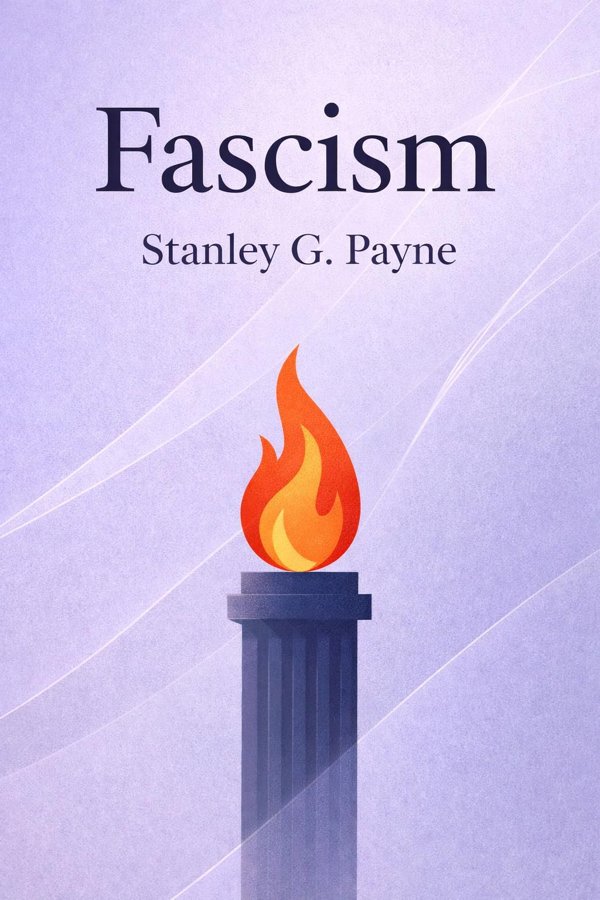
Fascism: Summary & Key Insights
 10 min9 chaptersAudio available
Key Takeaways from Fascism
One of the most important insights in Payne’s work is that fascism cannot be understood simply as dictatorship with harsher rhetoric.
Political language often becomes most misleading when emotions run highest.
Extremist movements rarely rise in calm, confident societies.
Few ideas are more emotionally potent than the promise that a fallen nation can be made great again through unity, sacrifice, and struggle.
A disturbing hallmark of fascism is that violence is not treated merely as a regrettable necessity but often as something cleansing, energizing, and morally transformative.
What Is Fascism About?
Fascism by Stanley G. Payne is a politics book. What makes fascism so difficult to define is also what makes it so dangerous: it can appear modern and anti-modern, revolutionary and reactionary, nationalistic and opportunistically adaptable all at once. In Fascism, historian Stanley G. Payne offers one of the clearest and most systematic attempts to explain this political phenomenon without reducing it to slogans or loose comparisons. Rather than treating fascism as a vague insult or a catch-all label for authoritarianism, Payne examines it as a distinct ideology, movement, and historical force that emerged in interwar Europe and reshaped the twentieth century. The book matters because debates about fascism often suffer from conceptual confusion. Payne helps readers distinguish fascism from conservatism, communism, military dictatorship, and other forms of authoritarian rule. He identifies its defining features, traces its social and political origins, and compares its national variations, especially in Italy and Germany. As one of the leading historians of modern Europe and authoritarian movements, Payne brings scholarly precision, comparative insight, and historical depth. The result is a book that equips readers to think more carefully about political extremism, mass mobilization, and the fragility of democratic societies.
This FizzRead summary covers all 9 key chapters of Fascism in approximately 10 minutes, distilling the most important ideas, arguments, and takeaways from Stanley G. Payne's work. Also available as an audio summary and Key Quotes Podcast.
Fascism
What makes fascism so difficult to define is also what makes it so dangerous: it can appear modern and anti-modern, revolutionary and reactionary, nationalistic and opportunistically adaptable all at once. In Fascism, historian Stanley G. Payne offers one of the clearest and most systematic attempts to explain this political phenomenon without reducing it to slogans or loose comparisons. Rather than treating fascism as a vague insult or a catch-all label for authoritarianism, Payne examines it as a distinct ideology, movement, and historical force that emerged in interwar Europe and reshaped the twentieth century.
The book matters because debates about fascism often suffer from conceptual confusion. Payne helps readers distinguish fascism from conservatism, communism, military dictatorship, and other forms of authoritarian rule. He identifies its defining features, traces its social and political origins, and compares its national variations, especially in Italy and Germany. As one of the leading historians of modern Europe and authoritarian movements, Payne brings scholarly precision, comparative insight, and historical depth. The result is a book that equips readers to think more carefully about political extremism, mass mobilization, and the fragility of democratic societies.
Who Should Read Fascism?
This book is perfect for anyone interested in politics and looking to gain actionable insights in a short read. Whether you're a student, professional, or lifelong learner, the key ideas from Fascism by Stanley G. Payne will help you think differently.
- ✓Readers who enjoy politics and want practical takeaways
- ✓Professionals looking to apply new ideas to their work and life
- ✓Anyone who wants the core insights of Fascism in just 10 minutes
Want the full summary?
Get instant access to this book summary and 100K+ more with Fizz Moment.
Get Free SummaryAvailable on App Store • Free to download
Key Chapters
One of the most important insights in Payne’s work is that fascism cannot be understood simply as dictatorship with harsher rhetoric. Many regimes are authoritarian, but not all are fascist. Payne insists that fascism is a specific kind of political movement with its own ideology, style, ambitions, and historical context. This distinction matters because when every repressive government is casually called fascist, the term loses analytical value.
Payne shows that fascism combined intense nationalism, anti-liberalism, anti-Marxism, a drive for national rebirth, glorification of action and violence, and the desire to mobilize the masses in a new political order. Unlike traditional authoritarian elites who often sought stability and limited participation, fascist movements aimed to create a dynamic, energized society built around myth, unity, discipline, and struggle. They wanted not merely to rule but to transform culture, identity, and the relationship between citizen and state.
A practical way to apply this idea is to compare different regimes. A military junta may suppress elections and censor the press, yet it may lack the revolutionary mass politics, ideological dynamism, and total social ambitions that characterize fascism. Similarly, a conservative dictatorship may preserve hierarchy, while fascism often tries to reshape society through mobilization, symbolism, youth culture, and political ritual.
For modern readers, this framework is useful when evaluating political rhetoric. Calls for national restoration, contempt for pluralism, celebration of violence, and demands for total unity should be examined together rather than in isolation. Payne encourages readers to look for patterns, not labels.
Actionable takeaway: When assessing a political movement, ask not only whether it is authoritarian, but whether it seeks ideological mass mobilization, national rebirth, and revolutionary transformation.
Political language often becomes most misleading when emotions run highest. Payne’s major contribution is to replace vague moral denunciation with a structured definition of fascism. He develops a comparative framework that identifies fascism through clusters of characteristics rather than one single trait. This method makes his analysis especially valuable for readers who want precision instead of polemics.
He groups fascist features into broad categories: ideology and goals, negations, and style or organization. In ideological terms, fascism seeks a new authoritarian nationalist state, often tied to myths of decline and rebirth. In the realm of negation, it rejects liberal democracy, socialism or Marxism, and usually much of the established conservative order as well. In style, it favors mass mobilization, charismatic leadership, militarization, ritual, youth symbolism, and an exaltation of will, struggle, and violence.
This matters because movements rarely announce themselves in textbook form. Some emphasize race, others empire, others spiritual renewal or anti-parliamentary energy. Payne’s typology helps readers see the family resemblance among different variants without pretending they are identical. For example, Italian Fascism and German National Socialism shared core features yet differed significantly in emphasis, especially regarding race and totalitarian radicalization.
In practical terms, Payne’s structured approach can be applied to media analysis, classroom debate, or political discussion. Instead of asking, “Is this leader fascist?” in the abstract, a better question is, “How many of the defining ideological, organizational, and stylistic elements are present?” That produces better judgment and less rhetorical inflation.
Actionable takeaway: Use a checklist approach when analyzing extremist politics, focusing on recurring patterns of ideology, negation, leadership style, and mass mobilization rather than relying on emotional labels.
Extremist movements rarely rise in calm, confident societies. Payne places fascism within the deep political, cultural, and social crises of early twentieth-century Europe. Fascism was not an accidental aberration but a response to the breakdowns and anxieties unleashed by war, economic dislocation, mass politics, class conflict, and disillusionment with liberal institutions.
The First World War plays a central role in this story. The war normalized violence, militarized political culture, and weakened faith in old liberal assumptions about gradual progress and rational compromise. Veterans, nationalists, and radical activists emerged from the war with a heightened sense of grievance and a desire for decisive collective action. At the same time, fear of socialist revolution, disappointment with parliamentary governments, and resentment over national humiliation created fertile ground for movements promising order, dignity, and rebirth.
Payne does not argue that crisis automatically produces fascism. Many societies face turmoil without becoming fascist. But he shows that fascism flourishes when crisis combines with weak democratic legitimacy, polarized elites, cultural pessimism, and organizations capable of channeling resentment into disciplined activism.
This insight has practical relevance today. Modern democracies also face moments of distrust, economic uncertainty, and identity conflict. Payne’s history suggests that the danger grows when institutions seem incapable of action, when political opponents are treated as enemies of the nation, and when citizens begin to crave mythic unity over pluralist negotiation.
A useful application is to watch how leaders respond to crisis. Do they strengthen institutions, encourage compromise, and defend lawful procedures? Or do they portray crisis as proof that democracy itself must be replaced by a more unified and forceful order?
Actionable takeaway: Treat prolonged political crisis as a warning sign and support institutions that can manage conflict without turning fear, humiliation, and grievance into authoritarian mass mobilization.
Few ideas are more emotionally potent than the promise that a fallen nation can be made great again through unity, sacrifice, and struggle. Payne emphasizes that fascism is animated by a myth of national rebirth. Fascists depict the nation as humiliated, corrupted, weakened, or betrayed, and they present themselves as the movement that will restore vitality, greatness, and historical destiny.
This idea of rebirth is not merely patriotic pride. Ordinary nationalism can coexist with constitutional politics and civic pluralism. Fascist nationalism is more intense, more totalizing, and often more exclusionary. It imagines the nation as an organic body whose internal divisions must be overcome and whose enemies, internal and external, must be defeated. The result is a politics that prizes purity, discipline, and emotional identification with a collective mission.
Payne’s analysis helps explain why fascist movements often use dramatic imagery, mass rallies, uniforms, salutes, songs, and carefully staged spectacles. These are not superficial decorations. They are tools for making rebirth feel visible and inevitable. They turn politics into a participatory ritual of belonging.
The practical lesson is that appeals to national renewal should be examined carefully. National improvement can be constructive when it involves civic reform, economic development, and democratic confidence. It becomes dangerous when decline is blamed on pluralism itself, when critics are portrayed as traitors, and when redemption is linked to violence or absolute unity.
In everyday civic life, this insight can improve how we read speeches, campaigns, and propaganda. Ask whether calls for renewal invite broad democratic participation or demand conformity under a single leader or movement.
Actionable takeaway: Distinguish healthy civic patriotism from mythic politics of rebirth by asking whether a movement seeks national improvement through institutions and inclusion or through purification, enemies, and forced unity.
A disturbing hallmark of fascism is that violence is not treated merely as a regrettable necessity but often as something cleansing, energizing, and morally transformative. Payne shows that fascist movements elevated action over deliberation and celebrated struggle as proof of vitality. This helps explain why fascist politics often became theatrical, militant, and intensely hostile to compromise.
In liberal democracy, politics is ideally a process of bargaining, persuasion, and lawful competition. Fascism rejects this model as weak, decadent, and indecisive. It values willpower, discipline, sacrifice, and direct confrontation. Violence can therefore become both a tactic and a symbol: a way to intimidate opponents, dramatize strength, and forge solidarity within the movement.
Historical examples make this clear. Fascist squads in Italy attacked socialist organizations and intimidated political enemies, while Nazi paramilitary formations used street violence to project strength and destabilize rivals. The point was not only to defeat opponents physically but to redefine politics as a sphere where force proved authenticity.
This idea remains useful in contemporary analysis. A movement need not openly wage civil war to normalize fascistic habits. Glorification of political aggression, admiration for lawless supporters, mockery of procedural restraint, and claims that only force can save the nation are all warning signs. Payne’s framework reminds us that contempt for peaceful politics can itself be ideologically meaningful.
In practical terms, citizens, journalists, and educators should pay attention to political style as much as policy. How does a movement speak about enemies? Does it frame violence as tragic, or as admirable? Does it value institutions, or thrill to their humiliation?
Actionable takeaway: Take seriously any movement that romanticizes political force, because when violence becomes honorable, democratic limits are already under pressure.
One reason Payne’s book remains influential is that it clarifies fascism by distinguishing it from neighboring ideologies. Fascism can borrow from the right, exploit fear of the left, and cooperate with conservative elites, yet it is not simply conservatism in militant form. Nor is it just another version of socialism. Payne demonstrates that fascism occupied its own revolutionary space.
Traditional conservatives generally seek order, continuity, hierarchy, and preservation of established institutions such as monarchy, church, or inherited authority. Fascists may ally with such forces temporarily, but they often despise passive traditionalism and seek a more dynamic, mobilized, and myth-driven politics. They want a new elite, a new state, and a new national culture. Their relationship with conservatism is therefore strategic but uneasy.
At the same time, fascism sharply opposes Marxism and class-based socialism. It rejects class struggle as the organizing principle of politics and instead promotes national unity above class divisions. Yet unlike classical liberalism, fascism also rejects individual rights, pluralism, and parliamentary limits. It often embraces a controlled or corporatist economy that subordinates economic life to national goals.
This distinction has practical value. Political analysis becomes clearer when we stop treating ideologies as simple left-right mirrors. A movement can be anti-socialist without being conservative, anti-liberal without being communist, and revolutionary without being emancipatory. Payne encourages readers to think comparatively and historically rather than mechanically.
In public debate, this means asking not where a movement sits on a crude spectrum, but what kind of state it seeks, how it treats conflict, what it believes about the nation, and whether it wants mobilized unity or institutional restraint.
Actionable takeaway: Avoid simplistic ideological labels and instead analyze what a movement wants to preserve, what it wants to destroy, and how radically it seeks to reorganize political and social life.
A major strength of Payne’s study is his insistence that fascism was a broader phenomenon than any single regime, yet never a uniform one. Italy and Germany provide the most famous examples, but Payne carefully shows that Italian Fascism and German National Socialism were related rather than identical. This comparative approach prevents readers from flattening important historical differences.
Italian Fascism under Mussolini was the original model in terms of movement form, political style, and organizational innovation. It emphasized nationalism, the corporate state, anti-parliamentarianism, and a cult of leadership and action. German Nazism shared many of these traits but fused them with a much more radical racial ideology, apocalyptic anti-Semitism, and a deeper drive toward total domination and exterminatory violence.
By distinguishing these cases, Payne helps readers understand both the common core and the variable expressions of fascism. Other movements across Europe borrowed symbols, strategies, or rhetoric without fully reproducing either model. Some remained marginal. Others became authoritarian without becoming fully fascist. This variation is central to serious historical understanding.
The practical lesson is that political categories should be flexible enough to recognize family resemblance without erasing specificity. In discussion, research, or teaching, it is more accurate to ask how closely a movement approximates fascist patterns rather than demanding perfect equivalence. This avoids two common errors: calling everything fascist, or denying fascism unless every feature of Nazi Germany is present.
Readers can apply this by comparing ideology, organization, use of violence, leadership cult, racial doctrine, and state ambitions across cases. Similarity should be argued, not assumed.
Actionable takeaway: When comparing extremist movements, look for shared structural traits while also identifying the unique national features that shape how those traits develop.
Fascism does not rise by mass enthusiasm alone. Payne highlights the crucial role of political elites, institutional weakness, and strategic miscalculation in the collapse of democratic systems. Fascist movements often begin on the margins, but they become decisive when traditional leaders believe they can use them, tame them, or benefit from them.
This is one of the book’s most sobering lessons. Conservative politicians, business interests, military figures, and monarchic institutions sometimes viewed fascists as useful allies against socialism, parliamentary paralysis, or national unrest. They assumed that once in government, radical movements could be controlled within established structures. Payne shows how disastrously wrong that assumption could be. Fascist leaders exploited legitimacy granted by elites while steadily dismantling the constraints that had allowed their rise.
The fall of democracy therefore cannot be explained only by popular extremism. It also involves failures of constitutional commitment among those already in power. When elites lose faith in democratic competition, tolerate political violence, or prioritize short-term advantage over institutional survival, they create openings for anti-democratic forces.
This insight has direct modern relevance. Democracies are often less threatened by outright coups than by gradual accommodation: emergency rhetoric, normalization of anti-system actors, weakening of guardrails, and the belief that constitutional norms are optional when one’s own side benefits.
In practical life, citizens should pay attention not just to extremist movements but to how mainstream institutions respond to them. Do parties isolate anti-democratic actors or absorb them? Do courts, media, and civil services remain independent? Do leaders defend procedures even when inconvenient?
Actionable takeaway: Protect democracy by judging political actors not only by their promises but by whether they uphold rules, reject violent allies, and refuse short-term bargains that empower anti-democratic movements.
Perhaps Payne’s deepest lesson is methodological: the more precise our historical understanding, the better our political judgment becomes. Fascism is too serious a subject to be treated as either a museum artifact or a casual insult. Payne models a disciplined way of thinking that combines definition, comparison, context, and caution.
He neither minimizes fascism’s destructive power nor turns it into a vague synonym for everything intolerant or authoritarian. Instead, he asks what made fascism distinctive, why it emerged when it did, how it interacted with other ideologies, and why some movements succeeded while others failed. This is not only good scholarship; it is a civic virtue. Democratic societies need language sharp enough to identify real threats and restrained enough to avoid conceptual panic.
This matters in contemporary culture, where public debate often rewards exaggeration. If the word fascism is used for every disliked policy, it loses force when genuinely relevant patterns appear. On the other hand, if historical fascism is treated as utterly unique and impossible to repeat in any form, warning signs may be dismissed too easily. Payne’s approach avoids both errors.
A practical application is to combine historical literacy with institutional awareness. Read political movements through their ideas, symbols, style, alliances, and goals. Notice whether they reject pluralism, romanticize force, mythologize national decline, and seek to subordinate all social life to a unitary political project. Then compare carefully before concluding.
For students, journalists, and citizens, this method fosters seriousness over sensationalism. It turns history into a tool for disciplined civic reasoning.
Actionable takeaway: Use historical concepts carefully and comparatively, so your understanding of extremism is both more accurate and more useful in defending democratic life.
All Chapters in Fascism
About the Author
Stanley G. Payne is a prominent American historian specializing in modern European history, with particular expertise in fascism, authoritarian movements, and twentieth-century Spain. He spent much of his academic career at the University of Wisconsin–Madison, where he became known for his rigorous comparative approach to political ideologies and regimes. Payne has written extensively on fascism, the Spanish Civil War, and the Franco period, and his work is widely respected for its conceptual clarity and historical depth. Rather than relying on vague political terminology, he has consistently sought to define complex movements with precision and evidence. This careful method has made him one of the most influential scholars in the study of fascism and the broader crises of modern European democracy.
Get This Summary in Your Preferred Format
Read or listen to the Fascism summary by Stanley G. Payne anytime, anywhere. FizzRead offers multiple formats so you can learn on your terms — all free.
Available formats: App · Audio · PDF · EPUB — All included free with FizzRead
Download Fascism PDF and EPUB Summary
Key Quotes from Fascism
“One of the most important insights in Payne’s work is that fascism cannot be understood simply as dictatorship with harsher rhetoric.”
“Political language often becomes most misleading when emotions run highest.”
“Extremist movements rarely rise in calm, confident societies.”
“Few ideas are more emotionally potent than the promise that a fallen nation can be made great again through unity, sacrifice, and struggle.”
“A disturbing hallmark of fascism is that violence is not treated merely as a regrettable necessity but often as something cleansing, energizing, and morally transformative.”
Frequently Asked Questions about Fascism
Fascism by Stanley G. Payne is a politics book that explores key ideas across 9 chapters. What makes fascism so difficult to define is also what makes it so dangerous: it can appear modern and anti-modern, revolutionary and reactionary, nationalistic and opportunistically adaptable all at once. In Fascism, historian Stanley G. Payne offers one of the clearest and most systematic attempts to explain this political phenomenon without reducing it to slogans or loose comparisons. Rather than treating fascism as a vague insult or a catch-all label for authoritarianism, Payne examines it as a distinct ideology, movement, and historical force that emerged in interwar Europe and reshaped the twentieth century. The book matters because debates about fascism often suffer from conceptual confusion. Payne helps readers distinguish fascism from conservatism, communism, military dictatorship, and other forms of authoritarian rule. He identifies its defining features, traces its social and political origins, and compares its national variations, especially in Italy and Germany. As one of the leading historians of modern Europe and authoritarian movements, Payne brings scholarly precision, comparative insight, and historical depth. The result is a book that equips readers to think more carefully about political extremism, mass mobilization, and the fragility of democratic societies.
You Might Also Like
Antifa: The Anti-Fascist Handbook
Mark Bray
10 min
Attack from Within: How Disinformation Is Sabotaging America
Barbara McQuade
10 min
Coercion, Capital, and European States, AD 990–1992
Charles Tilly
10 min
Digital Democracy: Concepts, Methodologies, Tools, and Applications
Various Authors
10 min
Fire And Fury: Inside The Trump White House
Michael Wolff
10 min
How To Fix Democracy
Andrew Keen
10 minBrowse by Category
Ready to read Fascism?
Get the full summary and 100K+ more books with Fizz Moment.