
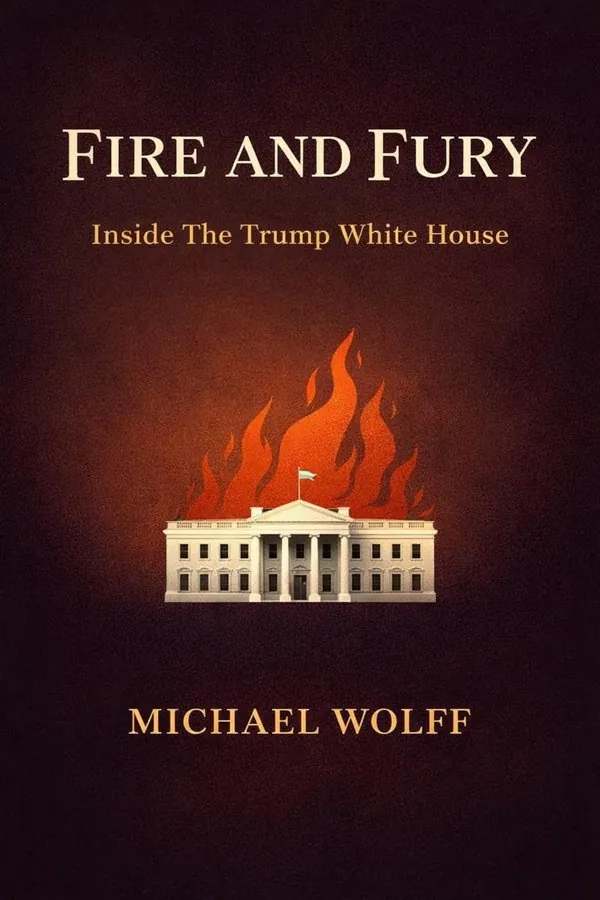
Fire And Fury: Inside The Trump White House: Summary & Key Insights
 10 min9 chaptersAudio available
Key Takeaways from Fire And Fury: Inside The Trump White House
Wolff portrays a White House where strategy, messaging, and policy frequently collided rather than aligned.
Power is rarely held by one person alone; it is usually shaped by the people competing to interpret that person’s will.
In Fire And Fury, media is not just an external force covering politics—it is part of the operating environment inside the White House itself.
A presidency is designed as an institution, but Fire And Fury argues that a forceful personality can dramatically reshape how that institution operates.
One of the oldest truths in politics is that formal authority and real influence are not always the same.
What Is Fire And Fury: Inside The Trump White House About?
Fire And Fury: Inside The Trump White House by Michael Wolff is a politics book. Fire And Fury: Inside The Trump White House is a controversial, fast-moving account of the first chaotic months of Donald Trump’s presidency. Michael Wolff takes readers behind closed doors to portray a White House defined by internal rivalries, competing power centers, media obsession, and constant uncertainty about who was truly in charge. Rather than presenting politics as a polished public performance, the book depicts governing as a messy human drama shaped by ego, loyalty, improvisation, and conflict. The book matters because it captures a pivotal political moment when traditional assumptions about the presidency, executive discipline, and media relations were under intense strain. For readers trying to understand how personality influences power, how political institutions react to disruption, and why modern governments can appear unstable even at the highest levels, Wolff’s narrative offers a vivid case study. Michael Wolff is a veteran journalist and columnist known for his insider reporting on media, culture, and power. His access to key figures and his talent for dramatic storytelling made Fire And Fury one of the most talked-about political books of its era. Whether read as reportage, political portrait, or cautionary tale, it remains an important lens on leadership under pressure.
This FizzRead summary covers all 9 key chapters of Fire And Fury: Inside The Trump White House in approximately 10 minutes, distilling the most important ideas, arguments, and takeaways from Michael Wolff's work. Also available as an audio summary and Key Quotes Podcast.
Fire And Fury: Inside The Trump White House
Fire And Fury: Inside The Trump White House is a controversial, fast-moving account of the first chaotic months of Donald Trump’s presidency. Michael Wolff takes readers behind closed doors to portray a White House defined by internal rivalries, competing power centers, media obsession, and constant uncertainty about who was truly in charge. Rather than presenting politics as a polished public performance, the book depicts governing as a messy human drama shaped by ego, loyalty, improvisation, and conflict.
The book matters because it captures a pivotal political moment when traditional assumptions about the presidency, executive discipline, and media relations were under intense strain. For readers trying to understand how personality influences power, how political institutions react to disruption, and why modern governments can appear unstable even at the highest levels, Wolff’s narrative offers a vivid case study.
Michael Wolff is a veteran journalist and columnist known for his insider reporting on media, culture, and power. His access to key figures and his talent for dramatic storytelling made Fire And Fury one of the most talked-about political books of its era. Whether read as reportage, political portrait, or cautionary tale, it remains an important lens on leadership under pressure.
Who Should Read Fire And Fury: Inside The Trump White House?
This book is perfect for anyone interested in politics and looking to gain actionable insights in a short read. Whether you're a student, professional, or lifelong learner, the key ideas from Fire And Fury: Inside The Trump White House by Michael Wolff will help you think differently.
- ✓Readers who enjoy politics and want practical takeaways
- ✓Professionals looking to apply new ideas to their work and life
- ✓Anyone who wants the core insights of Fire And Fury: Inside The Trump White House in just 10 minutes
Want the full summary?
Get instant access to this book summary and 100K+ more with Fizz Moment.
Get Free SummaryAvailable on App Store • Free to download
Key Chapters
One of the book’s most striking insights is that disorder was not merely an unfortunate byproduct of the administration’s early months—it often appeared to be the atmosphere in which decisions were made. Wolff portrays a White House where strategy, messaging, and policy frequently collided rather than aligned. Meetings shifted direction suddenly, informal conversations carried as much weight as formal process, and staff members often seemed uncertain about which instructions would still matter by the end of the day.
This matters because many people assume that executive power naturally produces discipline. Fire And Fury challenges that assumption. It suggests that if a leader values instinct over structure, conflict over coordination, and attention over consistency, then the entire institution can begin to mirror those preferences. In such an environment, factions emerge quickly. Staff do not simply execute a plan; they compete to define reality itself.
A practical way to understand this is to compare the White House to any high-pressure organization. In a company without clear reporting lines, employees waste energy decoding shifting priorities. In a crisis response team without agreed procedures, confusion can become as dangerous as the crisis itself. The lesson extends beyond politics: when systems depend too heavily on one volatile decision-maker, the organization becomes reactive instead of effective.
Wolff’s portrayal encourages readers to look past headlines and ask how power is actually managed day to day. Are decisions documented? Are roles clear? Is disagreement productive or merely theatrical? These questions determine whether a leader creates momentum or turbulence.
Actionable takeaway: In any leadership setting, build clear processes before pressure arrives, because unmanaged chaos quickly becomes a culture rather than a temporary problem.
Power is rarely held by one person alone; it is usually shaped by the people competing to interpret that person’s will. A central thread in Fire And Fury is the battle among rival camps inside the Trump White House. Wolff describes clashing groups with different ideologies, styles, and priorities, each trying to steer the president, control access, and define the administration’s identity.
These factional battles reveal an important truth about leadership systems: when the top decision-maker sends mixed signals, advisers begin to operate like courts around a monarch rather than executives in a modern institution. Instead of debating policy through stable channels, they maneuver through loyalty, proximity, timing, and media influence. The result is not simply disagreement but chronic instability, because every internal win can be reversed by the next conversation.
This is highly practical for readers interested in organizations, politics, or management. In a workplace, competing factions may form around different senior leaders, with teams pushing conflicting goals. In a startup, one group might prioritize growth while another insists on operational discipline. Without a shared framework for resolving disputes, personalities overpower principles.
Wolff’s account also shows that internal rivalry can become self-defeating. The energy spent undercutting colleagues is energy not spent on governing. Public confusion often reflects private competition. When factions treat every issue as a test of status, decision quality declines.
Readers can apply this lesson by paying attention to incentive structures. Do teams win by solving problems together, or by defeating internal rivals? Is information shared openly, or hoarded as leverage? These signs often predict institutional health better than mission statements do.
Actionable takeaway: If you lead a team, reduce factionalism by clarifying decision rights, rewarding collaboration, and making sure influence depends on results rather than proximity to power.
In Fire And Fury, media is not just an external force covering politics—it is part of the operating environment inside the White House itself. Wolff presents an administration deeply attentive to television coverage, headline cycles, and narrative battles. The book suggests that media consumption did not simply affect public image; it influenced priorities, moods, alliances, and responses from within the presidency.
This insight is larger than one administration. In the modern attention economy, institutions often begin managing perception with the same urgency as substance. Leaders may react to criticism before they evaluate outcomes. Staff may spend more time controlling optics than building durable policy. Over time, performance becomes harder to separate from spectacle.
A practical example can be seen in business and public life alike. A company facing a social media controversy may rush to produce messaging before understanding the underlying issue. A university leader might respond to online backlash more quickly than to internal data. When attention becomes the dominant metric, organizations become vulnerable to every surge of external noise.
Wolff’s narrative invites readers to ask a difficult question: what happens when leadership is governed by immediate visibility rather than long-term strategy? The answer is often short-term improvisation. This can generate dramatic moments, but it weakens institutional memory, policy coherence, and trust.
At the same time, the book does not imply that media can be ignored. Public communication matters. The real challenge is ensuring that communication serves decision-making rather than replacing it. Strong institutions know how to absorb scrutiny without becoming captive to it.
Actionable takeaway: Track external narratives, but anchor your choices in evidence and goals; if headlines start driving every decision, you are no longer leading—you are reacting.
A presidency is designed as an institution, but Fire And Fury argues that a forceful personality can dramatically reshape how that institution operates. Wolff depicts Donald Trump as a leader whose habits, preferences, and temperament affected everything from briefing structures to staff dynamics. The implication is powerful: formal systems may exist on paper, yet in practice they are filtered through the behavior of the person at the center.
This is a crucial lesson because many people place too much faith in structure alone. They assume titles, rules, and traditions will automatically contain volatility. Wolff’s account suggests otherwise. If a leader resists routine, distrusts expertise, or prefers improvisation to disciplined review, institutional norms can weaken surprisingly quickly. Staff then adapt not to official expectations, but to the leader’s impulses.
The same pattern appears outside politics. A founder-led company may have excellent governance documents, but if the founder dismisses them informally, employees learn that culture follows personality. A nonprofit may preach accountability, yet a dominant executive can still create fear, inconsistency, or confusion. Systems matter, but personalities activate or destabilize them.
Fire And Fury also highlights how people around such a leader may stop asking what the rules require and start asking what mood the leader is in. That shift is dangerous. It replaces predictability with guesswork and reduces serious decision-making to personal calibration.
For readers, the broader application is to examine whether institutions around you are robust or personality-dependent. Can the system function if one person changes course abruptly? Are procedures respected when they are inconvenient? These questions reveal whether an organization is resilient or fragile.
Actionable takeaway: Design teams and institutions so that key decisions rely on transparent processes, not on one individual’s moods, instincts, or personal dominance.
One of the oldest truths in politics is that formal authority and real influence are not always the same. Fire And Fury repeatedly shows that access to the president—who could speak with him, when, and under what circumstances—often mattered as much as official rank. Those who controlled time, information flow, or personal proximity could shape outcomes regardless of organizational charts.
This matters because many outsiders misunderstand how decisions are made in high-power environments. They assume titles determine leverage. In reality, influence often belongs to those who can frame an issue first, simplify complexity, or reach the leader in an unguarded moment. Wolff depicts a White House where gatekeeping became a strategic weapon and where personal chemistry could alter policy conversations.
This dynamic appears in many organizations. In a corporation, a chief of staff, executive assistant, or trusted adviser may have outsized influence because they control the leader’s schedule and context. In politics, a communications aide may shape decisions by defining how events are understood. In family businesses, informal relationships often outweigh formal responsibilities.
The practical lesson is not cynical; it is clarifying. If you want to understand power, look beyond public titles and examine who sets agendas, who filters information, and who gets heard early. Likewise, if you lead, be aware of how your access patterns can distort judgment. If only a narrow group reaches you, your decisions may reflect a distorted map of reality.
Wolff’s account suggests that organizations become healthier when access is structured thoughtfully rather than fought over constantly. Multiple channels of information reduce manipulation and broaden perspective.
Actionable takeaway: To understand any institution, map influence through access, information flow, and trust—not just through formal hierarchy.
Crises are not only battles over facts; they are also battles over interpretation. Fire And Fury demonstrates that during moments of pressure, people inside the White House were often engaged in a simultaneous struggle to define what was happening, who was responsible, and what story would prevail. In other words, crises had both operational and narrative dimensions, and the narrative fight could become almost as intense as the underlying event.
This is deeply relevant in modern leadership. Whether the issue is a policy setback, public scandal, business failure, or internal conflict, organizations rarely respond with one unified story. Different groups try to frame events in ways that protect their influence, validate their prior warnings, or shift blame elsewhere. If leadership does not establish a credible account quickly, internal confusion can amplify external damage.
Consider a company after a failed product launch. Engineers may blame unrealistic timelines, marketers may blame weak messaging, and executives may blame market conditions. Each explanation carries implications for power and future decisions. The same is true in government: the way a crisis is framed shapes who survives it and what changes afterward.
Wolff’s book shows that when institutions are already fragmented, crisis interpretation becomes even more unstable. People do not simply solve the problem; they use it to reposition themselves. That pattern slows response and erodes trust.
A strong practical application is to separate diagnosis from spin. Teams need spaces where facts can be gathered honestly before reputational defenses take over. Leaders who demand flattering narratives instead of accurate assessments often deepen the crisis.
Actionable takeaway: In moments of pressure, define a disciplined process for gathering facts first, then communicating clearly; the story you tell should emerge from reality, not from factional self-protection.
A recurring tension in Fire And Fury is the uneasy relationship between loyalty and competence. Wolff portrays an environment in which personal allegiance, ideological identity, media usefulness, and emotional trust often competed with conventional measures of experience or administrative skill. The result was a system where some appointments and internal decisions appeared driven as much by loyalty calculations as by the demands of governance.
This tension is not unique to politics. Every leader wants trusted people nearby, especially in uncertain conditions. Loyalty can create speed, cohesion, and psychological security. But when loyalty becomes the primary hiring or promotion standard, institutions begin to weaken. Critical feedback disappears, expertise is undervalued, and leaders become insulated from inconvenient truths.
In business, this can happen when a founder fills top roles with longtime loyalists who understand the founder but lack the technical skills for a larger company. In public service, a leader may prefer combative defenders over experienced administrators, only to discover that governing requires patience, detail, and coordination. Loyalty can protect a leader politically, yet still undermine performance operationally.
Wolff’s reporting invites readers to think carefully about the cost of confusing devotion with effectiveness. The strongest teams are not disloyal; they simply understand that honest disagreement is part of serious work. In healthy systems, loyalty means commitment to the mission and the institution, not blind agreement with the individual at the top.
A useful practical test is to ask whether people are rewarded for telling hard truths. If not, the organization may be choosing emotional comfort over durable success.
Actionable takeaway: Build teams where trust matters, but pair trust with proven capability and encourage respectful dissent before important decisions are made.
Fire And Fury suggests that in contemporary politics, power is exercised not only through laws, offices, and policies but through attention itself. Visibility can elevate insiders, marginalize opponents, and redefine priorities overnight. Wolff’s White House is full of figures who understand that in a media-saturated environment, being seen, quoted, and discussed can become a source of leverage.
This observation helps explain why some political systems feel permanently unstable. Attention is fast, emotional, and competitive. It rewards provocation more easily than patience. It privileges simple conflict over complex administration. When institutions absorb these incentives, they may start behaving like media platforms—always searching for the next dramatic turn.
The same pattern can be seen in companies, personal brands, and cultural organizations. A leader who generates constant buzz may appear powerful even while operational performance slips. A team may focus on launch announcements, online engagement, or public symbolism while neglecting slow but essential execution. Attention can create momentum, but it can also produce illusions.
Wolff’s account is valuable because it encourages readers to distinguish between prominence and effectiveness. The person dominating the conversation may not be the person building durable outcomes. The institution winning today’s narrative may be losing long-term credibility.
This is especially relevant for anyone leading in public. Communication matters, and invisibility can be costly. But attention should be treated as a tool, not a substitute for substance. Otherwise, leaders begin optimizing for reaction instead of results.
Actionable takeaway: Measure success by durable outcomes first and public attention second; use visibility to support real work, not to replace it.
Although Fire And Fury is famous for its portrait of turbulence, one of its most important indirect lessons is that institutions remain meaningful even when leadership appears erratic. The book shows friction, confusion, and internal conflict, but it also reveals the constant presence of competing constraints: staff processes, bureaucratic resistance, media scrutiny, legal structures, and the broader machinery of government. Even amid disorder, the system does not disappear.
This is an important corrective to both blind faith and fatalism. On one hand, institutions are not self-executing; they can be stressed, bypassed, or weakened. On the other hand, they are not instantly erased by personality alone. The functioning of government depends on many actors beyond the leader at the top, including civil servants, advisers, judges, legislators, and watchdogs. Their actions can slow, redirect, or expose unstable leadership patterns.
The broader application is useful in any organization. A school, company, or nonprofit may struggle under weak leadership, but underlying processes, professional norms, and responsible employees often preserve continuity. That does not mean institutions can be neglected. It means resilience usually comes from layers of practice, not from rhetoric.
Wolff’s account therefore serves as both warning and reassurance. It warns that institutions become vulnerable when procedures are ignored and conflict becomes normalized. But it also reassures readers that systems with multiple checks can still push back against chaos.
For anyone concerned with politics or leadership, the key question is not whether institutions matter, but how to strengthen them before they are tested.
Actionable takeaway: Support systems that distribute authority, preserve records, encourage oversight, and make accountability possible long before a crisis arrives.
All Chapters in Fire And Fury: Inside The Trump White House
About the Author
Michael Wolff is an American journalist, columnist, and author known for his reporting on media, politics, and power. Over several decades, he has written for prominent publications and built a reputation for insider access, sharp observation, and a highly narrative style that often highlights the personalities behind public institutions. Wolff has authored multiple books examining influential industries and political figures, with a particular interest in how image, ambition, and authority intersect. He became internationally famous with Fire And Fury, which sparked intense debate for its portrayal of Donald Trump’s White House. Supporters value Wolff’s ability to capture atmosphere and behind-the-scenes tension, while critics question aspects of his method and interpretation. Regardless, he remains one of the most talked-about chroniclers of modern power.
Get This Summary in Your Preferred Format
Read or listen to the Fire And Fury: Inside The Trump White House summary by Michael Wolff anytime, anywhere. FizzRead offers multiple formats so you can learn on your terms — all free.
Available formats: App · Audio · PDF · EPUB — All included free with FizzRead
Download Fire And Fury: Inside The Trump White House PDF and EPUB Summary
Key Quotes from Fire And Fury: Inside The Trump White House
“Wolff portrays a White House where strategy, messaging, and policy frequently collided rather than aligned.”
“Power is rarely held by one person alone; it is usually shaped by the people competing to interpret that person’s will.”
“In Fire And Fury, media is not just an external force covering politics—it is part of the operating environment inside the White House itself.”
“A presidency is designed as an institution, but Fire And Fury argues that a forceful personality can dramatically reshape how that institution operates.”
“One of the oldest truths in politics is that formal authority and real influence are not always the same.”
Frequently Asked Questions about Fire And Fury: Inside The Trump White House
Fire And Fury: Inside The Trump White House by Michael Wolff is a politics book that explores key ideas across 9 chapters. Fire And Fury: Inside The Trump White House is a controversial, fast-moving account of the first chaotic months of Donald Trump’s presidency. Michael Wolff takes readers behind closed doors to portray a White House defined by internal rivalries, competing power centers, media obsession, and constant uncertainty about who was truly in charge. Rather than presenting politics as a polished public performance, the book depicts governing as a messy human drama shaped by ego, loyalty, improvisation, and conflict. The book matters because it captures a pivotal political moment when traditional assumptions about the presidency, executive discipline, and media relations were under intense strain. For readers trying to understand how personality influences power, how political institutions react to disruption, and why modern governments can appear unstable even at the highest levels, Wolff’s narrative offers a vivid case study. Michael Wolff is a veteran journalist and columnist known for his insider reporting on media, culture, and power. His access to key figures and his talent for dramatic storytelling made Fire And Fury one of the most talked-about political books of its era. Whether read as reportage, political portrait, or cautionary tale, it remains an important lens on leadership under pressure.
More by Michael Wolff
You Might Also Like
Antifa: The Anti-Fascist Handbook
Mark Bray
10 min
Attack from Within: How Disinformation Is Sabotaging America
Barbara McQuade
10 min
Coercion, Capital, and European States, AD 990–1992
Charles Tilly
10 min
Digital Democracy: Concepts, Methodologies, Tools, and Applications
Various Authors
10 min
Fascism
Stanley G. Payne
10 min
How To Fix Democracy
Andrew Keen
10 minBrowse by Category
Ready to read Fire And Fury: Inside The Trump White House?
Get the full summary and 100K+ more books with Fizz Moment.