
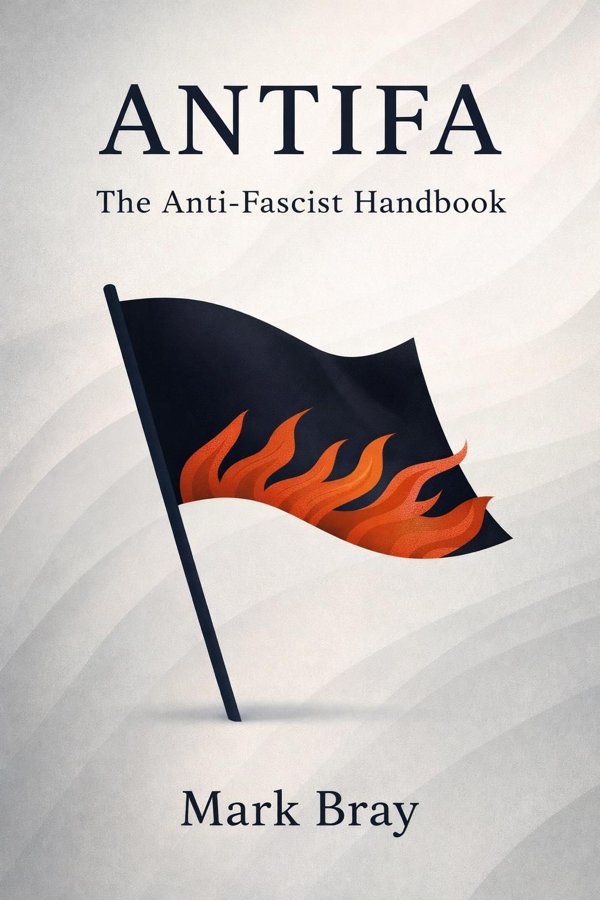
Antifa: The Anti-Fascist Handbook: Summary & Key Insights
by Mark Bray
 10 min9 chaptersAudio available
Key Takeaways from Antifa: The Anti-Fascist Handbook
The most unsettling lesson of fascist history is that it rarely arrives all at once.
A democracy can destroy itself by mistaking every threat for just another opinion.
One reason fascism can spread is that people recognize it too late or too narrowly.
Many people assume the state will intervene when anti-democratic movements become dangerous.
The fiercest controversy around antifa concerns violence, but Bray insists the real debate is about political context, not abstract morality.
What Is Antifa: The Anti-Fascist Handbook About?
Antifa: The Anti-Fascist Handbook by Mark Bray is a politics book. What should a society do when openly authoritarian movements use democratic freedoms to destroy democracy itself? In Antifa: The Anti-Fascist Handbook, historian and activist Mark Bray tackles that urgent question through a clear, provocative history of anti-fascist resistance. Rather than treating “antifa” as a vague slogan or media caricature, Bray explains it as a political tradition: a loose set of militant, community-based practices aimed at stopping fascist organizing before it becomes entrenched. Drawing on interviews with anti-fascists across Europe and North America, as well as historical research into movements from interwar Europe to the present, he shows how anti-fascism emerged in response to a recurring danger, not as an abstract theory but as a practical form of defense. The book matters because it confronts a dilemma many democracies prefer to ignore: whether tolerance should extend to those committed to hierarchy, exclusion, and political violence. Bray’s authority comes from both scholarship and engagement. He writes with historical depth, moral urgency, and a willingness to examine why anti-fascists believe conventional institutions often fail to stop fascism in time.
This FizzRead summary covers all 9 key chapters of Antifa: The Anti-Fascist Handbook in approximately 10 minutes, distilling the most important ideas, arguments, and takeaways from Mark Bray's work. Also available as an audio summary and Key Quotes Podcast.
Antifa: The Anti-Fascist Handbook
What should a society do when openly authoritarian movements use democratic freedoms to destroy democracy itself? In Antifa: The Anti-Fascist Handbook, historian and activist Mark Bray tackles that urgent question through a clear, provocative history of anti-fascist resistance. Rather than treating “antifa” as a vague slogan or media caricature, Bray explains it as a political tradition: a loose set of militant, community-based practices aimed at stopping fascist organizing before it becomes entrenched. Drawing on interviews with anti-fascists across Europe and North America, as well as historical research into movements from interwar Europe to the present, he shows how anti-fascism emerged in response to a recurring danger, not as an abstract theory but as a practical form of defense. The book matters because it confronts a dilemma many democracies prefer to ignore: whether tolerance should extend to those committed to hierarchy, exclusion, and political violence. Bray’s authority comes from both scholarship and engagement. He writes with historical depth, moral urgency, and a willingness to examine why anti-fascists believe conventional institutions often fail to stop fascism in time.
Who Should Read Antifa: The Anti-Fascist Handbook?
This book is perfect for anyone interested in politics and looking to gain actionable insights in a short read. Whether you're a student, professional, or lifelong learner, the key ideas from Antifa: The Anti-Fascist Handbook by Mark Bray will help you think differently.
- ✓Readers who enjoy politics and want practical takeaways
- ✓Professionals looking to apply new ideas to their work and life
- ✓Anyone who wants the core insights of Antifa: The Anti-Fascist Handbook in just 10 minutes
Want the full summary?
Get instant access to this book summary and 100K+ more with Fizz Moment.
Get Free SummaryAvailable on App Store • Free to download
Key Chapters
The most unsettling lesson of fascist history is that it rarely arrives all at once. Mark Bray argues that fascism grows through organizing, propaganda, street recruitment, and normalization long before it controls a state. Anti-fascism, therefore, is built on a preventive logic: if fascist movements are allowed to consolidate publicly, they become harder, not easier, to defeat. This perspective helps explain why anti-fascists focus not only on regimes, but also on rallies, networks, publications, online ecosystems, and local organizing spaces.
Bray situates this idea in the history of the 1920s and 1930s, when many elites underestimated fascist groups as fringe or temporary disturbances. By the time institutions reacted, these movements had already built loyal memberships, cultural legitimacy, and paramilitary confidence. Anti-fascists took the opposite view. They believed waiting for fascism to fully reveal itself was dangerous because fascist politics thrives on hesitation, appeasement, and the tendency of moderates to hope the threat will fade.
In practical terms, this means paying attention to early warning signs: dehumanizing rhetoric, conspiracy theories about national decline, organized intimidation, scapegoating minorities, and attempts to turn political opponents into existential enemies. It also means understanding that “free speech” can be strategically used by anti-democratic movements to gain visibility and recruits while planning to deny those same freedoms to others.
Bray does not present anti-fascism as paranoia. He presents it as historical pattern recognition. The goal is not to silence ordinary disagreement, but to stop organized authoritarianism before it gains the momentum to terrorize communities and reshape institutions.
Actionable takeaway: Learn to identify the early organizational stages of extremist movements in your community and respond early through monitoring, education, coalition-building, and public pushback.
A democracy can destroy itself by mistaking every threat for just another opinion. One of Bray’s central themes is “no platforming,” the practice of denying fascists and white supremacists public venues, prestige, and recruitment opportunities. Critics often frame this as intolerance, but Bray explains that anti-fascists see it as collective self-defense. The issue is not merely whether fascists have abstract rights to speak; it is whether society should help movements dedicated to domination expand their audience and organizational capacity.
Bray roots this tactic in historical experiences where fascist groups used debates, marches, newspapers, and public meetings not simply to express ideas, but to recruit followers, intimidate targets, and normalize political violence. From this perspective, the platform itself matters. A hall booking, a university event, a media interview, or an algorithmic recommendation can function as infrastructure for movement growth.
The book also clarifies that no platforming is not just about headline-grabbing confrontations. It can involve pressuring landlords to cancel events, convincing institutions not to host extremist speakers, exposing organizers, or making clear that certain forms of hate will face organized resistance. In everyday life, a school board, library, workplace, or community center may confront versions of this question when extremist groups try to launder their image under softer branding.
Bray’s argument asks readers to examine the difference between protecting dissent and enabling anti-democratic mobilization. He suggests that neutrality often favors the more aggressive actor, especially when targeted communities bear the cost of “open debate.”
Actionable takeaway: When extremist groups seek legitimacy through institutions you belong to, push for policies that distinguish protected disagreement from organized advocacy of exclusion, terror, and authoritarianism.
One reason fascism can spread is that people recognize it too late or too narrowly. Bray emphasizes that fascism is not reducible to uniforms, swastikas, or a single historical regime. It is better understood as a political formation organized around mythic nationalism, hierarchy, scapegoating, and the use or celebration of violence to purify the nation. This broader understanding matters because contemporary movements often avoid explicit historical symbols while preserving the same core logic.
Bray shows how fascist and far-right organizations adapt to their context. In one period they may present themselves openly as paramilitary revolutionaries; in another they may speak the language of cultural preservation, border security, anti-elitism, or “Western values.” This shape-shifting makes rigid definitions less useful than careful attention to behavior, structure, and intent. Does a movement glorify domination? Does it target minorities as pollutants or invaders? Does it frame politics as a civilizational battle requiring force? Does it reject pluralism in favor of ethnic or national purity?
This framework has practical value. It helps citizens, journalists, and educators avoid dismissing dangerous groups simply because they appear polished, meme-savvy, or electorally strategic. A group does not stop being authoritarian because it swaps boots for suits or street militancy for digital influence. Bray’s historical lens warns against superficial judgments based on branding.
For readers, the challenge is to cultivate political literacy rather than rely on clichés. Recognizing fascist tendencies requires examining networks, rhetoric, symbols, targets, and tactics together. The point is not to label every conservative or nationalist movement fascist, but to take seriously patterns that history has repeatedly shown to be lethal.
Actionable takeaway: Evaluate political movements by their goals, methods, and treatment of vulnerable groups, not by whether they resemble old textbook images of fascism.
Many people assume the state will intervene when anti-democratic movements become dangerous. Bray challenges that assumption by tracing how police, courts, media institutions, and mainstream parties have often underestimated, tolerated, or even cooperated with fascist forces. Anti-fascism emerged partly from this failure. Its core suspicion is that waiting for institutions to act can leave vulnerable communities exposed.
Historically, this distrust was not irrational. In several countries, elites viewed fascists as useful against labor movements, left parties, immigrants, or social unrest. Even where states later opposed fascism, they frequently did so only after movements had grown strong. Bray also points to the uneven way institutions enforce order: anti-fascists may be treated as equivalent to or worse than far-right aggressors because officials prioritize public calm over justice, or property over safety.
This does not mean every institution is always complicit, nor does Bray argue that formal politics is irrelevant. Rather, he insists that communities should not outsource responsibility entirely. Journalists can fail to contextualize extremist organizing. Platforms can amplify hate for engagement. Police may dismiss threats until violence escalates. Political leaders may prefer rhetorical condemnation over meaningful action.
In practical terms, this insight supports mutual aid, community defense, independent monitoring, and local organizing. If a neighborhood faces harassment, residents may need rapid response systems, legal support networks, and relationships with faith groups, unions, or tenant organizations. The anti-fascist lesson is that resilience comes from organized communities, not just laws on paper.
Bray’s argument is ultimately sobering: institutional neutrality can become a pathway for authoritarian advance when power holders refuse to confront danger early.
Actionable takeaway: Build local networks of information, solidarity, and protection instead of assuming authorities alone will recognize and stop extremist threats.
The fiercest controversy around antifa concerns violence, but Bray insists the real debate is about political context, not abstract morality. He explains that anti-fascists do not generally celebrate violence for its own sake. Instead, some defend militant tactics because they see fascist organizing as inseparable from intimidation, hate crimes, and future mass violence. If fascism is inherently violent, they argue, disrupting it can be defensive rather than aggressive.
Bray carefully situates this argument historically. Liberal critics often condemn anti-fascist militancy as illiberal, yet many anti-fascists respond that fascists exploit peaceful norms while targeting those least protected by the system. The book does not flatten all tactics into one category. It distinguishes among doxxing, sabotage, self-defense, physical confrontation, and broader community resistance. This matters because public discussion often treats all anti-fascist action as identical, erasing strategic and ethical differences.
At the same time, Bray does not deny the risks. Militancy can alienate potential allies, escalate conflict, or be misused. The practical question becomes not “violence or nonviolence” in the abstract, but which tactics reduce fascist capacity while protecting vulnerable people and sustaining broader movements. Historical cases show a spectrum of responses, from research and exposure to direct street confrontation.
For readers, the value of this discussion lies in confronting easy moral formulas. Condemning “violence on both sides” may sound balanced, but Bray argues that it can obscure asymmetries of ideology, intent, and harm. A movement seeking domination is not ethically interchangeable with those resisting it.
Actionable takeaway: When evaluating contentious tactics, focus on context, proportionality, consequences, and who is being protected, rather than relying on simplistic equivalences.
The public image of antifa often centers on black-clad clashes, but Bray broadens the picture dramatically. Anti-fascism, he explains, includes a wide range of community defense practices that are less visible but often more durable: research, intelligence gathering, neighborhood organizing, mutual aid, security culture, cultural work, legal solidarity, and support for those targeted by the far right. The movement is not only reactive protest; it is also infrastructure.
This broader lens matters because fascism operates socially as well as politically. It spreads through schools, music scenes, sports clubs, digital communities, workplaces, and local rumor networks. Countering it requires more than showing up at rallies. It may mean helping immigrant families after harassment, documenting extremist flyers, organizing teach-ins, supporting victims of hate crimes, or training communities in de-escalation and digital security.
Bray’s interviews help humanize anti-fascist work by showing that many participants are motivated less by ideology than by direct responsibility to neighbors. A synagogue threatened by neo-Nazis, a mosque facing intimidation, an LGBTQ center dealing with organized harassment, or a tenant building targeted by racist agitators may all need forms of solidarity that do not fit television stereotypes.
This idea expands the reader’s understanding of what resistance can look like. Effective anti-fascism is often patient, local, and relational. It builds trust before crises emerge and strengthens the social fabric fascists try to tear apart. Even people who reject militant tactics may find common ground in this protective, community-centered dimension.
Actionable takeaway: Support anti-authoritarian resilience where you live by combining education, mutual aid, incident reporting, and direct support for communities most likely to be targeted.
Societies do not simply forget fascism; they often sanitize it. Bray highlights the importance of historical memory in anti-fascist politics. When fascism is remembered only as a monstrous exception defeated long ago, people lose the ability to recognize its contemporary forms. Anti-fascists treat memory as a practical tool: studying how fascism rose, who enabled it, and why so many people dismissed it until too late.
This historical consciousness shapes anti-fascist urgency. It reminds readers that democratic erosion can occur gradually, through normalized cruelty, legal discrimination, conspiratorial mass politics, and street-level terror. Memory also counters myths that fascism was defeated solely by statesmen or armies. Bray emphasizes the role of workers, immigrants, partisans, local militants, and ordinary citizens who resisted in real time, often before official institutions did.
The application today is clear. Public history, education, archives, and memorial practices are not merely symbolic. They influence what communities recognize as dangerous and what they are willing to oppose. If young people learn fascism only as a foreign event with fixed symbols, they may miss how similar logics reappear under new names. Conversely, if they understand the warning signs, they may be better equipped to respond to dehumanization and organized hatred early.
Bray’s focus on memory also challenges passive commemoration. “Never again” has little meaning if it is detached from present-day vigilance. Historical lessons become useful only when they inform current choices about speech, organization, solidarity, and risk.
Actionable takeaway: Use local history, education, and public discussion to connect past fascist movements with present warning signs, turning remembrance into practical civic awareness.
Authoritarian movements grow by isolating their targets one by one. Bray repeatedly shows that anti-fascism depends on solidarity across class, race, religion, gender, and political subculture. Fascists often test their strength on groups they believe are easiest to marginalize first, assuming others will stay quiet. Anti-fascist strategy rejects that fragmentation by insisting that an attack on one community is a warning to all.
Historically, broad coalitions have been decisive. Workers, Jewish communities, immigrants, anarchists, socialists, students, clergy, and neighborhood groups have all played roles in resisting fascist advances. Bray acknowledges tensions within such alliances, but he argues that waiting for perfect ideological agreement is a luxury fascist movements exploit. The practical need is coordinated defense around shared threats.
This idea has strong contemporary applications. A city confronting white nationalist organizing may need labor unions to pressure venues, faith leaders to shift public opinion, researchers to expose networks, lawyers to support those targeted, and local residents to mobilize quickly. Online, solidarity can involve countering disinformation, supporting harassed journalists, and amplifying credible information from targeted communities rather than speaking over them.
Bray’s account suggests that anti-fascism is not only opposition to a political enemy; it is rehearsal for a different kind of public life, one grounded in mutual obligation. Solidarity also widens the moral lens. It prevents people from treating attacks on minorities as niche issues disconnected from democracy as a whole.
The challenge is to move from sympathy to structure. Coalitions must be organized before crises peak, with clear communication channels and practical commitments.
Actionable takeaway: Build cross-community relationships now so that when targeted harassment or extremist organizing appears, collective response is immediate rather than improvised.
Perhaps the deepest question in Bray’s book is whether democracy can defend itself without betraying its own ideals. Anti-fascism lives inside that contradiction. It often limits the public space available to openly anti-democratic movements in order to preserve a more substantive form of freedom for everyone else. Bray does not pretend this tension disappears. Instead, he argues that democracies already draw lines all the time; the real issue is where those lines are placed and whom they protect.
Liberal theory often prizes open exchange, but Bray notes that fascists exploit openness instrumentally. They seek access to spaces not to coexist with pluralism, but to destroy it. This creates a paradox of tolerance: unlimited tolerance can empower the intolerant. Anti-fascists answer that preserving democratic life may require refusing legitimacy to movements committed to exclusion and coercion.
The practical significance of this idea is enormous. Schools, publishers, event organizers, platforms, and local governments all make decisions about who gets visibility and institutional support. Bray invites readers to think less in terms of absolute neutrality and more in terms of democratic stewardship. Which choices expand equal participation, and which choices strengthen forces that would abolish it?
This argument does not offer easy comfort. It demands judgment, historical awareness, and accountability. But it also reframes anti-fascism as more than a fringe impulse. It becomes a difficult, recurring democratic problem: how to protect openness from organized enemies of openness.
Actionable takeaway: In public decisions about legitimacy and access, ask not only whether expression is being restricted, but whether democratic equality is being defended.
All Chapters in Antifa: The Anti-Fascist Handbook
About the Author
Mark Bray is a historian, author, and political commentator whose work focuses on fascism, anti-fascism, protest movements, and radical political traditions. Trained as a scholar of modern history, he has taught at the university level and written for both academic and general audiences. Bray is also known for his involvement in Occupy Wall Street, an experience that deepened his engagement with grassroots organizing and collective resistance. His writing often bridges scholarship and activism, combining archival history with attention to how political movements operate in the present. In Antifa: The Anti-Fascist Handbook, he brings that dual perspective to one of the most controversial topics in contemporary politics, offering readers both historical context and a close look at the ideas and practices of anti-fascist resistance.
Get This Summary in Your Preferred Format
Read or listen to the Antifa: The Anti-Fascist Handbook summary by Mark Bray anytime, anywhere. FizzRead offers multiple formats so you can learn on your terms — all free.
Available formats: App · Audio · PDF · EPUB — All included free with FizzRead
Download Antifa: The Anti-Fascist Handbook PDF and EPUB Summary
Key Quotes from Antifa: The Anti-Fascist Handbook
“The most unsettling lesson of fascist history is that it rarely arrives all at once.”
“A democracy can destroy itself by mistaking every threat for just another opinion.”
“One reason fascism can spread is that people recognize it too late or too narrowly.”
“Many people assume the state will intervene when anti-democratic movements become dangerous.”
“The fiercest controversy around antifa concerns violence, but Bray insists the real debate is about political context, not abstract morality.”
Frequently Asked Questions about Antifa: The Anti-Fascist Handbook
Antifa: The Anti-Fascist Handbook by Mark Bray is a politics book that explores key ideas across 9 chapters. What should a society do when openly authoritarian movements use democratic freedoms to destroy democracy itself? In Antifa: The Anti-Fascist Handbook, historian and activist Mark Bray tackles that urgent question through a clear, provocative history of anti-fascist resistance. Rather than treating “antifa” as a vague slogan or media caricature, Bray explains it as a political tradition: a loose set of militant, community-based practices aimed at stopping fascist organizing before it becomes entrenched. Drawing on interviews with anti-fascists across Europe and North America, as well as historical research into movements from interwar Europe to the present, he shows how anti-fascism emerged in response to a recurring danger, not as an abstract theory but as a practical form of defense. The book matters because it confronts a dilemma many democracies prefer to ignore: whether tolerance should extend to those committed to hierarchy, exclusion, and political violence. Bray’s authority comes from both scholarship and engagement. He writes with historical depth, moral urgency, and a willingness to examine why anti-fascists believe conventional institutions often fail to stop fascism in time.
You Might Also Like
Attack from Within: How Disinformation Is Sabotaging America
Barbara McQuade
10 min
Coercion, Capital, and European States, AD 990–1992
Charles Tilly
10 min
Digital Democracy: Concepts, Methodologies, Tools, and Applications
Various Authors
10 min
Fascism
Stanley G. Payne
10 min
Fire And Fury: Inside The Trump White House
Michael Wolff
10 min
How To Fix Democracy
Andrew Keen
10 minBrowse by Category
Ready to read Antifa: The Anti-Fascist Handbook?
Get the full summary and 100K+ more books with Fizz Moment.