
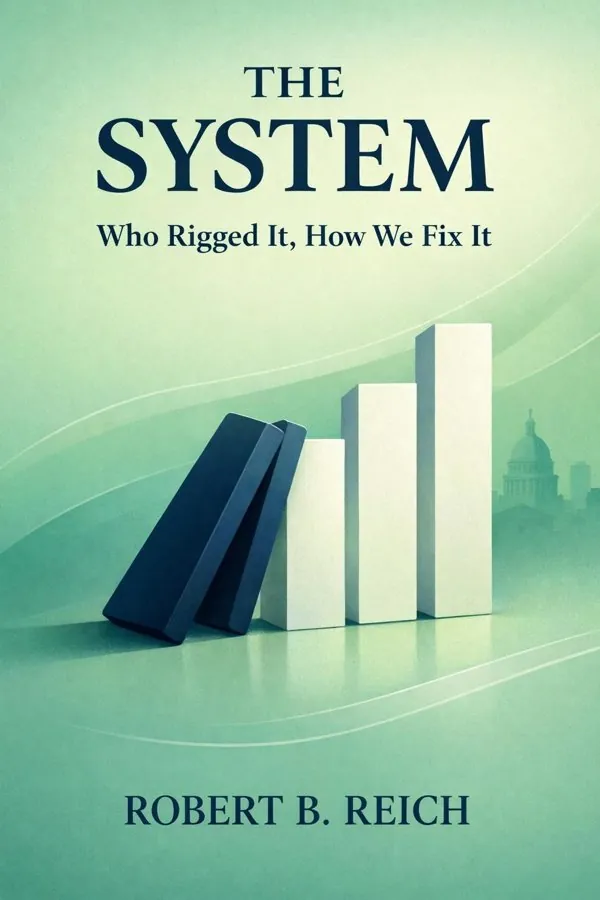
The System: Who Rigged It, How We Fix It: Summary & Key Insights
 10 min6 chaptersAudio available
What Is The System: Who Rigged It, How We Fix It About?
The System: Who Rigged It, How We Fix It by Robert B. Reich is a economics book spanning 6 pages. In this incisive work, Robert B. Reich examines how the American political and economic system has been structured to favor the wealthy and powerful. He explores the mechanisms of inequality, corporate influence, and political corruption that have eroded democracy and public trust. Reich also offers a vision for reform, advocating for systemic change to restore fairness and opportunity for all citizens.
This FizzRead summary covers all 6 key chapters of The System: Who Rigged It, How We Fix It in approximately 10 minutes, distilling the most important ideas, arguments, and takeaways from Robert B. Reich's work. Also available as an audio summary and Key Quotes Podcast.
The System: Who Rigged It, How We Fix It
In this incisive work, Robert B. Reich examines how the American political and economic system has been structured to favor the wealthy and powerful. He explores the mechanisms of inequality, corporate influence, and political corruption that have eroded democracy and public trust. Reich also offers a vision for reform, advocating for systemic change to restore fairness and opportunity for all citizens.
Who Should Read The System: Who Rigged It, How We Fix It?
This book is perfect for anyone interested in economics and looking to gain actionable insights in a short read. Whether you're a student, professional, or lifelong learner, the key ideas from The System: Who Rigged It, How We Fix It by Robert B. Reich will help you think differently.
- ✓Readers who enjoy economics and want practical takeaways
- ✓Professionals looking to apply new ideas to their work and life
- ✓Anyone who wants the core insights of The System: Who Rigged It, How We Fix It in just 10 minutes
Want the full summary?
Get instant access to this book summary and 100K+ more with Fizz Moment.
Get Free SummaryAvailable on App Store • Free to download
Key Chapters
In the decades following World War II, the United States achieved something remarkable: a broadly shared economic prosperity. Between the late 1940s and early 1970s, productivity and wages rose together. A factory worker could afford to buy a home, send children to college, and retire with dignity. Unions played a vital role in protecting workers, and corporate executives saw themselves as caretakers of communities, not just of balance sheets. Government policies — from progressive taxation to investment in education and infrastructure — supported the idea that economic success should benefit everyone.
That era reflected a balance of power between labor, government, and capital. It wasn’t perfect, but it contained the seeds of fairness. However, that balance began to dissolve in the 1970s. Inflation, oil shocks, and global competition gave rise to a new economic worldview — neoliberalism — advocating deregulation, market supremacy, and corporate freedom. Political leaders began dismantling the guardrails of the mid-century economy, justified by claims that markets were 'natural' and government interference was harmful.
In retrospect, the shift was seismic. Deregulation of airlines, trucking, and finance rewrote the rules of competition. Tax cuts for the wealthy undermined progressive redistribution. And an increasingly globalized economy placed workers in direct competition with lower-wage labor abroad. What seemed like modernization was in fact the quiet concentration of wealth and influence. By the late twentieth century, the social contract that bound economic power to public responsibility had been shredded. The system was being rebuilt, brick by brick, in favor of capital and those who controlled it.
As power flowed upward, a new American oligarchy took shape. It wasn’t marked by crowns or titles but by balance sheets and political contributions. Corporate executives, investors, and billionaires discovered that shaping public policy could yield higher returns than any market gamble. In this new reality, democracy became less a mechanism of representation and more a means to legitimize elite control.
The oligarchy’s rise rested on several interlocking strategies. First, it captured the political machinery through campaign financing. The Supreme Court’s decision in *Citizens United v. FEC* institutionalized the idea that money equals speech, allowing wealthy individuals and corporations to flood the political process with funds. Second, it manipulated regulatory frameworks. Industries like finance, healthcare, and energy invested heavily in lobbying to weaken oversight, turning watchdogs into lapdogs. Third, it perfected the art of revolving-door appointments, where public officials seamlessly transitioned between regulatory agencies and corporate boardrooms.
These mechanisms created a feedback loop of privilege. Power produced wealth, and wealth reinforced power. Policy choices once aimed at protecting common welfare became tools for maximizing shareholder value. The consequences were profound: tax codes tilted toward capital gains, antitrust enforcement evaporated, and corporate monopolies quietly expanded across sectors. Ordinary citizens lost their voice, and political rhetoric became an anesthetic to dull public outrage.
Within this oligarchic order, the illusion of choice persisted. Elections were held, parties changed places, but the gravitational pull of money remained constant. The system no longer served democracy; it served those who had mastered how to manipulate it. And because the mechanisms were procedural — legal, bureaucratic, institutional — they appeared invisible. My task throughout this book is to make them visible again.
+ 4 more chapters — available in the FizzRead app
All Chapters in The System: Who Rigged It, How We Fix It
About the Author
Robert B. Reich is an American economist, professor, author, and political commentator. He served as Secretary of Labor under President Bill Clinton and has written extensively on inequality, economics, and democracy. Reich is a professor of public policy at the University of California, Berkeley, and a prominent voice for progressive economic reform.
Get This Summary in Your Preferred Format
Read or listen to the The System: Who Rigged It, How We Fix It summary by Robert B. Reich anytime, anywhere. FizzRead offers multiple formats so you can learn on your terms — all free.
Available formats: App · Audio · PDF · EPUB — All included free with FizzRead
Download The System: Who Rigged It, How We Fix It PDF and EPUB Summary
Key Quotes from The System: Who Rigged It, How We Fix It
“In the decades following World War II, the United States achieved something remarkable: a broadly shared economic prosperity.”
“As power flowed upward, a new American oligarchy took shape.”
Frequently Asked Questions about The System: Who Rigged It, How We Fix It
The System: Who Rigged It, How We Fix It by Robert B. Reich is a economics book that explores key ideas across 6 chapters. In this incisive work, Robert B. Reich examines how the American political and economic system has been structured to favor the wealthy and powerful. He explores the mechanisms of inequality, corporate influence, and political corruption that have eroded democracy and public trust. Reich also offers a vision for reform, advocating for systemic change to restore fairness and opportunity for all citizens.
More by Robert B. Reich
Saving Capitalism: For the Many, Not the Few
Robert B. Reich
10 min
The Work of Nations: Preparing Ourselves for 21st Century Capitalism
Robert B. Reich
10 min
Supercapitalism: The Transformation of Business, Democracy, and Everyday Life
Robert B. Reich
10 min
The Common Good
Robert B. Reich
10 minYou Might Also Like
Business Adventures
John Brooks
10 min
Nudge
Richard H. Thaler, Cass R. Sunstein
10 min
The Hitchhiker"s Guide to the Galaxy
Douglas Adams
10 minThe Muqaddimah
Ibn Khaldun
10 minThe Outsiders
William N. Thorndike
10 min
A Little History of Economics
Niall Kishtainy
10 minBrowse by Category
Ready to read The System: Who Rigged It, How We Fix It?
Get the full summary and 100K+ more books with Fizz Moment.