
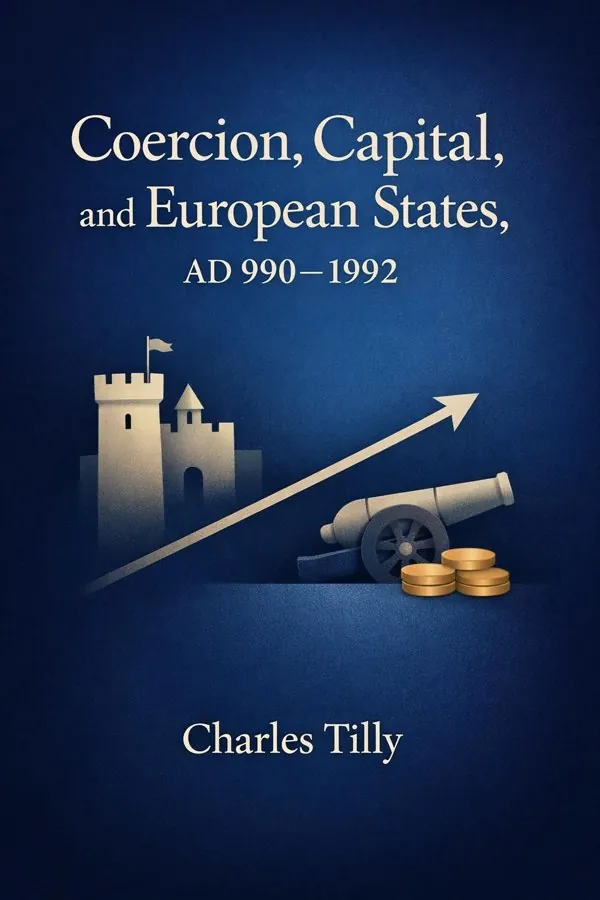
Coercion, Capital, and European States, AD 990–1992: Summary & Key Insights
 10 min9 chaptersAudio available
Key Takeaways from Coercion, Capital, and European States, AD 990–1992
A state looks permanent only after its violent origins have been forgotten.
Behind the polished language of sovereignty stands a hard truth: war was one of the greatest engines of state formation.
Not all states were built the same way because not all rulers relied on the same resources.
A tax system is never just about revenue; it is a map of political relationships.
Political history is not only written on battlefields; it is also written in ports, markets, and counting houses.
What Is Coercion, Capital, and European States, AD 990–1992 About?
Coercion, Capital, and European States, AD 990–1992 by Charles Tilly is a politics book. Charles Tilly’s Coercion, Capital, and European States, AD 990–1992 is one of the most influential books ever written on how states are built, how power is organized, and why Europe developed the political map we know today. Rather than treating states as natural or inevitable institutions, Tilly shows that they were forged through centuries of war-making, taxation, bargaining, extraction, and competition. His central insight is both simple and unsettling: states did not emerge primarily from noble ideals, but from rulers’ efforts to secure territory, raise armies, and extract resources from populations. What makes this book matter is its combination of historical sweep and analytical clarity. Covering roughly a thousand years, Tilly explains how coercion, concentrated in armies and governments, interacted with capital, concentrated in cities, trade, and finance, to produce different kinds of states across Europe. Some became highly centralized military powers; others grew through negotiation with merchants and urban elites. Tilly was a leading historical sociologist whose work reshaped the study of politics, social movements, and state formation. This book remains essential for understanding modern government, war, taxation, citizenship, and the deep historical forces behind political order.
This FizzRead summary covers all 9 key chapters of Coercion, Capital, and European States, AD 990–1992 in approximately 10 minutes, distilling the most important ideas, arguments, and takeaways from Charles Tilly's work. Also available as an audio summary and Key Quotes Podcast.
Coercion, Capital, and European States, AD 990–1992
Charles Tilly’s Coercion, Capital, and European States, AD 990–1992 is one of the most influential books ever written on how states are built, how power is organized, and why Europe developed the political map we know today. Rather than treating states as natural or inevitable institutions, Tilly shows that they were forged through centuries of war-making, taxation, bargaining, extraction, and competition. His central insight is both simple and unsettling: states did not emerge primarily from noble ideals, but from rulers’ efforts to secure territory, raise armies, and extract resources from populations.
What makes this book matter is its combination of historical sweep and analytical clarity. Covering roughly a thousand years, Tilly explains how coercion, concentrated in armies and governments, interacted with capital, concentrated in cities, trade, and finance, to produce different kinds of states across Europe. Some became highly centralized military powers; others grew through negotiation with merchants and urban elites.
Tilly was a leading historical sociologist whose work reshaped the study of politics, social movements, and state formation. This book remains essential for understanding modern government, war, taxation, citizenship, and the deep historical forces behind political order.
Who Should Read Coercion, Capital, and European States, AD 990–1992?
This book is perfect for anyone interested in politics and looking to gain actionable insights in a short read. Whether you're a student, professional, or lifelong learner, the key ideas from Coercion, Capital, and European States, AD 990–1992 by Charles Tilly will help you think differently.
- ✓Readers who enjoy politics and want practical takeaways
- ✓Professionals looking to apply new ideas to their work and life
- ✓Anyone who wants the core insights of Coercion, Capital, and European States, AD 990–1992 in just 10 minutes
Want the full summary?
Get instant access to this book summary and 100K+ more with Fizz Moment.
Get Free SummaryAvailable on App Store • Free to download
Key Chapters
A state looks permanent only after its violent origins have been forgotten. One of Tilly’s most important contributions is to reject the idea that states simply evolved as rational administrative solutions to social needs. Instead, he argues that European states were built through conflict, competition, and improvisation. Rulers did not begin with modern bureaucracies, clear borders, or loyal citizens. They pieced these things together over centuries while trying to survive against rivals.
Tilly asks us to imagine medieval Europe not as a collection of finished countries, but as a crowded field of princes, city-states, empires, feudal lords, church authorities, and armed entrepreneurs. Many political units disappeared. A smaller number consolidated power by defeating rivals, absorbing territories, and building administrative machinery strong enough to extract taxes and mobilize troops. What we call “the state” is the outcome of that historical struggle.
This perspective changes how we think about legitimacy and institutions. Tax agencies, police forces, censuses, courts, and standing armies were not created all at once because people agreed they were useful. They often emerged from rulers’ urgent need to fund wars and control populations. Over time, these arrangements became normalized and eventually presented as the natural structure of political life.
A practical application of Tilly’s insight is to examine any modern institution by asking what pressures created it. Why does a government maintain a large fiscal bureaucracy? Why are borders enforced so intensely? Why are identification systems so detailed? Often the answer lies in past struggles over security, extraction, and control.
Actionable takeaway: When analyzing any modern state, start with its history of conflict and consolidation rather than assuming its institutions arose from neutral administrative design.
Behind the polished language of sovereignty stands a hard truth: war was one of the greatest engines of state formation. Tilly’s famous argument is that war-making and state-making were deeply intertwined. Rulers needed armies to defend territory and fight rivals, but armies were expensive. To fund them, rulers had to extract resources more effectively from the populations they controlled. That pressure drove the creation of taxation systems, bureaucracies, policing mechanisms, and administrative routines.
The process was circular. War required extraction. Extraction required administration. Administration increased rulers’ reach over society. Expanded capacity then made further war possible. Over centuries, this cycle selected for political organizations that could mobilize men, money, and obedience at scale. States that failed to do so were conquered, fragmented, or marginalized.
Tilly does not romanticize this process. State-building was often coercive, exploitative, and uneven. Villagers resisted taxes. Local elites defended privileges. Peripheral regions rebelled against central authority. Yet repeated military competition rewarded rulers who could overcome or manage that resistance. In this sense, modern states were not created despite violence but partly through it.
This idea helps explain why periods of international conflict often produce rapid domestic institutional growth. During major wars, governments expand taxation, surveillance, infrastructure, and logistics. Even after war ends, these structures often remain. We can see echoes of Tilly’s argument in the long afterlife of wartime agencies, military technologies, and emergency powers.
Actionable takeaway: To understand why a state has strong administrative capacity, look at the military pressures it faced and how those pressures reshaped taxation, bureaucracy, and social control.
Not all states were built the same way because not all rulers relied on the same resources. Tilly’s framework revolves around two core forces: coercion and capital. Coercion refers to organized force, especially armies and the means of physical control. Capital refers to concentrated wealth, especially in cities, markets, trade networks, and financial institutions. The balance between these forces shaped the type of state that emerged.
In regions where coercion dominated, rulers depended heavily on direct military power and territorial control. These states tended to build strong centralized military structures and often imposed more direct rule over rural populations. In capital-rich regions, especially those with prosperous cities and commercial classes, rulers had to bargain more with merchants, financiers, and urban elites. That negotiation could produce more representative institutions, different fiscal arrangements, and a less purely military path to state-building.
Tilly distinguishes among coercion-intensive, capital-intensive, and capitalized coercion trajectories. The last category became especially important in powerful European states that combined military force with advanced fiscal and commercial systems. England and the Dutch Republic, for example, were able to mobilize capital through credit and finance in ways that enhanced military capacity without relying solely on blunt extraction.
This framework remains useful beyond historical Europe. Analysts today can ask whether a government relies primarily on security forces, on economic networks, or on a mix of both. A regime heavily dependent on oil rents and police power may look very different from one deeply embedded in taxable commerce and negotiated consent.
Actionable takeaway: When comparing political systems, identify where force is concentrated and where wealth is concentrated; the relationship between them often explains how power actually works.
A tax system is never just about revenue; it is a map of political relationships. Tilly shows that the need to extract resources from populations pushed rulers to build durable administrative structures and, in many cases, to negotiate with social groups that controlled wealth. Taxation therefore became a central mechanism linking war, bureaucracy, representation, and state capacity.
Where rulers could simply seize resources through force, they often relied less on broad bargaining. But where wealth was embedded in trade, urban property, and mobile capital, rulers needed cooperation from merchants, lenders, and local authorities. That cooperation often came at a price: privileges, legal protections, consultation, or formal representative institutions. In this way, extraction could generate negotiation, and negotiation could reshape the state.
This does not mean taxation automatically produces democracy. Tilly is careful to show that extraction can also intensify coercion. Still, when rulers depend on ongoing revenue from productive sectors rather than occasional plunder, they often have stronger incentives to regularize administration, record populations, standardize rules, and make credible commitments. The result is greater state capacity.
The idea travels well into the present. Governments that rely mostly on external rents, such as natural resources or foreign aid, may face weaker incentives to build accountable tax relationships with citizens. By contrast, governments that depend on domestic taxation often need more detailed fiscal systems and more durable forms of social bargaining.
For readers today, Tilly’s insight is a reminder that debates about tax policy are also debates about power, trust, and state reach. Who pays, how collection works, and what the state offers in return reveal the deeper structure of political order.
Actionable takeaway: Treat taxation as a political institution, not a technical one; follow the flow of revenue to understand who shapes the state and why.
Political history is not only written on battlefields; it is also written in ports, markets, and counting houses. Tilly emphasizes that cities were crucial centers of capital concentration, and their economic power profoundly influenced the evolution of European states. Urban merchants, financiers, and commercial elites provided rulers with money, credit, supplies, and administrative expertise. In return, they often demanded protections, charters, autonomy, and influence.
This relationship mattered because early rulers frequently lacked the cash flow needed for sustained warfare. Armies could not be maintained on feudal obligation alone. Access to credit and commercial taxation became increasingly important. Cities that controlled trade routes or financial networks gained bargaining leverage. In some places, this produced relatively decentralized arrangements in which urban actors constrained rulers. In others, rulers successfully absorbed urban wealth into expanding centralized states.
The contrast between commercially dynamic regions and more agrarian, coercion-heavy regions helps explain why European political development took multiple paths. Maritime powers with deep trading networks often developed different institutions than land-based dynasties focused on territorial conquest. Financial innovation, public debt, and commercial taxation could become just as important as castles and cavalry.
A modern application is to recognize that economic organization shapes political possibility. Today’s technology hubs, financial centers, and global supply chains can alter the balance between states and private actors much as medieval and early modern cities did. Wherever capital concentrates, bargaining over regulation, security, and influence follows.
Actionable takeaway: To understand political power, look beyond formal government structures and identify the economic centers that supply rulers with revenue, credit, and strategic leverage.
The map of Europe was not destined to become a world of nation-states; it was the residue of countless failed alternatives. Tilly insists that state formation was uneven across regions and deeply contested at every stage. Some rulers built durable central institutions. Others lost out to empires, federations, city alliances, or stronger neighbors. Internal resistance was also constant, from peasant uprisings and noble revolts to urban defiance and peripheral separatism.
This matters because it prevents a simplistic story of linear progress. Modern states did not emerge through a smooth march toward rational governance. They arose through messy struggles in which outcomes were uncertain. Geographic conditions, military technology, trade routes, class structures, and the distribution of capital all mattered. So did contingent events such as dynastic marriages, debt crises, foreign invasions, and civil wars.
Tilly’s approach also highlights that centralization often meant the destruction or subordination of alternative authorities. Local militias, church courts, feudal jurisdictions, guild governance, and regional autonomies were gradually curtailed as states expanded their monopoly over taxation, law, and violence. What appears from one angle as integration can look from another like dispossession.
This lens is useful for understanding contemporary state weakness and fragility. Countries with contested borders, strong regional elites, or competing armed groups are not simply “behind” on a universal path. They may be experiencing forms of political conflict that resemble earlier phases of state consolidation, though under very different global conditions.
Actionable takeaway: Avoid treating the modern state as an inevitable endpoint; instead, ask what rival authorities were defeated, absorbed, or left unresolved in the process of political consolidation.
Rights are rarely handed down generously from above; more often, they emerge from pressure, negotiation, and conflict. Although Tilly’s book centers on state formation, it also helps explain how citizenship developed alongside expanding state capacity. As rulers extracted more taxes, conscripted more soldiers, regulated more activity, and intervened more deeply in social life, populations demanded protections, recognition, and participation in return.
This exchange was never automatic. Many people were burdened by the state long before they were empowered by it. But over time, the growth of administrative reach created new arenas for political claims. If the state could count you, tax you, draft you, and police you, it became harder to deny that you had standing to demand rights. Citizenship thus grew through contentious politics, not just legal theory.
Representative institutions, legal equality, welfare protections, and national belonging all developed unevenly and often under pressure from below. War sometimes accelerated this process by forcing rulers to mobilize entire populations. Mass mobilization could strengthen claims for suffrage, veteran benefits, labor rights, and social provision. In other words, the very machinery built for control could become a target of democratic struggle.
This idea remains highly relevant. Modern debates over surveillance, taxation, military service, migration, and welfare still revolve around reciprocal obligations between states and people. Tilly reminds us that citizenship is not merely a status but a historically constructed relationship shaped by conflict and institutional change.
Actionable takeaway: When evaluating citizenship rights today, ask what forms of extraction or control citizens are expected to accept and what protections or voice they receive in exchange.
One of Tilly’s most provocative insights is that the line between protection and predation can be disturbingly thin. He famously suggested that in some respects state-makers resembled organized criminals: both claimed to offer protection while also creating or magnifying the dangers from which protection was needed. While the comparison is intentionally sharp, its purpose is analytical, not merely rhetorical. Tilly wants readers to see that early rulers often extracted resources under the promise of defense, even when their own military ambitions were a major source of insecurity.
This does not mean states are simply criminal enterprises. Rather, it means their historical formation involved coercive practices that later became institutionalized and legitimized. A ruler who taxes subjects to fund wars, suppress rivals, and secure borders may genuinely provide order, but that order is inseparable from extraction and force. The state’s claim to legitimacy grows stronger over time as it routinizes authority, defeats competitors, and provides more predictable administration.
The framework is powerful because it encourages skepticism toward official narratives. Whenever authorities justify expanded powers in the name of security, we should ask what threats are being managed, who benefits, who pays, and whether the same process increases state reach in lasting ways. This applies to historical armies and fortresses, but also to modern emergency laws, surveillance regimes, and security bureaucracies.
Tilly’s point is not cynicism for its own sake. It is a call to understand protection as a political transaction shaped by unequal power. Security can be real, but so can exploitation.
Actionable takeaway: Whenever a state expands coercive powers in the name of protection, examine both the security benefits and the long-term gains in control that authorities may be securing for themselves.
The strength or weakness of a modern state cannot be understood from current policy alone; it is the cumulative result of historical struggles over force, finance, and administration. Tilly’s long time horizon, stretching from AD 990 to 1992, shows that contemporary political institutions are layered products of centuries of competition. Fiscal systems, military traditions, legal arrangements, territorial boundaries, and administrative habits all carry traces of earlier conflicts.
This historical depth explains why states facing similar contemporary problems often respond very differently. Some governments can tax efficiently, coordinate nationally, and enforce rules across territory. Others struggle to project authority beyond major cities or to build trust in public institutions. These differences are not just matters of leadership quality or policy design. They are rooted in how states were formed, whom they had to bargain with, and what kinds of coercive and financial tools they developed.
Tilly’s framework also helps readers resist shallow institutional mimicry. Copying a constitution, agency model, or election system from one country to another does not recreate the historical processes that made those institutions effective. Durable capacity grows through relationships among rulers, economic actors, and populations, often under pressure from conflict and negotiation.
For practitioners in politics, development, or international relations, this is a critical lesson. Efforts to strengthen governance must account for inherited administrative structures, patterns of extraction, regional inequalities, and public expectations shaped by long histories. Present institutions make more sense when seen as accumulated responses to old problems.
Actionable takeaway: Before proposing political reform, trace the historical formation of state capacity in that society; durable change depends on understanding the deep roots of present institutions.
All Chapters in Coercion, Capital, and European States, AD 990–1992
About the Author
Charles Tilly was a renowned American historical sociologist and one of the most important scholars of state formation, political conflict, and social change. Born in 1929, he built a distinguished academic career through influential teaching and research at major universities, including the University of Michigan, the New School, and Columbia University. Tilly’s work examined how large historical processes such as war, migration, urbanization, and collective action shaped political institutions and everyday life. He became especially famous for his analysis of how states form through coercion, extraction, and competition, as well as for his studies of social movements and contentious politics. Clear, ambitious, and deeply comparative, his scholarship continues to shape debates across sociology, history, and political science.
Get This Summary in Your Preferred Format
Read or listen to the Coercion, Capital, and European States, AD 990–1992 summary by Charles Tilly anytime, anywhere. FizzRead offers multiple formats so you can learn on your terms — all free.
Available formats: App · Audio · PDF · EPUB — All included free with FizzRead
Download Coercion, Capital, and European States, AD 990–1992 PDF and EPUB Summary
Key Quotes from Coercion, Capital, and European States, AD 990–1992
“A state looks permanent only after its violent origins have been forgotten.”
“Behind the polished language of sovereignty stands a hard truth: war was one of the greatest engines of state formation.”
“Not all states were built the same way because not all rulers relied on the same resources.”
“A tax system is never just about revenue; it is a map of political relationships.”
“Political history is not only written on battlefields; it is also written in ports, markets, and counting houses.”
Frequently Asked Questions about Coercion, Capital, and European States, AD 990–1992
Coercion, Capital, and European States, AD 990–1992 by Charles Tilly is a politics book that explores key ideas across 9 chapters. Charles Tilly’s Coercion, Capital, and European States, AD 990–1992 is one of the most influential books ever written on how states are built, how power is organized, and why Europe developed the political map we know today. Rather than treating states as natural or inevitable institutions, Tilly shows that they were forged through centuries of war-making, taxation, bargaining, extraction, and competition. His central insight is both simple and unsettling: states did not emerge primarily from noble ideals, but from rulers’ efforts to secure territory, raise armies, and extract resources from populations. What makes this book matter is its combination of historical sweep and analytical clarity. Covering roughly a thousand years, Tilly explains how coercion, concentrated in armies and governments, interacted with capital, concentrated in cities, trade, and finance, to produce different kinds of states across Europe. Some became highly centralized military powers; others grew through negotiation with merchants and urban elites. Tilly was a leading historical sociologist whose work reshaped the study of politics, social movements, and state formation. This book remains essential for understanding modern government, war, taxation, citizenship, and the deep historical forces behind political order.
You Might Also Like
Antifa: The Anti-Fascist Handbook
Mark Bray
10 min
Attack from Within: How Disinformation Is Sabotaging America
Barbara McQuade
10 min
Digital Democracy: Concepts, Methodologies, Tools, and Applications
Various Authors
10 min
Fascism
Stanley G. Payne
10 min
Fire And Fury: Inside The Trump White House
Michael Wolff
10 min
How To Fix Democracy
Andrew Keen
10 minBrowse by Category
Ready to read Coercion, Capital, and European States, AD 990–1992?
Get the full summary and 100K+ more books with Fizz Moment.