

The Comfort Crisis: Summary & Key Insights
 10 min9 chaptersAudio available
Key Takeaways from The Comfort Crisis
One of the book’s central insights is unsettling: the very comforts we work so hard to create can slowly undermine our health, resilience, and sense of meaning.
Resilience is not something we can download from a podcast or absorb from motivational quotes; it is built by repeated exposure to manageable stress.
A striking paradox in The Comfort Crisis is that abundance often leaves us feeling unsatisfied.
Nature in this book is not presented as a scenic backdrop or a wellness cliché.
We often separate mental and physical well-being, treating the body as one issue and the mind as another.
What Is The Comfort Crisis About?
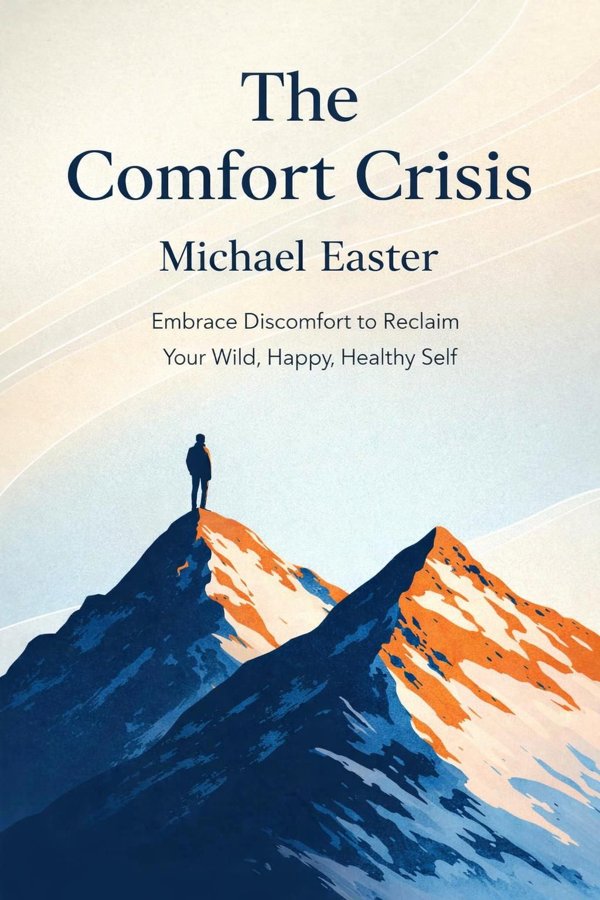
The Comfort Crisis by Michael Easter is a self-help book published in 2020 spanning 7 pages. Modern life is engineered to make us safe, entertained, fed, and comfortable at nearly every moment. Yet Michael Easter argues that this endless convenience has created an unexpected problem: many of us feel anxious, restless, physically weak, mentally scattered, and strangely unfulfilled. In The Comfort Crisis, Easter investigates why abundance and ease do not automatically lead to happiness—and why deliberate discomfort may be one of the missing ingredients in a meaningful life. Blending evolutionary science, psychology, anthropology, and immersive reporting, he explores how human beings evolved in conditions that demanded effort, uncertainty, and resilience, then shows what happens when those challenges disappear. A professor, journalist, and longtime researcher of performance and well-being, Easter grounds his argument in both evidence and experience. The book is anchored by his demanding hunting trip in the Alaskan wilderness, where exposure, hunger, fatigue, and solitude become a living laboratory for understanding the modern self. The Comfort Crisis matters because it offers more than a diagnosis of contemporary malaise. It provides a practical philosophy: if we want to think better, feel stronger, and live more fully, we may need to stop avoiding hardship and start using it wisely.
This FizzRead summary covers all 9 key chapters of The Comfort Crisis in approximately 10 minutes, distilling the most important ideas, arguments, and takeaways from Michael Easter's work. Also available as an audio summary and Key Quotes Podcast.
The Comfort Crisis
Modern life is engineered to make us safe, entertained, fed, and comfortable at nearly every moment. Yet Michael Easter argues that this endless convenience has created an unexpected problem: many of us feel anxious, restless, physically weak, mentally scattered, and strangely unfulfilled. In The Comfort Crisis, Easter investigates why abundance and ease do not automatically lead to happiness—and why deliberate discomfort may be one of the missing ingredients in a meaningful life. Blending evolutionary science, psychology, anthropology, and immersive reporting, he explores how human beings evolved in conditions that demanded effort, uncertainty, and resilience, then shows what happens when those challenges disappear.
A professor, journalist, and longtime researcher of performance and well-being, Easter grounds his argument in both evidence and experience. The book is anchored by his demanding hunting trip in the Alaskan wilderness, where exposure, hunger, fatigue, and solitude become a living laboratory for understanding the modern self. The Comfort Crisis matters because it offers more than a diagnosis of contemporary malaise. It provides a practical philosophy: if we want to think better, feel stronger, and live more fully, we may need to stop avoiding hardship and start using it wisely.
Who Should Read The Comfort Crisis?
This book is perfect for anyone interested in self-help and looking to gain actionable insights in a short read. Whether you're a student, professional, or lifelong learner, the key ideas from The Comfort Crisis by Michael Easter will help you think differently.
- ✓Readers who enjoy self-help and want practical takeaways
- ✓Professionals looking to apply new ideas to their work and life
- ✓Anyone who wants the core insights of The Comfort Crisis in just 10 minutes
Want the full summary?
Get instant access to this book summary and 100K+ more with Fizz Moment.
Get Free SummaryAvailable on App Store • Free to download
Key Chapters
One of the book’s central insights is unsettling: the very comforts we work so hard to create can slowly undermine our health, resilience, and sense of meaning. Human beings evolved in environments filled with friction—scarcity, movement, temperature shifts, uncertainty, and physical demands. Modern life removes much of that friction. We can order food without walking, regulate indoor climate with a thermostat, entertain ourselves endlessly through screens, and avoid boredom with a tap. These conveniences are real achievements, but Easter argues they also create an evolutionary mismatch. Our bodies and minds are still adapted for challenge, yet our environments increasingly shield us from it.
This mismatch helps explain why many people feel chronically dissatisfied despite unprecedented material comfort. When life becomes too easy, small inconveniences feel large, attention weakens, and discomfort tolerance drops. We may mistake the absence of struggle for well-being, when in fact some struggle is essential for growth. Easter does not romanticize suffering or suggest abandoning progress. Instead, he distinguishes harmful hardship from useful hardship. The goal is not misery; it is recalibration.
A practical example is exercise. Our ancestors did not “work out,” but they moved constantly because survival required it. Today we can sit all day and then wonder why we feel lethargic or mentally dull. Likewise, boredom once created space for reflection and creativity, while modern distraction trains us to escape even brief moments of stillness.
The takeaway is simple: audit your life for areas that have become too frictionless. Add small, intentional doses of challenge—walk instead of drive, carry your bags, skip some conveniences, or spend time without digital stimulation. Comfort is best used as a tool, not a permanent habitat.
Resilience is not something we can download from a podcast or absorb from motivational quotes; it is built by repeated exposure to manageable stress. Easter shows that voluntary discomfort—choosing hard things before life forces them on us—can train both body and mind to respond better under pressure. This idea appears across psychology, physiology, and performance science: systems grow stronger when challenged appropriately. Muscles strengthen under load, attention improves through practice, and emotional steadiness develops by facing stress rather than endlessly avoiding it.
The important distinction is between destructive overwhelm and purposeful challenge. Deliberate discomfort means selecting stressors that are difficult but constructive: a long hike, a cold morning run, an honest conversation, a period without your phone, or a demanding skill that requires patience. These experiences widen your “tolerance window.” You become less fragile, less reactive, and more capable when conditions are not ideal.
Easter’s Alaskan wilderness experience serves as an extreme example. Hunting in remote terrain required enduring hunger, fatigue, bad weather, uncertainty, and physical exertion. Those conditions stripped away many modern buffers and forced focus on immediate reality. While most readers will never recreate that trip, the lesson scales. You do not need Alaska to practice resilience; you need repeated contact with effort and discomfort.
In daily life, this could mean taking stairs while carrying groceries, setting a demanding training goal, fasting occasionally if medically appropriate, or leaving room in your schedule for hard but meaningful projects. It could also mean emotional discomfort—telling the truth, accepting feedback, or resisting the urge to numb yourself with endless entertainment.
Actionable takeaway: choose one form of voluntary discomfort this week and repeat it consistently. Start small but make it regular. Resilience grows less from dramatic breakthroughs than from dependable practice.
Nature in this book is not presented as a scenic backdrop or a wellness cliché. Easter treats the wild as a corrective environment—one that exposes capacities modern life lets atrophy. In natural settings, attention becomes more grounded, the body has to work, and the mind is pulled away from abstraction toward direct experience. Wilderness does not care about your notifications, status, or online identity. It confronts you with weather, terrain, hunger, patience, and consequence.
Through his backcountry hunting expedition, Easter shows how time in the wild reveals both weakness and strength. Physical hardship strips away excess and makes basic realities vivid: shelter, warmth, food, partnership, and persistence. In such conditions, many modern anxieties fade because they are replaced by immediate demands. This is not escapism. It is reconnection with a mode of living closer to how humans evolved.
Research supports many of these observations. Time in nature has been associated with lower stress, better mood, restored attention, and improved well-being. But Easter pushes further. He suggests that nature is especially powerful when it involves effort and unpredictability, not just passive consumption. A difficult trail, a night in the cold, or carrying everything you need on your back can create a more transformative experience than simply looking at a landscape from a car.
For urban readers, the lesson is still relevant. You do not need remote Alaska to benefit. Local parks, trail systems, camping trips, long outdoor walks, or phone-free weekends can all provide a dose of wildness. The key is to engage actively, not just aesthetically.
Actionable takeaway: schedule recurring time in nature that requires some effort. Hike instead of strolling, camp instead of glamping, or leave your headphones behind. Let the outdoors challenge you enough to wake up your senses and simplify your priorities.
We often separate mental and physical well-being, treating the body as one issue and the mind as another. Easter argues that this split is misleading. Physical exertion, environmental challenge, and bodily effort profoundly influence mood, focus, confidence, and emotional stability. When we remove physical struggle from daily life, we do not merely become less fit; we often become mentally duller, more anxious, and less capable of handling stress.
The logic is both biological and experiential. Human brains evolved in moving bodies. Effort regulates energy, improves sleep, supports attention, and gives stress a productive outlet. Hard physical experiences also produce a satisfying sense of earned competence. Finishing a hard climb, carrying weight up a hill, or enduring a tough workout creates evidence that you can do difficult things. That evidence changes self-perception.
Easter’s wilderness journey makes this vivid. Fatigue and discomfort were not pleasant in the moment, but they narrowed attention to essentials. Instead of spinning in endless thought loops, the mind focused on immediate tasks: walk, breathe, endure, observe. This can be one antidote to modern overthinking. When the body is meaningfully engaged, the mind often becomes calmer and clearer.
This does not require extreme athletics. Gardening, rucking, manual work, trail running, swimming in open water, or bodyweight training can all reconnect effort and cognition. The point is to choose forms of movement that feel substantial enough to demand adaptation. Pure convenience movement—short, easy, fragmented—is better than nothing but may not provide the same psychological return.
Actionable takeaway: adopt at least one weekly practice of strenuous, whole-body effort. Aim for challenge, not just calorie burn. Do something that leaves you tired, proud, and mentally reset. Your mind may need your body to work harder than your schedule currently allows.
Modern life trains us to eliminate boredom instantly. The moment a line is slow, a meeting pauses, or a quiet evening opens up, we reach for a screen. Easter argues that this reflex has hidden costs. Boredom is not merely an unpleasant gap between more stimulating moments; it is a useful mental state that can lead to reflection, creativity, and deeper attention. When we constantly anesthetize it, we lose an important source of inner development.
Boredom creates space for the mind to wander, connect ideas, and process experience. Many insights emerge not during periods of intense stimulation but during walks, chores, waiting, or idle time. Children once had more unscripted boredom, which often pushed them toward invention and exploration. Adults also benefit from empty space, yet many now fear it. If silence feels intolerable, that may be a sign that your nervous system has been conditioned by overinput.
Easter connects this to the broader comfort problem. Constant entertainment is a form of comfort: it protects us from the slight discomfort of being unstimulated. But avoiding boredom can make concentration weaker. If your brain expects novelty every few seconds, sustained reading, deep work, and simple conversation become harder. In this way, convenience technologies can erode capacities they seem to support.
Practical application might include walking without podcasts, commuting without checking your phone, spending an hour at home without background media, or resisting the urge to multitask during meals. These small acts of restraint can feel surprisingly difficult at first, which is exactly why they matter.
Actionable takeaway: intentionally leave one pocket of your day unfilled. No phone, no music, no scrolling. Let yourself be bored long enough for your mind to settle and then notice what thoughts, ideas, or emotions emerge.
Another major lesson in The Comfort Crisis is that ease and meaning are not the same thing. Many of the experiences people remember most fondly were difficult while they were happening: training for a race, raising children, building a business, learning a craft, recovering from failure, completing a demanding journey. Why do hard experiences often become meaningful ones? Easter suggests that struggle deepens value. We care more about what costs us effort.
This insight challenges a common modern assumption that a good life should feel smooth, optimized, and low-friction. In reality, some of life’s richest rewards depend on sacrifice, patience, and uncertainty. Without effort, success can feel hollow because it has not required transformation. Difficulty makes us invest ourselves. It asks for discipline, adaptation, and character, and those qualities create attachment to the outcome.
The wilderness hunt in the book is symbolic here. It is not just a physical challenge but a confrontation with uncertainty, repetition, and delayed gratification. Those conditions intensify awareness and make any success—finding food, enduring weather, navigating terrain—more meaningful than a frictionless equivalent. This principle applies broadly. Cooking from scratch can feel more satisfying than instant delivery. Building strength over months means more than buying a fitness gadget. Repairing a relationship through hard conversation matters more than maintaining shallow peace.
This does not mean seeking hardship for vanity or glorifying burnout. Some struggle is pointless or harmful. The key is choosing worthy difficulties tied to values. Meaning grows when effort serves something larger than immediate comfort.
Actionable takeaway: ask yourself what “hard thing” in your life is actually making you stronger, wiser, or more connected. Then lean into it instead of trying to eliminate every inconvenience. The goal is not an easy life, but a worthwhile one.
Easter also examines how modern definitions of success can intensify the comfort crisis. In affluent societies, status often centers on displays of convenience: outsourcing effort, accumulating goods, optimizing time, and avoiding hardship. Yet these markers do not necessarily produce vitality or satisfaction. In some cases, they do the opposite. If success means never carrying anything heavy, never being offline, never waiting, and never exerting yourself, then success may quietly distance you from the conditions that make you robust and fulfilled.
This reframing is powerful because it shifts the question from “How can I make life easier?” to “What kind of person is my lifestyle turning me into?” A hyper-convenient life may create dependence on comfort. You become less adaptable, less patient, and less appreciative. By contrast, a life that includes challenge often produces capability. You learn to regulate yourself, improvise, and persist. Those traits can matter more than polished appearances or consumer signals.
Practical examples are everywhere. A person who walks or bikes regularly may have less convenience but more energy and autonomy. Someone who cooks simply may sacrifice speed but gain skill and health. A family that camps together instead of always choosing luxury travel may create stronger memories and resilience. Recalibrating success means valuing competence, sturdiness, and presence over constant ease.
This idea can also reshape parenting and leadership. Protecting people from every difficulty may feel caring, but it can leave them underprepared. Better guidance often means helping others face manageable challenges and build confidence through effort.
Actionable takeaway: redefine one personal status symbol. Instead of admiring what makes life look effortless, admire what makes a person capable. Build your identity around strength, skill, and adaptability, not just convenience and display.
A useful feature of Easter’s argument is that it does not require readers to abandon civilization or pursue extreme feats. The comfort crisis can be addressed through small, repeatable changes. What matters most is not intensity alone but frequency and intention. A life with regular pockets of challenge is different from a life designed to eliminate every inconvenience.
This is where the idea of “micro-adventures” becomes valuable. A micro-adventure is a modest but meaningful break from routine comfort: sleeping outside for a night, taking a long walk in bad weather, carrying a heavy pack, doing a dawn hike before work, skipping digital entertainment for a day, or choosing an unfamiliar physical challenge. These experiences are accessible, but they still disrupt the passive drift into ease. They remind you that aliveness often lives on the other side of minor resistance.
The beauty of micro-adventures is that they reduce the excuse that transformation requires perfect timing or dramatic resources. You may not be able to disappear into the Alaskan backcountry, but you can create productive discomfort this weekend. Over time, these experiences accumulate. They improve confidence, expand competence, and make ordinary comforts feel more pleasurable.
The concept also works socially. Shared difficulty often creates stronger bonds than passive entertainment. A hard group hike, a camping trip, a volunteer project, or a challenging travel day can deepen relationships because people remember what they overcame together.
Actionable takeaway: plan one micro-adventure in the next seven days. Make it safe but slightly inconvenient, physically engaging, and free from excessive digital buffering. The goal is not escape from life; it is training for life through manageable doses of challenge.
All Chapters in The Comfort Crisis
About the Author
Michael Easter is an author, journalist, and professor whose work focuses on health, human performance, behavior, and the ways modern environments shape our lives. He has written for major publications and is known for blending rigorous research with firsthand reporting, often immersing himself in demanding experiences to better understand the subjects he covers. His writing explores how evolutionary history, psychology, and contemporary culture interact, especially in areas like resilience, fitness, attention, and well-being. In The Comfort Crisis, Easter combines scientific evidence with a wilderness hunting expedition in Alaska to examine why modern comfort can leave people feeling physically and mentally under-challenged. He is widely recognized for making complex ideas accessible, practical, and compelling for general readers.
Get This Summary in Your Preferred Format
Read or listen to the The Comfort Crisis summary by Michael Easter anytime, anywhere. FizzRead offers multiple formats so you can learn on your terms — all free.
Available formats: App · Audio · PDF · EPUB — All included free with FizzRead
Download The Comfort Crisis PDF and EPUB Summary
Key Quotes from The Comfort Crisis
“One of the book’s central insights is unsettling: the very comforts we work so hard to create can slowly undermine our health, resilience, and sense of meaning.”
“Resilience is not something we can download from a podcast or absorb from motivational quotes; it is built by repeated exposure to manageable stress.”
“A striking paradox in The Comfort Crisis is that abundance often leaves us feeling unsatisfied.”
“Nature in this book is not presented as a scenic backdrop or a wellness cliché.”
“We often separate mental and physical well-being, treating the body as one issue and the mind as another.”
Frequently Asked Questions about The Comfort Crisis
The Comfort Crisis by Michael Easter is a self-help book that explores key ideas across 9 chapters. Modern life is engineered to make us safe, entertained, fed, and comfortable at nearly every moment. Yet Michael Easter argues that this endless convenience has created an unexpected problem: many of us feel anxious, restless, physically weak, mentally scattered, and strangely unfulfilled. In The Comfort Crisis, Easter investigates why abundance and ease do not automatically lead to happiness—and why deliberate discomfort may be one of the missing ingredients in a meaningful life. Blending evolutionary science, psychology, anthropology, and immersive reporting, he explores how human beings evolved in conditions that demanded effort, uncertainty, and resilience, then shows what happens when those challenges disappear. A professor, journalist, and longtime researcher of performance and well-being, Easter grounds his argument in both evidence and experience. The book is anchored by his demanding hunting trip in the Alaskan wilderness, where exposure, hunger, fatigue, and solitude become a living laboratory for understanding the modern self. The Comfort Crisis matters because it offers more than a diagnosis of contemporary malaise. It provides a practical philosophy: if we want to think better, feel stronger, and live more fully, we may need to stop avoiding hardship and start using it wisely.
More by Michael Easter
You Might Also Like

Featured In
Browse by Category
Ready to read The Comfort Crisis?
Get the full summary and 100K+ more books with Fizz Moment.