
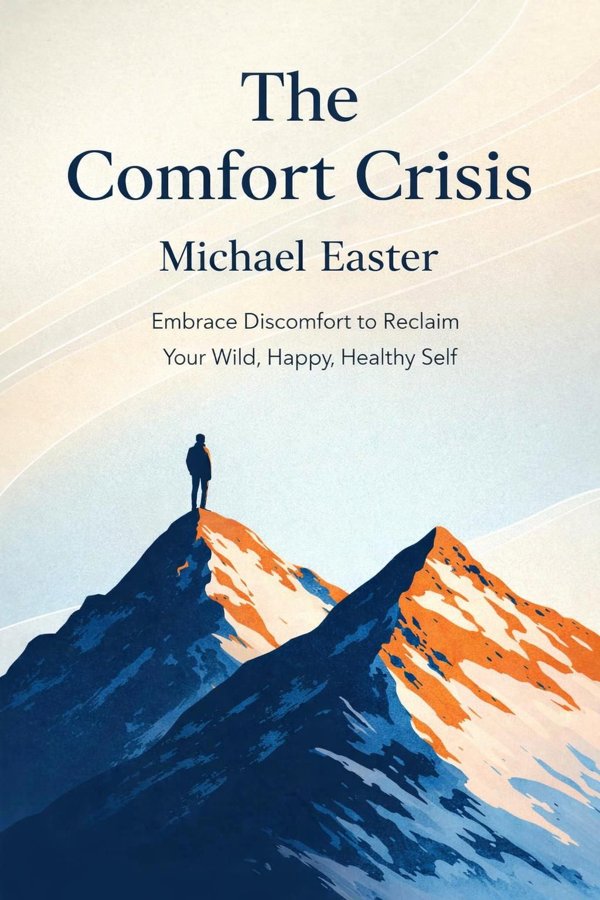
The Comfort Crisis: Embrace Discomfort to Reclaim Your Wild, Happy, Healthy Self: Summary & Key Insights
 10 min10 chaptersAudio available
Key Takeaways from The Comfort Crisis: Embrace Discomfort to Reclaim Your Wild, Happy, Healthy Self
A surprising truth sits at the heart of human history: our species did not become capable, creative, and resilient in comfort, but in difficulty.
Real clarity often arrives when the usual comforts disappear.
Not all technology is harmful, but much of it solves problems so efficiently that it also removes useful forms of friction.
One of the book’s most valuable insights is that stress is not always the enemy.
Modern life makes food astonishingly available.
What Is The Comfort Crisis: Embrace Discomfort to Reclaim Your Wild, Happy, Healthy Self About?
The Comfort Crisis: Embrace Discomfort to Reclaim Your Wild, Happy, Healthy Self by Michael Easter is a wellness book spanning 10 pages. In The Comfort Crisis, Michael Easter makes a striking argument: many of the problems of modern life are not caused by too little comfort, but by too much of it. Surrounded by convenience, constant entertainment, abundant food, climate control, and digital stimulation, we have built a world that shields us from struggle. Yet the human mind and body were shaped by challenge, uncertainty, movement, hunger, exposure, and effort. Easter explores what happens when those ancient demands disappear—and why rising rates of anxiety, restlessness, poor health, and lack of meaning may be tied to our overly softened lives. Combining evolutionary biology, psychology, physiology, anthropology, and firsthand reporting, he investigates how deliberate discomfort can restore resilience, sharpen attention, improve health, and deepen satisfaction. A central thread of the book is his demanding backcountry hunting trip in Alaska, which becomes both an experiment and a metaphor for what modern people are missing. Easter writes with the authority of a journalist and educator, but also with curiosity and humility. The result is a practical, thought-provoking wellness book that challenges readers to rethink convenience and rediscover the value of voluntary hardship.
This FizzRead summary covers all 10 key chapters of The Comfort Crisis: Embrace Discomfort to Reclaim Your Wild, Happy, Healthy Self in approximately 10 minutes, distilling the most important ideas, arguments, and takeaways from Michael Easter's work. Also available as an audio summary and Key Quotes Podcast.
The Comfort Crisis: Embrace Discomfort to Reclaim Your Wild, Happy, Healthy Self
In The Comfort Crisis, Michael Easter makes a striking argument: many of the problems of modern life are not caused by too little comfort, but by too much of it. Surrounded by convenience, constant entertainment, abundant food, climate control, and digital stimulation, we have built a world that shields us from struggle. Yet the human mind and body were shaped by challenge, uncertainty, movement, hunger, exposure, and effort. Easter explores what happens when those ancient demands disappear—and why rising rates of anxiety, restlessness, poor health, and lack of meaning may be tied to our overly softened lives. Combining evolutionary biology, psychology, physiology, anthropology, and firsthand reporting, he investigates how deliberate discomfort can restore resilience, sharpen attention, improve health, and deepen satisfaction. A central thread of the book is his demanding backcountry hunting trip in Alaska, which becomes both an experiment and a metaphor for what modern people are missing. Easter writes with the authority of a journalist and educator, but also with curiosity and humility. The result is a practical, thought-provoking wellness book that challenges readers to rethink convenience and rediscover the value of voluntary hardship.
Who Should Read The Comfort Crisis: Embrace Discomfort to Reclaim Your Wild, Happy, Healthy Self?
This book is perfect for anyone interested in wellness and looking to gain actionable insights in a short read. Whether you're a student, professional, or lifelong learner, the key ideas from The Comfort Crisis: Embrace Discomfort to Reclaim Your Wild, Happy, Healthy Self by Michael Easter will help you think differently.
- ✓Readers who enjoy wellness and want practical takeaways
- ✓Professionals looking to apply new ideas to their work and life
- ✓Anyone who wants the core insights of The Comfort Crisis: Embrace Discomfort to Reclaim Your Wild, Happy, Healthy Self in just 10 minutes
Want the full summary?
Get instant access to this book summary and 100K+ more with Fizz Moment.
Get Free SummaryAvailable on App Store • Free to download
Key Chapters
A surprising truth sits at the heart of human history: our species did not become capable, creative, and resilient in comfort, but in difficulty. For most of human existence, people had to walk long distances, endure cold and heat, find scarce food, navigate uncertainty, and solve problems without guarantees. Michael Easter argues that these conditions were not unfortunate side notes to evolution; they were the training ground that shaped our brains and bodies. We became adaptive because life demanded adaptation.
The problem today is that modern life often removes the very stressors that once kept us strong. We can sit all day, eat constantly, avoid weather, outsource physical effort, and distract ourselves from boredom in seconds. That sounds like progress, but Easter suggests that when challenge disappears, so do many of the benefits challenge creates: resilience, patience, self-trust, and metabolic health. We are still running ancient hardware in an environment designed to eliminate friction.
This idea helps explain why people can feel strangely dissatisfied in lives that are objectively easier than ever. Ease reduces strain, but it can also reduce engagement. A person who never has to push through discomfort may gradually lose confidence in their ability to handle life.
In practical terms, this means reintroducing manageable hardship into ordinary routines. Walk instead of drive when possible. Exercise outdoors in imperfect weather. Delay convenience occasionally. Choose activities that demand effort rather than instant reward. The takeaway is simple: stop treating all discomfort as a problem to eliminate, and start seeing some of it as a condition for becoming fully human.
Real clarity often arrives when the usual comforts disappear. To test his ideas, Easter joins a brutal thirty-three-day backcountry hunting expedition in the Alaskan wilderness. The trip strips life down to essentials: movement, weather, hunger, fatigue, teamwork, and attention. There are no easy escapes, no endless snacks, no digital distractions, and no soft buffer between desire and reality. Nature does not negotiate.
The significance of this journey is larger than adventure storytelling. In Alaska, Easter experiences the contrast between modern convenience and ancestral demands in the most direct way possible. Every calorie matters. Every decision carries consequences. The body is not an afterthought but a tool for survival. Discomfort becomes unavoidable, yet it also becomes clarifying. He discovers that when life is reduced to basics, mental noise fades. Petty concerns lose their grip. Presence sharpens.
This does not mean everyone needs to hunt in Alaska. The lesson is that immersive challenge can reconnect us with capacities we rarely use: patience, observation, grit, humility, and interdependence. Even short experiences in which comfort is limited—backpacking, camping, long hikes, endurance events, silent retreats, manual labor—can reveal how much modern life insulates us from reality.
The expedition also shows that hardship is not merely punishing. It can be deeply meaningful. Shared struggle often creates stronger bonds than easy leisure, and earned satisfaction lasts longer than passive pleasure. The actionable takeaway: schedule at least one experience each year that removes you from convenience and demands sustained effort, because transformation often begins where comfort ends.
Not all technology is harmful, but much of it solves problems so efficiently that it also removes useful forms of friction. Easter argues that the modern environment is engineered for convenience, stimulation, and consumption. Food delivery erases hunger. Streaming erases boredom. climate control erases exposure. Social media erases silence. Navigation apps erase uncertainty. Over time, this creates a lifestyle in which the body moves less, the mind tolerates less discomfort, and attention is constantly fragmented.
The danger is subtle because comfort feels good in the short term. Yet many convenience systems are designed to keep us using, scrolling, eating, and consuming. Highly processed food bypasses natural satiety. Digital media keeps the brain in a state of perpetual novelty-seeking. Endless choice creates overstimulation rather than freedom. We end up with an abundance of pleasures but a shortage of satisfaction.
Easter is not calling for rejection of modernity. He is asking readers to notice that tools shape habits, and habits shape identity. A person who reflexively avoids effort may become less capable of handling stress, waiting, or focusing. In this way, comfort can become a trap rather than a gift.
Practical applications are straightforward. Put friction back into behaviors you want less of and remove friction from behaviors you want more of. Keep junk food out of the house. Charge your phone outside the bedroom. Walk to a store instead of ordering online. Use a standing desk, take stairs, and leave pockets of boredom unfilled. The takeaway: convenience is useful, but when it becomes your default setting, it can slowly erode the strength it was supposed to serve.
One of the book’s most valuable insights is that stress is not always the enemy. Easter distinguishes between chronic, overwhelming stress—which can damage health—and brief, controlled stressors that help the body and brain adapt. This idea aligns with hormesis, the biological principle that small doses of challenge can trigger growth. Exercise, fasting, cold exposure, heat, altitude, intense learning, and wilderness experiences all ask the system to do hard things. In response, it often becomes more capable.
Psychologically, manageable discomfort also builds self-efficacy: the belief that you can handle what life throws at you. When people repeatedly avoid difficulty, they may become more anxious, not less, because they never gather evidence of their own competence. But when they face a challenge and survive it, the brain updates its expectations. Difficulty becomes less threatening.
Easter also connects challenge to neuroplasticity and mental sharpness. Novel, effortful experiences force attention. They interrupt autopilot. A difficult hike, a cold morning run, or learning a demanding skill can wake up a system dulled by routine ease.
The key is dosage. The goal is not reckless suffering, but intentional stress that leads to adaptation. A beginner might start with a harder workout twice a week, a brief cold shower, a day hike without constant phone use, or a short period of deep work without distractions. Each challenge should stretch you without breaking you. The actionable takeaway: choose one controlled discomfort this week and repeat it regularly, because the right kind of stress is not a threat to wellness—it is part of how wellness is built.
Modern life makes food astonishingly available. We can eat almost anything, at almost any time, with little effort and little waiting. Easter argues that this endless accessibility creates consequences beyond weight gain. Constant eating can dull appreciation, disconnect us from true hunger, and train us to satisfy every impulse immediately. By contrast, periods of hunger have historically been normal, and the human body is adapted to them.
The book explores fasting and food restraint not as extreme punishment, but as a way to restore balance. Temporary hunger can improve awareness, discipline, and gratitude. It reminds us that wanting something is not the same as needing it right now. It can also reset our relationship with food, making simple meals feel more satisfying and helping us distinguish habit from actual physiological need.
Easter’s broader point is philosophical as much as nutritional: abundance without boundaries often leads to excess without joy. Scarcity, even when chosen in small doses, can sharpen pleasure and increase appreciation. The first meal after a hard day outdoors or a fasting window often tastes better not because the food changed, but because perception did.
This principle can be applied carefully and sensibly. Someone might begin by avoiding constant snacking, trying a 12- to 14-hour overnight fast, or occasionally delaying breakfast to experience real hunger without panic. It also applies beyond food: delay purchases, postpone entertainment, or wait before checking messages. The takeaway is to practice voluntary restraint in one area of life, because learning not to indulge every urge is a powerful path to health, freedom, and deeper enjoyment.
Many people today are mentally overtaxed but physically underchallenged. Easter argues that this mismatch creates problems. The body is built to work, strain, climb, carry, and endure, yet modern routines often confine effort to brief exercise sessions or remove it altogether. When physical capability declines, something psychological often declines with it: the sense that you are strong enough to meet demands.
Physical challenge does more than improve fitness metrics. It rebuilds agency. Carrying a heavy pack, finishing a steep hike, lifting weights, swimming in cold water, or training for a difficult race gives immediate feedback: you can do hard things. That lesson transfers beyond the gym. People who regularly test themselves physically often become calmer under pressure because they are familiar with discomfort and know it passes.
Easter emphasizes that the point is not aesthetics or performance obsession. It is competence. A body that can move well through the world supports confidence, independence, and resilience. This is especially important in a culture that often treats comfort as the highest good and sees exertion as optional.
You do not need extreme adventures to apply this idea. Carry groceries instead of using a cart for small loads. Ruck with a weighted backpack. Train your legs by taking hills and stairs. Set a goal that scares you slightly, such as a long hike, a charity race, or a wilderness trip. Track progress by what you can do, not just how you look. The actionable takeaway: choose a physical challenge with a clear finish line, because earned capability is one of the fastest ways to rebuild self-belief.
One of Easter’s more counterintuitive points is that having less can sometimes make life feel more vivid. Human perception is relative. When everything is available all the time, pleasures flatten. Unlimited food, entertainment, climate control, and convenience can reduce sensitivity, making us chase stronger and more frequent stimulation. This is one reason abundance can coexist with boredom.
Scarcity changes the equation. When resources are limited, attention sharpens and appreciation rises. A warm meal after a cold day feels extraordinary. Rest after hard labor feels deeply satisfying. Silence after constant noise becomes restorative. In other words, deprivation in small, chosen doses can amplify experience rather than diminish it.
Easter links this to both psychology and consumer culture. The marketplace encourages us to believe that more options, more possessions, and more accessibility will improve life. But too much can fragment desire and produce hedonic adaptation—the tendency to quickly get used to what once felt rewarding. Deliberate scarcity interrupts that treadmill.
This does not require severe minimalism. It can mean taking one day a week away from shopping apps, social media, or entertainment. It can mean owning fewer but better things, repeating simple meals, or setting limits around consumption. Families can try screen-free evenings or camping weekends with basic gear. These practices make ordinary comforts feel fresh again.
The takeaway is to create intentional limits instead of waiting for life to impose them. By choosing small forms of scarcity, you recover gratitude, sharpen your senses, and remember that richness often comes not from endless access, but from renewed appreciation.
The natural world does something many modern environments do not: it asks for attention without overwhelming it. Easter shows how time outdoors can calm the nervous system, restore focus, elevate mood, and reconnect people to a wider reality beyond deadlines and screens. Nature offers sensory richness without the manipulative intensity of digital life. It is stimulating, but not addictive in the same way.
The book draws on research suggesting that outdoor exposure can reduce stress, improve cognition, and increase well-being. But Easter goes further than the usual advice to spend more time outside. He emphasizes wildness—the kind of environment that feels less controlled, less curated, and more indifferent to us. In such places, people often experience humility, perspective, and awe. Problems shrink. Attention broadens. The self becomes less noisy.
This matters because many people live in environments designed for efficiency rather than restoration. Artificial light, algorithmic feeds, traffic, and indoor routines keep the brain activated but not nourished. Nature counterbalances that condition by reintroducing variation, unpredictability, and embodied experience.
Practical application can start small. Walk in a park without headphones. Take meetings outside. Plan regular hikes, weekend camping trips, or longer annual time in remote landscapes. If possible, choose settings that are not overly domesticated and allow for some challenge. Even gardening, trail running, or sitting quietly outdoors at dawn can begin to shift your state.
The actionable takeaway: treat time in nature as a necessity, not a luxury, and seek not just scenery but genuine immersion, because the wild can restore parts of you that comfort culture slowly numbs.
It seems logical that a more comfortable society would be a less anxious one. Yet Easter highlights a paradox: as many forms of physical hardship have decreased, anxiety and psychological fragility have often increased. Part of the reason is that comfort can reduce exposure to the small challenges that build tolerance. When people rarely face boredom, uncertainty, exertion, cold, hunger, or inconvenience, those sensations begin to feel more threatening than they really are.
Avoidance can create a cycle. The more we escape discomfort, the less capable we feel of handling it. The less capable we feel, the more vigilant and anxious we become. This applies not only to physical sensations, but also to emotional and social experiences. Constant soothing does not always produce peace; sometimes it produces dependence on soothing.
Easter’s point is not to dismiss serious mental health struggles. Rather, he suggests that one contributor to modern unease is environmental overprotection. We may be shielding ourselves from exactly the experiences that would help us feel stronger.
A practical response is to build a tolerance for mild discomfort on purpose. Leave some idle time unfilled. Sit with a craving before acting on it. Exercise when you do not feel like it. Take a difficult conversation in person. Go outside in less-than-perfect conditions. Notice that discomfort rises, peaks, and passes. Over time, your alarm system recalibrates.
The takeaway is that resilience is often the antidote to anxiety. By meeting small discomforts voluntarily, you teach your mind and body an essential lesson: unpleasant does not mean dangerous, and you are more capable than your comfort-seeking habits suggest.
A final and profound insight in The Comfort Crisis is that the good life is not built from ease alone. People often assume happiness comes from maximizing pleasure and minimizing difficulty, but Easter suggests that meaning more often emerges from effort, responsibility, service, and shared struggle. Hard things matter partly because they connect us to other people and to purposes larger than comfort.
In the wilderness, survival and success depend on cooperation. In ordinary life, too, many of our most valued experiences involve sacrifice: parenting, building a career, caring for friends, mastering a craft, training for an event, serving a team, or contributing to a community. These pursuits are demanding, but that demand is part of what makes them satisfying.
Modern culture can isolate people in highly individualized convenience. Meals are solo, entertainment is on-demand, work is remote, and struggle is often hidden. Easter argues that reclaiming discomfort also means reclaiming communal effort. Doing hard things with others deepens belonging and reduces the emptiness of purely self-focused living.
This idea can be practiced by joining group challenges, volunteering for physically meaningful service, training with friends, taking family trips that involve effort instead of passive consumption, or participating in local communities where contribution is expected. The point is not just to suffer together, but to build identity through cooperation and commitment.
The actionable takeaway: choose one demanding activity that involves other people, because when discomfort is linked to purpose and community, it stops feeling like deprivation and starts becoming a source of meaning.
All Chapters in The Comfort Crisis: Embrace Discomfort to Reclaim Your Wild, Happy, Healthy Self
About the Author
Michael Easter is an author, journalist, and professor at the University of Nevada, Las Vegas. His work focuses on health, human performance, behavior, and the ways modern environments often clash with human evolutionary design. He has written for major outlets including Men’s Health, Outside, and other national publications, where he explores topics such as fitness, resilience, nutrition, nature, and psychological well-being. Easter is known for combining rigorous reporting with personal experimentation, often placing himself inside demanding experiences to better understand the science he covers. In The Comfort Crisis, he brings together anthropology, physiology, psychology, and adventure journalism to examine why comfort can become a hidden problem. His writing is accessible, evidence-informed, and especially appealing to readers who want practical insights rather than abstract theory.
Get This Summary in Your Preferred Format
Read or listen to the The Comfort Crisis: Embrace Discomfort to Reclaim Your Wild, Happy, Healthy Self summary by Michael Easter anytime, anywhere. FizzRead offers multiple formats so you can learn on your terms — all free.
Available formats: App · Audio · PDF · EPUB — All included free with FizzRead
Download The Comfort Crisis: Embrace Discomfort to Reclaim Your Wild, Happy, Healthy Self PDF and EPUB Summary
Key Quotes from The Comfort Crisis: Embrace Discomfort to Reclaim Your Wild, Happy, Healthy Self
“A surprising truth sits at the heart of human history: our species did not become capable, creative, and resilient in comfort, but in difficulty.”
“Real clarity often arrives when the usual comforts disappear.”
“Not all technology is harmful, but much of it solves problems so efficiently that it also removes useful forms of friction.”
“One of the book’s most valuable insights is that stress is not always the enemy.”
“Modern life makes food astonishingly available.”
Frequently Asked Questions about The Comfort Crisis: Embrace Discomfort to Reclaim Your Wild, Happy, Healthy Self
The Comfort Crisis: Embrace Discomfort to Reclaim Your Wild, Happy, Healthy Self by Michael Easter is a wellness book that explores key ideas across 10 chapters. In The Comfort Crisis, Michael Easter makes a striking argument: many of the problems of modern life are not caused by too little comfort, but by too much of it. Surrounded by convenience, constant entertainment, abundant food, climate control, and digital stimulation, we have built a world that shields us from struggle. Yet the human mind and body were shaped by challenge, uncertainty, movement, hunger, exposure, and effort. Easter explores what happens when those ancient demands disappear—and why rising rates of anxiety, restlessness, poor health, and lack of meaning may be tied to our overly softened lives. Combining evolutionary biology, psychology, physiology, anthropology, and firsthand reporting, he investigates how deliberate discomfort can restore resilience, sharpen attention, improve health, and deepen satisfaction. A central thread of the book is his demanding backcountry hunting trip in Alaska, which becomes both an experiment and a metaphor for what modern people are missing. Easter writes with the authority of a journalist and educator, but also with curiosity and humility. The result is a practical, thought-provoking wellness book that challenges readers to rethink convenience and rediscover the value of voluntary hardship.
More by Michael Easter

You Might Also Like
How We Heal: Uncover Your Power and Set Yourself Free
Alexandra Elle
10 min
A Year of Self-Care: Daily Practices and Inspiration for Caring for Yourself
Zoe Shaw
10 min
Biohacker’s Handbook: Upgrade Your Life
Olli Sovijärvi, Teemu Arina, Jaakko Halmetoja
10 min
Bliss More: How to Succeed in Meditation Without Really Trying
Light Watkins
10 min
Body Kindness: Transform Your Health from the Inside Out—and Never Say Diet Again
Rebecca Scritchfield
10 min
Cook, Eat, Run: Cook Fast, Boost Performance with 75 Ultimate Recipes for Runners
Charlie Watson
10 minBrowse by Category
Ready to read The Comfort Crisis: Embrace Discomfort to Reclaim Your Wild, Happy, Healthy Self?
Get the full summary and 100K+ more books with Fizz Moment.