
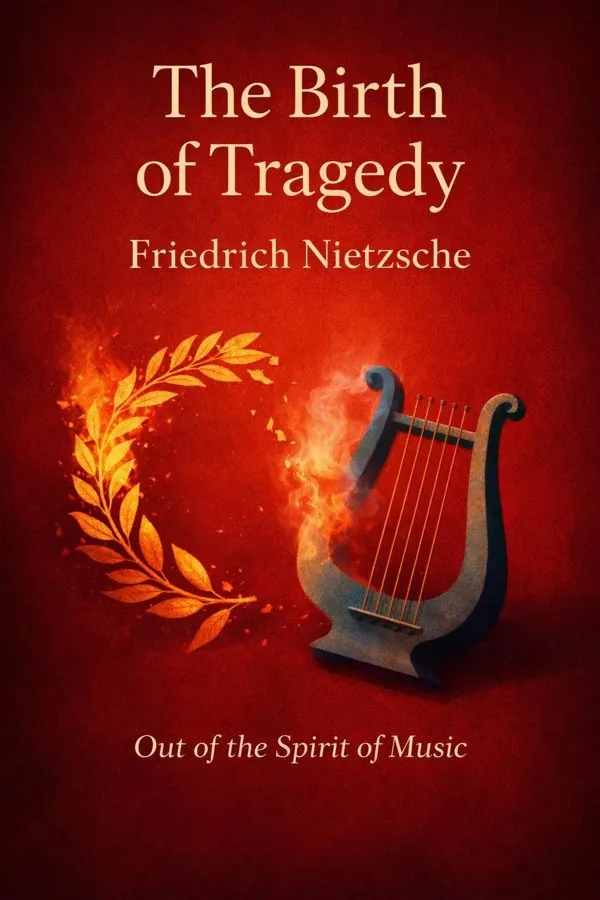
The Birth of Tragedy: Out of the Spirit of Music: Summary & Key Insights
 10 min9 chaptersAudio available
Key Takeaways from The Birth of Tragedy: Out of the Spirit of Music
Human beings do not survive on truth alone; we also need beautiful appearances that make life bearable.
Beneath every polished surface lies a deeper current of energy, suffering, intoxication, and unity.
The highest creativity does not come from pure order or pure chaos, but from their collision.
Some forms of art show us the world; music seems to come from beneath it.
The strange power of tragedy is that it confronts suffering without making life seem worthless.
What Is The Birth of Tragedy: Out of the Spirit of Music About?
The Birth of Tragedy: Out of the Spirit of Music by Friedrich Nietzsche is a western_phil book spanning 11 pages. First published in 1872, The Birth of Tragedy: Out of the Spirit of Music is Friedrich Nietzsche’s daring attempt to explain how great art emerges, why cultures rise and decay, and what ancient Greek tragedy can teach the modern world. Rather than treating Greek drama as a literary artifact, Nietzsche reads it as a profound expression of life itself. He argues that the highest art is born from the tension between two fundamental forces: the Apollonian, which gives form, beauty, restraint, and individuality, and the Dionysian, which dissolves boundaries in ecstasy, suffering, music, and collective feeling. Greek tragedy, at its peak, united these powers. The book matters because it is far more than a study of antiquity. It is also a critique of modern rationalism, an argument about the limits of logic, and an early statement of Nietzsche’s lifelong concern with whether culture affirms or denies life. Nietzsche wrote as a brilliant classical philologist with deep knowledge of Greek literature, but also as a philosopher willing to overturn accepted interpretations. The result is a provocative, poetic, and influential work that reshaped aesthetics, cultural criticism, and modern philosophy.
This FizzRead summary covers all 9 key chapters of The Birth of Tragedy: Out of the Spirit of Music in approximately 10 minutes, distilling the most important ideas, arguments, and takeaways from Friedrich Nietzsche's work. Also available as an audio summary and Key Quotes Podcast.
The Birth of Tragedy: Out of the Spirit of Music
First published in 1872, The Birth of Tragedy: Out of the Spirit of Music is Friedrich Nietzsche’s daring attempt to explain how great art emerges, why cultures rise and decay, and what ancient Greek tragedy can teach the modern world. Rather than treating Greek drama as a literary artifact, Nietzsche reads it as a profound expression of life itself. He argues that the highest art is born from the tension between two fundamental forces: the Apollonian, which gives form, beauty, restraint, and individuality, and the Dionysian, which dissolves boundaries in ecstasy, suffering, music, and collective feeling. Greek tragedy, at its peak, united these powers.
The book matters because it is far more than a study of antiquity. It is also a critique of modern rationalism, an argument about the limits of logic, and an early statement of Nietzsche’s lifelong concern with whether culture affirms or denies life. Nietzsche wrote as a brilliant classical philologist with deep knowledge of Greek literature, but also as a philosopher willing to overturn accepted interpretations. The result is a provocative, poetic, and influential work that reshaped aesthetics, cultural criticism, and modern philosophy.
Who Should Read The Birth of Tragedy: Out of the Spirit of Music?
This book is perfect for anyone interested in western_phil and looking to gain actionable insights in a short read. Whether you're a student, professional, or lifelong learner, the key ideas from The Birth of Tragedy: Out of the Spirit of Music by Friedrich Nietzsche will help you think differently.
- ✓Readers who enjoy western_phil and want practical takeaways
- ✓Professionals looking to apply new ideas to their work and life
- ✓Anyone who wants the core insights of The Birth of Tragedy: Out of the Spirit of Music in just 10 minutes
Want the full summary?
Get instant access to this book summary and 100K+ more with Fizz Moment.
Get Free SummaryAvailable on App Store • Free to download
Key Chapters
Human beings do not survive on truth alone; we also need beautiful appearances that make life bearable. This is the insight behind Nietzsche’s idea of the Apollonian. Named after Apollo, the god of light, measure, and image, the Apollonian represents the power of form: clarity, proportion, distinction, self-control, and the ability to shape experience into something intelligible. In dreams, sculpture, epic poetry, and all art that gives boundaries to chaos, Nietzsche sees the Apollonian at work.
For Nietzsche, Apollo is not mere prettiness or shallow calm. The Apollonian is a deep cultural necessity. It protects us from being overwhelmed by the raw pain, instability, and fragmentation of existence. It allows individuals to experience themselves as distinct selves with limits, identities, and stories. Greek sculpture, with its serene figures and idealized bodies, embodies this principle. It does not erase suffering entirely, but it places suffering within forms that can be contemplated.
This idea still applies today. We experience the Apollonian whenever we turn confusion into structure: a journal that organizes emotional turmoil, architecture that creates harmony from empty space, or a film whose visual precision gives shape to difficult themes. Even personal routines can be Apollonian, because they give order to otherwise shapeless days.
Nietzsche’s point is not that order is everything, but that without form, life becomes unbearable. Healthy culture needs symbols, rituals, and artistic images that help people endure reality without collapsing into despair.
Actionable takeaway: Notice where structure helps you live more fully, and deliberately create Apollonian forms—through art, routine, writing, or design—that give clarity to what would otherwise remain overwhelming.
Beneath every polished surface lies a deeper current of energy, suffering, intoxication, and unity. Nietzsche calls this the Dionysian. Named after Dionysus, the god of wine, ecstasy, and transformation, the Dionysian represents the breakdown of rigid boundaries between self and world. In Dionysian experience, individuality loosens, emotion intensifies, and people feel themselves swept into a greater pulse of life.
For Nietzsche, this is not simply drunkenness or emotional excess. The Dionysian reveals something metaphysical about existence: beneath our separate identities, we are participants in a shared reality marked by creation and destruction, joy and pain. Music becomes the privileged Dionysian art because it does not merely represent appearances; it seems to speak directly from the depths of life itself. In communal song, dance, festival, and ritual, human beings experience themselves not as isolated egos but as part of a larger living whole.
This helps explain why the Dionysian can feel both terrifying and liberating. It strips away comforting illusions. It reminds us that life is unstable, irrational, and often tragic. Yet it also reconnects us with vitality, passion, and a sense of belonging beyond the narrow self. Modern examples include the collective energy of a live concert, the overwhelming force of grief shared in community, or the feeling of being completely absorbed in movement, music, or celebration.
Nietzsche does not recommend permanent chaos. Rather, he insists that cultures and individuals become sterile when they suppress this dimension entirely. Without Dionysian depth, art becomes decorative and life becomes thin.
Actionable takeaway: Make room for experiences that dissolve rigid self-control—music, movement, ritual, emotional honesty, or collective celebration—so that vitality, not just order, has a place in your life.
The highest creativity does not come from pure order or pure chaos, but from their collision. This is the central aesthetic insight of The Birth of Tragedy. Nietzsche argues that Greek culture achieved greatness because it did not choose between Apollo and Dionysus. Instead, at its best, it held them in tension. The Apollonian gave form, image, and dramatic structure; the Dionysian supplied emotional depth, music, collective intensity, and contact with suffering. Tragedy was born from their union.
If art is only Apollonian, it becomes cold, decorative, and detached from life. If it is only Dionysian, it risks becoming formless, overwhelming, and unintelligible. Great tragedy works because it allows unbearable truths to appear in beautiful form. The audience confronts pain, fate, and destruction, but through a shaped, elevated artistic experience. This creates not despair, but a strange affirmation of life.
The principle applies far beyond Greek drama. A powerful novel combines emotional intensity with narrative design. A compelling speech balances passion with structure. A memorable brand, movement, or institution succeeds when it unites strong vision with living energy. Even in personal development, too much discipline can suffocate spontaneity, while too much spontaneity can destroy direction.
Nietzsche’s framework offers a way to diagnose imbalance. Do your projects have structure but no pulse? Energy but no form? Rules but no soul? The goal is not compromise in a weak sense, but dynamic integration. Form should not suppress life; it should reveal it. Energy should not destroy form; it should animate it.
Actionable takeaway: In your creative and professional work, ask two questions: What gives this form? What gives it life? Strengthen whichever side is missing until both order and intensity are present.
Some forms of art show us the world; music seems to come from beneath it. Nietzsche gives music a privileged place because he believes it expresses the Dionysian core of existence more directly than visual or narrative arts. While painting, sculpture, and even dramatic characters present images of the world of appearances, music speaks in a more immediate, less conceptual register. It does not argue or describe. It moves, seizes, and transforms.
This is why Nietzsche says tragedy arises out of the spirit of music. In ancient Greek tragedy, the chorus carried a musical and collective force that connected the audience to something deeper than individual plot. The visible drama onstage was only one layer. Beneath it, music disclosed the primal suffering and vitality of life itself. The characters became Apollonian images emerging from a deeper musical reality.
This insight helps explain why music often reaches people when explanations fail. A song can articulate grief better than analysis. A film score can make a scene meaningful before we fully understand why. National anthems, protest songs, religious chants, and funeral music all show how music binds individuals into a shared emotional world.
Nietzsche’s point is not merely that music is enjoyable, but that it reveals dimensions of existence that rational language cannot fully capture. In a culture overly dependent on analysis, music restores contact with the pre-conceptual, embodied, collective layers of life.
Practically, this means art should not be judged only by message or moral lesson. Its rhythm, tone, and atmosphere matter because these often carry the deepest meaning. In daily life, too, what moves us is not always what we can paraphrase.
Actionable takeaway: Use music intentionally—not just as background noise, but as a way to access emotion, insight, and collective energy that words alone cannot provide.
The strange power of tragedy is that it confronts suffering without making life seem worthless. Nietzsche believed this was one of the Greeks’ greatest achievements. Instead of denying pain or offering easy consolation, tragic art stages destruction, conflict, and limitation in ways that deepen the audience’s strength. The tragic hero may fall, but the work as a whole communicates something larger than defeat: life remains meaningful even when it includes suffering.
This is a radical claim. Many people assume that optimism comes from avoiding painful truths. Nietzsche argues the opposite. A shallow culture needs happy endings and moral reassurance because it cannot face reality. A stronger culture creates tragic art because it has enough vitality to look directly at terror and still say yes to existence. Tragedy transforms pain into insight and form, allowing suffering to become aesthetically bearable and even spiritually fruitful.
Aeschylus and Sophocles exemplify this achievement. Their dramas do not erase guilt, fate, or death, but neither do they reduce human life to nonsense. Through myth, chorus, and dramatic form, they make visible a world where destruction belongs to a deeper order of existence. The result is not resignation but elevation.
Modern audiences still seek this experience. Films, novels, and theater often move us most when they tell the truth about loss without collapsing into cynicism. A serious life, likewise, is not one that avoids pain at all costs, but one that can integrate pain into purpose.
Nietzsche’s insight has practical force: maturity means developing the capacity to endure complexity without demanding false comfort. Tragic wisdom is not pessimism. It is disciplined affirmation.
Actionable takeaway: When facing difficulty, resist the urge for instant reassurance; instead, ask how pain might be given form, meaning, and dignity through reflection, art, or action.
Not all tragedy is equal. For Nietzsche, the highest form of Greek tragedy appears in Aeschylus and Sophocles because their plays preserve the fertile tension between the Dionysian and the Apollonian. These dramatists create works in which mythic depth, ritual intensity, and musical chorus are not decorative extras but essential carriers of truth. Their tragedies do not reduce human beings to neat moral lessons. They reveal the grandeur and vulnerability of existence.
Aeschylus often presents vast collisions between human action, divine order, inherited guilt, and communal destiny. Sophocles refines tragic form while preserving depth; his heroes are luminous individuals, yet they remain bound to forces beyond rational mastery. In both writers, the audience encounters suffering that is neither merely personal nor easily explainable. The tragic world feels larger than ordinary psychology.
Nietzsche admires them because they avoid two temptations: sentimental simplification and rational over-explanation. Their characters are vivid and distinct, yet they still emerge from a mythic world sustained by chorus, poetry, and religious intensity. This balance lets the spectator experience both emotional identification and metaphysical distance.
The lesson extends beyond literary history. In any great work—whether a novel, film, or public institution—depth requires more than clever dialogue or realistic detail. It also requires connection to something larger: shared symbols, collective memory, existential stakes, or transcendent questions.
When creators lose that larger dimension, their work may remain technically competent but spiritually thin. Nietzsche thus treats Aeschylus and Sophocles not just as playwrights, but as examples of how a culture can produce art that dignifies suffering while enlarging consciousness.
Actionable takeaway: When evaluating art or creating your own, look beyond technical skill and ask whether it connects personal experience to larger human, communal, or existential realities.
A civilization begins to decline when it starts believing that everything important can be explained, justified, and corrected by reason alone. Nietzsche’s most controversial argument is that Greek tragedy decayed with Euripides because he brought onto the stage a new spirit shaped by Socratic rationalism. In Nietzsche’s reading, Euripides made drama more argumentative, psychological, and accessible to everyday reasoning, while weakening its mythic, musical, and Dionysian depth.
Behind Euripides stands Socrates, whom Nietzsche sees as the embodiment of the “theoretical man.” This type believes that knowledge can solve the deepest problems of existence, that reason can penetrate reality fully, and that what cannot be understood clearly is somehow suspect. Nietzsche does not deny the power of reason, but he argues that when reason becomes tyrannical, it destroys the conditions for tragic wisdom. Mystery is replaced by explanation, ritual by debate, art by analysis.
This critique remains highly relevant. Modern culture often assumes that data, clarity, and optimization are enough. We want measurable outcomes, transparent logic, and immediate intelligibility. Yet human life includes grief, ecstasy, contradiction, and meaning that cannot be fully captured in formulas. When institutions privilege only what can be rationally defended, they may become efficient but spiritually empty.
Nietzsche’s concern is not anti-intellectualism. It is reductionism. A healthy culture needs science and reason, but it also needs art, myth, embodiment, and forms of knowledge that are not merely conceptual. Otherwise, it loses contact with life’s depths.
Actionable takeaway: Use reason as a tool, not a total worldview; when confronting major human questions, include art, ritual, emotion, and symbolic understanding alongside analysis.
The more a culture worships explanation, the less able it may become to live. Nietzsche’s figure of the theoretical man is not confined to ancient Athens. It describes a recurring human tendency: the belief that existence is justified only if it can be understood, managed, and solved. This mindset seeks certainty, mistrusts ambiguity, and assumes that knowledge automatically leads to wisdom. Nietzsche thinks this is profoundly incomplete.
The theoretical man is productive in many domains. Science advances, institutions become more organized, and practical problems can be solved. But when this spirit spreads into every area of life, people start treating mystery as failure and suffering as a technical glitch. The result is often anxiety, not freedom. If life must always make rational sense, then tragedy, contradiction, and irreducible pain become intolerable.
This describes much of modern restlessness. We overanalyze relationships, optimize every hour, medicalize every discomfort, and expect explanations to remove existential unease. Yet information rarely answers the deepest questions: How should one suffer? What makes life worth affirming? How do we endure uncertainty with dignity? These questions require more than technique.
Nietzsche’s answer is not to abandon knowledge, but to balance it with tragic insight. Art teaches us how to dwell with what cannot be solved. Ritual gives shape to transitions reason cannot complete. Community and music restore forms of meaning that do not depend on perfect clarity.
In practical terms, the theoretical mindset often appears in personal life as compulsive self-analysis. Reflection is valuable, but endless explanation can become an avoidance of living. Some truths must be enacted, felt, and embodied.
Actionable takeaway: When you find yourself trapped in overthinking, stop asking only what can be explained and begin asking what must be lived, practiced, or artistically expressed.
A culture does not survive by information alone; it needs shared myths that organize experience and give suffering significance. Nietzsche believed Greek tragedy flourished because it emerged from a living mythic world. Myth, in his sense, is not a childish falsehood but a symbolic framework that binds individuals to a deeper communal and existential reality. When myth dies, culture becomes fragmented, overly self-conscious, and spiritually exhausted.
This concern leads Nietzsche to modernity. He worries that modern culture, proud of its science and criticism, has become detached from the artistic and mythic energies that once gave civilization depth. People may become more informed yet less rooted. They gain explanation but lose orientation. Without symbols, rituals, and serious art, societies struggle to transform suffering into meaning.
Nietzsche initially looked to Richard Wagner as a possible source of cultural renewal, imagining that modern music drama might recover something of ancient tragic power. Even if his hopes for Wagner later changed, the broader idea remains important: cultures periodically need artistic re-founding. They need works that restore contact with collective feeling and life-affirming seriousness.
For individuals, the same is true. A life without myth becomes purely functional. We work, consume, and manage tasks, but we may lack a narrative or symbolic structure that tells us why any of it matters. Renewal requires more than productivity hacks. It requires re-engagement with art, story, ritual, memory, and communities of meaning.
Nietzsche asks for courage here: the courage to resist sterile rationalism, to create new forms without naïve nostalgia, and to affirm life even when certainty is unavailable. Cultural health depends on this bravery.
Actionable takeaway: Rebuild your connection to meaning by engaging seriously with art, symbols, and communal rituals that help place your personal struggles within a larger human story.
All Chapters in The Birth of Tragedy: Out of the Spirit of Music
About the Author
Friedrich Wilhelm Nietzsche (1844–1900) was a German philosopher, philologist, and cultural critic whose work transformed modern thought. Trained in classical studies, he became a professor of philology at the University of Basel at just twenty-four, an unusually young appointment that reflected his exceptional brilliance. Although he began as a scholar of ancient Greek culture, he soon expanded into philosophy, producing bold and often controversial critiques of religion, morality, rationalism, and modern society. His major works include The Birth of Tragedy, Thus Spoke Zarathustra, Beyond Good and Evil, and On the Genealogy of Morality. Nietzsche’s style is aphoristic, poetic, and confrontational, and his ideas influenced existentialism, psychology, literary theory, and postmodern philosophy. Despite lifelong illness and relative isolation, he remains one of the most widely read and debated thinkers in Western intellectual history.
Get This Summary in Your Preferred Format
Read or listen to the The Birth of Tragedy: Out of the Spirit of Music summary by Friedrich Nietzsche anytime, anywhere. FizzRead offers multiple formats so you can learn on your terms — all free.
Available formats: App · Audio · PDF · EPUB — All included free with FizzRead
Download The Birth of Tragedy: Out of the Spirit of Music PDF and EPUB Summary
Key Quotes from The Birth of Tragedy: Out of the Spirit of Music
“Human beings do not survive on truth alone; we also need beautiful appearances that make life bearable.”
“Beneath every polished surface lies a deeper current of energy, suffering, intoxication, and unity.”
“The highest creativity does not come from pure order or pure chaos, but from their collision.”
“Some forms of art show us the world; music seems to come from beneath it.”
“The strange power of tragedy is that it confronts suffering without making life seem worthless.”
Frequently Asked Questions about The Birth of Tragedy: Out of the Spirit of Music
The Birth of Tragedy: Out of the Spirit of Music by Friedrich Nietzsche is a western_phil book that explores key ideas across 9 chapters. First published in 1872, The Birth of Tragedy: Out of the Spirit of Music is Friedrich Nietzsche’s daring attempt to explain how great art emerges, why cultures rise and decay, and what ancient Greek tragedy can teach the modern world. Rather than treating Greek drama as a literary artifact, Nietzsche reads it as a profound expression of life itself. He argues that the highest art is born from the tension between two fundamental forces: the Apollonian, which gives form, beauty, restraint, and individuality, and the Dionysian, which dissolves boundaries in ecstasy, suffering, music, and collective feeling. Greek tragedy, at its peak, united these powers. The book matters because it is far more than a study of antiquity. It is also a critique of modern rationalism, an argument about the limits of logic, and an early statement of Nietzsche’s lifelong concern with whether culture affirms or denies life. Nietzsche wrote as a brilliant classical philologist with deep knowledge of Greek literature, but also as a philosopher willing to overturn accepted interpretations. The result is a provocative, poetic, and influential work that reshaped aesthetics, cultural criticism, and modern philosophy.
More by Friedrich Nietzsche

You Might Also Like
A Little History of Philosophy
Nigel Warburton
10 min
Areopagitica
John Milton
10 min
How To Think Like A Philosopher: Essential Principles For Clear Thinking
Peter Cave
10 min
Language, Truth and Logic
A. J. Ayer
10 min
The Age of Reason
Thomas Paine
10 min
The Essays
Michel De Montaigne
10 minBrowse by Category
Ready to read The Birth of Tragedy: Out of the Spirit of Music?
Get the full summary and 100K+ more books with Fizz Moment.