
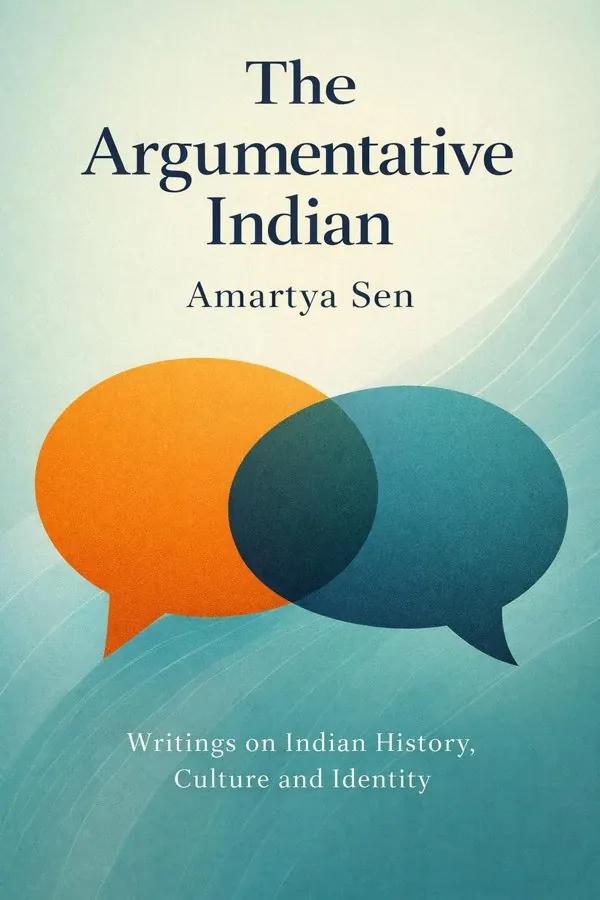
The Argumentative Indian: Writings on Indian History, Culture and Identity: Summary & Key Insights
by Amartya Sen
 10 min9 chaptersAudio available
What Is The Argumentative Indian: Writings on Indian History, Culture and Identity About?
The Argumentative Indian: Writings on Indian History, Culture and Identity by Amartya Sen is a civilization book spanning 9 pages. A collection of essays by Nobel laureate Amartya Sen exploring India's intellectual and cultural traditions of public debate, reasoning, and pluralism. The book examines how these traditions have shaped Indian identity, democracy, and social development, offering insights into the country's historical and contemporary discourse.
This FizzRead summary covers all 9 key chapters of The Argumentative Indian: Writings on Indian History, Culture and Identity in approximately 10 minutes, distilling the most important ideas, arguments, and takeaways from Amartya Sen's work. Also available as an audio summary and Key Quotes Podcast.
The Argumentative Indian: Writings on Indian History, Culture and Identity
A collection of essays by Nobel laureate Amartya Sen exploring India's intellectual and cultural traditions of public debate, reasoning, and pluralism. The book examines how these traditions have shaped Indian identity, democracy, and social development, offering insights into the country's historical and contemporary discourse.
Who Should Read The Argumentative Indian: Writings on Indian History, Culture and Identity?
This book is perfect for anyone interested in civilization and looking to gain actionable insights in a short read. Whether you're a student, professional, or lifelong learner, the key ideas from The Argumentative Indian: Writings on Indian History, Culture and Identity by Amartya Sen will help you think differently.
- ✓Readers who enjoy civilization and want practical takeaways
- ✓Professionals looking to apply new ideas to their work and life
- ✓Anyone who wants the core insights of The Argumentative Indian: Writings on Indian History, Culture and Identity in just 10 minutes
Want the full summary?
Get instant access to this book summary and 100K+ more with Fizz Moment.
Get Free SummaryAvailable on App Store • Free to download
Key Chapters
The history of Indian debate begins well before the modern age. In ancient India, knowledge was never monopolized by priests or kings; it was dissected, exchanged, and argued in public assemblies. The early Buddhist councils, for example, brought together monks across regions to discuss questions of doctrine and discipline. These were not quiet ceremonies of obedience but vibrant forums of intellectual contest, where argument itself became a spiritual exercise.
Similarly, the edicts of Emperor Ashoka show how deeply public reasoning permeated governance. After the Kalinga War, Ashoka embraced a policy of dhamma—ethical conduct driven by compassion—but he propagated it through persuasion rather than coercion. His inscriptions, carved in stone across the subcontinent, were messages addressed to his subjects, inviting reflection and participation. This was governance through dialogue—a remarkably modern concept.
In classical Sanskrit literature, too, argumentation took sophisticated forms. Works on logic and philosophy, such as those within the Nyaya school, emphasized proofs, refutations, and systematic reasoning. The debates between different schools of thought—advaita and dvaita Vedanta, Mimamsa and Buddhist epistemology—reveal an intellectual culture fearless of disagreement. To understand India’s pluralism, one must begin here, where thought was never silenced by authority.
These traditions collectively established a precedent: that truth is best approached through reasoning among equals. In today’s India, as we struggle with political polarization and social division, we can learn from this historical legacy—a model of inclusiveness achieved through dialogue, not imposed consensus.
India’s religions have never been monolithic; they have evolved through conversation and critique. Hinduism, Buddhism, Jainism, and later Islam interacted not as isolated belief systems but as participants in a vast moral discourse. The Hindu scriptures are filled with questioning voices—the dialogues of the Upanishads, where students interrogate their teachers, are some of the earliest examples of philosophical freedom. Buddhism emerged partly from such questioning, challenging ritualism with reason and compassion.
The Jains contributed an especially profound concept: anekantavada, the doctrine of many-sided truth. This idea—that reality can be seen from multiple perspectives—forms a deep ethical foundation for tolerance. Islam brought new metaphysical insights and models of inquiry; during the medieval period, Sufi thinkers and Indian philosophers engaged each other in debates about divine unity and moral responsibility. These exchanges were not always harmonious, but they reflected a recognition that understanding must be pursued through dialogue.
The result of these interactions was not uniformity, but a dynamic pluralism. The Indian conception of religion itself shifted from exclusive faith to inclusive interpretation. This tradition explains why India could evolve a secular ethos long before the term was formally articulated: religion was respected, but reasoning was not surrendered to it. For me, this represents one of India’s most distinctive achievements—the coexistence of faiths bound by the freedom to argue.
+ 7 more chapters — available in the FizzRead app
All Chapters in The Argumentative Indian: Writings on Indian History, Culture and Identity
About the Author
Amartya Sen is an Indian economist and philosopher, awarded the Nobel Prize in Economic Sciences in 1998 for his contributions to welfare economics and social choice theory. He has taught at Harvard, Cambridge, and Oxford, and is known for his work on poverty, inequality, and human development.
Get This Summary in Your Preferred Format
Read or listen to the The Argumentative Indian: Writings on Indian History, Culture and Identity summary by Amartya Sen anytime, anywhere. FizzRead offers multiple formats so you can learn on your terms — all free.
Available formats: App · Audio · PDF · EPUB — All included free with FizzRead
Download The Argumentative Indian: Writings on Indian History, Culture and Identity PDF and EPUB Summary
Key Quotes from The Argumentative Indian: Writings on Indian History, Culture and Identity
“The history of Indian debate begins well before the modern age.”
“India’s religions have never been monolithic; they have evolved through conversation and critique.”
Frequently Asked Questions about The Argumentative Indian: Writings on Indian History, Culture and Identity
The Argumentative Indian: Writings on Indian History, Culture and Identity by Amartya Sen is a civilization book that explores key ideas across 9 chapters. A collection of essays by Nobel laureate Amartya Sen exploring India's intellectual and cultural traditions of public debate, reasoning, and pluralism. The book examines how these traditions have shaped Indian identity, democracy, and social development, offering insights into the country's historical and contemporary discourse.
More by Amartya Sen
You Might Also Like
The Structure of Scientific Revolutions
Thomas S. Kuhn
10 min
Genius
Harold Bloom
10 min
A Cultural History of the Medieval Age
Various Editors
10 min
A History of God: The 4,000-Year Quest of Judaism, Christianity and Islam
Karen Armstrong
10 min
A History of the World in 10½ Chapters
Julian Barnes
10 min
A Short History of Progress
Ronald Wright
10 minBrowse by Category
Ready to read The Argumentative Indian: Writings on Indian History, Culture and Identity?
Get the full summary and 100K+ more books with Fizz Moment.