
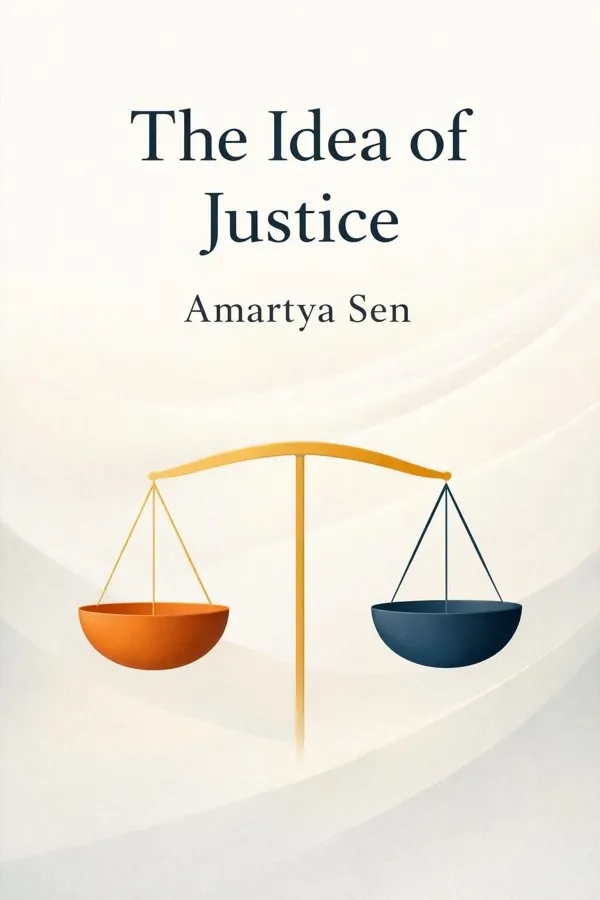
The Idea of Justice: Summary & Key Insights
by Amartya Sen
 10 min12 chaptersAudio available
What Is The Idea of Justice About?
The Idea of Justice by Amartya Sen is a western_phil book spanning 12 pages. In this influential work, Amartya Sen offers a profound critique of traditional theories of justice, particularly those of John Rawls. Sen argues that justice should not be understood as an ideal state but as a comparative process that helps societies make reasoned judgments about reducing injustice. Drawing on philosophy, economics, and global examples, Sen develops the concept of 'realization-focused comparison' to address practical issues of fairness and equity in the modern world.
This FizzRead summary covers all 12 key chapters of The Idea of Justice in approximately 10 minutes, distilling the most important ideas, arguments, and takeaways from Amartya Sen's work. Also available as an audio summary and Key Quotes Podcast.
The Idea of Justice
In this influential work, Amartya Sen offers a profound critique of traditional theories of justice, particularly those of John Rawls. Sen argues that justice should not be understood as an ideal state but as a comparative process that helps societies make reasoned judgments about reducing injustice. Drawing on philosophy, economics, and global examples, Sen develops the concept of 'realization-focused comparison' to address practical issues of fairness and equity in the modern world.
Who Should Read The Idea of Justice?
This book is perfect for anyone interested in western_phil and looking to gain actionable insights in a short read. Whether you're a student, professional, or lifelong learner, the key ideas from The Idea of Justice by Amartya Sen will help you think differently.
- ✓Readers who enjoy western_phil and want practical takeaways
- ✓Professionals looking to apply new ideas to their work and life
- ✓Anyone who wants the core insights of The Idea of Justice in just 10 minutes
Want the full summary?
Get instant access to this book summary and 100K+ more with Fizz Moment.
Get Free SummaryAvailable on App Store • Free to download
Key Chapters
John Rawls’s *A Theory of Justice* remains one of the towering achievements of modern political philosophy. I have immense respect for its intellectual power and moral seriousness. Yet, as I read Rawls, I became convinced that his 'transcendental institutionalism'—his focus on designing an ideally just society—misses something crucial. It assumes that once we identify the perfect set of principles and institutions, justice will follow. But real societies do not emerge from perfect blueprints; they evolve within contexts of conflict, history, and human diversity.
The essential difficulty with seeking perfect justice is that it does not guide us sufficiently in dealing with actual injustice. When people suffer discrimination, hunger, or deprivation, the pressing question is not whether our society perfectly reflects some abstract principles, but whether one arrangement of social priorities can reduce these wrongs more effectively than another. We must compare, not idealize.
My argument is not simply theoretical. Even if we agreed on Rawls’s principles—the famous combination of basic liberty and fair equality of opportunity—their institutional realization would vary across contexts. The focus must therefore shift from the search for a flawless outcome to the evaluation of real states of affairs. Comparative judgments, in which we identify improvements and regressions in the reduction of injustice, are far more relevant to public reasoning than perfectionist constructions that remain unattainable. Justice becomes a journey, not a destination.
At the heart of my conception of justice lies the idea of *public reasoning*. Reasoning is not a solitary pursuit of rational deduction; it is an open, participatory process in which individuals deliberate on what is fair and right. A just society depends not merely on institutions that claim to embody fairness, but on citizens who can assess, challenge, and redefine what is reasonable through dialogue.
This belief echoes an ancient understanding of democracy—not as a mechanism of voting, but as the active engagement of people in reasoned discussion. Public reasoning broadens the domain of rationality beyond economic calculation or institutional design; it invites the moral imagination of humanity into collective life. Through reason, we acknowledge one another’s experiences and reassess our priorities. Reasoning thus functions as the lifeblood of justice.
If justice is to mean anything more than procedural legitimacy, it must be rooted in this ongoing conversation. Open reasoning refines our sense of fairness, making us responsive to suffering and inequality. When people are joined by the shared capacity to critique their own society, justice ceases to be an abstract word—it becomes a living method of collective self-correction.
+ 10 more chapters — available in the FizzRead app
All Chapters in The Idea of Justice
About the Author
Amartya Sen is an Indian economist and philosopher, renowned for his contributions to welfare economics, social choice theory, and the study of poverty and inequality. He was awarded the Nobel Prize in Economic Sciences in 1998 for his work on welfare economics and social justice. Sen has taught at Harvard University, Cambridge University, and the London School of Economics.
Get This Summary in Your Preferred Format
Read or listen to the The Idea of Justice summary by Amartya Sen anytime, anywhere. FizzRead offers multiple formats so you can learn on your terms — all free.
Available formats: App · Audio · PDF · EPUB — All included free with FizzRead
Download The Idea of Justice PDF and EPUB Summary
Key Quotes from The Idea of Justice
“John Rawls’s *A Theory of Justice* remains one of the towering achievements of modern political philosophy.”
“At the heart of my conception of justice lies the idea of *public reasoning*.”
Frequently Asked Questions about The Idea of Justice
The Idea of Justice by Amartya Sen is a western_phil book that explores key ideas across 12 chapters. In this influential work, Amartya Sen offers a profound critique of traditional theories of justice, particularly those of John Rawls. Sen argues that justice should not be understood as an ideal state but as a comparative process that helps societies make reasoned judgments about reducing injustice. Drawing on philosophy, economics, and global examples, Sen develops the concept of 'realization-focused comparison' to address practical issues of fairness and equity in the modern world.
More by Amartya Sen


You Might Also Like
A Little History of Philosophy
Nigel Warburton
10 min
Areopagitica
John Milton
10 min
How To Think Like A Philosopher: Essential Principles For Clear Thinking
Peter Cave
10 min
Language, Truth and Logic
A. J. Ayer
10 min
The Age of Reason
Thomas Paine
10 min
The Essays
Michel De Montaigne
10 minBrowse by Category
Ready to read The Idea of Justice?
Get the full summary and 100K+ more books with Fizz Moment.