
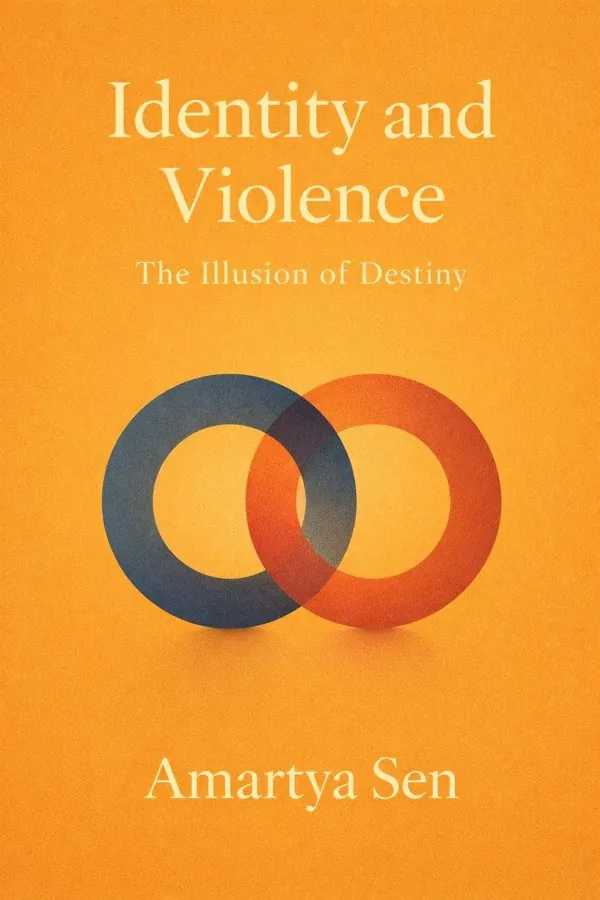
Identity and Violence: The Illusion of Destiny: Summary & Key Insights
by Amartya Sen
 10 min10 chaptersAudio available
Key Takeaways from Identity and Violence: The Illusion of Destiny
Violence often begins with a story people tell about who they are.
The most peaceful societies are not those without differences, but those that understand difference without imprisonment.
Globalization is often portrayed as a clash between invading modernity and threatened tradition.
Identity influences us, but it does not completely rule us.
Some of the identities we treat as ancient and natural are, in fact, products of political history.
What Is Identity and Violence: The Illusion of Destiny About?
Identity and Violence: The Illusion of Destiny by Amartya Sen is a politics book spanning 10 pages. Why do ordinary people come to see neighbors, colleagues, and even fellow citizens as enemies? In Identity and Violence, Nobel Prize–winning economist and philosopher Amartya Sen argues that one major reason is our habit of reducing human beings to a single identity—religion, nationality, ethnicity, or civilization. Once people are boxed into one dominant label, conflict becomes easier to justify and mutual understanding becomes harder to sustain. Sen challenges this dangerous simplification by insisting that every person belongs to many groups at once and has the capacity to reason about which affiliations matter most in different contexts. This book matters because it speaks directly to some of the defining tensions of modern life: religious conflict, nationalism, immigration, globalization, and political polarization. Sen combines philosophical clarity with historical insight, drawing on examples from India, Europe, the Middle East, and beyond. His authority comes not only from his academic achievements in economics, political theory, and ethics, but also from his lived experience of communal violence and colonial aftermath. The result is a powerful, humane argument for plural identity, democratic reasoning, and a more peaceful way of living together.
This FizzRead summary covers all 10 key chapters of Identity and Violence: The Illusion of Destiny in approximately 10 minutes, distilling the most important ideas, arguments, and takeaways from Amartya Sen's work. Also available as an audio summary and Key Quotes Podcast.
Identity and Violence: The Illusion of Destiny
Why do ordinary people come to see neighbors, colleagues, and even fellow citizens as enemies? In Identity and Violence, Nobel Prize–winning economist and philosopher Amartya Sen argues that one major reason is our habit of reducing human beings to a single identity—religion, nationality, ethnicity, or civilization. Once people are boxed into one dominant label, conflict becomes easier to justify and mutual understanding becomes harder to sustain. Sen challenges this dangerous simplification by insisting that every person belongs to many groups at once and has the capacity to reason about which affiliations matter most in different contexts.
This book matters because it speaks directly to some of the defining tensions of modern life: religious conflict, nationalism, immigration, globalization, and political polarization. Sen combines philosophical clarity with historical insight, drawing on examples from India, Europe, the Middle East, and beyond. His authority comes not only from his academic achievements in economics, political theory, and ethics, but also from his lived experience of communal violence and colonial aftermath. The result is a powerful, humane argument for plural identity, democratic reasoning, and a more peaceful way of living together.
Who Should Read Identity and Violence: The Illusion of Destiny?
This book is perfect for anyone interested in politics and looking to gain actionable insights in a short read. Whether you're a student, professional, or lifelong learner, the key ideas from Identity and Violence: The Illusion of Destiny by Amartya Sen will help you think differently.
- ✓Readers who enjoy politics and want practical takeaways
- ✓Professionals looking to apply new ideas to their work and life
- ✓Anyone who wants the core insights of Identity and Violence: The Illusion of Destiny in just 10 minutes
Want the full summary?
Get instant access to this book summary and 100K+ more with Fizz Moment.
Get Free SummaryAvailable on App Store • Free to download
Key Chapters
Violence often begins with a story people tell about who they are. Sen’s central insight is that many conflicts are fueled by the false belief that each person has one essential identity that determines their worldview, loyalties, and destiny. This is the illusion of singular identity. It appears in phrases such as “the Muslim world,” “the West,” or “the Hindu nation,” which flatten vast internal differences into one supposedly decisive category.
Sen argues that this way of thinking is not merely inaccurate; it is dangerous. When individuals are portrayed as members of only one camp, they become easier to mobilize against another camp. Political leaders, ideologues, and extremists often benefit from this simplification because it creates sharper lines between “us” and “them.” Once those lines harden, empathy weakens and violence can be made to seem natural, even necessary.
In real life, however, identities overlap constantly. A person may be at once a citizen, parent, teacher, woman, athlete, migrant, voter, musician, and believer. Which identity matters most depends on the situation and on personal judgment. A doctor treating a patient does not first act as a nationalist. A parent comforting a child is not primarily defined by party affiliation. Sen’s point is that reducing people to one category strips away this complexity and invites conflict.
You can see this in public discourse today. Social media debates often demand that people choose one side and one label. Nuance is treated as weakness. Sen offers a corrective: remember that identity is layered, chosen, and contextual. The actionable takeaway is simple: whenever a person or group is described by one totalizing label, pause and ask what other affiliations, commitments, and human realities are being ignored.
The most peaceful societies are not those without differences, but those that understand difference without imprisonment. Sen emphasizes that every human being has multiple identities, and this plurality is not a complication to be eliminated but a strength to be recognized. We do not belong to one tribe alone. We move through life as members of families, professions, regions, linguistic communities, political traditions, and moral circles that often overlap.
Sen uses his own life as an example: he can be Indian, Bengali, economist, philosopher, secular thinker, teacher, Asian, and a citizen of the world—all at once. None of these identities cancels the others. This matters because social peace depends on refusing the idea that one affiliation must dominate every situation. If religion is made the defining feature of a person’s existence, then every disagreement can become a religious conflict. If nationality becomes absolute, then criticism of the state can be cast as betrayal.
Plural identity also helps explain why individuals from the same religious or ethnic group often disagree deeply on politics, values, art, or justice. Two people may share a faith but differ by class, profession, gender, education, and ideology. Recognizing this complexity makes crude stereotypes harder to sustain.
In everyday life, this insight has practical value. Schools can teach history through intersecting identities rather than civilizational blocks. Workplaces can resist tokenism by seeing employees as more than demographic representatives. Citizens can avoid assuming that one label tells them everything about another person.
Sen’s larger claim is that plural identities expand freedom. They remind us that we are not prisoners of inherited categories. The actionable takeaway: make it a habit to describe yourself and others in at least three meaningful ways, not one. That simple mental exercise can weaken prejudice and widen understanding.
Globalization is often portrayed as a clash between invading modernity and threatened tradition. Sen rejects this dramatic but misleading picture. His argument is that global exchange is not the property of any one civilization, nor is it automatically a force of cultural destruction. Ideas, technologies, foods, arts, and institutions have always traveled across borders. What we call globalization today is an intensified version of an old human pattern: interconnectedness.
The danger arises when globalization is narrated as a battle between pure cultures. Critics may portray it as Western domination, while defenders may celebrate it as the spread of superior values. Sen disputes both simplifications. Many supposedly “Western” achievements, such as scientific inquiry, mathematics, public reasoning, and cosmopolitan exchange, have roots in multiple regions. Likewise, non-Western societies are not passive recipients of outside influence; they are active participants in creating global culture.
This matters politically because fear-based accounts of globalization can strengthen exclusionary nationalism or civilizational resentment. If people are told that trade, migration, and communication threaten their authentic identity, they may retreat into hardened cultural camps. But if global contact is understood as mutual learning, shared invention, and selective adaptation, it becomes less threatening.
Consider everyday examples: a smartphone may include innovations from the United States, East Asia, Europe, and India; a city’s cuisine may reflect centuries of migration; democratic ideas may be shaped by debates across continents. These realities challenge any story of sealed civilizations.
Sen does not deny inequality or exploitation in global systems. He insists, however, that we should criticize unfair arrangements without endorsing myths of cultural isolation. The actionable takeaway is to ask, whenever globalization is discussed: are we talking about domination, exchange, inequality, creativity, or all of them? Precise thinking prevents cultural panic.
Identity influences us, but it does not completely rule us. One of Sen’s most important contributions is his defense of human agency: people can reason about their affiliations and decide which ones should matter in particular circumstances. This directly opposes deterministic views that treat religion, ethnicity, or civilization as fixed destinies that automatically dictate action.
For Sen, individuals are not simply programmed by group membership. A person may care about faith, but also about justice, profession, friendship, or democratic values. When these commitments conflict, reasoning matters. Someone might reject a political movement that claims to speak for their religion because it promotes cruelty. Another might oppose a war launched in the name of national honor because they prioritize human life and international law.
This emphasis on choice is crucial for resisting manipulation. Extremist leaders often insist that “real” members of a group must think, vote, or fight in a certain way. Sen shows that such claims deny people their moral independence. They convert identity into coercion. Public debate should therefore not ask only what group a person belongs to, but also what arguments they find convincing and what values they endorse.
In practice, this idea applies to voting, media consumption, and civic life. Citizens can refuse to support parties that flatter one identity while undermining broader freedoms. Teachers can encourage students to examine inherited loyalties critically. Journalists can avoid speaking as though entire communities share one inevitable stance.
Sen’s argument restores dignity to individual judgment. We belong to groups, but we are not reducible to them. The actionable takeaway: when faced with a group-based demand on your loyalty, ask not “What does my identity require?” but “What do reason, justice, and humanity require in this situation?”
Some of the identities we treat as ancient and natural are, in fact, products of political history. Sen pays close attention to how colonial rule reinforced rigid social classifications, often organizing populations into religious, ethnic, or communal blocs for administrative convenience and political control. These categories were not always invented from nothing, but they were hardened, simplified, and made more decisive than they had previously been.
Colonial census practices, legal systems, and educational narratives often encouraged people to think of themselves primarily in communal terms. Complex and fluid social relations were turned into neat boxes. Once these boxes became embedded in institutions, they shaped representation, rights, and political competition. Over time, people began to inhabit the categories that power had stabilized.
This historical point matters because it challenges the claim that current divisions reflect timeless civilizational truths. What looks ancient may be partly modern. Religious antagonisms, for instance, can be intensified when the state allocates power through communal labels. National histories may be rewritten to emphasize cultural purity and uninterrupted hostility, even when past interactions were more mixed.
The legacy remains visible today. Electoral politics in many countries still rewards appeals to fixed communities. Public discourse often treats census labels as deep essences. Yet understanding the historical construction of these divisions opens space for political imagination. If identities were shaped by institutions, they can also be reshaped by better institutions.
This does not mean history is irrelevant or that communities are unreal. It means that political systems help determine how identities become salient, competitive, or violent. The actionable takeaway is to question any claim that a present-day conflict is simply the inevitable expression of ancient hatreds. Ask instead: what institutions, incentives, and historical narratives made this identity so politically powerful?
When violence erupts, religion is often treated as the master key. Sen warns against this habit. Religious identity can certainly motivate conflict, but it rarely explains events on its own. Political power, economic inequality, historical grievance, state failure, and strategic manipulation usually play major roles. To describe a conflict as simply Muslim versus Christian, Hindu versus Muslim, or secular versus religious is often to stop thinking too soon.
Sen’s critique is not anti-religious. Rather, he objects to assigning religion a monopoly over human motivation. Believers are also workers, neighbors, parents, citizens, and moral agents. Religious traditions themselves contain internal diversity, argument, and interpretation. There is no single “Muslim position” or “Christian mind” on most political questions. Treating religion as all-defining erases this complexity and can intensify sectarianism.
This matters in journalism and policy. If leaders frame violence exclusively through religion, they may ignore material injustices or opportunistic politics. A riot may be labeled communal even when electoral incentives, policing failures, and local economic tensions were central. A terrorist movement may claim sacred motives while exploiting humiliation, exclusion, or geopolitical chaos.
On a personal level, Sen’s argument encourages intellectual discipline. If a coworker from a religious community disagrees with you, it may reflect personality, profession, class, or values—not merely faith. If a political movement recruits from one religion, that does not mean everyone of that religion shares its goals.
Sen asks us to resist lazy explanation. Religion matters, but not as destiny. The actionable takeaway: whenever religion is cited as the cause of a conflict, deliberately identify at least two nonreligious factors that may also be shaping events.
Few ideas are more politically seductive than the notion that humanity is divided into separate civilizations with fixed values. Sen challenges this “West versus the rest” framework by showing how misleading it is. Neither the West nor the non-West is culturally uniform, and many values presented as uniquely Western—such as tolerance, rational inquiry, and democratic discussion—have rich histories in Asia, Africa, and the Middle East as well.
This critique matters because civilizational language often justifies arrogance on one side and resentment on the other. If freedom is described as Western, non-Western critics may reject it as foreign intrusion. If non-Western societies are depicted as inherently traditional or authoritarian, their internal reformers can be dismissed as inauthentic. Sen rejects both errors. Human achievements are rarely the property of a single civilization.
He points to the long history of intellectual exchange: mathematics, medicine, philosophy, literature, and trade have crossed cultural boundaries for centuries. The modern world is built from these entanglements. To claim that reason belongs to Europe or spirituality belongs to Asia is to replace history with caricature.
This has immediate relevance for contemporary politics. Immigration debates, foreign policy rhetoric, and culture-war arguments often rely on civilizational stereotypes. Sen reminds us that such framing conceals diversity within societies and shared aspirations across them. A feminist in Cairo, a dissident in Beijing, a judge in Delhi, and a journalist in London may have more in common on certain issues than political slogans admit.
The actionable takeaway is to challenge sweeping civilizational claims. When you hear that a value is “Western” or “non-Western,” ask for the historical evidence and look for examples from outside the supposed civilizational boundary.
A society becomes more humane when people are free not only to possess identities but also to interpret, combine, and reorder them. Sen’s idea of freedom is therefore broader than legal permission alone. It includes the capability to think critically about one’s affiliations and to avoid being trapped by categories imposed from outside. Identity becomes oppressive when others insist they know what you are before you speak for yourself.
This is especially relevant for minorities, migrants, and anyone subjected to stereotype. A person may be told they must represent their religion, ethnic group, or nation at all times. Their individuality disappears beneath collective expectation. Sen argues that this is a moral injury because it denies human agency. People should be able to decide how much weight to give to ancestry, belief, language, profession, or political conviction.
Freedom in this sense also depends on social conditions. Education, public safety, economic opportunity, and free expression all affect whether individuals can resist coercive identities. A poor or marginalized person may find it harder to escape the social scripts that surround them. Thus Sen’s argument links identity to broader questions of justice and capability.
In practical terms, institutions can either widen or narrow this freedom. Schools can encourage independent judgment rather than communal loyalty. Media can interview people as thinkers rather than spokespeople for a group. Governments can protect civil liberties that allow dissent within communities.
Sen’s vision is not rootless individualism. He does not ask people to abandon belonging. He asks that belonging remain compatible with reflection and choice. The actionable takeaway: notice where in your life you are being reduced to one inherited label, and practice asserting a fuller self-description in conversations, decisions, and civic participation.
Peaceful coexistence is not sustained by silence; it is sustained by argument conducted under fair conditions. Sen places great importance on democracy understood not merely as elections, but as public reasoning. A democratic society works when citizens can debate, criticize, persuade, and revise opinions across lines of identity. This process weakens the power of rigid group thinking because it treats people as participants in shared reasoning, not just as members of blocs.
For Sen, public reason matters because identities become less combustible when individuals encounter one another through institutions of discussion—parliaments, courts, media, universities, civic organizations, and local forums. These spaces make it harder to maintain simplistic images of the other side. They also provide nonviolent ways to address grievance. Where public discussion is suppressed, rumor and communal mobilization often fill the vacuum.
This idea has practical importance far beyond formal politics. In workplaces, families, neighborhoods, and online communities, rules of fair discussion can prevent differences from turning into hostility. Listening, evidence, and openness to revision are not abstract virtues; they are civic tools.
Sen is especially alert to the role of a free press and educational culture. Journalism can widen public understanding or inflame factionalism. Schools can teach students how to evaluate arguments rather than merely inherit loyalties. Democracy, then, is not only a procedure for choosing rulers; it is a habit of collective reasoning.
In polarized times, this argument feels urgent. If every issue is filtered through identity first, persuasion becomes impossible. Sen’s answer is to protect spaces where reasons can compete without violence. The actionable takeaway: in any contentious discussion, insist on addressing claims and evidence before assigning people to camps.
All Chapters in Identity and Violence: The Illusion of Destiny
About the Author
Amartya Sen is an Indian economist and philosopher whose work has shaped modern thinking on welfare, justice, freedom, and development. Born in 1933, he studied at Presidency College in Kolkata and Trinity College, Cambridge, later teaching at leading universities including Delhi, Oxford, Cambridge, and Harvard. Sen received the 1998 Nobel Prize in Economic Sciences for his contributions to welfare economics and social choice theory, especially his analysis of poverty, inequality, and collective decision-making. He is also widely known for the capability approach, developed with Martha Nussbaum, which focuses on what people are genuinely able to be and do. Across his books and essays, Sen combines economic rigor with moral and political philosophy. His writing consistently addresses urgent human questions, from famine and democracy to identity, freedom, and global justice.
Get This Summary in Your Preferred Format
Read or listen to the Identity and Violence: The Illusion of Destiny summary by Amartya Sen anytime, anywhere. FizzRead offers multiple formats so you can learn on your terms — all free.
Available formats: App · Audio · PDF · EPUB — All included free with FizzRead
Download Identity and Violence: The Illusion of Destiny PDF and EPUB Summary
Key Quotes from Identity and Violence: The Illusion of Destiny
“Violence often begins with a story people tell about who they are.”
“The most peaceful societies are not those without differences, but those that understand difference without imprisonment.”
“Globalization is often portrayed as a clash between invading modernity and threatened tradition.”
“Identity influences us, but it does not completely rule us.”
“Some of the identities we treat as ancient and natural are, in fact, products of political history.”
Frequently Asked Questions about Identity and Violence: The Illusion of Destiny
Identity and Violence: The Illusion of Destiny by Amartya Sen is a politics book that explores key ideas across 10 chapters. Why do ordinary people come to see neighbors, colleagues, and even fellow citizens as enemies? In Identity and Violence, Nobel Prize–winning economist and philosopher Amartya Sen argues that one major reason is our habit of reducing human beings to a single identity—religion, nationality, ethnicity, or civilization. Once people are boxed into one dominant label, conflict becomes easier to justify and mutual understanding becomes harder to sustain. Sen challenges this dangerous simplification by insisting that every person belongs to many groups at once and has the capacity to reason about which affiliations matter most in different contexts. This book matters because it speaks directly to some of the defining tensions of modern life: religious conflict, nationalism, immigration, globalization, and political polarization. Sen combines philosophical clarity with historical insight, drawing on examples from India, Europe, the Middle East, and beyond. His authority comes not only from his academic achievements in economics, political theory, and ethics, but also from his lived experience of communal violence and colonial aftermath. The result is a powerful, humane argument for plural identity, democratic reasoning, and a more peaceful way of living together.
More by Amartya Sen

You Might Also Like

Antifa: The Anti-Fascist Handbook
Mark Bray
10 min
Attack from Within: How Disinformation Is Sabotaging America
Barbara McQuade
10 min
Coercion, Capital, and European States, AD 990–1992
Charles Tilly
10 min
Digital Democracy: Concepts, Methodologies, Tools, and Applications
Various Authors
10 min
Fascism
Stanley G. Payne
10 min
Fire And Fury: Inside The Trump White House
Michael Wolff
10 minBrowse by Category
Ready to read Identity and Violence: The Illusion of Destiny?
Get the full summary and 100K+ more books with Fizz Moment.