
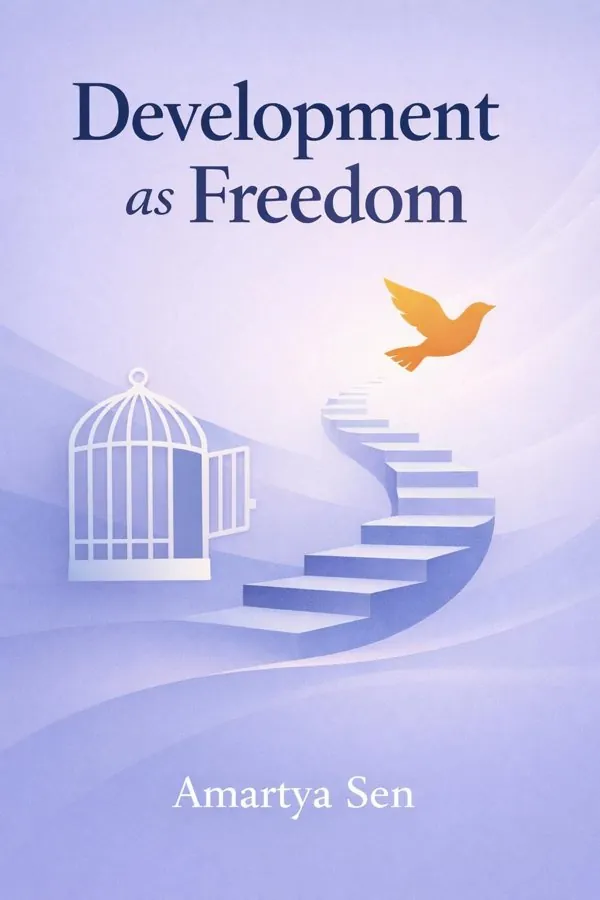
Development as Freedom: Summary & Key Insights
by Amartya Sen
 10 min10 chaptersAudio available
Key Takeaways from Development as Freedom
A society is not truly developed if people are richer but still unable to make meaningful choices about their lives.
The most important measure of progress is not output, but opportunity.
People are not merely recipients of aid or policy; they are agents capable of shaping their own destinies.
Freedom is not one thing; it is a network of mutually reinforcing conditions.
Poverty is more than low income; it is the inability to achieve basic human functionings.
What Is Development as Freedom About?
Development as Freedom by Amartya Sen is a economics book spanning 10 pages. What if development were measured not by how much an economy produces, but by how much freedom people actually have to live the lives they value? In Development as Freedom, Nobel Prize-winning economist and philosopher Amartya Sen offers a powerful redefinition of progress. He argues that rising GDP, industrial growth, and technological advancement matter only insofar as they expand people’s real opportunities: to be healthy, educated, politically heard, economically secure, and socially respected. In Sen’s framework, development is not just about wealth accumulation; it is about removing the forms of unfreedom that trap people in deprivation, exclusion, and vulnerability. This book matters because it reshaped how policymakers, economists, and global institutions think about poverty and human well-being. Sen challenges narrow economic metrics and replaces them with a richer, more humane vision centered on capability, agency, and justice. Drawing on economics, moral philosophy, political theory, and real-world evidence from famine, democracy, gender inequality, and globalization, he shows why freedom is both the goal of development and its most effective instrument. Few books have changed the development conversation so deeply or enduringly.
This FizzRead summary covers all 10 key chapters of Development as Freedom in approximately 10 minutes, distilling the most important ideas, arguments, and takeaways from Amartya Sen's work. Also available as an audio summary and Key Quotes Podcast.
Development as Freedom
What if development were measured not by how much an economy produces, but by how much freedom people actually have to live the lives they value? In Development as Freedom, Nobel Prize-winning economist and philosopher Amartya Sen offers a powerful redefinition of progress. He argues that rising GDP, industrial growth, and technological advancement matter only insofar as they expand people’s real opportunities: to be healthy, educated, politically heard, economically secure, and socially respected. In Sen’s framework, development is not just about wealth accumulation; it is about removing the forms of unfreedom that trap people in deprivation, exclusion, and vulnerability.
This book matters because it reshaped how policymakers, economists, and global institutions think about poverty and human well-being. Sen challenges narrow economic metrics and replaces them with a richer, more humane vision centered on capability, agency, and justice. Drawing on economics, moral philosophy, political theory, and real-world evidence from famine, democracy, gender inequality, and globalization, he shows why freedom is both the goal of development and its most effective instrument. Few books have changed the development conversation so deeply or enduringly.
Who Should Read Development as Freedom?
This book is perfect for anyone interested in economics and looking to gain actionable insights in a short read. Whether you're a student, professional, or lifelong learner, the key ideas from Development as Freedom by Amartya Sen will help you think differently.
- ✓Readers who enjoy economics and want practical takeaways
- ✓Professionals looking to apply new ideas to their work and life
- ✓Anyone who wants the core insights of Development as Freedom in just 10 minutes
Want the full summary?
Get instant access to this book summary and 100K+ more with Fizz Moment.
Get Free SummaryAvailable on App Store • Free to download
Key Chapters
A society is not truly developed if people are richer but still unable to make meaningful choices about their lives. One of Amartya Sen’s central insights is that freedom plays a dual role in development: it is both the ultimate objective and one of the most powerful tools for achieving progress. We value freedom because being able to choose, participate, and act has intrinsic importance. At the same time, freedom also has instrumental value because open societies, educated citizens, and secure individuals tend to create better economic and social outcomes.
Sen rejects the idea that development can be reduced to higher income levels. A rise in wages means little if people remain illiterate, politically silenced, or unable to access healthcare. Likewise, a nation may post strong growth figures while large segments of the population remain malnourished or socially excluded. Development, in Sen’s account, is the expansion of substantive freedoms: the genuine ability to avoid hunger, receive medical care, attend school, work with dignity, and participate in civic life.
This distinction helps explain why some countries with modest incomes achieve better human outcomes than wealthier societies with weak public institutions. For example, public health campaigns, universal schooling, and democratic accountability can dramatically improve lives even before a country becomes affluent. Freedom is not something to be postponed until after growth; it is part of what makes growth beneficial and sustainable.
Actionable takeaway: when evaluating any policy, ask two questions at once: does it increase people’s real freedom, and does it use freedom-enhancing methods to create progress?
The most important measure of progress is not output, but opportunity. Sen argues that development should be understood as a process of expanding the real freedoms people enjoy. This means looking beyond resources to what people are actually able to be and do. Two people with the same income may live very different lives if one faces discrimination, poor health, unsafe streets, or lack of education. Development therefore concerns capabilities, not just commodities.
Sen’s approach broadens the entire field of economics. Traditional models often assume that more goods automatically produce better lives. Sen shows why that assumption fails. A bicycle is useful only if roads are safe and one knows how to ride. A job offer matters only if a person is healthy enough to work and free to travel. Political rights matter only if people can use them without intimidation. Real freedom depends on social, institutional, and personal conditions working together.
This lens changes how we think about policy. Instead of asking only whether the economy is growing, governments should ask whether citizens can realistically pursue valued lives. Are girls able to stay in school? Can rural families reach hospitals? Can workers seek employment without coercion? Can minorities access justice? These are development questions just as much as inflation, trade, or investment rates.
Sen also emphasizes that freedom has a public dimension. Your opportunities depend partly on the institutions around you: schools, courts, media, elections, public health systems, and norms of inclusion. Development is therefore a collective project of building conditions in which people can flourish.
Actionable takeaway: assess success by tracking expanded options in everyday life, not just rising averages in income or production.
People are not merely recipients of aid or policy; they are agents capable of shaping their own destinies. Sen insists that a good society must see individuals not as passive beneficiaries of development, but as active participants in it. This idea of agency is one of the book’s deepest moral and political contributions. Human beings value not only outcomes, but also the ability to pursue goals they have reason to endorse.
A narrow welfare view asks whether people are better off in terms of consumption or comfort. Sen’s agency-centered view asks whether they can act, decide, organize, protest, create, care for others, and contribute to collective life. This distinction is crucial. A government may provide basic material relief while still denying citizens a voice. But without agency, people cannot hold institutions accountable, express their preferences, or challenge injustice.
Agency also changes how development programs should be designed. Consider a rural education initiative. It is more effective when local communities, especially parents and women, help define priorities, monitor teacher attendance, and shape school management. Similarly, poverty reduction programs work better when the poor participate in decisions about credit, infrastructure, and healthcare access, rather than receiving top-down solutions that ignore local needs.
Sen’s emphasis on agency connects individual dignity to democratic practice. Empowered people create better families, stronger communities, and more responsive institutions. Development is not something done to people; it is something advanced by people.
Actionable takeaway: in any social or organizational change effort, build participation into the process so that those affected are decision-makers, not just targets of intervention.
Freedom is not one thing; it is a network of mutually reinforcing conditions. Sen identifies five instrumental freedoms that help drive development: political freedoms, economic facilities, social opportunities, transparency guarantees, and protective security. These are not isolated policy categories. They interact, support one another, and create a wider environment of human capability.
Political freedoms include voting rights, free speech, open debate, and the ability to criticize government. Economic facilities refer to opportunities to use resources, access markets, work, produce, and exchange. Social opportunities include education, healthcare, and other services that increase individual effectiveness. Transparency guarantees reduce corruption and build trust by ensuring openness in public dealings. Protective security provides safety nets such as unemployment relief, famine prevention, and emergency support for the vulnerable.
Sen’s key contribution is to show that these freedoms reinforce one another in practice. Education improves employability and political awareness. Free media exposes corruption and helps prevent disaster. Social safety nets allow people to take productive risks rather than cling to survival strategies. Markets function better when trust, legal reliability, and public information exist. Democracies are stronger when people are healthy and literate enough to participate effectively.
A practical example is public food distribution during drought. It relies on protective security, but it is more likely to function well when transparency exists, media can report failures, and citizens can pressure leaders politically. Development succeeds when institutions are designed as an ecosystem of freedoms rather than as disconnected reforms.
Actionable takeaway: when solving social problems, look for combinations of freedoms that reinforce each other instead of relying on a single policy lever.
Poverty is more than low income; it is the inability to achieve basic human functionings. Sen’s capability approach transformed the study of deprivation by shifting attention from money alone to what people can actually do with the resources available to them. Someone may earn above a statistical poverty line yet still be deeply deprived because of disability, illness, social exclusion, unsafe housing, or lack of public services. Poverty, in this sense, is the failure of substantive freedom.
This perspective explains why income-based measures often miss the lived reality of disadvantage. Consider two households with similar earnings. One has access to clean water, schools, public transport, and clinics; the other lives in a polluted area with no healthcare and insecure work. Their capabilities are radically different. The second household faces higher “conversion costs” just to achieve the same basic outcomes.
Sen’s framework also captures forms of deprivation hidden within households and communities. Women, the elderly, minorities, and people with disabilities may receive fewer resources or opportunities even when average household income appears adequate. A capability perspective therefore directs attention toward nutrition, mobility, bodily security, literacy, social respect, and participation.
This idea has major policy implications. Anti-poverty efforts should not focus only on cash transfers or growth rates. They should also improve health services, public education, sanitation, legal rights, transportation, and protection from discrimination. Money matters, but it matters because of the freedoms it can help secure.
Actionable takeaway: when assessing poverty, ask not just “How much do people earn?” but “What are they actually able to become and achieve?”
Markets are powerful, but they are not morally self-sufficient. Sen offers a nuanced defense of markets while rejecting both romantic anti-market views and simplistic faith in laissez-faire. Markets can expand freedom by enabling voluntary exchange, creating employment, increasing choice, and allowing people to pursue economic opportunities. The freedom to transact, produce, and consume can be an important part of human liberty.
But Sen also warns that markets do not automatically generate justice, equality, or adequate living conditions. They can exclude people who lack education, capital, health, or legal protection. A person is not truly free to participate in markets if they are starving, illiterate, or trapped by social hierarchy. Market outcomes depend on background conditions, and those conditions are shaped by institutions, ethics, and public policy.
This is why Sen insists on the complementarity of markets and the state. Public investment in schooling, vaccination, infrastructure, and legal systems makes market participation more genuinely accessible. Regulation can reduce fraud, exploitation, and monopoly. Social norms of trust and fairness help transactions function. In this sense, markets work best when embedded in broader frameworks of capability and accountability.
A clear example is entrepreneurship. Telling people to start businesses is hollow advice if they lack roads, credit, literacy, electricity, and legal recourse. Once those foundations exist, markets can become engines of freedom rather than mechanisms of exclusion.
Actionable takeaway: support markets where they expand opportunity, but pair them with public goods and ethical safeguards so that participation is genuinely open to all.
No substantial famine has ever occurred in a functioning democracy with a relatively free press. This famous claim captures one of Sen’s most compelling arguments: democracy is not a luxury for rich countries but a core component of development itself. Political freedom has intrinsic value because people deserve a voice in how they are governed. Yet it also has life-saving practical effects.
Democracies create incentives for governments to respond to public suffering. Elections, opposition parties, open journalism, and civic activism make it costly for leaders to ignore starvation, unemployment, or social collapse. Authoritarian regimes can suppress bad news and delay action. In contrast, democracies expose problems earlier and force governments into public justification. Sen points to famine prevention as a dramatic case of how public reasoning and accountability convert freedom into survival.
But democracy, for Sen, is more than voting. It includes ongoing public discussion, criticism, and reasoning among citizens. Development requires informed debate about priorities: should a government spend more on defense or primary care, urban highways or rural schools, industrial subsidies or nutrition? Public reasoning helps societies discover needs, contest injustice, and revise policy in light of evidence.
This view makes democracy central even in poor countries. It is not something to wait for until after growth. In fact, democratic participation can improve growth quality by revealing local problems, reducing corruption, and making institutions more responsive.
Actionable takeaway: treat open debate, free media, and civic participation as practical development tools, not merely as political ideals.
A society cannot be called developed when half its population faces systematic barriers to health, education, work, property, and voice. Sen places gender inequality at the heart of development analysis, arguing that discrimination against women is both a profound injustice and a major source of social failure. When women are denied freedom, entire communities lose capability, productivity, and moral legitimacy.
Sen examines gender bias in survival, nutrition, healthcare, schooling, employment, inheritance, and household bargaining power. He famously drew attention to the phenomenon of “missing women,” referring to the millions of women who would be alive if they had received the same care and social value as men. This is not only a demographic anomaly but a revelation of how deeply inequality can be normalized.
His analysis goes beyond formal rights. Even where legal equality exists, women may face unequal burdens of unpaid care, restricted mobility, social pressure, or lack of control over household resources. Development therefore requires changing both institutions and norms. Educating girls, protecting reproductive health, strengthening women’s property rights, supporting employment, and increasing political representation all expand capability in ways that benefit future generations too.
Practical evidence strongly supports Sen’s case. Societies that invest in women’s literacy and health often see lower child mortality, improved nutrition, and stronger household well-being. Women’s agency changes family decisions, local governance, and the intergenerational transmission of opportunity.
Actionable takeaway: evaluate any development effort by asking how it expands women’s actual power, safety, education, and decision-making capacity.
Globalization is neither a cure-all nor a villain; its value depends on whether it expands human freedom. Sen resists simplistic narratives that portray global integration as automatically beneficial or inherently exploitative. Trade, technology, communication, and cross-border exchange can create enormous opportunities. They can spread knowledge, reduce costs, improve access to medicine, and connect poorer societies to wider markets. But these gains are uneven and can be undermined by exclusion, instability, and power imbalances.
Sen’s framework asks a better question than “Is globalization good?” It asks: who gains real capabilities from it, under what conditions, and with what institutional support? If globalization increases export earnings while workers remain insecure, public health deteriorates, or local communities lose voice, then development has not meaningfully advanced. On the other hand, when global integration is paired with education, labor protections, transparent governance, and social investment, it can widen freedom substantially.
He also rejects the claim that poor countries must choose between national identity and openness. Societies have long benefited from intellectual, scientific, and cultural exchange across borders. The problem is not global connection itself, but unequal access to its benefits and the absence of institutions that protect vulnerable populations from shocks.
Today this insight applies to digital trade, migration, climate policy, and global supply chains. The challenge is to shape integration so that it serves human capabilities rather than narrow aggregates.
Actionable takeaway: judge global economic change not by headline growth alone, but by whether ordinary people gain security, voice, and genuine opportunity from it.
Freedom does not flourish by accident; it depends on institutions that make rights real and opportunities usable. Throughout the book, Sen shows that development is inseparable from the quality of public institutions, social norms, and legal arrangements. Individual choices matter, but choices are constrained or enabled by schools, courts, public health systems, media, financial rules, and local governance structures.
This institutional perspective helps explain why similar policies can produce different outcomes in different places. A subsidy program may fail where corruption is rampant. Microcredit may have limited impact where women cannot travel safely or retain control over earnings. Elections may not increase accountability if the press is censored or citizens are illiterate. Sen’s point is not that institutions must be perfect before progress begins, but that durable freedom requires supportive structures.
Strong institutions expand trust and reduce vulnerability. Transparent procedures help citizens know what they are entitled to. Reliable courts make contracts and rights meaningful. Public health systems convert medical knowledge into longer lives. Schools translate formal opportunity into practical capability. Social insurance reduces fear and allows households to invest in the future.
Institutions also shape public reason. They create spaces where claims can be debated, injustices exposed, and policies revised. This is why development cannot be reduced to private consumption. It is also about the public architecture that turns abstract rights into lived possibilities.
Actionable takeaway: if you want lasting progress, invest in institutions that make freedom practical, visible, and enforceable in everyday life.
All Chapters in Development as Freedom
About the Author
Amartya Sen is an Indian economist and philosopher whose work has had a profound impact on welfare economics, development theory, political philosophy, and the study of inequality. Born in 1933, he taught at major institutions including the University of Delhi, the London School of Economics, Oxford, Cambridge, and Harvard. Sen received the Nobel Memorial Prize in Economic Sciences in 1998 for his contributions to social choice theory and for advancing the understanding of poverty, famine, and human welfare. He is especially known for developing the capability approach, which shifted attention from income alone to the real freedoms people have to live meaningful lives. His ideas helped shape global thinking on human development and continue to influence economists, policymakers, and philosophers around the world.
Get This Summary in Your Preferred Format
Read or listen to the Development as Freedom summary by Amartya Sen anytime, anywhere. FizzRead offers multiple formats so you can learn on your terms — all free.
Available formats: App · Audio · PDF · EPUB — All included free with FizzRead
Download Development as Freedom PDF and EPUB Summary
Key Quotes from Development as Freedom
“A society is not truly developed if people are richer but still unable to make meaningful choices about their lives.”
“The most important measure of progress is not output, but opportunity.”
“People are not merely recipients of aid or policy; they are agents capable of shaping their own destinies.”
“Freedom is not one thing; it is a network of mutually reinforcing conditions.”
“Poverty is more than low income; it is the inability to achieve basic human functionings.”
Frequently Asked Questions about Development as Freedom
Development as Freedom by Amartya Sen is a economics book that explores key ideas across 10 chapters. What if development were measured not by how much an economy produces, but by how much freedom people actually have to live the lives they value? In Development as Freedom, Nobel Prize-winning economist and philosopher Amartya Sen offers a powerful redefinition of progress. He argues that rising GDP, industrial growth, and technological advancement matter only insofar as they expand people’s real opportunities: to be healthy, educated, politically heard, economically secure, and socially respected. In Sen’s framework, development is not just about wealth accumulation; it is about removing the forms of unfreedom that trap people in deprivation, exclusion, and vulnerability. This book matters because it reshaped how policymakers, economists, and global institutions think about poverty and human well-being. Sen challenges narrow economic metrics and replaces them with a richer, more humane vision centered on capability, agency, and justice. Drawing on economics, moral philosophy, political theory, and real-world evidence from famine, democracy, gender inequality, and globalization, he shows why freedom is both the goal of development and its most effective instrument. Few books have changed the development conversation so deeply or enduringly.
More by Amartya Sen
You Might Also Like

Business Adventures
John Brooks
10 min
Nudge
Richard H. Thaler, Cass R. Sunstein
10 min
The Hitchhiker"s Guide to the Galaxy
Douglas Adams
10 minThe Muqaddimah
Ibn Khaldun
10 minThe Outsiders
William N. Thorndike
10 min
A Little History of Economics
Niall Kishtainy
10 minBrowse by Category
Ready to read Development as Freedom?
Get the full summary and 100K+ more books with Fizz Moment.