
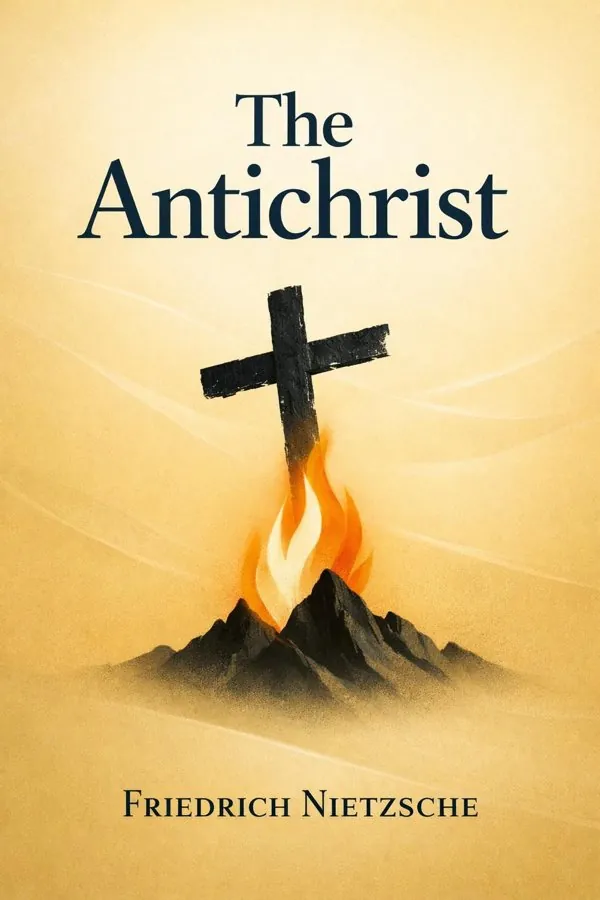
The Antichrist: Summary & Key Insights
 10 min6 chaptersAudio available
What Is The Antichrist About?
The Antichrist by Friedrich Nietzsche is a western_phil book spanning 6 pages. The Antichrist is one of Friedrich Nietzsche’s late works, written in 1888 and first published in 1895. In this book, Nietzsche delivers a radical critique of Christianity and its moral foundations. He portrays Christian morality as a denial of life and calls for a revaluation of all values based on strength, vitality, and self-determination. The work is considered one of Nietzsche’s most provocative and philosophically profound writings.
This FizzRead summary covers all 6 key chapters of The Antichrist in approximately 10 minutes, distilling the most important ideas, arguments, and takeaways from Friedrich Nietzsche's work. Also available as an audio summary and Key Quotes Podcast.
The Antichrist
The Antichrist is one of Friedrich Nietzsche’s late works, written in 1888 and first published in 1895. In this book, Nietzsche delivers a radical critique of Christianity and its moral foundations. He portrays Christian morality as a denial of life and calls for a revaluation of all values based on strength, vitality, and self-determination. The work is considered one of Nietzsche’s most provocative and philosophically profound writings.
Who Should Read The Antichrist?
This book is perfect for anyone interested in western_phil and looking to gain actionable insights in a short read. Whether you're a student, professional, or lifelong learner, the key ideas from The Antichrist by Friedrich Nietzsche will help you think differently.
- ✓Readers who enjoy western_phil and want practical takeaways
- ✓Professionals looking to apply new ideas to their work and life
- ✓Anyone who wants the core insights of The Antichrist in just 10 minutes
Want the full summary?
Get instant access to this book summary and 100K+ more with Fizz Moment.
Get Free SummaryAvailable on App Store • Free to download
Key Chapters
From the first words of *The Antichrist*, I declare war on the morality that turns vitality into vice. Strength, for me, is not merely physical power; it is a sign of fullness of being, of one who says yes to life. The noble and healthy type affirms existence and takes joy in his own capacities; he does not seek to escape from the world but to engage with it. Christianity, in contrast, makes a virtue of weakness. It praises humility, meekness, and submission; it transforms suffering into a sacred duty. Such a reversal of values is not innocent—it is the strategy of the sick, of those who cannot bear the world as it is and therefore create a ‘moral’ world to condemn the strong.
To exalt the weak and condemn the strong is to falsify life at its very root. The instinct of a flourishing being is expansion, creation, domination—the will to power. Christian morality brands these instincts as evil. It glorifies what should be overcome and condemns what should be celebrated. In doing so, it undermines the human capacity for greatness. This reversal is the crucial turning point in Western conscience: instead of life being something we embody with pride, it becomes something we must justify and repent for. I call this despicable.
When you look closely, the consequence of this reversal is the moral domestication of humanity. Men come to believe their natural desires are sinful, that their strength is dangerous, that self-denial is holy. It is as if life itself had been pronounced guilty. I wrote *The Antichrist* to expose this degeneration as the most profound symptom of decay. True nobility exists in the ability to affirm one’s instincts, not in the attempt to mutilate them for the sake of a supposed purity. The health of an individual—and of a culture—is determined by how fully it can say yes to the instincts that serve life itself.
To understand Christianity’s power, one must trace its ancestry to the priestly values of ancient Judaism. The priests, faced with the dominance of warrior nobles, discovered the most ingenious form of revenge—not by physical force but by moral inversion. The noble man of antiquity saw his own instincts as good; the priest convinced him they were evil. Where vitality and strength had been celebrated, the priest declared suffering and obedience to be divine. Thus was born the morality of resentment.
The Jewish priestly genius did not destroy his enemies openly; instead, he transformed his impotence into moral superiority. He built an ethical universe where those unable to act could still claim victory through judgment. In their resentment, the sick created a morality that declared the healthy and powerful ‘sinners.’ Every affirmation of life was reinterpreted as rebellion against God. In time, Christianity inherited and universalized this morality of impotence.
Christianity took this ressentiment—the spiritual weapon of the weak—and made it the soul of European culture. The ‘Kingdom of God’ became the promise of revenge against existence itself. When I say that Christianity is the religion of pity, I mean that it sanctifies suffering, incorporates decay into its theology, and erects weakness as a global ideal. Pity is the most destructive emotion—it multiplies pain, weakens judgment, and promotes dependence. A religion built upon pity creates generations of invalids who rejoice in their own sickness. In this inversion, every noble instinct is pathologized; the desire to rise is condemned as pride, courage is reclassified as sin, and joy becomes suspect.
My critique, therefore, is not directed at individual believers but at this systematically cultivated resentment that deforms human nature. The priests needed guilt to maintain their power. The invention of sin was their masterpiece, ensuring that every human being would feel an eternal debt to the divine authority—and, of course, to their earthly representatives. Thus, the psychology of guilt becomes the instrument of social control, and the moral vocabulary of Christianity becomes a net that captures the instinctual vitality of mankind.
+ 4 more chapters — available in the FizzRead app
All Chapters in The Antichrist
About the Author
Friedrich Wilhelm Nietzsche (1844–1900) was a German philosopher, philologist, and writer. He is regarded as one of the most influential thinkers of modern times. His works, including Thus Spoke Zarathustra, Beyond Good and Evil, and The Antichrist, shaped existential philosophy, psychology, and cultural criticism of the 20th century. Nietzsche was known for his sharp critique of religion, morality, and metaphysics.
Get This Summary in Your Preferred Format
Read or listen to the The Antichrist summary by Friedrich Nietzsche anytime, anywhere. FizzRead offers multiple formats so you can learn on your terms — all free.
Available formats: App · Audio · PDF · EPUB — All included free with FizzRead
Download The Antichrist PDF and EPUB Summary
Key Quotes from The Antichrist
“From the first words of *The Antichrist*, I declare war on the morality that turns vitality into vice.”
“To understand Christianity’s power, one must trace its ancestry to the priestly values of ancient Judaism.”
Frequently Asked Questions about The Antichrist
The Antichrist by Friedrich Nietzsche is a western_phil book that explores key ideas across 6 chapters. The Antichrist is one of Friedrich Nietzsche’s late works, written in 1888 and first published in 1895. In this book, Nietzsche delivers a radical critique of Christianity and its moral foundations. He portrays Christian morality as a denial of life and calls for a revaluation of all values based on strength, vitality, and self-determination. The work is considered one of Nietzsche’s most provocative and philosophically profound writings.
More by Friedrich Nietzsche



You Might Also Like

A Little History of Philosophy
Nigel Warburton
10 min
Areopagitica
John Milton
10 min
How To Think Like A Philosopher: Essential Principles For Clear Thinking
Peter Cave
10 min
Language, Truth and Logic
A. J. Ayer
10 min
The Age of Reason
Thomas Paine
10 min
The Essays
Michel De Montaigne
10 minBrowse by Category
Ready to read The Antichrist?
Get the full summary and 100K+ more books with Fizz Moment.