
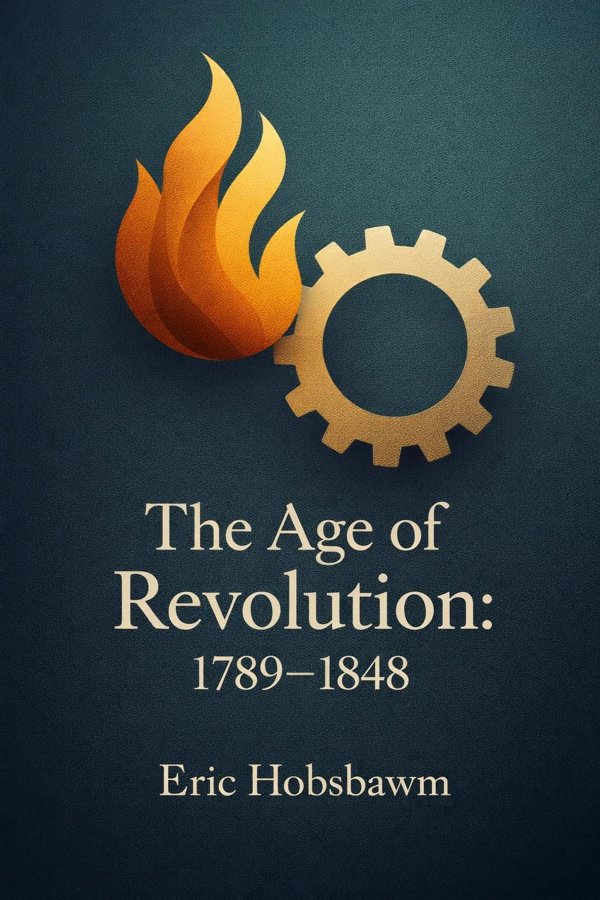
The Age of Revolution: 1789–1848: Summary & Key Insights
 10 min9 chaptersAudio available
Key Takeaways from The Age of Revolution: 1789–1848
A political system can appear permanent right up until the moment it collapses.
New machines alone do not make a revolution; new social relations do.
History often turns when a rising class gains the confidence to make its values seem universal.
Ideas matter most when they become tools for collective action.
Modern society did not simply produce wealth; it produced a new class whose struggles would define the next century.
What Is The Age of Revolution: 1789–1848 About?
The Age of Revolution: 1789–1848 by Eric Hobsbawm is a world_history book spanning 4 pages. Eric Hobsbawm’s The Age of Revolution: 1789–1848 is one of the most influential interpretations of the modern world’s birth. Covering the turbulent decades between the French Revolution and the revolutions of 1848, the book argues that two great upheavals changed history more profoundly than almost any other forces: the political revolution centered in France and the industrial revolution centered in Britain. Together, they dismantled the old aristocratic order, expanded capitalism, transformed class relations, and created the social and political language of modernity. What makes this book enduring is not just its scope, but its synthesis. Hobsbawm shows how economics, politics, ideas, empire, and daily life were intertwined. He explains why revolutions spread beyond borders, why industrialization reordered society, and how new classes, movements, and ideologies emerged from the wreckage of the old regime. A renowned Marxist historian with extraordinary command of European and global history, Hobsbawm writes with clarity, force, and interpretive ambition. This is not simply a history of events. It is a map of how the modern age was made.
This FizzRead summary covers all 9 key chapters of The Age of Revolution: 1789–1848 in approximately 10 minutes, distilling the most important ideas, arguments, and takeaways from Eric Hobsbawm's work. Also available as an audio summary and Key Quotes Podcast.
The Age of Revolution: 1789–1848
Eric Hobsbawm’s The Age of Revolution: 1789–1848 is one of the most influential interpretations of the modern world’s birth. Covering the turbulent decades between the French Revolution and the revolutions of 1848, the book argues that two great upheavals changed history more profoundly than almost any other forces: the political revolution centered in France and the industrial revolution centered in Britain. Together, they dismantled the old aristocratic order, expanded capitalism, transformed class relations, and created the social and political language of modernity.
What makes this book enduring is not just its scope, but its synthesis. Hobsbawm shows how economics, politics, ideas, empire, and daily life were intertwined. He explains why revolutions spread beyond borders, why industrialization reordered society, and how new classes, movements, and ideologies emerged from the wreckage of the old regime. A renowned Marxist historian with extraordinary command of European and global history, Hobsbawm writes with clarity, force, and interpretive ambition. This is not simply a history of events. It is a map of how the modern age was made.
Who Should Read The Age of Revolution: 1789–1848?
This book is perfect for anyone interested in world_history and looking to gain actionable insights in a short read. Whether you're a student, professional, or lifelong learner, the key ideas from The Age of Revolution: 1789–1848 by Eric Hobsbawm will help you think differently.
- ✓Readers who enjoy world_history and want practical takeaways
- ✓Professionals looking to apply new ideas to their work and life
- ✓Anyone who wants the core insights of The Age of Revolution: 1789–1848 in just 10 minutes
Want the full summary?
Get instant access to this book summary and 100K+ more with Fizz Moment.
Get Free SummaryAvailable on App Store • Free to download
Key Chapters
A political system can appear permanent right up until the moment it collapses. That is one of Hobsbawm’s central lessons in his account of the French Revolution. Before 1789, Europe was still dominated by monarchy, hereditary privilege, feudal obligations, and a social order rooted in rank rather than citizenship. France, though wealthy and culturally powerful, embodied the contradictions of this old regime: a growing economy trapped inside outdated institutions, a state burdened by debt, and a privileged elite resistant to reform.
Hobsbawm argues that the French Revolution mattered not only because it overthrew a king, but because it shattered the legitimacy of aristocratic society at Europe’s center. The Declaration of the Rights of Man and of the Citizen, the abolition of feudal dues, and the mobilization of the nation for war introduced a new political world. Power could now be justified in the name of the people, not divine right or inherited status. Even where rulers survived, they could no longer ignore the revolutionary language of rights, representation, and national sovereignty.
The revolution also revealed the power of mass politics. Crowds, peasants, radical clubs, and urban workers were not background actors; they were forces capable of shaping history. Later reformers and revolutionaries across Europe learned from both the revolution’s promise and its violence.
A practical way to apply this idea is to look at any institution that seems fixed today and ask what hidden pressures are accumulating beneath its surface. Hobsbawm reminds us that deep structural tensions often precede sudden political change.
Actionable takeaway: When analyzing political crises, look beyond leaders and events to the social contradictions that make an old order vulnerable to collapse.
New machines alone do not make a revolution; new social relations do. Hobsbawm presents the British Industrial Revolution as a transformation far larger than a set of inventions. It was the beginning of a new economic system organized around mechanized production, expanding markets, wage labor, and relentless accumulation. Britain industrialized first because agriculture had become more productive, capital was available, overseas trade was extensive, and political conditions favored commercial development.
Textiles, coal, iron, steam power, and transport did more than increase output. They changed the rhythm of life. Production moved from workshops and households into factories. Time became disciplined, measured, and monetized. Labor was increasingly bought and sold as a commodity. Economic growth ceased to be occasional and became expected, even necessary.
Hobsbawm emphasizes that industrialization was uneven. While Britain surged ahead, much of continental Europe lagged behind or adapted more slowly. This imbalance helped define international power. It also intensified inequality inside societies. Factory owners, merchants, and financiers gained influence, while workers faced insecurity, low wages, dangerous conditions, and urban overcrowding.
The concept remains useful today whenever technological change is discussed. Just as steam power remade work and society, digital automation and artificial intelligence are reshaping labor markets, power structures, and daily habits. The key question is not only what technology can do, but who controls it and who benefits.
Actionable takeaway: When evaluating economic change, examine the institutions, labor systems, and inequalities surrounding innovation, not just the innovation itself.
History often turns when a rising class gains the confidence to make its values seem universal. For Hobsbawm, the age between 1789 and 1848 was the age in which the bourgeoisie became the defining social force of modern Europe. This class included industrialists, merchants, professionals, financiers, and others whose status came less from birth than from property, education, and commercial success.
The triumph of bourgeois society did not mean aristocrats vanished overnight. In many places they retained land, titles, and political influence. But the terms of power changed. Efficiency, enterprise, legality, competition, and individual advancement became increasingly authoritative ideals. The bourgeoisie favored constitutional government, secure property rights, standardized laws, and institutions that supported commerce. Even old elites often had to adapt by becoming more businesslike or by allying with capitalist interests.
This shift affected culture as much as economics. Respectability, self-discipline, domestic order, literacy, and career ambition became markers of social legitimacy. Cities expanded as centers of exchange and administration. Education became more valuable because modern states and capitalist firms needed trained personnel. In this sense, bourgeois society was not merely a class victory; it was a redefinition of what counted as success and civilization.
You can apply this framework by observing how dominant groups shape common sense. Today, corporate norms, professional credentials, and market values often seem natural, but Hobsbawm shows they are historically produced and socially contested.
Actionable takeaway: To understand a society, identify which class’s values are treated as normal and ask how those values shape politics, culture, and opportunity.
Ideas matter most when they become tools for collective action. Hobsbawm shows that liberalism and nationalism were among the most dynamic political forces of this era. Liberalism challenged arbitrary rule, defended civil equality, and sought constitutional limits on power. Nationalism, though still developing, linked political legitimacy to a people imagined as sharing language, history, territory, or destiny.
These ideologies were initially disruptive because they undermined dynastic empires and inherited privilege. If citizens were equal before the law, then legal exemptions for nobles and clergy became harder to defend. If sovereignty belonged to the nation, then monarchs could not govern merely by tradition. The Napoleonic wars spread these principles across Europe, sometimes by conquest and sometimes by resistance to French domination. In both cases, old political boundaries came under pressure.
Yet Hobsbawm also notes that liberalism and nationalism were not automatically democratic in the modern sense. Liberal reformers often feared mass participation. Nationalism could unify people against empire, but it could also exclude minorities and justify new hierarchies. This tension remains familiar today in debates over citizenship, borders, rights, and representation.
A practical example is contemporary politics in post-imperial or multinational states, where constitutional reform and national identity still intersect. Hobsbawm helps readers see that such conflicts are not anomalies but inheritances from the revolutionary age.
Actionable takeaway: Whenever political movements invoke freedom or national identity, ask who is included, who is excluded, and what kind of state they are trying to build.
Modern society did not simply produce wealth; it produced a new class whose struggles would define the next century. Hobsbawm treats the emergence of the working class as one of the deepest consequences of industrial capitalism. Peasants, artisans, and laborers were drawn or forced into wage dependence, especially in expanding towns and factories. Their lives were shaped by unstable employment, long hours, low pay, and weak political rights.
This was not just economic hardship. It was a social reorganization of existence. Workers lost many traditional protections and rhythms. Family life changed. Communities were uprooted. Skills that once guaranteed status could be devalued by mechanization. Out of these pressures came new forms of consciousness and collective action: strikes, protests, machine-breaking, mutual aid societies, early trade unions, and radical political movements.
Hobsbawm emphasizes that class formation is historical, not automatic. People do not become a class merely by sharing conditions; they become one through experience, organization, and struggle. This insight helps explain why social unrest sometimes remains fragmented and at other times develops into disciplined political movements.
The relevance today is obvious in discussions of precarious labor, gig work, and workplace organizing. Economic systems continuously generate new categories of workers, but solidarity depends on whether those workers can interpret their experiences as collective rather than personal.
Actionable takeaway: To understand labor politics, focus not only on wages and jobs but on how shared experiences are translated into organization, identity, and demands.
Europe’s revolutions were never purely European. Hobsbawm insists that the making of modern Europe depended heavily on empire, colonial extraction, and global trade. Britain’s industrial lead was tied to overseas markets, raw materials, naval power, and imperial finance. Sugar, cotton, slavery, and colonial commerce formed part of the wider system that made industrial expansion possible.
The same is true politically. Revolutionary and Napoleonic wars were global conflicts with repercussions in the Americas, the Caribbean, and beyond. The crisis of European empires helped trigger independence movements in Latin America. Colonial societies were not passive recipients of European change; they were entangled participants in it. Commodities, capital, soldiers, and ideas moved across oceans, binding local transformations to international structures.
Hobsbawm’s perspective helps correct narrow national histories. Industrialization in Manchester cannot be fully understood without cotton from the American South and India. Political upheaval in Spain cannot be separated from imperial crisis overseas. Even debates over freedom were compromised by systems of enslavement and racial domination.
This wider lens matters today because globalization is often presented as a recent phenomenon. Hobsbawm shows that modern capitalism was global from the beginning, built through unequal exchange as much as domestic innovation.
Actionable takeaway: When studying any nation’s rise, trace the international networks of labor, resources, coercion, and trade that made it possible.
Counterrevolution is powerful, but it rarely restores the past intact. After Napoleon’s defeat, European rulers tried to rebuild stability through the Congress of Vienna and the conservative order associated with Metternich. Monarchies were restored, radicalism was repressed, censorship spread, and diplomatic coordination sought to contain future upheaval. At first glance, reaction seemed successful.
But Hobsbawm shows that restoration was inherently limited. The old regime could be reassembled in form, yet the social and political world had already changed. Administrative centralization, legal reform, national feeling, capitalist development, and middle-class influence could not simply be erased. Even conservative governments often relied on institutions shaped by the revolutionary era. They defended hierarchy while operating in a world transformed by war, bureaucracy, and markets.
This is one of Hobsbawm’s sharpest insights: reaction itself can become a form of adaptation. Elites survive by adjusting, compromising, and absorbing parts of what they once opposed. That is why the post-1815 order was both restrictive and unstable. Beneath the surface, liberal and national demands continued to grow, and social tensions intensified with industrialization.
A modern application can be seen when governments respond to reform movements by restoring order while keeping selective innovations. Institutions often preserve themselves by changing just enough to endure.
Actionable takeaway: When assessing political backlash, distinguish between symbolic restoration and structural reality; ask what has truly been reversed and what has merely been repackaged.
Great transformations do not stay confined to factories and parliaments; they reshape imagination itself. Hobsbawm pays close attention to culture because literature, religion, art, and public life reveal how people made sense of revolutionary change. Romanticism, for example, was not just an artistic style. It expressed a reaction to rationalization, industrial discipline, political violence, and the emotional intensity of a rapidly changing world.
As traditional structures weakened, culture became a field in which new identities were forged. National histories were written, folk traditions were collected, and languages were standardized. Intellectuals and artists helped create the emotional architecture of nationalism. Meanwhile, the bourgeois public sphere expanded through newspapers, publishing, clubs, lectures, and debate. Public opinion acquired new importance because political legitimacy increasingly required some engagement with society beyond court circles.
Hobsbawm also helps us see that culture can both resist and support social change. Romantic celebration of the past could criticize industrial modernity, yet cultural nationalism could also mobilize modern political movements. Likewise, religion could be a conservative force or a source of popular dissent depending on context.
In practical terms, this reminds readers to take symbols seriously. Songs, stories, school curricula, and commemorations are not decorative extras; they help organize collective memory and political feeling.
Actionable takeaway: To understand major social change, examine the cultural narratives and symbols that make people feel that change, fear it, or fight for it.
Some revolutions fail in the short term yet succeed in redefining the future. Hobsbawm treats 1848 as the climax of the age of revolution because it brought together many of the era’s unresolved tensions: liberal reform versus monarchy, nationalism versus empire, and social demands versus bourgeois caution. Across Europe, uprisings erupted with astonishing speed, suggesting how widespread dissatisfaction had become.
Yet the revolutions of 1848 largely failed to consolidate power. Coalitions fractured. Middle-class liberals often recoiled from working-class radicalism. National movements competed with one another. States regrouped and repressed revolt. On the surface, counterrevolution again prevailed.
But Hobsbawm insists that 1848 was still historically decisive. It exposed the weakness of old regimes, confirmed the growing force of nationalism and liberalism, and announced the independent political presence of the working class. It also showed that bourgeois society could be revolutionary against aristocracy but conservative against social equality. This insight would shape later socialist analysis and political strategy.
The broader lesson is that historical turning points are not always measured by immediate victories. Failed movements can clarify interests, create political languages, and reveal future fault lines. Many later reforms and revolutions became thinkable because 1848 had already tested them.
Actionable takeaway: When judging political movements, do not ask only whether they won immediately; ask what alliances they exposed, what ideas they normalized, and what future struggles they made possible.
All Chapters in The Age of Revolution: 1789–1848
About the Author
Eric Hobsbawm (1917–2012) was a British historian and one of the most important interpreters of the modern age. Born in Alexandria and raised in Vienna and Berlin before settling in Britain, he brought a distinctly international perspective to European history. He taught for many years at Birkbeck, University of London, and became widely known for his sweeping analyses of capitalism, class, nationalism, empire, and revolution. A committed Marxist historian, Hobsbawm combined social and economic analysis with vivid historical storytelling. His celebrated works include The Age of Revolution, The Age of Capital, The Age of Empire, and The Age of Extremes. Across these books, he traced the making of the modern world with exceptional range, clarity, and intellectual ambition.
Get This Summary in Your Preferred Format
Read or listen to the The Age of Revolution: 1789–1848 summary by Eric Hobsbawm anytime, anywhere. FizzRead offers multiple formats so you can learn on your terms — all free.
Available formats: App · Audio · PDF · EPUB — All included free with FizzRead
Download The Age of Revolution: 1789–1848 PDF and EPUB Summary
Key Quotes from The Age of Revolution: 1789–1848
“A political system can appear permanent right up until the moment it collapses.”
“New machines alone do not make a revolution; new social relations do.”
“History often turns when a rising class gains the confidence to make its values seem universal.”
“Ideas matter most when they become tools for collective action.”
“Modern society did not simply produce wealth; it produced a new class whose struggles would define the next century.”
Frequently Asked Questions about The Age of Revolution: 1789–1848
The Age of Revolution: 1789–1848 by Eric Hobsbawm is a world_history book that explores key ideas across 9 chapters. Eric Hobsbawm’s The Age of Revolution: 1789–1848 is one of the most influential interpretations of the modern world’s birth. Covering the turbulent decades between the French Revolution and the revolutions of 1848, the book argues that two great upheavals changed history more profoundly than almost any other forces: the political revolution centered in France and the industrial revolution centered in Britain. Together, they dismantled the old aristocratic order, expanded capitalism, transformed class relations, and created the social and political language of modernity. What makes this book enduring is not just its scope, but its synthesis. Hobsbawm shows how economics, politics, ideas, empire, and daily life were intertwined. He explains why revolutions spread beyond borders, why industrialization reordered society, and how new classes, movements, and ideologies emerged from the wreckage of the old regime. A renowned Marxist historian with extraordinary command of European and global history, Hobsbawm writes with clarity, force, and interpretive ambition. This is not simply a history of events. It is a map of how the modern age was made.
More by Eric Hobsbawm
You Might Also Like
The Age of Capital
Eric Hobsbawm
10 min
The Gulag Archipelago
Aleksandr Solzhenitsyn
10 min
Jerusalem: The Biography
Simon Sebag Montefiore
10 min
The Anglo-Saxons
James Campbell
10 min
The Boer War
Thomas Pakenham
10 min
The Industrial Revolutionaries: The Making of the Modern World 1776–1914
Gavin Weightman
10 minBrowse by Category
Ready to read The Age of Revolution: 1789–1848?
Get the full summary and 100K+ more books with Fizz Moment.