
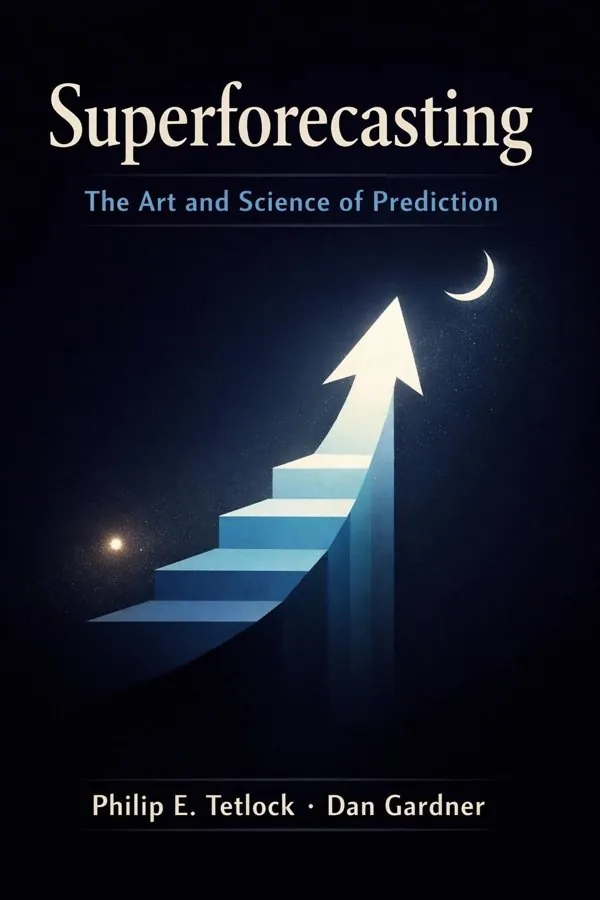
Superforecasting: The Art and Science of Prediction: Summary & Key Insights
by Philip E. Tetlock, Dan Gardner
 10 min9 chaptersAudio available
Key Takeaways from Superforecasting: The Art and Science of Prediction
Confidence is easy to mistake for competence, especially when the future is involved.
The future rarely arrives as a clean yes-or-no outcome, yet most people talk about it as if it does.
Strong convictions can feel like strength, but in forecasting they often become a liability.
A forecast is not a one-time proclamation; it is an evolving estimate.
Complex events become more manageable when you stop treating them as single mysteries.
What Is Superforecasting: The Art and Science of Prediction About?
Superforecasting: The Art and Science of Prediction by Philip E. Tetlock, Dan Gardner is a cognition book spanning 5 pages. What if the future is not nearly as unknowable as we often assume? In Superforecasting, Philip E. Tetlock and Dan Gardner challenge the common belief that accurate prediction is the domain of charismatic experts, insiders, or gifted intuitives. Drawing on years of research, especially the groundbreaking Good Judgment Project, they show that some ordinary people consistently make unusually accurate forecasts about political events, economic shifts, and global crises. These people are not prophets. They are disciplined thinkers. The book matters because modern life is saturated with uncertainty. Leaders, investors, professionals, and citizens constantly make decisions based on imperfect guesses about what comes next. Tetlock, a renowned scholar of judgment and decision-making, brings decades of empirical work to the subject, while Gardner adds journalistic clarity and narrative force. Together, they explain why many experts fail, how cognitive habits shape prediction quality, and what practical methods anyone can use to improve. Superforecasting is both a critique of overconfidence and a hopeful guide to better thinking. Its central promise is simple but powerful: while perfect foresight is impossible, better forecasting is learnable.
This FizzRead summary covers all 9 key chapters of Superforecasting: The Art and Science of Prediction in approximately 10 minutes, distilling the most important ideas, arguments, and takeaways from Philip E. Tetlock, Dan Gardner's work. Also available as an audio summary and Key Quotes Podcast.
Superforecasting: The Art and Science of Prediction
What if the future is not nearly as unknowable as we often assume? In Superforecasting, Philip E. Tetlock and Dan Gardner challenge the common belief that accurate prediction is the domain of charismatic experts, insiders, or gifted intuitives. Drawing on years of research, especially the groundbreaking Good Judgment Project, they show that some ordinary people consistently make unusually accurate forecasts about political events, economic shifts, and global crises. These people are not prophets. They are disciplined thinkers.
The book matters because modern life is saturated with uncertainty. Leaders, investors, professionals, and citizens constantly make decisions based on imperfect guesses about what comes next. Tetlock, a renowned scholar of judgment and decision-making, brings decades of empirical work to the subject, while Gardner adds journalistic clarity and narrative force. Together, they explain why many experts fail, how cognitive habits shape prediction quality, and what practical methods anyone can use to improve. Superforecasting is both a critique of overconfidence and a hopeful guide to better thinking. Its central promise is simple but powerful: while perfect foresight is impossible, better forecasting is learnable.
Who Should Read Superforecasting: The Art and Science of Prediction?
This book is perfect for anyone interested in cognition and looking to gain actionable insights in a short read. Whether you're a student, professional, or lifelong learner, the key ideas from Superforecasting: The Art and Science of Prediction by Philip E. Tetlock, Dan Gardner will help you think differently.
- ✓Readers who enjoy cognition and want practical takeaways
- ✓Professionals looking to apply new ideas to their work and life
- ✓Anyone who wants the core insights of Superforecasting: The Art and Science of Prediction in just 10 minutes
Want the full summary?
Get instant access to this book summary and 100K+ more with Fizz Moment.
Get Free SummaryAvailable on App Store • Free to download
Key Chapters
Confidence is easy to mistake for competence, especially when the future is involved. One of the book’s most unsettling insights is that many celebrated experts perform far worse at prediction than their reputations suggest. Tetlock’s earlier research tracked thousands of predictions made by political commentators, policy specialists, and analysts over many years. The broad result was humbling: many experts were only slightly better than chance, and some were worse. Their mistakes were not random. They often clung to grand theories, defended their status, and spoke with certainty even when evidence was thin.
This finding set the stage for the Good Judgment Project, which asked a sharper question: if many experts are poor forecasters, can some people do much better? The answer was yes. In carefully designed forecasting tournaments, certain participants consistently outperformed intelligence analysts with access to classified information. They did this not through secret knowledge but through better habits of mind.
The practical lesson is profound. We should be cautious about trusting pundits simply because they are famous, eloquent, or institutionally powerful. Accurate forecasting is not the same as storytelling, ideology, or professional prestige. In business, public policy, and personal decisions, we should demand track records, probabilistic reasoning, and accountability rather than confident declarations.
A useful application is to evaluate advice based on measurable performance. If a consultant, manager, or commentator makes repeated predictions, ask what happened and whether they updated their views when facts changed. A forecast that can’t be checked is not much use.
Actionable takeaway: Judge forecasters by calibration and results, not confidence, titles, or media visibility.
The future rarely arrives as a clean yes-or-no outcome, yet most people talk about it as if it does. Superforecasters stand out because they replace categorical claims with probabilistic thinking. Instead of saying an event will happen or won’t happen, they ask how likely it is and how that likelihood should shift as new evidence emerges. This sounds simple, but it changes everything.
Probabilistic thinking forces humility. A 70% chance of an election outcome or a 30% chance of a market downturn acknowledges uncertainty while still supporting action. It also allows learning. If you assign a probability and later compare it to reality, you can improve your judgment over time. By contrast, vague claims like “things look shaky” are impossible to score and therefore impossible to refine.
Superforecasters are also well calibrated. When they say 80%, outcomes occur roughly 80% of the time over many predictions. That calibration reflects mental discipline, not magic. They avoid dramatic overstatement and instead break uncertainty into gradations. For example, a project manager estimating whether a launch will be delayed can move from “I think we’re on track” to “There’s a 40% chance of a two-week delay unless supplier lead times improve.” That precision encourages better planning.
This way of thinking is useful far beyond geopolitics. Investors can estimate downside scenarios. Hiring managers can assess the odds a candidate succeeds in a role. Individuals can think more clearly about health choices, career changes, or major purchases by assigning rough probabilities instead of relying on gut-level certainty.
Actionable takeaway: Express important predictions as percentages, then revisit them later to see whether your confidence was justified.
Strong convictions can feel like strength, but in forecasting they often become a liability. Tetlock contrasts two thinking styles using a famous metaphor: hedgehogs know one big thing, while foxes know many small things. Hedgehogs interpret events through a single grand theory. Foxes are more eclectic, flexible, and willing to combine multiple perspectives. Superforecasters consistently look more like foxes.
This does not mean they lack principles or knowledge. It means they resist forcing reality into a rigid conceptual box. They are intellectually curious, self-critical, and alert to disconfirming evidence. Rather than defending an identity built around being right, they focus on getting closer to the truth. That often requires saying, “I may be wrong,” “This depends,” or “The evidence is mixed.”
In practice, open-mindedness helps forecasters avoid common traps. A political analyst committed to one ideological lens may overlook signals that voters are shifting for local, economic, or emotional reasons. A business leader attached to a favorite strategy may dismiss warning signs from customers. Superforecasters ask what evidence would change their mind before they become emotionally invested in a conclusion.
This mindset is especially powerful in fast-changing environments. During a crisis, people who are psychologically committed to a narrative tend to interpret every new fact as confirmation. Open-minded thinkers instead test whether the new fact actually strengthens or weakens their view. They can pivot without feeling humiliated.
One practical habit is to regularly articulate the best argument against your current belief. Another is to seek out informed critics rather than surrounding yourself with people who reinforce your assumptions.
Actionable takeaway: Treat beliefs as hypotheses to be tested, not identities to be defended.
A forecast is not a one-time proclamation; it is an evolving estimate. One of the defining habits of superforecasters is their willingness to update beliefs continuously as new information arrives. They do not see revision as weakness. They see it as the whole point of intelligent prediction.
This updating process is closely related to Bayesian reasoning, even when forecasters do not use formal equations. They begin with a base estimate, then adjust in light of fresh evidence. If they initially think there is a 60% chance of a trade deal passing, and then a key legislator changes position, they revise the probability rather than clinging to the old number. Small updates matter. The best forecasters often outperform others not by making dramatic reversals but by making many modest, well-timed adjustments.
Most people update poorly because ego gets in the way. We anchor on first impressions, search for confirming facts, and hesitate to admit uncertainty. Superforecasters fight these instincts. They actively monitor whether new data is genuinely informative, how reliable the source is, and how much the evidence should move the estimate.
This discipline has clear applications. A product team launching a new feature can start with assumptions about adoption rates, then revise weekly based on usage, retention, and customer feedback. A recruiter can update confidence in a candidate after each interview instead of relying too heavily on the first impression. Even personal planning benefits from this approach: if your financial outlook changes, your probability estimates about moving, studying, or switching jobs should change too.
Actionable takeaway: Revisit important forecasts regularly and ask, “What new evidence should shift my estimate, and by how much?”
Complex events become more manageable when you stop treating them as single mysteries. Superforecasters often tackle hard questions by decomposing them into smaller, more answerable parts. Instead of asking, “Will country X become unstable?” they ask about elections, inflation, leadership succession, military loyalty, protest intensity, and foreign pressure. This structured breakdown improves judgment by making assumptions visible.
Decomposition works because broad questions tend to trigger vague intuition, while smaller questions invite evidence. A company considering expansion into a new market might ask: What is the probability of regulatory approval? What are expected customer acquisition costs? How likely is a local competitor to retaliate? Each subquestion can be researched, estimated, and revised. The final judgment becomes more grounded than a global impression of “promising” or “risky.”
The method also helps expose hidden disagreements. Two people may seem to disagree about whether a startup will succeed, but the real difference may lie in one specific assumption, such as churn rate or access to capital. Once the disagreement is localized, it becomes easier to investigate.
Superforecasters combine decomposition with synthesis. They do not get lost in fragments; they reassemble the parts into an overall probability. The goal is not false precision but improved clarity. Breaking a question down also makes it easier to know what information would be most valuable. If one subfactor is especially uncertain and highly important, it becomes the priority for further research.
This is useful whenever stakes are high and uncertainty is broad, from strategic planning to public policy to major life decisions.
Actionable takeaway: For any difficult prediction, write down three to seven subquestions and estimate them separately before making the final call.
More minds do not automatically produce better judgment, but well-designed collaboration often does. The Good Judgment Project found that teams, when composed and managed thoughtfully, could outperform many individuals. The reason was not simple averaging alone. Strong teams created an environment where assumptions could be challenged, evidence shared, and blind spots reduced.
The best forecasting teams were not echo chambers. They benefited from cognitive diversity, mutual respect, and norms that encouraged debate without turning disagreement into conflict. Members brought different knowledge, noticed different signals, and corrected one another’s errors. Just as important, they were willing to revise views after hearing better arguments.
Aggregation also matters. Combining multiple forecasts can improve accuracy because individual errors often cancel one another out. But the quality of the group depends on how forecasts are pooled and whether members are influenced by status, conformity, or dominant personalities. A group in which everyone follows the loudest voice can become less accurate than a thoughtful individual.
In organizations, this insight has practical value. Before making a strategic decision, leaders can gather independent estimates from several people, compare reasoning, and then aggregate judgments. This avoids anchoring everyone to the first opinion voiced in the room. Forecasting tournaments inside companies can also identify employees with unusually strong judgment who may not hold prestigious titles.
The broader message is that collaboration works best when it preserves independence of thought while enabling evidence-rich discussion. Good teams do not suppress disagreement; they refine it.
Actionable takeaway: Collect independent predictions before group discussion, then aggregate and debate them to improve the final forecast.
Better forecasting is not a gift bestowed at birth; it is a skill that can be trained. One of the book’s most encouraging claims is that meaningful improvement comes from deliberate practice. People get better when they make clear forecasts, receive timely feedback, compare predictions with outcomes, and adjust their methods. This is how athletes, musicians, and chess players improve, and forecasting is no different.
The Good Judgment Project showed that training participants in probabilistic reasoning, common cognitive biases, and structured analytic techniques improved performance. Even relatively modest instruction helped people think more carefully about uncertainty. Over time, repeated exposure to forecasting questions sharpened calibration and encouraged better habits, such as seeking base rates, examining assumptions, and updating frequently.
The key is feedback quality. Many real-world domains provide poor feedback because outcomes arrive slowly, are ambiguous, or can be rationalized after the fact. Public commentators can make vague claims and never be held accountable. Superforecasters improve because they operate in an environment where forecasts are specific enough to score.
This principle can be applied personally and professionally. A sales leader can predict quarterly conversion rates, then compare estimates with actuals. A founder can forecast runway, hiring timelines, or user growth and use errors as learning tools. Even personal decisions can be tracked: estimate how much time a project will take, how likely a habit will stick, or whether a negotiation will succeed.
Improvement will not be glamorous. It comes through repetition, reflection, and error correction. But that is precisely what makes it accessible.
Actionable takeaway: Keep a forecasting journal with dated predictions, percentages, and post-outcome reviews to steadily improve your judgment.
Human judgment is flawed by design, yet those flaws do not make better prediction impossible. The book emphasizes that superforecasters are not free of bias; they are simply better at recognizing and managing it. Overconfidence, confirmation bias, hindsight bias, anchoring, and motivated reasoning can distort how anyone interprets evidence. The difference is that strong forecasters build habits and processes that reduce the damage.
Overconfidence is especially dangerous because it feels like insight. People routinely underestimate uncertainty and exaggerate what they know. Hindsight bias then rewrites memory after the fact, making outcomes seem obvious and reducing the urge to learn. Confirmation bias narrows attention to evidence that supports an existing view. Together, these tendencies make inaccurate forecasters feel unjustifiably certain.
Superforecasters counter these tendencies through several methods. They use outside views and base rates before diving into case-specific details. They ask what evidence would prove them wrong. They compare multiple scenarios instead of locking onto one narrative. They score their predictions and review misses honestly. This turns self-critique into a discipline rather than an occasional mood.
In practical settings, bias management can be embedded into decision processes. Teams can appoint a devil’s advocate, require written rationales before discussion, or run premortems to imagine how a plan could fail. Individuals can delay judgment long enough to gather contradictory evidence and avoid making major decisions in emotionally charged states.
The lesson is not to trust yourself less in a fatalistic way, but to trust unaided intuition less and structured thinking more.
Actionable takeaway: Before finalizing any important forecast, list your top three possible biases and one step you will take to counter each.
The book is optimistic about improvement, but it never claims the future can be mastered. Some events are genuinely hard to predict because systems are complex, data is noisy, incentives shift, and rare shocks occur. Black swans, feedback loops, and strategic interactions can make precise forecasting impossible beyond certain horizons. Recognizing these limits is not defeatism; it is part of intellectual honesty.
Superforecasters succeed partly because they know when confidence should remain low. They understand that not every question can be answered with the same accuracy. Short-term, well-defined questions with abundant feedback are often easier than long-range, ambiguous ones. Predicting whether a bill will pass this quarter is different from predicting the geopolitical order ten years from now.
This realism is essential for decision-making. Good forecasting does not eliminate uncertainty; it helps us navigate it more intelligently. A doctor cannot predict exactly how every patient will respond, but probabilistic estimates still improve treatment choices. A business cannot know the future of an industry with certainty, but better scenario planning and calibrated probabilities still lead to better strategy.
The most mature lesson in the book may be that humility and usefulness can coexist. You can say, “I do not know for sure, but here is my best estimate, how I arrived at it, and what would change my mind.” That is far more valuable than false certainty.
Actionable takeaway: Match confidence to the quality of the evidence and the predictability of the domain, especially when making long-term or high-stakes forecasts.
All Chapters in Superforecasting: The Art and Science of Prediction
About the Authors
Philip E. Tetlock is a Canadian-American political scientist and one of the leading researchers on judgment, decision-making, and forecasting. He has taught at major institutions including the University of California, Berkeley and the University of Pennsylvania, where his work has examined how experts make predictions and why they so often go wrong. His research on expert political judgment and the Good Judgment Project has been especially influential in intelligence analysis and decision science. Dan Gardner is a Canadian journalist and bestselling author known for writing about risk, psychology, and public affairs in a clear, accessible style. His work often translates complex behavioral and social science research for broad audiences. Together, Tetlock and Gardner combine rigorous evidence with compelling storytelling to explain how better forecasting is possible.
Get This Summary in Your Preferred Format
Read or listen to the Superforecasting: The Art and Science of Prediction summary by Philip E. Tetlock, Dan Gardner anytime, anywhere. FizzRead offers multiple formats so you can learn on your terms — all free.
Available formats: App · Audio · PDF · EPUB — All included free with FizzRead
Download Superforecasting: The Art and Science of Prediction PDF and EPUB Summary
Key Quotes from Superforecasting: The Art and Science of Prediction
“Confidence is easy to mistake for competence, especially when the future is involved.”
“The future rarely arrives as a clean yes-or-no outcome, yet most people talk about it as if it does.”
“Strong convictions can feel like strength, but in forecasting they often become a liability.”
“A forecast is not a one-time proclamation; it is an evolving estimate.”
“Complex events become more manageable when you stop treating them as single mysteries.”
Frequently Asked Questions about Superforecasting: The Art and Science of Prediction
Superforecasting: The Art and Science of Prediction by Philip E. Tetlock, Dan Gardner is a cognition book that explores key ideas across 9 chapters. What if the future is not nearly as unknowable as we often assume? In Superforecasting, Philip E. Tetlock and Dan Gardner challenge the common belief that accurate prediction is the domain of charismatic experts, insiders, or gifted intuitives. Drawing on years of research, especially the groundbreaking Good Judgment Project, they show that some ordinary people consistently make unusually accurate forecasts about political events, economic shifts, and global crises. These people are not prophets. They are disciplined thinkers. The book matters because modern life is saturated with uncertainty. Leaders, investors, professionals, and citizens constantly make decisions based on imperfect guesses about what comes next. Tetlock, a renowned scholar of judgment and decision-making, brings decades of empirical work to the subject, while Gardner adds journalistic clarity and narrative force. Together, they explain why many experts fail, how cognitive habits shape prediction quality, and what practical methods anyone can use to improve. Superforecasting is both a critique of overconfidence and a hopeful guide to better thinking. Its central promise is simple but powerful: while perfect foresight is impossible, better forecasting is learnable.
More by Philip E. Tetlock, Dan Gardner
You Might Also Like
A Field Guide to Lies: Critical Thinking in the Information Age
Daniel J. Levitin
10 min
A Theory of Cognitive Dissonance
Leon Festinger
10 min
Black-And-White Thinking: The Burden of a Binary Brain in a Complex World
Kevin Dutton
10 min
Born Liars: Why We Can’t Live Without Deceit
Ian Leslie
10 min
Collective Illusions: Conformity, Complicity, and the Science of Why We Make Bad Decisions
Todd Rose
10 min
Concrete Mathematics: A Foundation for Computer Science
Ronald L. Graham, Donald E. Knuth, Oren Patashnik
10 minBrowse by Category
Ready to read Superforecasting: The Art and Science of Prediction?
Get the full summary and 100K+ more books with Fizz Moment.