
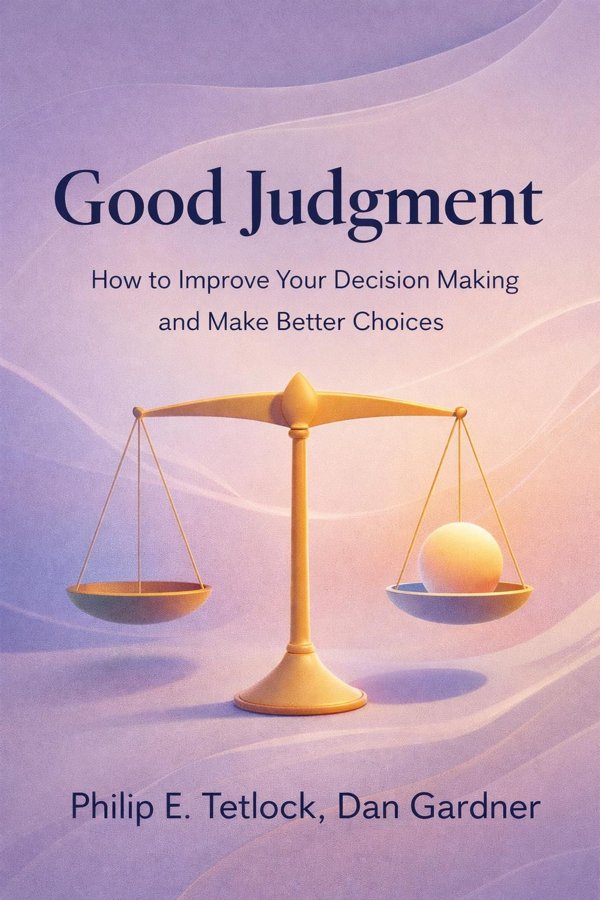
Good Judgment: How to Improve Your Decision Making and Make Better Choices: Summary & Key Insights
by Philip E. Tetlock, Dan Gardner
 10 min10 chaptersAudio available
Key Takeaways from Good Judgment: How to Improve Your Decision Making and Make Better Choices
One of the book’s most provocative findings is that ordinary people can often predict important events more accurately than celebrated experts.
The minds of strong forecasters are built on a paradox: they think seriously without thinking rigidly.
A striking lesson from Tetlock’s broader research is that expertise does not guarantee accuracy.
Complex problems often feel unmanageable because we confront them in one intimidating piece.
Good judgment grows when predictions meet reality.
What Is Good Judgment: How to Improve Your Decision Making and Make Better Choices About?
Good Judgment: How to Improve Your Decision Making and Make Better Choices by Philip E. Tetlock, Dan Gardner is a cognition book spanning 10 pages. Good Judgment is a practical and evidence-based guide to thinking more clearly about an uncertain world. In this book, Philip E. Tetlock and Dan Gardner draw on the groundbreaking Good Judgment Project, a large-scale forecasting tournament that tested whether ordinary people could make accurate predictions about complex global events. The results were surprising: some participants consistently outperformed experts, intelligence agencies, and conventional wisdom. These top performers, called “superforecasters,” were not prophets or geniuses with secret information. They were disciplined thinkers who approached uncertainty with humility, curiosity, and a willingness to revise their views. The book matters because modern life demands constant judgment under uncertainty. We make choices about careers, investments, health, politics, hiring, and strategy without ever having complete information. Tetlock, a renowned psychologist known for his research on expert political judgment, and Gardner, an accomplished journalist and writer on decision-making, combine rigorous research with vivid storytelling to show how better forecasting is possible. Their core message is hopeful: good judgment is not an inborn gift. It is a skill set that can be learned, practiced, and improved.
This FizzRead summary covers all 10 key chapters of Good Judgment: How to Improve Your Decision Making and Make Better Choices in approximately 10 minutes, distilling the most important ideas, arguments, and takeaways from Philip E. Tetlock, Dan Gardner's work. Also available as an audio summary and Key Quotes Podcast.
Good Judgment: How to Improve Your Decision Making and Make Better Choices
Good Judgment is a practical and evidence-based guide to thinking more clearly about an uncertain world. In this book, Philip E. Tetlock and Dan Gardner draw on the groundbreaking Good Judgment Project, a large-scale forecasting tournament that tested whether ordinary people could make accurate predictions about complex global events. The results were surprising: some participants consistently outperformed experts, intelligence agencies, and conventional wisdom. These top performers, called “superforecasters,” were not prophets or geniuses with secret information. They were disciplined thinkers who approached uncertainty with humility, curiosity, and a willingness to revise their views.
The book matters because modern life demands constant judgment under uncertainty. We make choices about careers, investments, health, politics, hiring, and strategy without ever having complete information. Tetlock, a renowned psychologist known for his research on expert political judgment, and Gardner, an accomplished journalist and writer on decision-making, combine rigorous research with vivid storytelling to show how better forecasting is possible. Their core message is hopeful: good judgment is not an inborn gift. It is a skill set that can be learned, practiced, and improved.
Who Should Read Good Judgment: How to Improve Your Decision Making and Make Better Choices?
This book is perfect for anyone interested in cognition and looking to gain actionable insights in a short read. Whether you're a student, professional, or lifelong learner, the key ideas from Good Judgment: How to Improve Your Decision Making and Make Better Choices by Philip E. Tetlock, Dan Gardner will help you think differently.
- ✓Readers who enjoy cognition and want practical takeaways
- ✓Professionals looking to apply new ideas to their work and life
- ✓Anyone who wants the core insights of Good Judgment: How to Improve Your Decision Making and Make Better Choices in just 10 minutes
Want the full summary?
Get instant access to this book summary and 100K+ more with Fizz Moment.
Get Free SummaryAvailable on App Store • Free to download
Key Chapters
One of the book’s most provocative findings is that ordinary people can often predict important events more accurately than celebrated experts. That idea challenges a common assumption: that status, credentials, and media visibility automatically produce better judgment. Through the Good Judgment Project, Tetlock and his colleagues asked thousands of volunteers to forecast real-world developments such as elections, geopolitical conflicts, economic shifts, and policy outcomes. The forecasts were scored with precision, making it possible to compare performance over time. Again and again, a small subset of forecasters stood out.
These “superforecasters” were not mystical seers. They came from different professions and backgrounds. What united them was not special access to information but a distinct style of thinking. They were intellectually humble, comfortable with uncertainty, eager to update their opinions, and careful to separate what they knew from what they merely assumed. They resisted the urge to make dramatic, absolute claims and instead thought in probabilities.
This matters because many organizations still reward confidence more than accuracy. Public debate often favors bold declarations over nuanced estimates. Yet the book shows that forecasting skill is measurable and improvable. Reliable judgment comes less from sounding certain and more from thinking carefully, gathering evidence, and revising beliefs when reality changes.
In practical terms, this insight applies far beyond geopolitics. A manager deciding whether a product launch will succeed, an investor weighing a market trend, or a family estimating the likelihood of a move paying off can all benefit from forecasting habits. Instead of asking, “What do I believe?” ask, “What is the probability, and what evidence supports it?”
Actionable takeaway: Start expressing important predictions as probabilities, then track the results to learn whether your confidence matches reality.
The minds of strong forecasters are built on a paradox: they think seriously without thinking rigidly. Most people want certainty. We feel safer when our opinions are clear and our identities are attached to them. But certainty can become a trap. The best forecasters avoid this by treating beliefs as tools, not possessions. They are committed to getting things right, not to defending what they said yesterday.
Tetlock and Gardner describe a set of habits that distinguish better judgment. Superforecasters are actively open-minded. They seek out disconfirming evidence instead of hiding from it. They remain curious about alternative explanations. They also break their ego’s attachment to being right. This does not make them indecisive. On the contrary, it makes them more adaptable. Because they are willing to revise their estimates, they often stay closer to reality as new information appears.
This style of thinking is useful in everyday decisions. Imagine a leader convinced that a competitor will fail. A rigid mind filters every new development through that expectation. A flexible mind asks whether early assumptions still hold. Or consider a person deciding whether to switch careers. Rather than framing the choice as success or failure, a more curious thinker might explore multiple scenarios, probabilities, and timelines.
Humility in this context does not mean low confidence. It means recognizing the limits of your knowledge. Curiosity means continuing to investigate. Flexibility means changing course when the evidence warrants it. Together, these qualities make judgment stronger, not weaker.
Actionable takeaway: When you form a strong opinion, immediately ask yourself, “What evidence would make me change my mind?” and actively look for it.
A striking lesson from Tetlock’s broader research is that expertise does not guarantee accuracy. In fact, experts can be especially vulnerable to overconfidence because they have compelling stories, strong reputations, and loyal audiences. The problem is not knowledge itself. The problem is the illusion that knowledge automatically translates into predictive skill. Many experts explain the world persuasively after events happen, but that does not mean they were good at seeing those events in advance.
The book distinguishes between experts who simplify the world into one grand theory and those who use many smaller, testable ideas. The first type tends to be more confident and more wrong. They fit everything into one framework and resist inconvenient facts. The second type is more cautious, eclectic, and responsive to evidence. This second style resembles the superforecaster mindset.
Overconfidence shows up everywhere. Executives become sure a merger will succeed because the strategic narrative sounds coherent. Political commentators make sweeping predictions based on ideology. Even in personal life, people overestimate how well they understand relationships, health risks, or future preferences. Confidence feels good, but it often exceeds what the evidence can justify.
A better approach is to separate explanation from prediction. Someone may be eloquent and knowledgeable yet still poor at assigning realistic odds. The key question is not, “Does this person sound convincing?” but, “How accurate have their forecasts been over time?” This shift can improve whom we trust, how we evaluate decisions, and how we monitor our own thinking.
Actionable takeaway: Before relying on an expert opinion, look for a track record of calibrated forecasts rather than polished certainty or impressive credentials alone.
Complex problems often feel unmanageable because we confront them in one intimidating piece. One of the most useful forecasting techniques in Good Judgment is to decompose a hard question into smaller, more tractable parts. Instead of asking, “Will this policy succeed?” or “Will this startup become profitable?” skilled forecasters ask a series of narrower questions that can be analyzed more realistically.
For example, a geopolitical forecast about whether a country will sign a treaty might be broken down into leadership incentives, domestic political pressures, economic conditions, military developments, and timing. A business decision about launching in a new market can be divided into customer demand, regulatory barriers, likely competitor responses, pricing sensitivity, and operational readiness. Each piece may still be uncertain, but it is easier to estimate than the whole.
This method improves thinking in several ways. It reduces emotional overwhelm, exposes hidden assumptions, and invites more specific evidence gathering. It also helps reveal where disagreement really lies. Two people may both disagree about a final prediction, yet the real difference may come from only one sub-question. Once the issue is isolated, discussion becomes more productive.
Decomposition also supports better planning. If a major outcome depends heavily on one uncertain variable, that is where monitoring and contingency preparation should focus. Instead of arguing endlessly about the big picture, you can identify leverage points.
Many poor decisions happen because people jump from vague intuition straight to a conclusion. Breaking a problem apart forces structure onto ambiguity. It turns a mysterious future into a series of questions that can be tested, revised, and improved over time.
Actionable takeaway: For any major decision, write the main question at the top of a page and list five smaller questions whose answers most influence the outcome.
Good judgment grows when predictions meet reality. One of the reasons people fail to improve is that they rarely receive clear, timely feedback on whether their beliefs were justified. Forecasting changes this by creating feedback loops. If you assign a 70 percent chance to an event and then repeatedly track similar predictions, you can learn whether your 70 percent really means 70 percent in practice.
This is the idea of calibration: how closely your confidence levels match actual outcomes. A well-calibrated person who says “80 percent likely” should be right about eight times out of ten over many cases. Calibration matters because many of us are systematically too certain or too hesitant. Without measurement, those tendencies remain invisible.
The Good Judgment Project improved performance by giving participants repeated opportunities to forecast, update, and compare outcomes. This created a learning system. Forecasters could see where they were too optimistic, too anchored on first impressions, or too slow to incorporate new evidence. Over time, many became better not because they discovered a magic formula but because they learned from error.
The same principle applies in organizations and personal life. A hiring manager can record predictions about candidate performance and later compare them to results. A product team can estimate launch metrics before release and then review misses. A person deciding on time commitments can forecast how long projects will take and track actual completion times. These simple practices reveal patterns of bias that intuition alone misses.
Feedback is only useful when it is honest and specific. Vague reflection like “that went badly” teaches little. Measured comparison between expected and actual outcomes teaches a lot.
Actionable takeaway: Keep a decision journal that records your prediction, confidence level, reasoning, and outcome so you can systematically learn from your own forecasting errors.
Another powerful insight from the book is that forecasting often improves when people think together well. Collective intelligence is not automatic. Groups can become echo chambers, status hierarchies, or vehicles for groupthink. But when designed properly, teams can outperform individuals by pooling diverse knowledge, challenging assumptions, and refining judgments through debate.
The Good Judgment Project found that teams of forecasters often did better than solo participants, especially when members were encouraged to share reasoning rather than merely state conclusions. Strong teams balanced independence and collaboration. Members first developed their own views, reducing conformity pressure, and then compared evidence and arguments. This process allowed the group to benefit from varied perspectives while avoiding premature consensus.
Diversity matters here, but not only demographic diversity. Cognitive diversity is crucial. Teams improve when members bring different models, experiences, and information sources. A political scientist, regional specialist, economist, and statistician may each notice something others miss. The goal is not endless disagreement but constructive friction.
This has broad applications. In business, strategic planning improves when finance, operations, sales, and customer-facing teams each contribute forecasts. In medicine, diagnosis can improve when clinicians compare interpretations rather than defer too quickly to senior authority. Even family decisions, such as moving or making a major purchase, can benefit from each person offering their own probability estimate before discussing the final choice.
The key is structure. Good teams reward accuracy, not ego. They ask people to explain why, update publicly, and revise without shame. Under those conditions, collaboration becomes an engine of better judgment instead of a source of distortion.
Actionable takeaway: In group decisions, collect individual forecasts before discussion, then compare reasoning openly to produce a more accurate final estimate.
The future is rarely a matter of yes or no. One of the book’s central lessons is that better judgment depends on probabilistic thinking. Most people dislike speaking in percentages because it feels less decisive. We prefer categorical statements like “This will happen” or “That will never work.” But certainty language is often misleading in an uncertain world. Probabilities are not weakness. They are precision about uncertainty.
Superforecasters routinely think in ranges and odds. Instead of asking whether a company will grow, they ask how likely growth is under current conditions. Instead of debating whether a policy is a failure, they consider multiple possible outcomes and assign estimated likelihoods. This allows for more nuanced judgment and better updating as evidence changes.
Probabilistic thinking is closely linked to Bayesian updating, the process of starting with an initial estimate and revising it incrementally when new information arrives. Rather than swinging wildly from one belief to another, the forecaster asks: how much should this new fact change my current probability? This prevents overreaction and underreaction. It turns belief revision into a disciplined process.
Consider a manager estimating whether a major client will renew a contract. An initial estimate might be 60 percent. Positive signals from recent meetings may raise it modestly, while signs of budget trouble may lower it. The point is not to guess perfectly from the start but to keep improving the estimate. The same logic applies to investing, medical choices, legal strategy, and personal planning.
The habit of probabilistic thinking also improves communication. It clarifies how confident you are, where uncertainty lies, and what would change your view.
Actionable takeaway: Replace absolute predictions with percentages and update them in small steps whenever meaningful new evidence appears.
People think more carefully when they expect their judgments to be examined. Accountability is a recurring theme in Good Judgment because forecasting quality improves when predictions are explicit, recorded, and reviewable. Vague claims allow us to rewrite history in our favor. Specific predictions expose whether our reasoning was actually sound.
This matters because many institutions unintentionally reward the wrong things. Leaders are often praised for decisiveness, charisma, and persuasive narratives, even when their forecasts prove inaccurate. In contrast, systems that track outcomes create incentives for rigor. When people know they will have to compare expectations with results, they become more likely to seek evidence, question assumptions, and communicate uncertainty honestly.
Structured decision-making reinforces this effect. A good process might require decision-makers to define the question clearly, estimate probabilities, identify key assumptions, note alternative scenarios, and specify what evidence would trigger an update. This does not eliminate error, but it makes error more visible and learning more possible.
In organizations, accountability can transform planning meetings from theatrical confidence displays into serious forecasting exercises. Teams can review past predictions, identify recurring biases, and improve resource allocation. In personal life, accountability helps with major choices like home purchases, career moves, and financial planning. Writing down why you believe something will happen creates a reference point that future-you can learn from.
Importantly, accountability should not become punishment for being wrong in a genuinely uncertain world. The goal is not perfect foresight. The goal is better process, more honest reasoning, and steady improvement.
Actionable takeaway: For important decisions, document your forecast, assumptions, and success criteria before acting, then review the outcome against what you originally expected.
It is easy to assume that forecasting is relevant only to intelligence analysts, economists, or political specialists. Tetlock and Gardner show the opposite. The habits of good judgment are useful anywhere uncertainty exists, which means almost everywhere. Whether you are deciding when to hire, how much money to save, whether to pivot a business, or how likely a lifestyle change is to last, forecasting principles can improve the quality of your choices.
A useful shift is to see decisions and predictions as connected. Every decision contains an implicit forecast. Accepting a job means predicting that the role, company, and compensation will make the change worthwhile. Starting a business means predicting customer demand and your own persistence. Entering a relationship, moving to a new city, or beginning a degree program all involve assumptions about future outcomes. If we become more explicit about those assumptions, we gain the chance to test and improve them.
Applying forecasting in daily life means estimating probabilities, considering base rates, breaking complex choices into components, and updating with new information. For example, instead of saying “I’ll definitely stick to this budget,” estimate the likelihood based on your past behavior, upcoming expenses, and environmental triggers. Instead of assuming a project will be finished on time, compare with similar past projects and adjust expectations.
Organizations can institutionalize this by using forecast questions in strategy reviews, postmortems, and scenario planning. Individuals can do it through journals, checklists, and periodic reflection. The aim is not to turn life into a spreadsheet. It is to make hidden assumptions visible so choices become more realistic and resilient.
Actionable takeaway: Treat every major decision as an implicit forecast and ask, “What future am I betting on, and how likely is it really?”
The book’s implications reach beyond personal success or organizational performance. Tetlock and Gardner argue that judgment quality matters for democracy itself. Public life is filled with uncertainty, yet political discourse often rewards certainty, tribal loyalty, and rhetorical force. Forecasting offers a healthier model: one grounded in evidence, probability, updating, and accountability.
When citizens, journalists, policymakers, and experts think probabilistically, public debate becomes less about defending identities and more about comparing expectations with reality. Instead of cheering for narratives that flatter one side, people can ask concrete questions: How likely is this policy to reduce inflation? What are the probable consequences of military intervention? Which assumptions underlie this reform proposal? Such questions do not remove disagreement, but they make disagreement more disciplined.
The book also highlights the danger of closed-mindedness in polarized environments. Once beliefs become badges of belonging, changing your mind feels like betrayal. Superforecasting points toward a different civic virtue: revisability. A mature democracy needs people who can hold strong values while remaining open to evidence about what works.
This idea applies to institutions too. Governments and media organizations can improve judgment by tracking forecasts, rewarding accuracy, and distinguishing between speculation and evidence-based estimation. Public trust grows when claims are transparent and revisable rather than absolute and evasive.
Ultimately, better judgment is not just a private asset. It is a social good. Societies make wiser choices when they create cultures that respect nuance, encourage learning, and measure predictive performance instead of theatrical certainty.
Actionable takeaway: In political and public discussions, focus less on who sounds most certain and more on which claims are specific, testable, and open to revision.
All Chapters in Good Judgment: How to Improve Your Decision Making and Make Better Choices
About the Authors
Philip E. Tetlock is a leading psychologist, researcher, and professor at the University of Pennsylvania, where he has studied political judgment, forecasting, and decision-making for decades. He is widely known for his influential work on why expert predictions often fail and for helping lead the Good Judgment Project, which identified the traits and methods of highly accurate forecasters. Dan Gardner is a journalist and bestselling author whose work focuses on psychology, risk, decision-making, and human behavior. He is known for turning complex research into engaging, accessible narratives for a broad audience. Together, Tetlock and Gardner combine scientific depth with practical clarity, making their collaboration especially valuable for readers who want both rigorous evidence and actionable insight.
Get This Summary in Your Preferred Format
Read or listen to the Good Judgment: How to Improve Your Decision Making and Make Better Choices summary by Philip E. Tetlock, Dan Gardner anytime, anywhere. FizzRead offers multiple formats so you can learn on your terms — all free.
Available formats: App · Audio · PDF · EPUB — All included free with FizzRead
Download Good Judgment: How to Improve Your Decision Making and Make Better Choices PDF and EPUB Summary
Key Quotes from Good Judgment: How to Improve Your Decision Making and Make Better Choices
“One of the book’s most provocative findings is that ordinary people can often predict important events more accurately than celebrated experts.”
“The minds of strong forecasters are built on a paradox: they think seriously without thinking rigidly.”
“A striking lesson from Tetlock’s broader research is that expertise does not guarantee accuracy.”
“Complex problems often feel unmanageable because we confront them in one intimidating piece.”
“Good judgment grows when predictions meet reality.”
Frequently Asked Questions about Good Judgment: How to Improve Your Decision Making and Make Better Choices
Good Judgment: How to Improve Your Decision Making and Make Better Choices by Philip E. Tetlock, Dan Gardner is a cognition book that explores key ideas across 10 chapters. Good Judgment is a practical and evidence-based guide to thinking more clearly about an uncertain world. In this book, Philip E. Tetlock and Dan Gardner draw on the groundbreaking Good Judgment Project, a large-scale forecasting tournament that tested whether ordinary people could make accurate predictions about complex global events. The results were surprising: some participants consistently outperformed experts, intelligence agencies, and conventional wisdom. These top performers, called “superforecasters,” were not prophets or geniuses with secret information. They were disciplined thinkers who approached uncertainty with humility, curiosity, and a willingness to revise their views. The book matters because modern life demands constant judgment under uncertainty. We make choices about careers, investments, health, politics, hiring, and strategy without ever having complete information. Tetlock, a renowned psychologist known for his research on expert political judgment, and Gardner, an accomplished journalist and writer on decision-making, combine rigorous research with vivid storytelling to show how better forecasting is possible. Their core message is hopeful: good judgment is not an inborn gift. It is a skill set that can be learned, practiced, and improved.
More by Philip E. Tetlock, Dan Gardner
You Might Also Like
A Field Guide to Lies: Critical Thinking in the Information Age
Daniel J. Levitin
10 min
A Theory of Cognitive Dissonance
Leon Festinger
10 min
Black-And-White Thinking: The Burden of a Binary Brain in a Complex World
Kevin Dutton
10 min
Born Liars: Why We Can’t Live Without Deceit
Ian Leslie
10 min
Collective Illusions: Conformity, Complicity, and the Science of Why We Make Bad Decisions
Todd Rose
10 min
Concrete Mathematics: A Foundation for Computer Science
Ronald L. Graham, Donald E. Knuth, Oren Patashnik
10 minBrowse by Category
Ready to read Good Judgment: How to Improve Your Decision Making and Make Better Choices?
Get the full summary and 100K+ more books with Fizz Moment.