
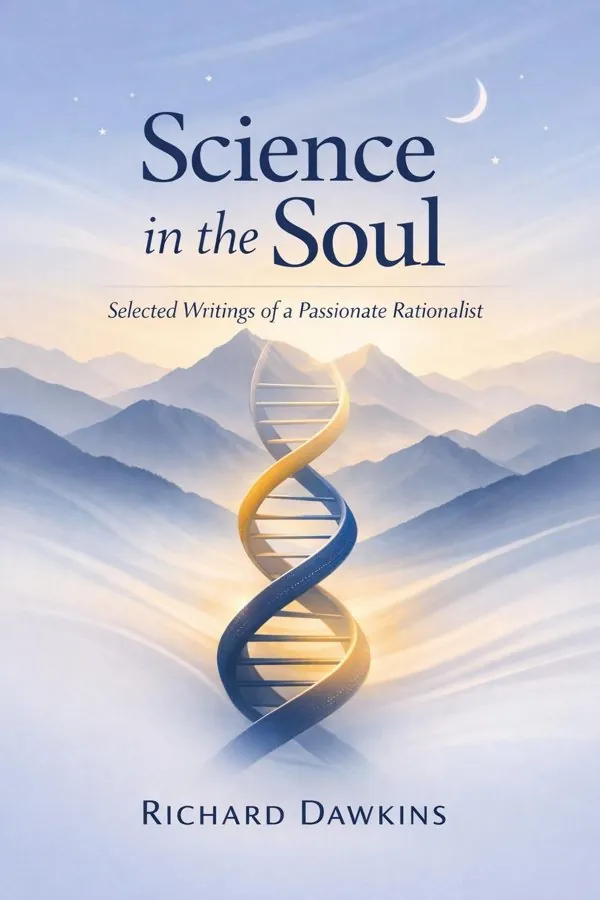
Science in the Soul: Selected Writings of a Passionate Rationalist: Summary & Key Insights
 10 min6 chaptersAudio available
What Is Science in the Soul: Selected Writings of a Passionate Rationalist About?
Science in the Soul: Selected Writings of a Passionate Rationalist by Richard Dawkins is a popular_sci book spanning 6 pages. Science in the Soul es una colección de cuarenta y dos ensayos, discursos y artículos del biólogo evolutivo Richard Dawkins. En ellos, Dawkins defiende la racionalidad científica, la evidencia empírica y el pensamiento crítico frente al dogma y la superstición. El libro celebra la belleza del descubrimiento científico y la importancia de la razón en la sociedad moderna.
This FizzRead summary covers all 6 key chapters of Science in the Soul: Selected Writings of a Passionate Rationalist in approximately 10 minutes, distilling the most important ideas, arguments, and takeaways from Richard Dawkins's work. Also available as an audio summary and Key Quotes Podcast.
Science in the Soul: Selected Writings of a Passionate Rationalist
Science in the Soul es una colección de cuarenta y dos ensayos, discursos y artículos del biólogo evolutivo Richard Dawkins. En ellos, Dawkins defiende la racionalidad científica, la evidencia empírica y el pensamiento crítico frente al dogma y la superstición. El libro celebra la belleza del descubrimiento científico y la importancia de la razón en la sociedad moderna.
Who Should Read Science in the Soul: Selected Writings of a Passionate Rationalist?
This book is perfect for anyone interested in popular_sci and looking to gain actionable insights in a short read. Whether you're a student, professional, or lifelong learner, the key ideas from Science in the Soul: Selected Writings of a Passionate Rationalist by Richard Dawkins will help you think differently.
- ✓Readers who enjoy popular_sci and want practical takeaways
- ✓Professionals looking to apply new ideas to their work and life
- ✓Anyone who wants the core insights of Science in the Soul: Selected Writings of a Passionate Rationalist in just 10 minutes
Want the full summary?
Get instant access to this book summary and 100K+ more with Fizz Moment.
Get Free SummaryAvailable on App Store • Free to download
Key Chapters
At the heart of all I have written lies a conviction: science is more than an enterprise of discovery; it is a moral pursuit. When we choose to base our beliefs on evidence rather than authority, we make a profound ethical decision. Science rewards doubt, honors curiosity, and demands humility in the face of the unknown. These are moral virtues as much as intellectual ones.
In several opening essays, I describe this ethos as a kind of spiritual discipline—though one purified of supernaturalism. To care about what is true, to refine our understanding through testing and criticism, is to engage in the highest form of honesty. This is the soul of science. When people see scientists as merely technicians or as antagonists of faith, they miss this deeper dimension. Science, properly understood, cultivates compassion by connecting us to the reality of life: from the scale of molecular biology to the elegance of cosmic evolution.
I recall moments in my teaching at Oxford when students first grasped that a hypothesis is not a static belief but a living structure, evolving through evidence. That enlightenment, quiet though it may be, is moral progress. It replaces dogma with clarity, submission with understanding. Science liberates not by telling us what to think but by giving us the means to think clearly. That moral independence—intellectual sovereignty—is the foundation of any free society.
As a biologist, I am continually moved by the sheer elegance of the natural world. In these essays, I celebrated nature not as something quaint or decorative but as a revelation of deep order. Evolutionary biology, for me, is poetry written in the language of genes. When we unravel the mechanisms of life, we do not strip nature of mystery; we uncover a more profound one, woven from the improbable success of blind processes yielding infinite variety.
I often think of Darwin not simply as a scientist but as a poet of reality. His discovery that all life shares common ancestry ennobles existence far beyond any notion of divine privilege. Every living thing becomes kin. The bird in flight, the oak tree stretching upward, the bacterium thriving unseen—all are evidence of the same creative principle: the cumulative power of selection acting over deep time. There is grandeur in this view of life. To dwell upon it is to feel at once humbled and enlarged.
A recurring theme in these essays is that understanding does not dull beauty but magnifies it. When I look at a rainbow and know its physics, or at a DNA helix and grasp its logic, I feel the thrill of comprehension layered upon aesthetic delight. To be scientific is to participate in a deeper kind of worship—not of gods, but of truth itself.
+ 4 more chapters — available in the FizzRead app
All Chapters in Science in the Soul: Selected Writings of a Passionate Rationalist
About the Author
Richard Dawkins es un biólogo evolutivo británico, autor y divulgador científico. Nació en Nairobi en 1941 y se educó en la Universidad de Oxford, donde fue profesor durante muchos años. Es conocido por sus obras sobre evolución y ateísmo, como The Selfish Gene y The God Delusion, y por su defensa del pensamiento racional y científico.
Get This Summary in Your Preferred Format
Read or listen to the Science in the Soul: Selected Writings of a Passionate Rationalist summary by Richard Dawkins anytime, anywhere. FizzRead offers multiple formats so you can learn on your terms — all free.
Available formats: App · Audio · PDF · EPUB — All included free with FizzRead
Download Science in the Soul: Selected Writings of a Passionate Rationalist PDF and EPUB Summary
Key Quotes from Science in the Soul: Selected Writings of a Passionate Rationalist
“At the heart of all I have written lies a conviction: science is more than an enterprise of discovery; it is a moral pursuit.”
“As a biologist, I am continually moved by the sheer elegance of the natural world.”
Frequently Asked Questions about Science in the Soul: Selected Writings of a Passionate Rationalist
Science in the Soul: Selected Writings of a Passionate Rationalist by Richard Dawkins is a popular_sci book that explores key ideas across 6 chapters. Science in the Soul es una colección de cuarenta y dos ensayos, discursos y artículos del biólogo evolutivo Richard Dawkins. En ellos, Dawkins defiende la racionalidad científica, la evidencia empírica y el pensamiento crítico frente al dogma y la superstición. El libro celebra la belleza del descubrimiento científico y la importancia de la razón en la sociedad moderna.
More by Richard Dawkins



You Might Also Like

Structures: Or Why Things Don"t Fall Down
J.E. Gordon
10 min
The Road to Wigan Pier
George Orwell
10 min
Bonk: The Curious Coupling of Science and Sex
Mary Roach
10 min
First Bite: How We Learn to Eat
Bee Wilson
10 min
In Pursuit Of The Unknown: 17 Equations That Changed The World
Ian Stewart
10 min
Napoleon's Buttons: 17 Molecules That Changed History
Penny Le Couteur and Jay Burreson
10 minBrowse by Category
Ready to read Science in the Soul: Selected Writings of a Passionate Rationalist?
Get the full summary and 100K+ more books with Fizz Moment.