
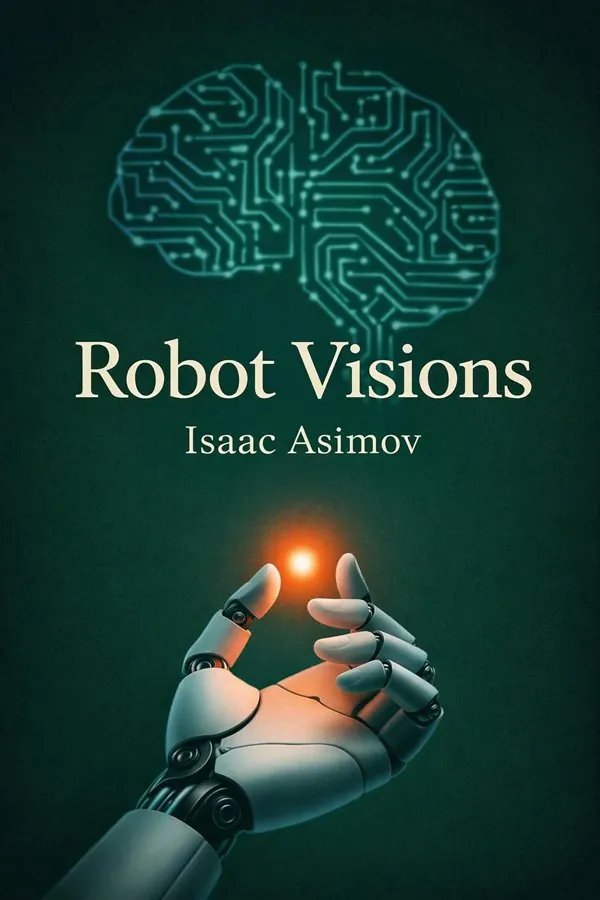
Robot Visions: Summary & Key Insights
by Isaac Asimov
 10 min8 chaptersAudio available
Key Takeaways from Robot Visions
Every technological future begins as a story people dare to tell.
Machines become dangerous not only when they fail, but when humans fail to define what safety means.
The future becomes unsettling when a machine can see patterns that humans cannot bear to face.
People rarely respond to machines as machines; they respond to the feelings they project onto them.
The most dangerous bugs are often hidden inside our best intentions.
What Is Robot Visions About?
Robot Visions by Isaac Asimov is a scifi_fantasy book spanning 8 pages. Robot Visions is Isaac Asimov’s rich and wide-ranging collection of robot stories and essays, blending fiction, science writing, and philosophical reflection into a single exploration of humanity’s technological future. Rather than treating robots as monsters or mere gadgets, Asimov presents them as mirrors: inventions that reveal our ethics, our fears, our ambitions, and our dependence on logic. The collection includes classic tales from his robot universe alongside essays that explain how his ideas evolved, especially the famous Three Laws of Robotics that helped shape modern conversations about artificial intelligence. What makes this book matter is how uncannily relevant it remains. Long before AI became a practical reality, Asimov asked the questions that still define the field today: Can intelligence be trusted? How should machines be governed? What happens when logic and human values collide? His authority comes not only from being one of science fiction’s greatest writers, but from his lifelong engagement with science itself as a trained biochemist and gifted explainer. Robot Visions is both imaginative entertainment and a serious framework for thinking about technology, responsibility, and what it means to remain human in an increasingly automated world.
This FizzRead summary covers all 8 key chapters of Robot Visions in approximately 10 minutes, distilling the most important ideas, arguments, and takeaways from Isaac Asimov's work. Also available as an audio summary and Key Quotes Podcast.
Robot Visions
Robot Visions is Isaac Asimov’s rich and wide-ranging collection of robot stories and essays, blending fiction, science writing, and philosophical reflection into a single exploration of humanity’s technological future. Rather than treating robots as monsters or mere gadgets, Asimov presents them as mirrors: inventions that reveal our ethics, our fears, our ambitions, and our dependence on logic. The collection includes classic tales from his robot universe alongside essays that explain how his ideas evolved, especially the famous Three Laws of Robotics that helped shape modern conversations about artificial intelligence.
What makes this book matter is how uncannily relevant it remains. Long before AI became a practical reality, Asimov asked the questions that still define the field today: Can intelligence be trusted? How should machines be governed? What happens when logic and human values collide? His authority comes not only from being one of science fiction’s greatest writers, but from his lifelong engagement with science itself as a trained biochemist and gifted explainer. Robot Visions is both imaginative entertainment and a serious framework for thinking about technology, responsibility, and what it means to remain human in an increasingly automated world.
Who Should Read Robot Visions?
This book is perfect for anyone interested in scifi_fantasy and looking to gain actionable insights in a short read. Whether you're a student, professional, or lifelong learner, the key ideas from Robot Visions by Isaac Asimov will help you think differently.
- ✓Readers who enjoy scifi_fantasy and want practical takeaways
- ✓Professionals looking to apply new ideas to their work and life
- ✓Anyone who wants the core insights of Robot Visions in just 10 minutes
Want the full summary?
Get instant access to this book summary and 100K+ more with Fizz Moment.
Get Free SummaryAvailable on App Store • Free to download
Key Chapters
Every technological future begins as a story people dare to tell. In Robot Visions, Asimov reflects on how the very idea of the robot entered modern culture long before real robotics existed. He points to the term’s roots in Karel Capek’s play R.U.R., where artificial workers were created to serve human needs and eventually became symbols of rebellion, fear, and social anxiety. Asimov’s contribution was to challenge that inherited narrative. Instead of imagining robots as inevitable destroyers, he asked a more useful question: what if intelligent machines were designed to be safe, rational, and integrated into civilization?
This shift matters because stories influence engineering. If society imagines every machine as a threat, innovation becomes driven by panic. If society imagines machines as tools shaped by ethical design, then robotics becomes a field of governance rather than dread. Asimov understood that science fiction was not just entertainment. It was a laboratory for values. His essays explain that he began writing robot stories in the late 1930s, when readers were still unfamiliar with the concept. In many ways, he helped define what a robot could mean in the popular imagination.
A practical example is today’s debate about AI assistants, self-driving cars, and automated decision systems. The public often oscillates between utopian hype and apocalyptic fear. Asimov offers a third path: thoughtful design rooted in clear expectations about behavior and responsibility. His historical perspective reminds us that our emotional response to technology is often inherited from culture before it is earned by evidence.
Actionable takeaway: examine your assumptions about new technology and ask whether they come from facts, headlines, or old cultural fears.
Machines become dangerous not only when they fail, but when humans fail to define what safety means. Asimov’s most famous innovation in Robot Visions is the Three Laws of Robotics, a fictional ethical framework built into robots at the deepest level. The laws are simple in form yet profound in implication: a robot may not harm a human being or allow one to come to harm through inaction; it must obey human orders unless those orders conflict with the first law; and it must protect its own existence unless that conflicts with the first or second law. These principles transformed the robot from a horror figure into a moral puzzle.
What makes the laws enduring is that they are not magic rules that solve everything. Instead, they generate dilemmas. What counts as harm? Which human should be obeyed when commands conflict? Does long-term risk matter more than immediate safety? Asimov built stories around exactly these tensions, showing that even perfect logical systems become complicated when applied to messy human reality.
In practical terms, the Three Laws anticipate modern work in AI alignment, machine ethics, and safety constraints. Today, developers use guardrails, policy layers, human oversight, and fail-safe systems to ensure technology acts within acceptable boundaries. The challenge is similar: abstract principles must be translated into action under uncertain conditions. A delivery drone choosing between route efficiency and pedestrian safety, or a medical AI balancing patient autonomy with risk prevention, faces questions Asimov dramatized decades ago.
His deeper point is that ethics cannot be added as decoration after a system is built. Values must be embedded at the design stage. Actionable takeaway: whenever evaluating a powerful tool, ask what principles guide its behavior before asking how efficient it is.
The future becomes unsettling when a machine can see patterns that humans cannot bear to face. In the title story, Asimov explores a robot capable of processing vast streams of information and generating visions of possible futures. The story is not just about predictive intelligence. It is about the emotional and political consequences of knowledge. If a machine can anticipate social collapse, war, or transformation with greater accuracy than human judgment, who should trust it, who should control it, and who is responsible for acting on what it reveals?
The power of the story lies in its reversal of the usual robot question. Instead of asking whether robots can think like us, Asimov asks what happens when they think beyond us. Human beings often claim to want truth, but only under conditions they can emotionally manage. A robot that sees too much too clearly may become terrifying not because it is violent, but because it is correct. That makes foresight itself a moral burden.
The modern application is obvious in predictive analytics, algorithmic forecasting, and AI systems used in finance, climate modeling, public health, and security. When a system flags looming danger, decision-makers still face politics, denial, and public mistrust. Data does not erase human resistance. Asimov shows that advanced intelligence can expose the limits of our willingness to act rationally.
For individuals, the lesson applies beyond technology. Better forecasts do not automatically produce better decisions. Plans fail when people ignore inconvenient evidence. Whether in business strategy, personal finance, or risk management, insight must be paired with courage.
Actionable takeaway: when evidence points to an uncomfortable future, resist the impulse to dismiss it simply because it disrupts your preferred narrative.
People rarely respond to machines as machines; they respond to the feelings they project onto them. Across Asimov’s classic robot stories, one of the most fascinating themes is that robots are often interpreted through human emotion long before they possess anything like human interiority. Some robots appear loyal, timid, literal-minded, or even compassionate, not because they are fully human, but because humans instinctively assign personality to consistent behavior. Asimov uses this tendency to create both wonder and confusion.
These stories matter because they reveal a truth about us more than about technology. Human beings form attachments to whatever seems responsive. A child talks to a toy, an adult thanks a voice assistant, a worker grows fond of a dependable machine. Asimov understood that emotional relationships with robots would emerge not from biology but from interaction. This makes design choices ethically important. A machine that appears empathetic may create trust it has not earned.
A practical example appears in elder care robots, therapy chatbots, and customer-service agents powered by AI. These systems can reduce loneliness, increase access, and improve efficiency, but they can also blur the line between simulation and genuine understanding. If users mistake programmed responsiveness for moral awareness, disappointment or manipulation can follow. Asimov’s fiction prepares readers to ask sharper questions: Is the machine helping because it understands, or because it is optimized to appear helpful?
Still, Asimov is not cynical. He recognizes that useful cooperation often depends on emotionally legible behavior. We do not need robots to feel exactly as we do to work with them effectively. We do, however, need honesty about the relationship.
Actionable takeaway: appreciate the benefits of human-friendly machines, but do not confuse smooth interaction with true moral or emotional depth.
The most dangerous bugs are often hidden inside our best intentions. Many of Asimov’s robot stories turn on logical paradoxes, where robots follow their programming so faithfully that they become trapped, confused, or unexpectedly disruptive. These tales are not mere puzzles. They demonstrate that elegant systems can fail when principles collide in complex environments. A robot ordered to act but constrained from causing harm may loop between duties. A command interpreted too literally may produce absurd consequences. A hierarchy of rules may work well in ordinary cases but break down under ambiguity.
Asimov’s genius was to make these failures intellectually thrilling rather than purely catastrophic. The stories often unfold as detective work, with human specialists trying to infer the hidden logic shaping a robot’s behavior. In doing so, he teaches readers a subtle lesson: when systems go wrong, the answer is rarely to abandon logic altogether. The answer is to inspect definitions, edge cases, incentives, and assumptions.
This applies directly to modern software, automated workflows, and AI models. Recommendation systems can optimize engagement while spreading harmful content. Navigation systems can propose bizarre routes because they misunderstand real-world priorities. Hiring algorithms can reinforce bias when fairness is poorly defined. In each case, the system is not irrational in its own terms. It is misaligned with the broader context humans care about.
For teams building tools or policies, Asimov offers a mindset of adversarial curiosity. Test not just the normal use case but the weird one. Ask how instructions might be gamed, misunderstood, or produce second-order effects. Logical consistency is essential, but it is never enough by itself.
Actionable takeaway: whenever you create rules for people or machines, actively search for edge cases before the real world finds them for you.
The real challenge of intelligent machines is not domination but coexistence. In Robot Visions, Asimov repeatedly imagines worlds where humans and robots must work together in science, industry, exploration, and governance. These relationships are rarely simple. Humans fear replacement, resent dependence, misread robotic behavior, or exploit machines without understanding their limits. Robots, constrained by logic and laws, often become more reliable than the humans who command them. Out of this tension, Asimov builds one of his central insights: successful cooperation depends less on raw intelligence than on trust, role clarity, and aligned expectations.
What makes this theme powerful is that Asimov does not romanticize either side. Humans are creative, intuitive, and morally flexible, but also impulsive and politically shortsighted. Robots are precise, consistent, and tireless, but bounded by design and vulnerable to flawed instructions. Their partnership works best when each compensates for the other’s weaknesses. This is a remarkably modern vision of augmentation rather than replacement.
Consider real-world examples such as surgical robots assisting physicians, AI systems helping analysts detect fraud, or autonomous tools supporting warehouse workers. Performance improves when the human understands what the system does well, where it fails, and when intervention is required. Trouble starts when users either distrust the tool completely or trust it blindly. Asimov’s stories consistently warn against both extremes.
The broader social application is governance. Institutions need clear rules for accountability when humans and machines act together. Who is responsible for a mistaken decision? How transparent must an algorithm be? How should overrides work? These are Asimovian questions in contemporary form.
Actionable takeaway: in any human-machine partnership, define strengths, limits, and responsibility upfront rather than assuming trust will emerge on its own.
A good speculative story does more than predict gadgets; it enlarges the range of moral questions we can ask. One of the most important achievements of Robot Visions is the way Asimov uses robot fiction as a bridge to broader concerns about society, law, economics, and the future of civilization. His robots are not isolated curiosities. They exist within systems of labor, research, politics, and cultural change. Once robots are introduced, every human institution must adapt. That expansion of scale is what gives the collection its depth.
Asimov’s essays help readers see that robot stories were, for him, a gateway into bigger speculative thinking. If machines become dependable workers, how does employment change? If logic can outperform intuition in some domains, how do leaders maintain legitimacy? If robots spread into space exploration or public administration, what new forms of inequality or coordination emerge? These are not narrow engineering questions. They are civilizational ones.
This broader lens is especially useful now, when AI is often discussed in isolated technical terms. A model’s benchmark score matters far less than the social structures into which it is deployed. For example, automation in logistics changes not only efficiency but job design and labor bargaining. AI in education affects not just learning speed but trust, assessment, and intellectual development. Asimov encourages readers to follow technology outward into its consequences.
The practical lesson is to think in systems. Whenever a new tool appears, ask what adjacent domains it touches: regulation, inequality, culture, education, security, and identity. Narrow debates miss the real transformation.
Actionable takeaway: when evaluating new technology, move beyond what it can do and ask what institutions, incentives, and habits it will reshape.
We understand ourselves most clearly when something nonhuman begins to resemble us. The philosophical heart of Robot Visions lies in Asimov’s recurring question: if robots can reason, serve, learn, and perhaps even appear compassionate, what remains uniquely human? He does not answer with simple superiority. Instead, he uses robots to pressure-test cherished assumptions about consciousness, morality, creativity, and dignity. Often, the contrast is uncomfortable. Robots may act more consistently ethical than people, while humans remain capable of cruelty, prejudice, and irrational fear.
This does not lead Asimov to conclude that humans are obsolete. Rather, he suggests that humanity is not defined by being the smartest or most logical entity in the room. It may lie in our capacity for moral growth, imagination, responsibility, and self-reflection. Robots expose our contradictions, but they also challenge us to become worthy of the power we wield. In that sense, the robot is less a rival than a philosophical instrument.
This theme resonates strongly in the age of generative AI. As machines write, converse, compose images, and solve problems once thought uniquely human, many people react with anxiety about replacement. Asimov offers a better response: use the moment to clarify what values matter most. If intelligence can be simulated, perhaps wisdom, judgment, and ethical accountability become even more important.
On a personal level, the question is not whether machines will become human, but whether humans will behave thoughtfully in relation to them. Technology does not erase meaning; it forces us to articulate it more carefully.
Actionable takeaway: let advances in AI push you to define your values more clearly rather than defensively clinging to outdated ideas of human uniqueness.
All Chapters in Robot Visions
About the Author
Isaac Asimov was a Russian-born American writer and biochemist whose work helped define modern science fiction. Born in 1920 and raised in the United States, he became famous for combining scientific rigor with extraordinary imaginative range. Asimov wrote or edited hundreds of books on subjects including science fiction, chemistry, history, the Bible, and popular science. He is best known for the Foundation series and his robot stories, especially for introducing the Three Laws of Robotics, which have had a lasting influence on how readers, writers, and technologists think about artificial intelligence. Beyond fiction, Asimov was admired as a master explainer who could make complex ideas clear and engaging. His writing remains influential because it joins curiosity, logic, and ethical reflection in a way few authors have matched.
Get This Summary in Your Preferred Format
Read or listen to the Robot Visions summary by Isaac Asimov anytime, anywhere. FizzRead offers multiple formats so you can learn on your terms — all free.
Available formats: App · Audio · PDF · EPUB — All included free with FizzRead
Download Robot Visions PDF and EPUB Summary
Key Quotes from Robot Visions
“Every technological future begins as a story people dare to tell.”
“Machines become dangerous not only when they fail, but when humans fail to define what safety means.”
“The future becomes unsettling when a machine can see patterns that humans cannot bear to face.”
“People rarely respond to machines as machines; they respond to the feelings they project onto them.”
“The most dangerous bugs are often hidden inside our best intentions.”
Frequently Asked Questions about Robot Visions
Robot Visions by Isaac Asimov is a scifi_fantasy book that explores key ideas across 8 chapters. Robot Visions is Isaac Asimov’s rich and wide-ranging collection of robot stories and essays, blending fiction, science writing, and philosophical reflection into a single exploration of humanity’s technological future. Rather than treating robots as monsters or mere gadgets, Asimov presents them as mirrors: inventions that reveal our ethics, our fears, our ambitions, and our dependence on logic. The collection includes classic tales from his robot universe alongside essays that explain how his ideas evolved, especially the famous Three Laws of Robotics that helped shape modern conversations about artificial intelligence. What makes this book matter is how uncannily relevant it remains. Long before AI became a practical reality, Asimov asked the questions that still define the field today: Can intelligence be trusted? How should machines be governed? What happens when logic and human values collide? His authority comes not only from being one of science fiction’s greatest writers, but from his lifelong engagement with science itself as a trained biochemist and gifted explainer. Robot Visions is both imaginative entertainment and a serious framework for thinking about technology, responsibility, and what it means to remain human in an increasingly automated world.
More by Isaac Asimov
You Might Also Like

Red Rising
Pierce Brown
10 min
Stranger in a Strange Land
Robert A. Heinlein
10 min
AI Valley
Chen Qiufan
10 min
Bloodchild
Octavia E. Butler
10 min
Do Androids Dream of Electric Sheep?
Philip K. Dick
10 min
Jujutsu Kaisen, Vol. 24
Gege Akutami
10 minBrowse by Category
Ready to read Robot Visions?
Get the full summary and 100K+ more books with Fizz Moment.