
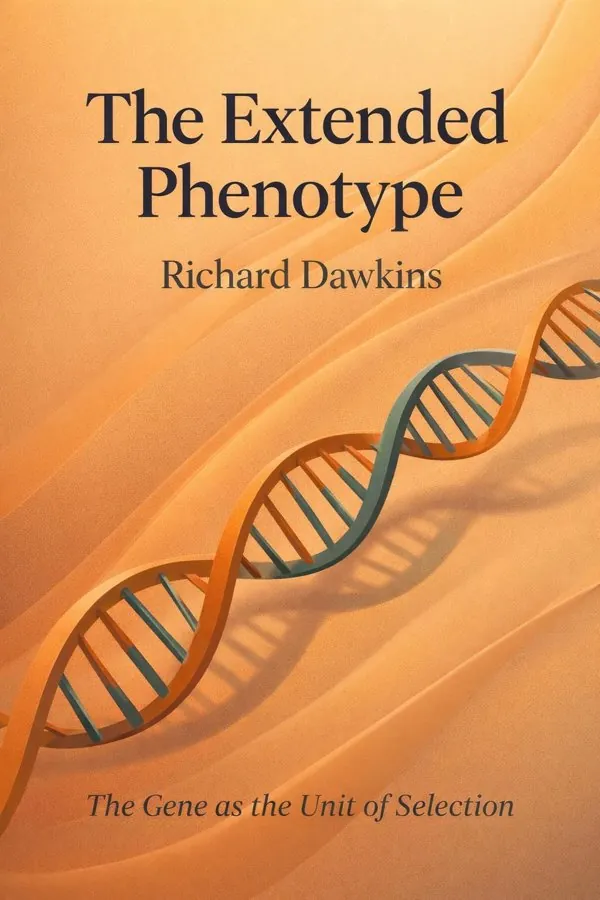
The Extended Phenotype: The Gene as the Unit of Selection: Summary & Key Insights
 10 min10 chaptersAudio available
Key Takeaways from The Extended Phenotype: The Gene as the Unit of Selection
A powerful shift happens when we stop asking what is good for the organism and start asking what persists through evolutionary time.
Before the phenotype can be extended, it must first be understood correctly.
The body feels like a natural boundary, but evolution has no reason to respect our intuitions about where an organism ends.
Some of the clearest extended phenotypes are the constructions animals leave behind.
One of Dawkins’ most fascinating insights is that genes do not even need to remain confined to the body that houses them in order to produce adaptive effects.
What Is The Extended Phenotype: The Gene as the Unit of Selection About?
The Extended Phenotype: The Gene as the Unit of Selection by Richard Dawkins is a life_science book spanning 10 pages. What if an animal’s body is only the beginning of what its genes can build? In The Extended Phenotype, Richard Dawkins pushes evolutionary thinking beyond skin, feathers, fur, and bone. Expanding the gene-centered perspective he introduced in The Selfish Gene, Dawkins argues that a gene’s effects do not stop at the organism’s body. They can extend outward into nests, webs, burrows, manipulated hosts, and even the behavior of other organisms. In this view, the true phenotype of a gene may include parts of the external world that the gene helps shape. This idea matters because it sharpens one of biology’s biggest questions: what, exactly, does natural selection act upon? Dawkins makes the case that genes are the enduring units of selection, while organisms are temporary vehicles through which genes exert influence. The book is more technical and theoretical than his popular works, but it is also one of his most important. Written by one of the most influential evolutionary biologists and science writers of the modern era, The Extended Phenotype offers a rigorous, provocative framework that changes how we think about adaptation, behavior, and the boundaries of the living self.
This FizzRead summary covers all 10 key chapters of The Extended Phenotype: The Gene as the Unit of Selection in approximately 10 minutes, distilling the most important ideas, arguments, and takeaways from Richard Dawkins's work. Also available as an audio summary and Key Quotes Podcast.
The Extended Phenotype: The Gene as the Unit of Selection
What if an animal’s body is only the beginning of what its genes can build? In The Extended Phenotype, Richard Dawkins pushes evolutionary thinking beyond skin, feathers, fur, and bone. Expanding the gene-centered perspective he introduced in The Selfish Gene, Dawkins argues that a gene’s effects do not stop at the organism’s body. They can extend outward into nests, webs, burrows, manipulated hosts, and even the behavior of other organisms. In this view, the true phenotype of a gene may include parts of the external world that the gene helps shape.
This idea matters because it sharpens one of biology’s biggest questions: what, exactly, does natural selection act upon? Dawkins makes the case that genes are the enduring units of selection, while organisms are temporary vehicles through which genes exert influence. The book is more technical and theoretical than his popular works, but it is also one of his most important. Written by one of the most influential evolutionary biologists and science writers of the modern era, The Extended Phenotype offers a rigorous, provocative framework that changes how we think about adaptation, behavior, and the boundaries of the living self.
Who Should Read The Extended Phenotype: The Gene as the Unit of Selection?
This book is perfect for anyone interested in life_science and looking to gain actionable insights in a short read. Whether you're a student, professional, or lifelong learner, the key ideas from The Extended Phenotype: The Gene as the Unit of Selection by Richard Dawkins will help you think differently.
- ✓Readers who enjoy life_science and want practical takeaways
- ✓Professionals looking to apply new ideas to their work and life
- ✓Anyone who wants the core insights of The Extended Phenotype: The Gene as the Unit of Selection in just 10 minutes
Want the full summary?
Get instant access to this book summary and 100K+ more with Fizz Moment.
Get Free SummaryAvailable on App Store • Free to download
Key Chapters
A powerful shift happens when we stop asking what is good for the organism and start asking what persists through evolutionary time. Dawkins begins from the distinction between replicators and vehicles. Replicators are genes: entities that make copies of themselves with high fidelity, though not perfect fidelity. Vehicles are the bodies, cells, and organisms that carry those genes and interact with the environment. Natural selection can only produce adaptation where there is differential survival of replicators, and for Dawkins, genes best fit that role.
This is not a denial that organisms matter. Organisms are indispensable. They are the integrated survival machines through which genes influence the world. But organisms are temporary and ultimately disposable from evolution’s point of view. A gene may endure across many generations, finding itself in countless bodies, while each body lives briefly and dies. That continuity makes the gene the most useful unit for explaining the appearance of design in nature.
Consider a beaver. It seems natural to say selection favored beavers with dam-building instincts because dams help beavers survive and reproduce. Dawkins asks us to go one level deeper: genes associated with dam-building persisted because dams improved the conditions under which those genes were passed on. The organism remains central, but the explanatory focus shifts to the replicator.
This framework clarifies many puzzles in evolution, from altruism among relatives to conflict between parents and offspring. Actionable takeaway: when analyzing any adaptation, ask not only how it helps the organism, but how it may increase the replication of the genes involved.
Before the phenotype can be extended, it must first be understood correctly. A phenotype is not just an animal’s visible appearance. It includes every effect genes have on the body and its functioning: anatomy, physiology, development, immune responses, neural wiring, and behavioral tendencies. Eye color is a phenotype, but so is blood-clotting efficiency. A bird’s wing shape is a phenotype, but so is the hormonal machinery that times migration.
Dawkins emphasizes that genes do not directly “cause” traits in a simplistic one-gene-one-feature manner. Their effects are mediated through development, interaction with other genes, and environmental conditions. Still, genes can be treated as causal agents in an important statistical and evolutionary sense: some genes tend reliably to produce effects that improve their own chances of being copied.
This matters because misunderstandings about phenotype often lead people to imagine genes as little blueprints for static traits. Dawkins instead presents phenotype as a dynamic cascade of effects. The body is a nexus where genetic influence is translated into physical form and behavioral capacity. Once we grasp this broad definition, it becomes easier to see why there is no principled reason to stop phenotype at the skin.
A spider’s silk glands are part of its internal phenotype. So are the instincts and motor patterns that guide web-spinning. Once the web is built, Dawkins says, we should not artificially ignore it merely because it lies outside the body.
Actionable takeaway: redefine phenotype broadly in your own thinking. Include not just visible traits, but all the gene-influenced effects that help an organism survive and reproduce.
The body feels like a natural boundary, but evolution has no reason to respect our intuitions about where an organism ends. Dawkins’ central claim is that a gene’s phenotypic effect may reach beyond the organism’s body into the external world. If a gene influences structures or events outside the body in ways that affect its own replication, those external effects are part of the phenotype in an evolutionary sense.
This is the extended phenotype. A beaver dam is the classic example. The dam changes water flow, creates a pond, protects the lodge, and influences food access. If genes contribute to the beaver’s dam-building behavior, then the dam itself can be seen as an expression of those genes. The same logic applies to a bird’s nest, a caddisfly’s protective case, a spider’s web, or a bowerbird’s elaborate display structure.
The concept becomes even more striking in parasitism. Some parasites alter host behavior in ways that aid the parasite’s transmission. In such cases, the host’s changed behavior can be interpreted as part of the parasite’s extended phenotype. The parasite’s genes are exerting effects through another organism’s body.
Dawkins’ point is not metaphorical. He is proposing a precise way to think about adaptation. Selection can favor genes for effects wherever those effects occur, provided they influence replication.
Actionable takeaway: when you encounter an external structure or manipulated behavior in nature, ask whose genes are benefiting. That question often reveals the hidden architecture of selection.
Some of the clearest extended phenotypes are the constructions animals leave behind. A nest, hive, tunnel, cocoon, or dam may look like a mere by-product of behavior, but Dawkins urges us to see these structures as functional outcomes shaped by natural selection. If genes influence building behavior, and the resulting structure increases reproductive success, then the structure belongs in the phenotype.
This perspective changes how we interpret engineering in nature. A termite mound is not just a pile of dirt. It regulates temperature, gas exchange, moisture, and colony defense. A weaver bird’s nest is not only shelter; it is a selective achievement shaped by generations of inherited tendencies and material choices. A spider web extends sensory reach, prey capture ability, and survival. These constructions perform tasks the body alone cannot.
The practical application of this idea reaches beyond biology. Human beings also build environments that alter survival and reproduction, though culture complicates the analysis. In ecology and evolutionary theory, Dawkins’ insight encourages researchers to study not just organisms, but organism-built environments as products of selection.
Importantly, seeing a structure as part of the phenotype does not require conscious design. Selection can shape rule-based behaviors that reliably generate useful outcomes. The animal need not understand fluid dynamics for the dam to be adaptive.
Actionable takeaway: treat animal-built structures as evidence of inherited adaptive strategy, not as incidental debris. Look at what the construction accomplishes, and you will often see what selection has been favoring.
One of Dawkins’ most fascinating insights is that genes do not even need to remain confined to the body that houses them in order to produce adaptive effects. Parasites offer vivid examples. A parasite may alter the physiology or behavior of its host in ways that serve the parasite’s reproductive interests. In such cases, the manipulated host becomes part of the parasite’s extended phenotype.
Think of a parasite that causes an intermediate host to become sluggish, more visible, or attracted to danger, making it easier for a predator to eat the host and thus complete the parasite’s life cycle. The host’s new behavior is not serving the host’s genes. It is serving the parasite’s genes. The causal arrow in evolutionary explanation points to the replicator benefiting from the effect.
This idea helps biologists avoid confusion when adaptation appears misplaced. Why would a host behave self-destructively? Because the relevant phenotype may belong to another genome altogether. The same framework can illuminate brood parasitism, microbial manipulation, and host-pathogen interactions. It also encourages more precise thinking about conflict inside living systems, where different genetic interests may clash.
Dawkins’ broader contribution here is methodological: always identify the level at which adaptation makes sense. If a trait appears harmful to the organism, ask whether another replicator may be pulling the strings.
Actionable takeaway: in cases of bizarre or self-defeating behavior, consider whether the behavior may be an adaptation of a parasite, symbiont, or other genetic agent rather than of the apparent actor.
The extended phenotype sounds radical, but Dawkins presents it as a logical extension of standard natural selection. Genes differ in their effects. Some effects, whether internal or external, increase the probability that copies of those genes will appear in future generations. Over time, genes associated with beneficial effects accumulate. That is the core logic. The novelty lies only in refusing to restrict those effects to the organism’s body.
This move strengthens the gene-centered view rather than weakening it. If a gene can influence the world beyond the body, then the true target of selection is better understood as the gene’s total causal impact on replication. Bodies remain crucial because they are the primary means by which genes exert influence, but they are not the only arena in which adaptive effects appear.
Dawkins also uses this logic to caution against vague appeals to “the good of the species” or “the good of the group.” Those explanations often hide the real question: which replicators gain a transmission advantage? By centering analysis on genes and their phenotypic consequences, evolutionary explanations become more exact and testable.
For example, alarm calls, cooperative breeding, and parental investment may look like group-serving traits. Yet they can often be explained by gene-level benefits such as kin selection, reciprocal conditions, or long-term reproductive advantage. Precision matters because selection can produce cooperation without group selection being the primary cause.
Actionable takeaway: whenever an evolutionary explanation feels fuzzy, translate it into gene-level terms. Ask how the trait changes the expected replication of the genes underlying it.
It is tempting to think evolution favors traits because they benefit the group, population, or species. After all, many organisms appear to cooperate, restrain themselves, or act in ways that preserve social order. Dawkins argues that this way of thinking usually misleads. Group selection can occur in principle, but in most cases it is too weak or unstable to explain the fine-tuned adaptations we observe. Gene-level selection does a better job.
The problem is straightforward. Within any group, genes that help their carriers outcompete others tend to spread, even if they impose a cost on the group as a whole. A group of restrained individuals may flourish temporarily, but if a selfish variant can exploit that restraint and still reproduce, it will often invade. Unless special conditions exist, group-benefiting traits are vulnerable to gene-level cheating.
Dawkins does not deny cooperation. He explains it more rigorously. Cooperation can evolve when genes benefit indirectly through relatives, when repeated interactions favor reciprocity, or when mechanisms punish defectors. In each case, the apparent group-level harmony is grounded in gene-level incentives.
This insight is valuable outside evolutionary biology as well. Many social systems fail when rules rely only on collective goodwill and ignore individual incentives. Good institutions work because they align local advantage with broader benefit.
Actionable takeaway: be cautious with explanations that invoke “the good of the group.” First ask whether individual or gene-level benefits could generate the same pattern more convincingly.
Organisms do not merely adapt to environments; through their genes, they also modify them. Dawkins shows that genes can be understood partly by the environmental conditions they help construct. A burrow changes temperature and predation risk. A nest changes offspring survival. A dam changes a landscape. These alterations feed back into selection, creating a tighter relationship between genes and world than traditional organism-centered pictures often allow.
This does not mean genes control everything. Environments are complex, and many forces interact. But Dawkins invites us to see environmental modification as one more route by which genes influence their own propagation. In effect, genes can engineer circumstances favorable to their future copies.
This idea has implications for ecology, behavior, and coevolution. A species that reliably alters its habitat may change the selective pressures acting on itself and others. Earthworms modify soil. Corals build reefs. Trees change light and moisture conditions. Such activities affect entire communities, yet they still begin with traits that had consequences for replication.
For readers today, the concept also connects with niche construction and systems thinking. The central point remains distinctively Dawkinsian: environmental change matters evolutionarily because it is tied to the differential success of replicators.
Actionable takeaway: when studying any organism, examine both how it adapts to its environment and how it alters that environment in ways that may feed back into its evolutionary success.
Behavior occupies a special place in Dawkins’ argument because it is often the mechanism through which genes extend their influence into the world. A body can only go so far on anatomy alone. Behavior makes genes mobile, flexible, and responsive. Through behavior, genes can generate nests, courtship displays, territorial patterns, social interactions, and strategic responses to threats and opportunities.
Dawkins treats behavior as fully part of phenotype, not an afterthought. A bird’s instinct to collect specific materials, a wasp’s sequence of provisioning acts, or a beaver’s persistent response to running water are all phenotypic expressions shaped by selection. Their products may be temporary, but temporariness does not disqualify them. Many internal phenotypic events are temporary too, such as hormonal changes or immune reactions.
This perspective is useful because it resists a false divide between “physical traits” and “mere behavior.” If a behavioral tendency is heritable and reliably affects reproductive success, it is as central to evolutionary explanation as a claw or tooth. The same goes for communication signals, mating rituals, and parental strategies.
Modern research in behavioral ecology, animal cognition, and social evolution reflects this insight. Questions about why animals signal, deceive, share, or compete become clearer when behavior is treated as a selectable output of genes operating through nervous systems.
Actionable takeaway: do not rank anatomy above behavior in evolutionary importance. Often the most consequential phenotypic effects are acts, patterns, and interactions rather than structures.
At its deepest level, The Extended Phenotype is not only about dams, webs, and parasites. It is about explanatory discipline. Dawkins wants biology to define its units carefully and follow causal logic wherever it leads. The result is a philosophical reorientation: the organism is no longer the unquestioned center of adaptation. Instead, it is one crucial medium through which genes produce effects in the world.
This has broad theoretical consequences. It sharpens debates about units of selection, adaptationism, individuality, and agency. It also challenges everyday intuitions about the self. We tend to think the body marks a natural boundary between me and not-me. Dawkins shows that from an evolutionary perspective, that boundary is porous. Genes can have consequences in soil, water, air, artifacts, and other organisms.
Importantly, the argument is not mystical or reductionist in a crude sense. Dawkins is not saying organisms are unreal or that every biological question has a simple gene answer. He is offering a framework for identifying where selection’s bookkeeping is most coherent. In many cases, that bookkeeping works best at the level of the gene and the totality of its phenotypic effects.
For scientists, the book is a call to think more precisely. For general readers, it is a reminder that nature often exceeds our categories. Actionable takeaway: whenever you confront a biological puzzle, question the boundaries you are taking for granted. Better explanations often begin by redrawing the map.
All Chapters in The Extended Phenotype: The Gene as the Unit of Selection
About the Author
Richard Dawkins is a British evolutionary biologist, author, and one of the most prominent science communicators of the last half-century. Educated at Oxford University under Nobel laureate Nikolaas Tinbergen, Dawkins later became a fellow of New College and a professor at Oxford. He rose to international prominence with The Selfish Gene, which popularized the gene-centered view of evolution and introduced memorable concepts such as the meme. His other major works include The Blind Watchmaker, Climbing Mount Improbable, Unweaving the Rainbow, and The God Delusion. Dawkins is known for combining conceptual rigor with vivid, persuasive prose. In evolutionary biology, The Extended Phenotype is widely regarded as one of his most important theoretical contributions, deepening the understanding of how genes influence organisms and their environments.
Get This Summary in Your Preferred Format
Read or listen to the The Extended Phenotype: The Gene as the Unit of Selection summary by Richard Dawkins anytime, anywhere. FizzRead offers multiple formats so you can learn on your terms — all free.
Available formats: App · Audio · PDF · EPUB — All included free with FizzRead
Download The Extended Phenotype: The Gene as the Unit of Selection PDF and EPUB Summary
Key Quotes from The Extended Phenotype: The Gene as the Unit of Selection
“A powerful shift happens when we stop asking what is good for the organism and start asking what persists through evolutionary time.”
“Before the phenotype can be extended, it must first be understood correctly.”
“The body feels like a natural boundary, but evolution has no reason to respect our intuitions about where an organism ends.”
“Some of the clearest extended phenotypes are the constructions animals leave behind.”
“One of Dawkins’ most fascinating insights is that genes do not even need to remain confined to the body that houses them in order to produce adaptive effects.”
Frequently Asked Questions about The Extended Phenotype: The Gene as the Unit of Selection
The Extended Phenotype: The Gene as the Unit of Selection by Richard Dawkins is a life_science book that explores key ideas across 10 chapters. What if an animal’s body is only the beginning of what its genes can build? In The Extended Phenotype, Richard Dawkins pushes evolutionary thinking beyond skin, feathers, fur, and bone. Expanding the gene-centered perspective he introduced in The Selfish Gene, Dawkins argues that a gene’s effects do not stop at the organism’s body. They can extend outward into nests, webs, burrows, manipulated hosts, and even the behavior of other organisms. In this view, the true phenotype of a gene may include parts of the external world that the gene helps shape. This idea matters because it sharpens one of biology’s biggest questions: what, exactly, does natural selection act upon? Dawkins makes the case that genes are the enduring units of selection, while organisms are temporary vehicles through which genes exert influence. The book is more technical and theoretical than his popular works, but it is also one of his most important. Written by one of the most influential evolutionary biologists and science writers of the modern era, The Extended Phenotype offers a rigorous, provocative framework that changes how we think about adaptation, behavior, and the boundaries of the living self.
More by Richard Dawkins
You Might Also Like
The Selfish Gene
Richard Dawkins
10 min
Awakenings
Oliver Sacks
10 min
Parasite Rex: Inside the Bizarre World of Nature's Most Dangerous Creatures
Carl Zimmer
10 min
The Atlas of Life on Earth
Various
10 min
The Book of Humans: The Story of How We Became Us
Adam Rutherford
10 min
The Horse
Wendy Williams
10 minBrowse by Category
Ready to read The Extended Phenotype: The Gene as the Unit of Selection?
Get the full summary and 100K+ more books with Fizz Moment.