
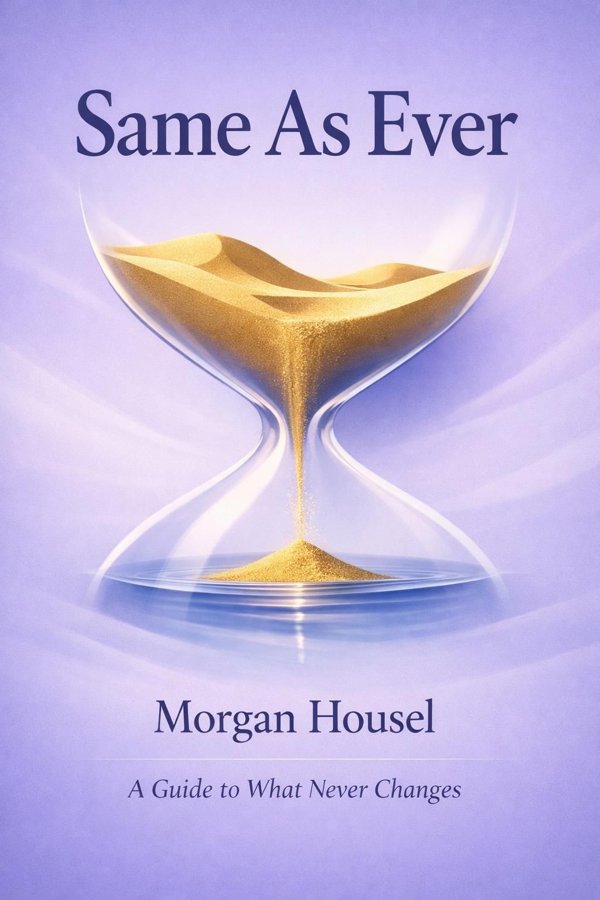
Same as Ever: Summary & Key Insights
 10 min10 chaptersAudio available
Key Takeaways from Same as Ever
Every era believes it is living through something unprecedented, yet the emotional engine behind events remains remarkably familiar.
People often want history to predict the future with precision, but Housel argues that history is more useful as a mirror than as a map.
One of the most comforting but dangerous beliefs is that uncertainty is temporary.
The biggest financial wins often come not from superior intelligence but from superior behavior.
People are more adaptable than they realize, and that adaptability is one of the most reliable sources of long-term resilience.
What Is Same as Ever About?
Same as Ever by Morgan Housel is a finance book published in 2023 spanning 10 pages. In Same as Ever, Morgan Housel makes a deceptively simple argument: the best way to understand the future is to study what never changes. Markets rise and crash, technologies reshape industries, and headlines constantly scream that everything is different now. But beneath the noise, the same human emotions keep driving outcomes: fear, greed, envy, impatience, overconfidence, hope, and adaptability. Housel’s gift is showing that these enduring patterns matter more than short-term predictions. This book is not a manual for forecasting the next economic cycle. It is a guide to recognizing timeless behaviors that shape wealth, risk, happiness, opportunity, and resilience. Drawing on history, psychology, business, and finance, Housel explains why uncertainty is permanent, why luck and tail events matter more than we admit, and why patience and room for error are among the most underrated advantages in life. Housel is uniquely qualified to tell this story. As the bestselling author of The Psychology of Money and a longtime observer of markets and decision-making, he has built a reputation for turning complex financial ideas into memorable human lessons. Same as Ever is valuable because it helps readers think more clearly when the world feels most unpredictable.
This FizzRead summary covers all 10 key chapters of Same as Ever in approximately 10 minutes, distilling the most important ideas, arguments, and takeaways from Morgan Housel's work. Also available as an audio summary and Key Quotes Podcast.
Same as Ever
In Same as Ever, Morgan Housel makes a deceptively simple argument: the best way to understand the future is to study what never changes. Markets rise and crash, technologies reshape industries, and headlines constantly scream that everything is different now. But beneath the noise, the same human emotions keep driving outcomes: fear, greed, envy, impatience, overconfidence, hope, and adaptability. Housel’s gift is showing that these enduring patterns matter more than short-term predictions.
This book is not a manual for forecasting the next economic cycle. It is a guide to recognizing timeless behaviors that shape wealth, risk, happiness, opportunity, and resilience. Drawing on history, psychology, business, and finance, Housel explains why uncertainty is permanent, why luck and tail events matter more than we admit, and why patience and room for error are among the most underrated advantages in life.
Housel is uniquely qualified to tell this story. As the bestselling author of The Psychology of Money and a longtime observer of markets and decision-making, he has built a reputation for turning complex financial ideas into memorable human lessons. Same as Ever is valuable because it helps readers think more clearly when the world feels most unpredictable.
Who Should Read Same as Ever?
This book is perfect for anyone interested in finance and looking to gain actionable insights in a short read. Whether you're a student, professional, or lifelong learner, the key ideas from Same as Ever by Morgan Housel will help you think differently.
- ✓Readers who enjoy finance and want practical takeaways
- ✓Professionals looking to apply new ideas to their work and life
- ✓Anyone who wants the core insights of Same as Ever in just 10 minutes
Want the full summary?
Get instant access to this book summary and 100K+ more with Fizz Moment.
Get Free SummaryAvailable on App Store • Free to download
Key Chapters
Every era believes it is living through something unprecedented, yet the emotional engine behind events remains remarkably familiar. That is one of Morgan Housel’s central observations: while the surface of life changes quickly, the motives and reactions beneath it change very slowly. New technologies, new forms of media, and new financial products make the present feel unique, but human beings still chase status, fear loss, follow crowds, and overreact to uncertainty just as they always have.
This matters because people often make poor decisions when they assume the present is so different that old lessons no longer apply. Investors may convince themselves that a booming sector has permanently rewritten the rules. Leaders may believe a temporary trend guarantees lasting success. Consumers may mistake novelty for durability. Housel argues that this mindset leads to fragile thinking because it ignores the timeless forces shaping behavior.
Consider speculative bubbles. Whether the object is railroad stocks, dot-com companies, cryptocurrencies, or artificial intelligence startups, the details differ but the psychology is similar: excitement grows, stories spread, skepticism fades, and eventually reality collides with expectation. The form changes; the pattern does not.
In daily life, the same idea applies beyond money. Workplace fads, political panics, and social trends often look revolutionary in the moment, yet they are usually variations of recurring human habits. Studying what stays the same helps you remain steady when others become swept up in drama.
Actionable takeaway: before reacting to any “new era” claim, ask which timeless human behavior is really at work underneath the surface.
People often want history to predict the future with precision, but Housel argues that history is more useful as a mirror than as a map. It cannot tell us exactly what will happen next, because circumstances, technologies, institutions, and timing are always different. What history can do is reveal recurring patterns in how people behave when faced with fear, opportunity, competition, scarcity, and surprise.
That distinction is powerful. If you treat history like a blueprint, you may force false comparisons and miss what is genuinely different. But if you treat it like a mirror, it helps you see enduring truths. You notice that booms create overconfidence, leverage turns small mistakes into disasters, and periods of stability often plant the seeds of future instability. The goal is not prediction. The goal is better judgment.
For investors, this means reading about past bubbles, crashes, and recoveries not to identify the exact date of the next downturn, but to understand how quickly sentiment can flip and how dangerous crowd psychology can become. For business leaders, it means studying how companies lost their edge through arrogance, short-termism, or failure to adapt. For individuals, it means recognizing that stress, uncertainty, and overreaction are not unique to your moment in time.
History also encourages humility. When you realize that smart, experienced people in previous generations were also blindsided by events, you become less confident in your own ability to forecast perfectly. That humility can lead to more robust decisions, such as diversifying, saving more, and avoiding overcommitment.
Actionable takeaway: use history to identify recurring behavioral patterns, not to make precise forecasts about timing or outcomes.
One of the most comforting but dangerous beliefs is that uncertainty is temporary. Housel pushes back against that idea. Uncertainty is not a problem to be solved once and for all; it is the permanent cost of living in a world where the future has not happened yet. People often believe that if they can just gather a little more information, wait for one more signal, or hear from one more expert, they can eliminate doubt. But uncertainty is built into investing, business, careers, and life itself.
This has practical consequences. Many people freeze when things feel unclear, assuming that better decisions require complete confidence. Housel argues the opposite: successful people do not wait for certainty. They build systems that work despite uncertainty. Investors diversify because they know they can be wrong. Businesses maintain cash reserves because surprises are inevitable. Households avoid overstretching their finances because even stable incomes can disappear.
A clear example is long-term investing. No one knows what markets will do next year. Recessions, geopolitical crises, inflation spikes, and technological shocks arrive unexpectedly. Yet disciplined investors still succeed by accepting uncertainty and structuring their behavior around it: saving regularly, avoiding panic selling, and holding enough resilience to survive volatility.
On a personal level, uncertainty also shapes careers and relationships. The person who keeps learning, stays flexible, and maintains a financial cushion is better prepared than the person who assumes current conditions will last forever. Security often comes less from prediction than from adaptability.
Actionable takeaway: stop waiting for certainty and instead design your finances and decisions with enough margin to withstand inevitable surprises.
The biggest financial wins often come not from superior intelligence but from superior behavior. Housel repeatedly emphasizes that forecasting is overrated and conduct is underrated. Many people believe success comes from knowing more, predicting better, or spotting turning points before anyone else. In reality, long-term outcomes are often determined by whether you can remain calm, patient, and consistent when emotions are running high.
A mediocre plan followed with discipline can outperform a brilliant plan abandoned under stress. This is why investors who chase hot funds, react to headlines, or trade constantly often underperform the very assets they own. Their issue is not a lack of information; it is behavior. Fear makes them sell low. Greed makes them buy high. Boredom makes them tinker with sound strategies.
Housel’s insight applies just as much to business and everyday life. A company does not fail only because competitors are smarter; it often fails because leaders become arrogant, overexpand, ignore risks, or lose patience. A person may know all the right health or productivity advice and still sabotage progress through inconsistency. Knowledge matters, but behavior determines whether knowledge gets translated into results.
One practical application is to simplify your financial system so it is easier to stick with. Automate savings, limit unnecessary decisions, hold a sensible asset allocation, and stop trying to optimize every move. The best strategy is often the one you can maintain during stressful periods, not the one that looks perfect in a spreadsheet.
Actionable takeaway: choose financial and life strategies that are psychologically sustainable, because the plan you can stick with beats the one you only admire in theory.
The stories people tell themselves are often more powerful than the facts in front of them. Housel stresses that enduring human biases influence how we interpret reality, especially in money and markets. We do not experience the world objectively. We filter it through emotion, identity, prior experience, and social comparison. That is why two people can see the same set of facts and draw opposite conclusions.
Among the most common biases are overconfidence, recency bias, confirmation bias, and herd behavior. Overconfidence convinces people they understand more than they do. Recency bias makes the recent past feel like a permanent trend. Confirmation bias encourages people to seek evidence that supports what they already believe. Herd behavior makes crowd approval feel like proof. These tendencies are ancient, and they remain highly influential despite better data and more sophisticated tools.
In investing, these biases are costly. An investor who has just experienced a bull market may come to believe risk has disappeared. Someone who lived through a crash may become permanently too cautious. Social media intensifies these distortions by turning opinion into performance and rewarding certainty over nuance.
The antidote is not becoming perfectly rational; that is impossible. The better goal is creating systems that reduce the damage biases can cause. Use checklists before big decisions. Write down your reasoning so you can review it later. Seek dissenting views. Limit the role of emotion-driven news consumption in your strategy.
Actionable takeaway: assume your judgment is biased, then build habits and decision rules that protect you from your own blind spots.
People often confuse wealth with visible signs of success, but Housel draws a crucial distinction between money, status, and freedom. The world rewards displays of achievement: expensive homes, luxury goods, prestigious titles, and public recognition. Yet these signals can obscure the deeper value of wealth, which is control over your time, choices, and peace of mind. Real financial success is not just having money; it is having the ability to live with less compulsion and more autonomy.
This matters because status competition is endless. If your definition of success depends on outperforming others visibly, satisfaction keeps moving further away. There is always a bigger house, a higher salary, or a more impressive peer group. Chasing external markers can lead to overspending, overworking, and tying your identity to comparison. That path may look successful from the outside while producing anxiety on the inside.
Housel encourages readers to think of wealth as what you do not see: the savings not spent, the debt avoided, the flexibility preserved, the ability to walk away from bad opportunities, and the calm that comes from enough. Happiness is often linked less to maximizing income than to reducing dependence, improving relationships, and creating a life aligned with your values.
A practical example is the person who earns less than a flashy peer but saves consistently, avoids lifestyle inflation, and builds enough assets to retire early or choose meaningful work. That person may appear less successful in the short term yet possess more genuine freedom.
Actionable takeaway: measure wealth by the independence and options it gives you, not by the status signals it helps you display.
Confidence can build success, but unchecked confidence can destroy it. Housel argues that humility is not weakness; it is a practical defense against the many ways reality can surprise you. In finance and life, the future is shaped by too many variables for anyone to fully understand or control. The people who forget this often become overleveraged, overcommitted, and overexposed right before conditions turn against them.
Humility begins with acknowledging that luck and risk play larger roles than most people admit. Good outcomes are not always proof of skill, and bad outcomes are not always proof of failure. When people interpret every win as evidence of superiority, they stop preparing for the possibility that circumstances may change. They may borrow too much, concentrate too heavily, or assume their streak will continue indefinitely.
This is why Housel values room for error so highly. A humble investor assumes some of their assumptions will be wrong. A humble business leader keeps reserves and avoids expanding to the edge of capacity. A humble household resists basing long-term commitments on best-case scenarios. Humility does not mean pessimism; it means respecting uncertainty enough to prepare for it.
The same principle applies to opinions. Humble thinkers update their views when evidence changes. They avoid speaking in absolutes about complex systems. They know confidence can impress others, but caution often protects results.
Actionable takeaway: build room for error into your finances and plans by assuming that some of your beliefs, forecasts, and favorable conditions will eventually prove wrong.
We like to imagine progress as smooth, logical, and steadily upward, but Housel reminds us that most progress is noisy, uneven, and filled with setbacks. Economies expand and contract. Markets surge and crash. Innovations fail repeatedly before changing the world. Careers stall before accelerating. Seen up close, improvement often looks like confusion; seen from a distance, it becomes a meaningful upward trend.
This perspective matters because people often abandon good strategies when they encounter the inevitable messiness of real progress. Investors expect growth without drawdowns. Entrepreneurs expect success without failed experiments. Employees expect careers without detours. When setbacks arrive, they interpret them as evidence that the plan was flawed, when in many cases setbacks are simply the price of advancement.
A stock market chart over a century is a classic example. In the long run, the trend may be strongly positive. In the short run, it contains wars, recessions, crashes, panics, inflation, and political turmoil. If you focus only on the turbulence, you miss the trajectory. If you expect no turbulence, you will panic at exactly the wrong moments.
This applies beyond investing. Breakthrough technologies emerge through years of false starts. Strong organizations survive mistakes and course corrections. Personal growth often comes through embarrassment, frustration, and repeated effort. Progress and pain are not opposites; they often travel together.
Actionable takeaway: judge progress over sufficiently long periods, and treat setbacks as a normal part of advancement rather than automatic proof that you are on the wrong path.
Patience is one of the most underappreciated advantages in a world addicted to speed. Housel shows that time is not just a backdrop for success; it is often the main engine behind it. Compounding works in investing, but it also works in reputation, knowledge, relationships, and business momentum. The challenge is that compounding is usually invisible at first. Early gains look small, slow, and unimpressive, which tempts people to quit before the real payoff begins.
This is why impatience is so costly. Investors interrupt compounding by jumping between strategies. Businesses chase quarterly results and sacrifice long-term strength. Individuals abandon habits because the first few weeks or months show little visible reward. Housel argues that staying power often matters more than brilliance because valuable outcomes require time to mature.
Patience also works as an emotional edge. The person who can tolerate temporary discomfort, boredom, or volatility often benefits while others react impulsively. In markets, this might mean holding quality assets through downturns. In careers, it might mean consistently improving skills while others chase shortcuts. In relationships and trust, it means recognizing that meaningful bonds are built slowly through repeated reliability.
Importantly, patience is not passive. It works best when paired with deliberate action: saving regularly, investing steadily, practicing useful skills, and making decisions that future compounding can amplify. You plant, protect, and wait.
Actionable takeaway: identify one area where compounding can work for you, then commit to a simple process long enough for slow early progress to turn into meaningful long-term results.
All Chapters in Same as Ever
About the Author
Morgan Housel is an American author, speaker, and investor best known for his work on behavioral finance and decision-making. He is a partner at The Collaborative Fund, where he writes and thinks about investing, business, and how people make choices under uncertainty. Before that, he was a columnist at The Motley Fool and The Wall Street Journal, earning a reputation for explaining complex financial ideas in clear, engaging language. Housel is the bestselling author of The Psychology of Money, a widely praised book that showed how financial success depends as much on behavior as on knowledge. In Same as Ever, he extends that perspective beyond investing, exploring the timeless patterns of human nature that influence risk, wealth, success, and resilience.
Get This Summary in Your Preferred Format
Read or listen to the Same as Ever summary by Morgan Housel anytime, anywhere. FizzRead offers multiple formats so you can learn on your terms — all free.
Available formats: App · Audio · PDF · EPUB — All included free with FizzRead
Download Same as Ever PDF and EPUB Summary
Key Quotes from Same as Ever
“Every era believes it is living through something unprecedented, yet the emotional engine behind events remains remarkably familiar.”
“People often want history to predict the future with precision, but Housel argues that history is more useful as a mirror than as a map.”
“One of the most comforting but dangerous beliefs is that uncertainty is temporary.”
“The biggest financial wins often come not from superior intelligence but from superior behavior.”
“People are more adaptable than they realize, and that adaptability is one of the most reliable sources of long-term resilience.”
Frequently Asked Questions about Same as Ever
Same as Ever by Morgan Housel is a finance book that explores key ideas across 10 chapters. In Same as Ever, Morgan Housel makes a deceptively simple argument: the best way to understand the future is to study what never changes. Markets rise and crash, technologies reshape industries, and headlines constantly scream that everything is different now. But beneath the noise, the same human emotions keep driving outcomes: fear, greed, envy, impatience, overconfidence, hope, and adaptability. Housel’s gift is showing that these enduring patterns matter more than short-term predictions. This book is not a manual for forecasting the next economic cycle. It is a guide to recognizing timeless behaviors that shape wealth, risk, happiness, opportunity, and resilience. Drawing on history, psychology, business, and finance, Housel explains why uncertainty is permanent, why luck and tail events matter more than we admit, and why patience and room for error are among the most underrated advantages in life. Housel is uniquely qualified to tell this story. As the bestselling author of The Psychology of Money and a longtime observer of markets and decision-making, he has built a reputation for turning complex financial ideas into memorable human lessons. Same as Ever is valuable because it helps readers think more clearly when the world feels most unpredictable.
More by Morgan Housel
You Might Also Like

Browse by Category
Ready to read Same as Ever?
Get the full summary and 100K+ more books with Fizz Moment.