
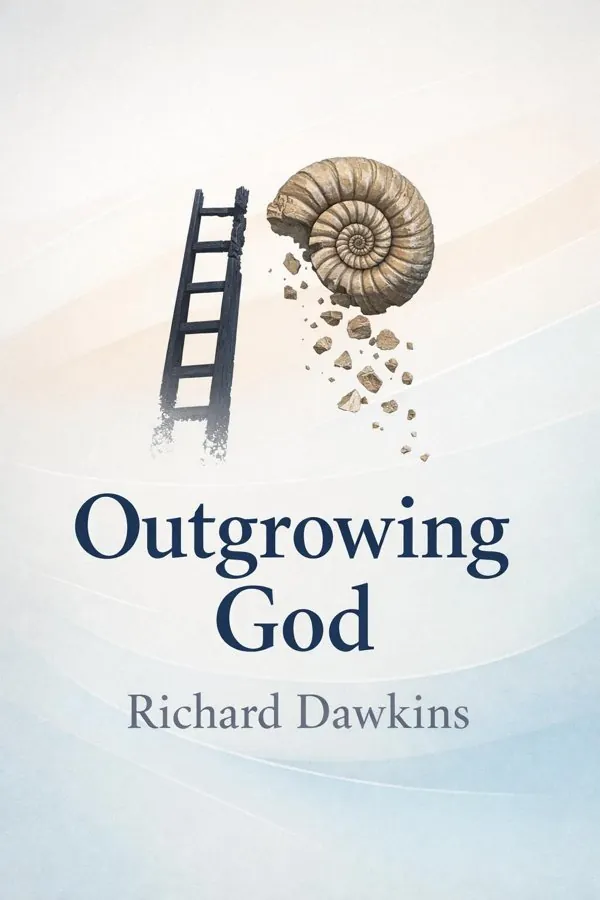
Outgrowing God: A Beginner’s Guide: Summary & Key Insights
 10 min11 chaptersAudio available
What Is Outgrowing God: A Beginner’s Guide About?
Outgrowing God: A Beginner’s Guide by Richard Dawkins is a popular_sci book spanning 11 pages. Outgrowing God: A Beginner’s Guide is a 2019 book by evolutionary biologist Richard Dawkins. Written in accessible language, it explores questions about religion, morality, and science, aiming to help younger readers think critically about belief in God. Dawkins discusses the origins of religious faith, the evidence for evolution, and the moral frameworks that exist independently of religion.
This FizzRead summary covers all 11 key chapters of Outgrowing God: A Beginner’s Guide in approximately 10 minutes, distilling the most important ideas, arguments, and takeaways from Richard Dawkins's work. Also available as an audio summary and Key Quotes Podcast.
Outgrowing God: A Beginner’s Guide
Outgrowing God: A Beginner’s Guide is a 2019 book by evolutionary biologist Richard Dawkins. Written in accessible language, it explores questions about religion, morality, and science, aiming to help younger readers think critically about belief in God. Dawkins discusses the origins of religious faith, the evidence for evolution, and the moral frameworks that exist independently of religion.
Who Should Read Outgrowing God: A Beginner’s Guide?
This book is perfect for anyone interested in popular_sci and looking to gain actionable insights in a short read. Whether you're a student, professional, or lifelong learner, the key ideas from Outgrowing God: A Beginner’s Guide by Richard Dawkins will help you think differently.
- ✓Readers who enjoy popular_sci and want practical takeaways
- ✓Professionals looking to apply new ideas to their work and life
- ✓Anyone who wants the core insights of Outgrowing God: A Beginner’s Guide in just 10 minutes
Want the full summary?
Get instant access to this book summary and 100K+ more with Fizz Moment.
Get Free SummaryAvailable on App Store • Free to download
Key Chapters
Most people do not choose their religion the way they might choose a philosophy or a scientific theory; they inherit it. In this first section, I urge my readers to reflect on how deeply our beliefs are shaped by geography and upbringing. A child born in Riyadh is far more likely to be Muslim, one born in Rome likely Catholic, and one in Utah perhaps Mormon. These coincidences of birth, I argue, should immediately make us cautious about assuming that our own faith is the one true path. If the accident of birthplace determines our creed, what does that say about divine truth?
When I was young, I too inherited a form of faith, absorbed through family and culture rather than evidence. But with time, I came to realize that belief should never rest on loyalty alone. Asking questions is not rebellion—it’s integrity. The young reader I address may feel a tension between familial love and intellectual honesty, and I acknowledge that. The goal is not to reject one’s background in anger, but to examine it bravely. Once you begin questioning, you see that dogmas are reinforced through repetition, habit, and ritual more than by rational justification. The first step toward intellectual independence is recognizing that belief, whatever its form, demands the same scrutiny as any other claim about truth.
Through examples from different faiths and historical shifts, I show that every religion regards itself as natural and inevitable from within, yet arbitrary from without. Once this pattern is seen, the reader begins to understand why critical thinking is essential: it frees us to ask not only *what* we believe, but *why*.
Having loosened the grip of inherited certainty, I move to explore where religious stories come from. Human beings are storytelling creatures. Long before writing, our ancestors used myth to explain thunder, birth, death, and the changing seasons. These stories were not lies in their time; they were early attempts to make sense of mystery with the tools available. Understanding their origins helps us appreciate religion anthropologically rather than divinely.
I invite readers to compare different creation myths—from Genesis to ancient Egyptian cosmology, to the tales of Indigenous peoples—and to see their common patterns. Each imagines a world born out of chaos, often through divine speech or battle, and each encodes moral lessons suited to its culture. Yet the very diversity of these myths reveals their human origin. If one religion’s story is sacred truth, what of the others? Recognizing this multiplicity does not demean their beauty, but rather enriches our understanding of humanity’s imagination.
I also emphasize how sacred texts evolved through translation, oral tradition, and political influence. Reverence often shields these histories from view, yet knowing them only deepens our respect for the cultures that birthed them—without mistaking poetry for physics.
+ 9 more chapters — available in the FizzRead app
All Chapters in Outgrowing God: A Beginner’s Guide
About the Author
Richard Dawkins is a British evolutionary biologist, ethologist, and author. He is best known for his works on evolutionary theory and for popularizing science through books such as The Selfish Gene and The God Delusion. Dawkins has been a prominent advocate for atheism and secularism.
Get This Summary in Your Preferred Format
Read or listen to the Outgrowing God: A Beginner’s Guide summary by Richard Dawkins anytime, anywhere. FizzRead offers multiple formats so you can learn on your terms — all free.
Available formats: App · Audio · PDF · EPUB — All included free with FizzRead
Download Outgrowing God: A Beginner’s Guide PDF and EPUB Summary
Key Quotes from Outgrowing God: A Beginner’s Guide
“Most people do not choose their religion the way they might choose a philosophy or a scientific theory; they inherit it.”
“Having loosened the grip of inherited certainty, I move to explore where religious stories come from.”
Frequently Asked Questions about Outgrowing God: A Beginner’s Guide
Outgrowing God: A Beginner’s Guide by Richard Dawkins is a popular_sci book that explores key ideas across 11 chapters. Outgrowing God: A Beginner’s Guide is a 2019 book by evolutionary biologist Richard Dawkins. Written in accessible language, it explores questions about religion, morality, and science, aiming to help younger readers think critically about belief in God. Dawkins discusses the origins of religious faith, the evidence for evolution, and the moral frameworks that exist independently of religion.
More by Richard Dawkins
You Might Also Like

Structures: Or Why Things Don"t Fall Down
J.E. Gordon
10 min
The Road to Wigan Pier
George Orwell
10 min
Bonk: The Curious Coupling of Science and Sex
Mary Roach
10 min
First Bite: How We Learn to Eat
Bee Wilson
10 min
In Pursuit Of The Unknown: 17 Equations That Changed The World
Ian Stewart
10 min
Napoleon's Buttons: 17 Molecules That Changed History
Penny Le Couteur and Jay Burreson
10 minBrowse by Category
Ready to read Outgrowing God: A Beginner’s Guide?
Get the full summary and 100K+ more books with Fizz Moment.