
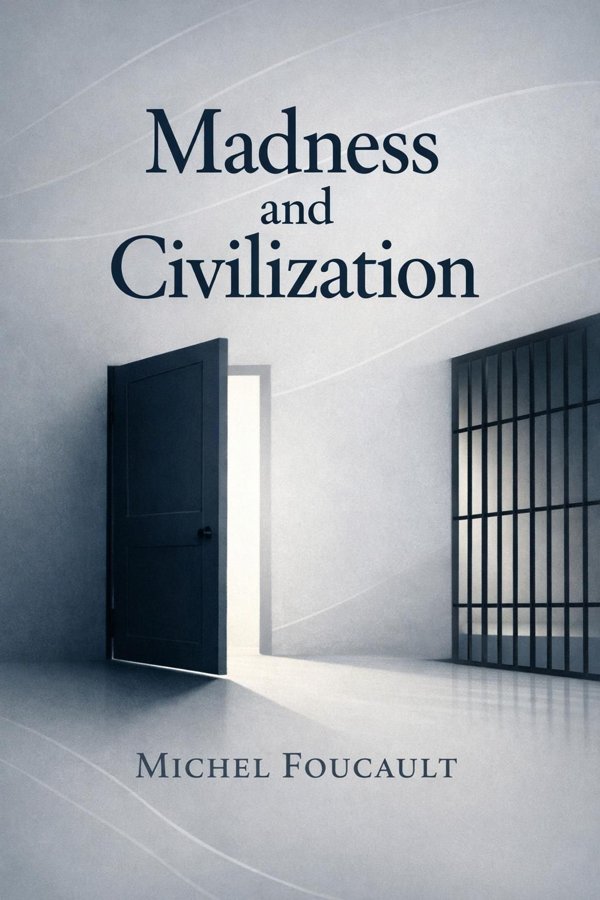
Madness and Civilization: A History of Insanity in the Age of Reason: Summary & Key Insights
 10 min9 chaptersAudio available
What Is Madness and Civilization: A History of Insanity in the Age of Reason About?
Madness and Civilization: A History of Insanity in the Age of Reason by Michel Foucault is a civilization book spanning 9 pages. First published in English in 1965, this landmark work by Michel Foucault traces the cultural and institutional history of madness in Western civilization from the Renaissance to the modern era. Foucault examines how reason and unreason were separated, leading to the confinement of the mad and the rise of psychiatry. The book challenges conventional understandings of mental illness and explores the social mechanisms that define normality and deviance.
This FizzRead summary covers all 9 key chapters of Madness and Civilization: A History of Insanity in the Age of Reason in approximately 10 minutes, distilling the most important ideas, arguments, and takeaways from Michel Foucault's work. Also available as an audio summary and Key Quotes Podcast.
Madness and Civilization: A History of Insanity in the Age of Reason
First published in English in 1965, this landmark work by Michel Foucault traces the cultural and institutional history of madness in Western civilization from the Renaissance to the modern era. Foucault examines how reason and unreason were separated, leading to the confinement of the mad and the rise of psychiatry. The book challenges conventional understandings of mental illness and explores the social mechanisms that define normality and deviance.
Who Should Read Madness and Civilization: A History of Insanity in the Age of Reason?
This book is perfect for anyone interested in civilization and looking to gain actionable insights in a short read. Whether you're a student, professional, or lifelong learner, the key ideas from Madness and Civilization: A History of Insanity in the Age of Reason by Michel Foucault will help you think differently.
- ✓Readers who enjoy civilization and want practical takeaways
- ✓Professionals looking to apply new ideas to their work and life
- ✓Anyone who wants the core insights of Madness and Civilization: A History of Insanity in the Age of Reason in just 10 minutes
Want the full summary?
Get instant access to this book summary and 100K+ more with Fizz Moment.
Get Free SummaryAvailable on App Store • Free to download
Key Chapters
In the Renaissance, madness was not a purely medical phenomenon; it lived alongside wisdom and folly, often inseparable from the truth of human existence. Artists like Bosch and Bruegel depicted it as part of a cosmic order — grotesque, visionary, and deeply moral. Literature too — from Erasmus’s praise of folly to Shakespeare’s tragic fools — revealed madness as a paradoxical form of insight. I focus on how this coexistence demonstrates that madness was once part of the human dialogue about destiny and meaning. To be mad was to approach the limits of reason, not to fall outside it.
During this period, the idea of madness was intertwined with dreams of revelation and creativity. It taught that reality was fragile, that truth could shimmer through distortion. The Renaissance did not yet seek to silence madness; it played with its ambiguity. This was an age when the madman could be a philosopher, and the fool could unveil divine wisdom. The cosmic imagery surrounding madness in art represented a world of moral disorder but not of exclusion. Everyone could glimpse themselves in the mad — a shared reflection of human frailty and transcendence.
Yet this sense of affinity would not last. With the coming of the classical age, the encounter with madness progressively became an experience of distance. The Renaissance dialogue between wisdom and folly gave way to a moral separation, marking the beginning of confinement.
In the seventeenth century, Europe underwent what I call the Great Confinement. Across France and other parts of the continent, vast institutions were established — not merely for the sick or insane, but for the idle, the poor, and the delinquent. In Paris, the Hôpital Général became emblematic: a space where entire categories of social deviation were gathered under one roof. This was not medical care; it was a political and moral gesture. Society sought to impose order by enclosing whatever disturbed its newly emerging bourgeois rationality.
Madness became only one among many forms of exclusion. The unemployed and the libertine were confined alongside the insane, revealing that society no longer distinguished folly from moral failure. The confinement represented a transformation in Europe’s collective conscience: the need to repress the raucous voices that mocked discipline, labor, and propriety.
Through this mass internment, madness lost its place in moral dialogue; it was turned into noise. To be confined was to be removed from discourse itself. The mad were no longer seen in their tragic humanity but as elements of disorder needing administrative control. I want you to see that this episode marks the turning point where madness enters silence. The institutional walls literalized a boundary — a physical separation between reason and its excluded Other.
+ 7 more chapters — available in the FizzRead app
All Chapters in Madness and Civilization: A History of Insanity in the Age of Reason
About the Author
Michel Foucault (1926–1984) was a French philosopher, historian of ideas, and social theorist. He taught at the Collège de France and is best known for his studies of power, knowledge, and social institutions. His major works include 'Discipline and Punish' and 'The Order of Things.'
Get This Summary in Your Preferred Format
Read or listen to the Madness and Civilization: A History of Insanity in the Age of Reason summary by Michel Foucault anytime, anywhere. FizzRead offers multiple formats so you can learn on your terms — all free.
Available formats: App · Audio · PDF · EPUB — All included free with FizzRead
Download Madness and Civilization: A History of Insanity in the Age of Reason PDF and EPUB Summary
Key Quotes from Madness and Civilization: A History of Insanity in the Age of Reason
“In the Renaissance, madness was not a purely medical phenomenon; it lived alongside wisdom and folly, often inseparable from the truth of human existence.”
“In the seventeenth century, Europe underwent what I call the Great Confinement.”
Frequently Asked Questions about Madness and Civilization: A History of Insanity in the Age of Reason
Madness and Civilization: A History of Insanity in the Age of Reason by Michel Foucault is a civilization book that explores key ideas across 9 chapters. First published in English in 1965, this landmark work by Michel Foucault traces the cultural and institutional history of madness in Western civilization from the Renaissance to the modern era. Foucault examines how reason and unreason were separated, leading to the confinement of the mad and the rise of psychiatry. The book challenges conventional understandings of mental illness and explores the social mechanisms that define normality and deviance.
More by Michel Foucault

The History of Sexuality, Volume 1: An Introduction
Michel Foucault
10 min
The Archaeology of Knowledge
Michel Foucault
10 min
The Birth Of The Clinic: An Archaeology Of Medical Perception
Michel Foucault
10 min
Discipline and Punish: The Birth of the Prison
Michel Foucault
10 minYou Might Also Like

The Structure of Scientific Revolutions
Thomas S. Kuhn
10 min
Genius
Harold Bloom
10 min
A Cultural History of the Medieval Age
Various Editors
10 min
A History of God: The 4,000-Year Quest of Judaism, Christianity and Islam
Karen Armstrong
10 min
A History of the World in 10½ Chapters
Julian Barnes
10 min
A Short History of Progress
Ronald Wright
10 minBrowse by Category
Ready to read Madness and Civilization: A History of Insanity in the Age of Reason?
Get the full summary and 100K+ more books with Fizz Moment.