
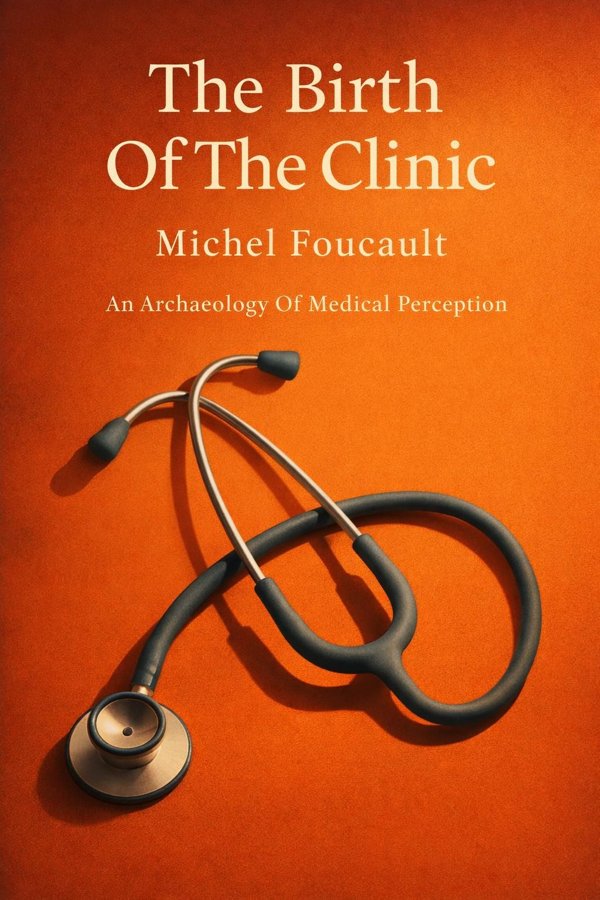
The Birth Of The Clinic: An Archaeology Of Medical Perception: Summary & Key Insights
 10 min10 chaptersAudio available
What Is The Birth Of The Clinic: An Archaeology Of Medical Perception About?
The Birth Of The Clinic: An Archaeology Of Medical Perception by Michel Foucault is a western_phil book spanning 10 pages. In this influential work, Michel Foucault examines the historical transformation of medical knowledge at the end of the eighteenth century. He explores how the emergence of the clinical gaze redefined the relationship between doctor, patient, and disease, marking the birth of modern medicine. Through his archaeological method, Foucault reveals how new forms of visibility and discourse shaped the medical field and the broader structures of knowledge and power.
This FizzRead summary covers all 10 key chapters of The Birth Of The Clinic: An Archaeology Of Medical Perception in approximately 10 minutes, distilling the most important ideas, arguments, and takeaways from Michel Foucault's work. Also available as an audio summary and Key Quotes Podcast.
The Birth Of The Clinic: An Archaeology Of Medical Perception
In this influential work, Michel Foucault examines the historical transformation of medical knowledge at the end of the eighteenth century. He explores how the emergence of the clinical gaze redefined the relationship between doctor, patient, and disease, marking the birth of modern medicine. Through his archaeological method, Foucault reveals how new forms of visibility and discourse shaped the medical field and the broader structures of knowledge and power.
Who Should Read The Birth Of The Clinic: An Archaeology Of Medical Perception?
This book is perfect for anyone interested in western_phil and looking to gain actionable insights in a short read. Whether you're a student, professional, or lifelong learner, the key ideas from The Birth Of The Clinic: An Archaeology Of Medical Perception by Michel Foucault will help you think differently.
- ✓Readers who enjoy western_phil and want practical takeaways
- ✓Professionals looking to apply new ideas to their work and life
- ✓Anyone who wants the core insights of The Birth Of The Clinic: An Archaeology Of Medical Perception in just 10 minutes
Want the full summary?
Get instant access to this book summary and 100K+ more with Fizz Moment.
Get Free SummaryAvailable on App Store • Free to download
Key Chapters
Before the advent of the modern clinic, medicine operated under what I call an old regime of knowledge. Disease was conceived less as a specific lesion or localized disorder and more as an imbalance within the system of humors. The physician, in this order, was a reader of signs, but these signs referred to an invisible essence rather than to measurable structures. Hospitals, when they existed, were primarily places of charity, not laboratories of observation. The goal was to alleviate suffering, not to categorize it.
Medical knowledge at that time was thus woven into a different grid of intelligibility. The physician’s interpretation was guided by the logic of resemblance and correspondence; the language of medicine relied on a rhetoric of qualities rather than an anatomy of structures. When a patient complained of fever or pain, the physician invoked a cosmic or harmonic imbalance—something to be described through general theory, not dissected through precise observation. Disease was a discourse about the body’s sympathy with nature, not about empirical lesions.
What disappears at the end of the eighteenth century is precisely this speculative dimension. In its place arises a new relationship between seeing and knowing. Where once the eyes of the physician saw symptoms as surface clues to hidden essences, they now began to see structures—organs, tissues, lesions—that explained the visible. The gaze, once metaphorical, became literal. The transformation from a medicine of signs to a medicine of observation signaled the collapse of the old epistemic order.
A transformation in knowledge is never purely intellectual; it always unfolds through changes in institutions, practices, and spaces. The emergence of the modern clinic required a new spatial organization that would render disease visible and comparable. The hospital, once a sanctuary for the poor and dying, was reorganized as an apparatus of observation. Patients were no longer enclosed as recipients of charity but distributed as cases within a field of study. Beds were aligned, bodies classified, symptoms recorded. The hospital became a diagram of visibility—a disciplined space that made it possible to see through multiplicities what had previously been scattered and obscure.
This spatial rearrangement was accompanied by a social one. Physicians took on a new role, not merely as healers but as observers and classifiers. The hospital staff and architecture conspired to produce an uninterrupted surface of observation, where each patient contributed to a collective table of knowledge. Space thus became epistemic; it ordered seeing, recording, and comparing.
In reconfiguring the hospital into a space of visibility, medicine created the conditions for its own scientificity. Knowledge no longer emanated from books or authorities, but from the physical alignment of bodies, instruments, and eyes. The reorganization of space was the reorganization of truth.
+ 8 more chapters — available in the FizzRead app
All Chapters in The Birth Of The Clinic: An Archaeology Of Medical Perception
About the Author
Michel Foucault (1926–1984) was a French philosopher, historian of ideas, and social theorist. His work on power, knowledge, and discourse profoundly influenced contemporary philosophy, sociology, and cultural theory. Foucault’s major works include 'Discipline and Punish', 'The History of Sexuality', and 'Madness and Civilization'.
Get This Summary in Your Preferred Format
Read or listen to the The Birth Of The Clinic: An Archaeology Of Medical Perception summary by Michel Foucault anytime, anywhere. FizzRead offers multiple formats so you can learn on your terms — all free.
Available formats: App · Audio · PDF · EPUB — All included free with FizzRead
Download The Birth Of The Clinic: An Archaeology Of Medical Perception PDF and EPUB Summary
Key Quotes from The Birth Of The Clinic: An Archaeology Of Medical Perception
“Before the advent of the modern clinic, medicine operated under what I call an old regime of knowledge.”
“A transformation in knowledge is never purely intellectual; it always unfolds through changes in institutions, practices, and spaces.”
Frequently Asked Questions about The Birth Of The Clinic: An Archaeology Of Medical Perception
The Birth Of The Clinic: An Archaeology Of Medical Perception by Michel Foucault is a western_phil book that explores key ideas across 10 chapters. In this influential work, Michel Foucault examines the historical transformation of medical knowledge at the end of the eighteenth century. He explores how the emergence of the clinical gaze redefined the relationship between doctor, patient, and disease, marking the birth of modern medicine. Through his archaeological method, Foucault reveals how new forms of visibility and discourse shaped the medical field and the broader structures of knowledge and power.
More by Michel Foucault

The History of Sexuality, Volume 1: An Introduction
Michel Foucault
10 min
The Archaeology of Knowledge
Michel Foucault
10 min
Madness and Civilization: A History of Insanity in the Age of Reason
Michel Foucault
10 min
Discipline and Punish: The Birth of the Prison
Michel Foucault
10 minYou Might Also Like

A Little History of Philosophy
Nigel Warburton
10 min
Areopagitica
John Milton
10 min
How To Think Like A Philosopher: Essential Principles For Clear Thinking
Peter Cave
10 min
Language, Truth and Logic
A. J. Ayer
10 min
The Age of Reason
Thomas Paine
10 min
The Essays
Michel De Montaigne
10 minBrowse by Category
Ready to read The Birth Of The Clinic: An Archaeology Of Medical Perception?
Get the full summary and 100K+ more books with Fizz Moment.